Normal view

France is putting $22 million into Ukrainian defense tech. Deal comes with battlefield testing

17 June 2026 at 16:11

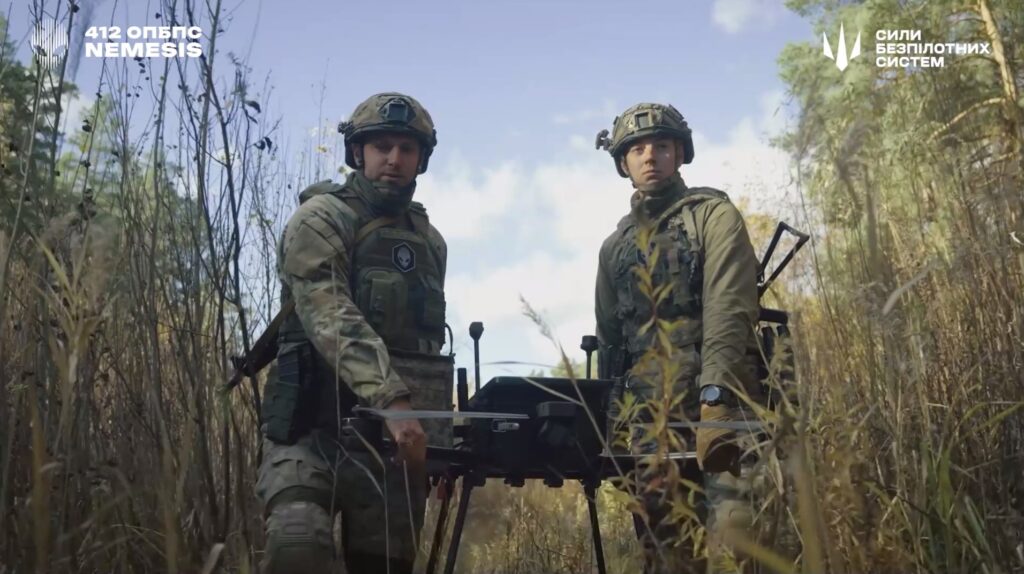
ukraine's nemesis drone battalion expands regiment pilots 412th 'nemesis' unmanned systems forces (sbs) has grown size sbs reported 26 ukraine news ukrainian reports

Ukraine's Brave1 defense technology cluster and France's Defense Innovation Agency (AID) launched the Brave France joint defense innovation program with a $22 million budget. Ukraine and France first announced their intention to create Brave France in February 2026, with the final launch agreement signed at Eurosatory 2026, Ukraine's Defense Ministry announces

Brave France extends Ukraine's growing network of bilateral defense innovation partnerships with European NATO members, following the May 2026 launch of Brave Germany with Berlin.

AID Director Patrick Aufort and Brave1 Operations Director Iryna Zabolotna signed the agreement, with French Minister of Armed Forces and Veterans Affairs Catherine Vautrin in attendance.

The parties are currently coordinating the list of priority topics, technical requirements for projects, and forming a joint executive board and expert commissions.

Brave France funds joint Ukrainian-French drone, missile, and air defense development

The program's primary focus areas align with Ukraine's most urgent battlefield needs and France's defense-industrial priorities. The maximum grant size of $1.1 million per project is designed to support both early-stage technology development and scaling of proven systems toward production.

Both AID and Brave1 will share oversight through joint expert commissions and an executive board currently being formed.

The September 2026 launch date for the first competitions gives the joint executive board approximately three months to finalize priority topics and technical requirements before opening applications to Ukrainian and French defense companies.

Test in Ukraine platform integrates battlefield validation into Brave France

A key element of Brave France will be integration with the Test in Ukraine platform, which allows foreign manufacturers to test new defense technologies in conditions close to actual combat. Ukraine's Defense Ministry offered the same Test in Ukraine framework to Germany earlier this year, with foreign manufacturers sending products to Ukraine, providing online training, and receiving operational reports from Ukrainian forces who deploy them.

The Brave France program will use the Test in Ukraine framework to accelerate the identification of technologies suitable for Ukraine's Defense Forces. The combined approach gives French defense manufacturers access to battlefield validation data while channeling Ukrainian frontline experience into joint product development.

The bilateral programs operate alongside ongoing co-production frameworks announced at Eurosatory 2026, including the Swedish-Ukrainian AIDronesUA-Njord Technology partnership for joint production of MAUL ground robots. 
Ukraine just showed world its first homegrown glide bomb in Paris

17 June 2026 at 08:48

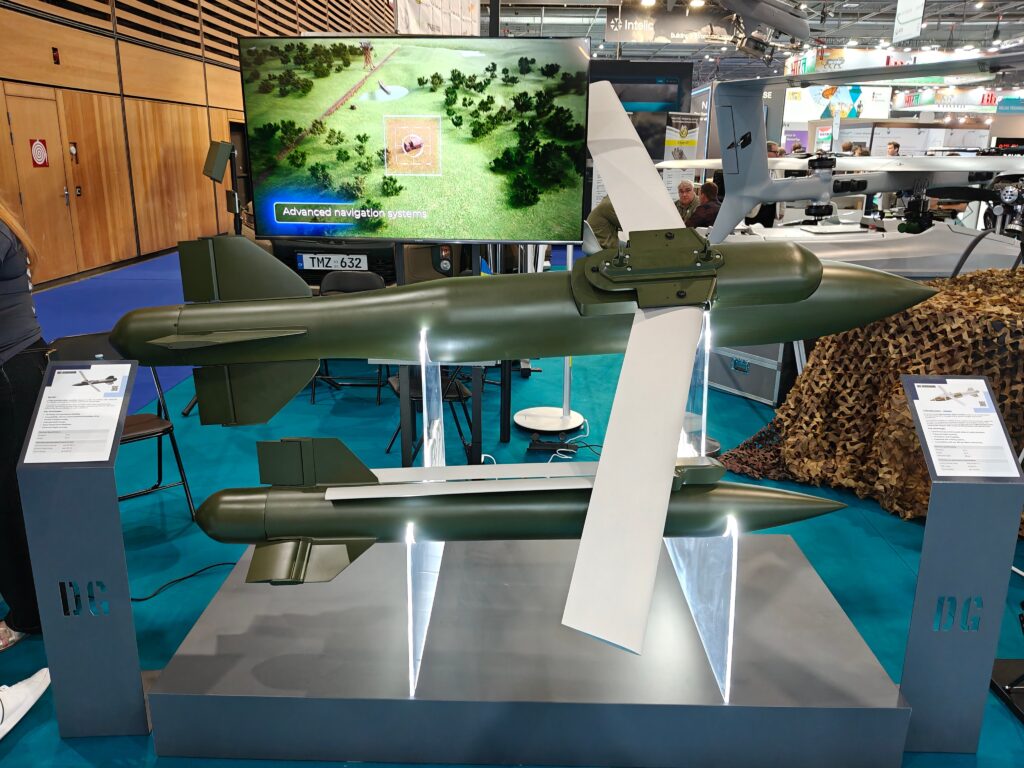
Ukraine's first domestic guided glide bomb, Vyrivniuvach, made its public debut at the Eurosatory-2026 defense exhibition in Paris. Source: X/Jeff21461

    Ukraine's first domestic guided glide bomb, Vyrivniuvach, made its public debut at the Eurosatory-2026 defense exhibition in Paris. Images from the OSINT source Jeff2146 on X have revealed the design of the 250-kilogram weapon developed by DG Industry through the Brave1 platform. 

    The Vyrivniuvach matters because it represents Ukraine's first domestically produced response to Russia's intensive use of KAB glide bombs, which Russia dropped at a rate exceeding 5,700 per month in January 2026. Ukraine announced the Vyrivniuvach's combat readiness on 18 May 2026. The bomb costs approximately one-third as much as the US JDAM-ER kits Ukraine has used since early 2023.

    Defense Express analysis indicates the bomb's declared maximum range of 130+ kilometers is achievable only from high altitude, with a realistic combat range likely closer to 40 kilometers when launched via low-altitude toss-bombing.

    Defense Express analysis identifies design differences from US JDAM-ER

    The Vyrivniuvach consists of two main modules: a wing block with deployment and locking mechanisms that mounts to the bomb body via clamps, and a tail section that replaces standard fin assemblies and contains the navigation and guidance module.

    Defense Express analysts examined the Vyrivniuvach photographs released from Eurosatory-2026 and identified key design differences from the US JDAM-ER kit Ukraine has used since 2023.

    The American JDAM-ER uses three of four fully rotating control surfaces, while the Vyrivniuvach uses stabilizers combined with smaller-area control surfaces. The Ukrainian design represents what Brave1 described in May as a unique Ukrainian construction rather than a copy of Western or Soviet systems, per Business Insider. 

    Russian air superiority forces low-altitude toss-bombing tactics

    Defense Express analysts assessed that the only realistic application of the Vyrivniuvach is low-altitude release via a toss-bombing maneuver, when the carrier aircraft approaches the target at low altitude and executes a sharp climb (Ukrainian "hirka" or "hill").

    In this tactical profile, the bomb's range is limited to approximately 40 kilometers rather than the declared 130+ kilometers. The tactical constraint results from Russia's deployment of long-range surface-to-air missiles and fighter aircraft that threaten Ukrainian carrier aircraft attempting high-altitude releases. 

    The 40-kilometer effective range nonetheless exceeds the engagement range of most Russian frontline air defenses while keeping carrier aircraft below the Russian fighter radar envelope.

    The same 40-kilometer figure approximates the operational range of standard Russian UMPK kits before Russia introduced the extended-range UMPK-PD variant in 2025.

    Brave1 platform enables Ukrainian domestic precision weapons production

    The Vyrivniuvach development was supported by Brave1, Ukraine's defense technology accelerator, established on 26 April 2023 by the Ministry of Digital Transformation, jointly with the Ministry of Defense, the General Staff, the Ministry for Strategic Industries, the Ministry of Economy, and the National Security and Defense Council.

    Brave1 has registered more than 3,500 defense developments, codified over 260 items to NATO standards, and distributed more than 470 grants totaling approximately $29.3 million, according to Army Recognition. 

    The Vyrivniuvach represents one of Brave1's highest-profile precision-weapon outputs, joining a portfolio that includes missiles, anti-Shahed systems, sea drones, swarm drones, anti-KAB systems, and other guided munitions, per the War Zone. Ukraine's Defense Ministry confirmed the procurement of an initial experimental batch in May 2026 for further operational evaluation under combat conditions. 

    At world’s top defense exhibition in Paris, Ukraine and Sweden agree to mass-produce combat robot born on frontline

    16 June 2026 at 21:23

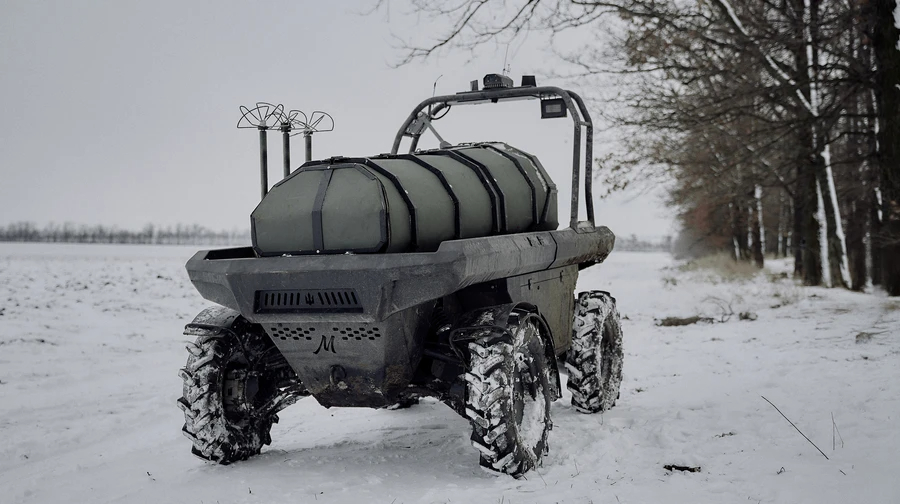
    The MAUL unmanned ground vehicle. Source: AIDronesUA

    Ukrainian defense manufacturer AIDronesUA and Swedish technology firm Njord Technology AB have signed a Memorandum of Strategic Partnership at the Eurosatory-2026 defense exhibition in Paris, per Oboronka. The partnership scales production of the MAUL casualty evacuation, logistics, and ammunition delivery platform in Sweden. 

    The MAUL ground robot costs between $22,600 and $33,900 per unit, depending on the communication configuration. AIDronesUA says that MAUL was developed and continuously refined based on real combat experience and direct feedback from Ukrainian soldiers operating the platform on the frontline.

    AIDronesUA expands Ukrainian production capacity through Swedish partnership

    "Together with Njord Technology AB, we plan to organize joint production of UGV MAUL on Swedish territory, which will allow expanding production capabilities and accelerating delivery of robotic systems," AIDronesUA says.

    The Ukrainian company emphasizes that its priority remains meeting the needs of the Ukrainian Defense Forces, with most of the produced complexes intended for logistics, casualty evacuation, and the preservation of Ukrainian soldiers' lives. 

    Njord Technology brings Swedish engineering to Ukrainian battlefield experience

    "The combination of Ukrainian practical experience and Swedish engineering expertise will create modern robotic solutions that improve task performance and help save lives," Njord Technology notes.

    This partnership will also foster industrial cooperation between Sweden and Ukraine and create new opportunities for technological development and innovation, the company said. 

    The Swedish company creates autonomous solutions and AI systems, and is a member of the Swedish Security and Defense Industry Association (SOFF). The partnership joins a growing list of Swedish-Ukrainian defense industry agreements, including the Saab-Radionix sensor and defense electronics memorandum and ongoing discussions regarding potential Gripen fighter aircraft supply.

    Ground robotic systems lead Ukrainian defense innovation

    Ground robotic systems have become one of the most active categories of Ukrainian defense industry expansion. Ukraine ordered 25,000 ground robots for H1 2026 procurement, which is more than double the 2025 total.

    Defense Minister Mykhailo Fedorov reported in March 2026 that Ukrainian ground robotics manufacturers had grown from zero to more than 100 since the start of the full-scale aggression. 

    ❌