Normal view

France is putting $22 million into Ukrainian defense tech. Deal comes with battlefield testing

17 June 2026 at 16:11

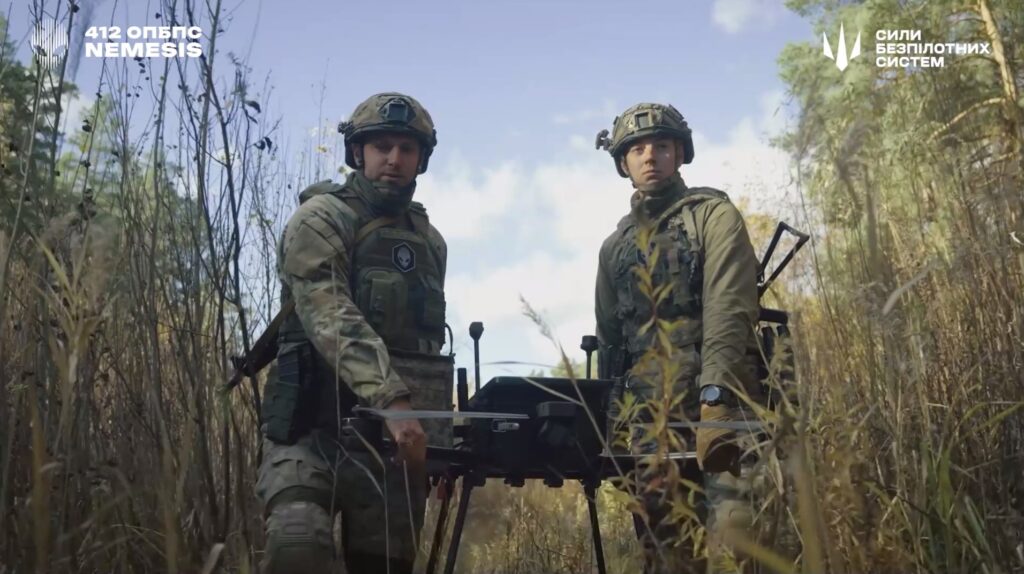
ukraine's nemesis drone battalion expands regiment pilots 412th 'nemesis' unmanned systems forces (sbs) has grown size sbs reported 26 ukraine news ukrainian reports

Ukraine's Brave1 defense technology cluster and France's Defense Innovation Agency (AID) launched the Brave France joint defense innovation program with a $22 million budget. Ukraine and France first announced their intention to create Brave France in February 2026, with the final launch agreement signed at Eurosatory 2026, Ukraine's Defense Ministry announces

Brave France extends Ukraine's growing network of bilateral defense innovation partnerships with European NATO members, following the May 2026 launch of Brave Germany with Berlin.

AID Director Patrick Aufort and Brave1 Operations Director Iryna Zabolotna signed the agreement, with French Minister of Armed Forces and Veterans Affairs Catherine Vautrin in attendance.

The parties are currently coordinating the list of priority topics, technical requirements for projects, and forming a joint executive board and expert commissions.

Brave France funds joint Ukrainian-French drone, missile, and air defense development

The program's primary focus areas align with Ukraine's most urgent battlefield needs and France's defense-industrial priorities. The maximum grant size of $1.1 million per project is designed to support both early-stage technology development and scaling of proven systems toward production.

Both AID and Brave1 will share oversight through joint expert commissions and an executive board currently being formed.

The September 2026 launch date for the first competitions gives the joint executive board approximately three months to finalize priority topics and technical requirements before opening applications to Ukrainian and French defense companies.

Test in Ukraine platform integrates battlefield validation into Brave France

A key element of Brave France will be integration with the Test in Ukraine platform, which allows foreign manufacturers to test new defense technologies in conditions close to actual combat. Ukraine's Defense Ministry offered the same Test in Ukraine framework to Germany earlier this year, with foreign manufacturers sending products to Ukraine, providing online training, and receiving operational reports from Ukrainian forces who deploy them.

The Brave France program will use the Test in Ukraine framework to accelerate the identification of technologies suitable for Ukraine's Defense Forces. The combined approach gives French defense manufacturers access to battlefield validation data while channeling Ukrainian frontline experience into joint product development.

The bilateral programs operate alongside ongoing co-production frameworks announced at Eurosatory 2026, including the Swedish-Ukrainian AIDronesUA-Njord Technology partnership for joint production of MAUL ground robots. 
Ukraine found Russian artillery’s weak spot and destroyed 250 systems in two nights

17 June 2026 at 15:50

russian losses

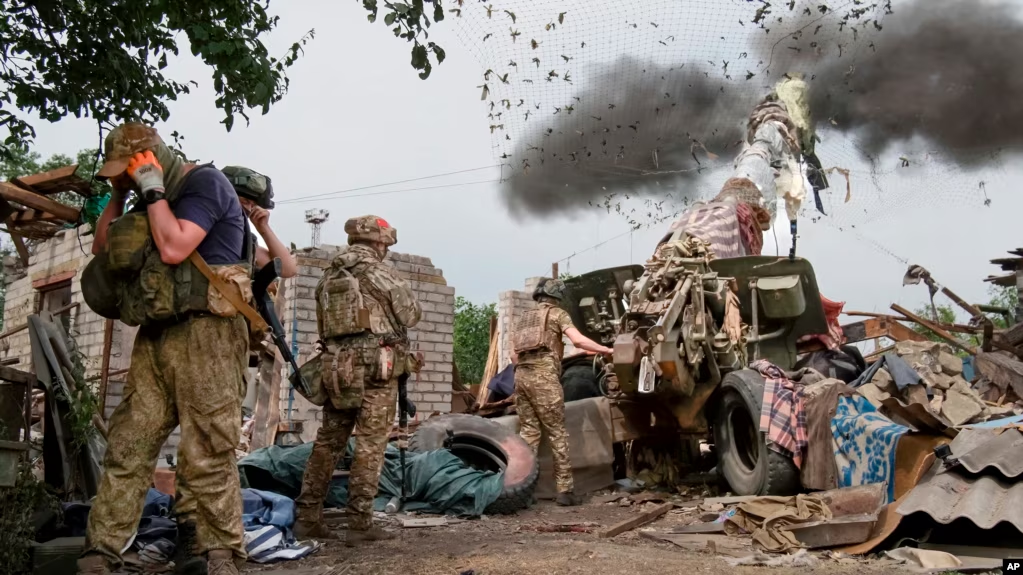
Ukraine destroyed 250 Russian artillery systems in two nights during Operation Artashan using a newly developed munition designed specifically to destroy artillery barrels, Defense Minister Mykhailo Fedorov announced in a PRESSING YouTube interview with Army Media. Operation Artashan is the sequel to last year's Operation Ashan, which targeted Russian armored vehicles, with the new operation focused specifically on Russian artillery.

The Artashan operation matters because Russian artillery remains responsible for over 10% of Ukrainian military casualties on parts of the front, reaching up to 20% on some sectors, per Fedorov.

The new munition specifically addresses a tactical problem that has limited Ukrainian counter-artillery effectiveness: standard drone or projectile strikes often damage but don't permanently disable Russian artillery, allowing Russian forces to repair systems and return them to combat positions.

Ukrainian engineers spent recent months developing the specialized munition that targets the artillery barrel — the key element whose destruction renders a system permanently inoperable. 

Special munition destroys artillery barrels to prevent Russian repair

"A special projectile was developed that destroys artillery barrels. In two nights, 250 Russian artillery systems were destroyed. We have video confirmation for all of it," Fedorov stated.

The conventional Ukrainian counter-artillery approach, using FPV drones, loitering munitions, or counter-battery fire, often damages Russian artillery systems without rendering them permanently inoperable, allowing Russian forces to repair damaged guns and return them to combat.

The new munition specifically targets the barrel, the most expensive and hardest-to-replace component of any artillery system. 

Earlier, Fedorov launched an additional $113 million in procurement funding for middle-strike drones. The middle-strike program targets Russian rear-area logistics, command posts, and key military capabilities at depths of 20 to 300 kilometers behind the front line.

Ukrainian middle-strike operations have contributed to a steady rise in the cost of Russian advances, from roughly 120 soldiers killed or wounded per square kilometer of advance a year ago to 316 in Q1 2026 in Donetsk Oblast

Ukraine built 90% of its newly authorized weapons itself. Year ago, it was 70%

16 June 2026 at 20:33

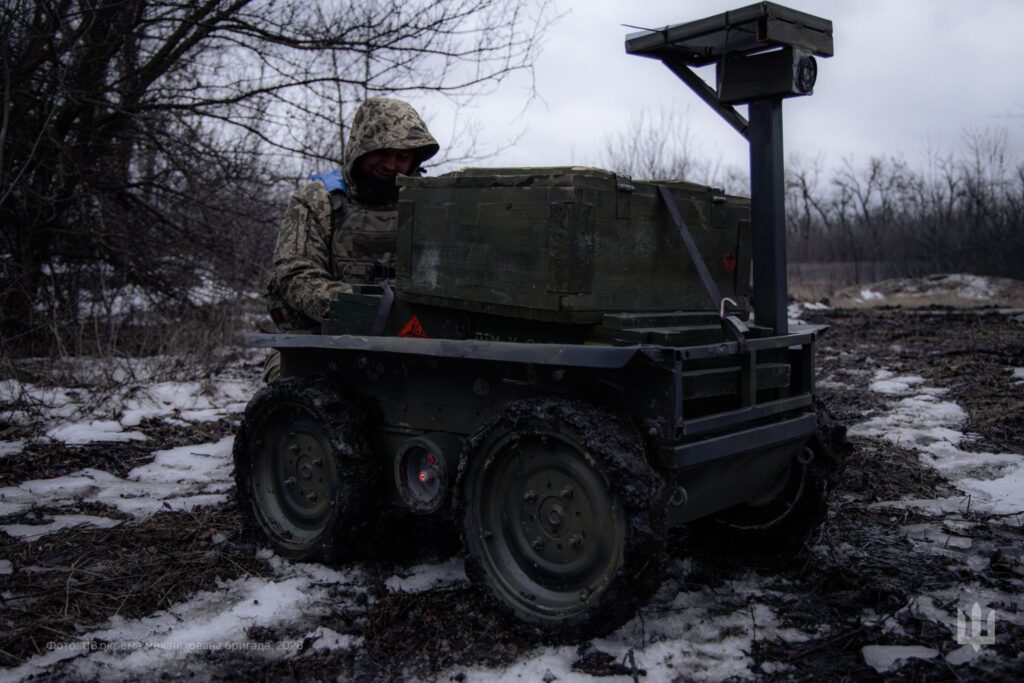
A Ukrainian soldier is loading a ground robotic system. Source: The General Staff

Ukraine's Defense Ministry has announced that it has codified and authorized 1,000 samples of weapons and military equipment since the start of 2026. It's a 50% increase from the 659 samples authorized during the same period in 2025.

The pace of codification and the domestic share signal a substantive shift in Ukraine's wartime defense-industrial dependency, with Ukrainian defense industry capacity progressively scaling over three years of full-scale war.

Of the 1,000 samples authorized, 892 are produced in Ukraine, raising the domestic share to nearly 90%, up from 69.6% in 2025 and 74.6% in 2024.

The 1,000 samples include over 300 unmanned aerial complexes, 188 ammunition types, 128 communication systems, more than 60 electronic warfare and electronic intelligence systems, 50 ground robotic complexes, and nearly 50 armored vehicles and special armored cars. 

Unmanned aerial systems lead 2026 weapons codification

"All of the codified samples have passed the necessary testing and confirmed their declared characteristics. A significant portion is already being used by Defense Forces units," the Defense Ministry stated.

The pace of codification accelerated through 2026: in May 2026 alone, the Defense Ministry codified 175 new weapons models for operational use.

The dominance of unmanned aerial complexes among the 2026 codifications reflects Ukrainian battlefield priorities — Russia's intensified Shahed-type drone strikes, Ukraine's middle-strike operations against Russian rear targets, and the operational shift toward unmanned-systems integration across combat arms.

Ukrainian manufacturers expand domestic share to 90%

The Ukrainian-made share of newly authorized weapons has risen sharply over three years of full-scale war from 74.6% in 2024 to 69.6% in 2025 to nearly 90% in 2026. The Defense Ministry emphasized that Ukrainian manufacturers are increasingly producing high-technology weapons and military equipment designed with consideration of contemporary war experience and frontline needs.

Cabinet allocates $244.6 million to boost defense capabilities

The Cabinet of Ministers additionally allocated $244.6 million in May 2026 to strengthen Ukraine's defense capabilities. Of this amount, $204.2 million is directed to new weapons procurement, modernization, and the repair of military equipment, while $40.4 million is invested in the development of the Ukrainian defense industrial complex.

The defense-industrial investment is allocated to implementing new technologies, expanding production capacity, and supporting further sector development. Fedorov took over as Defense Minister on 14 January 2026 and has focused his tenure on the technological transformation of the Ukrainian Armed Forces.

❌