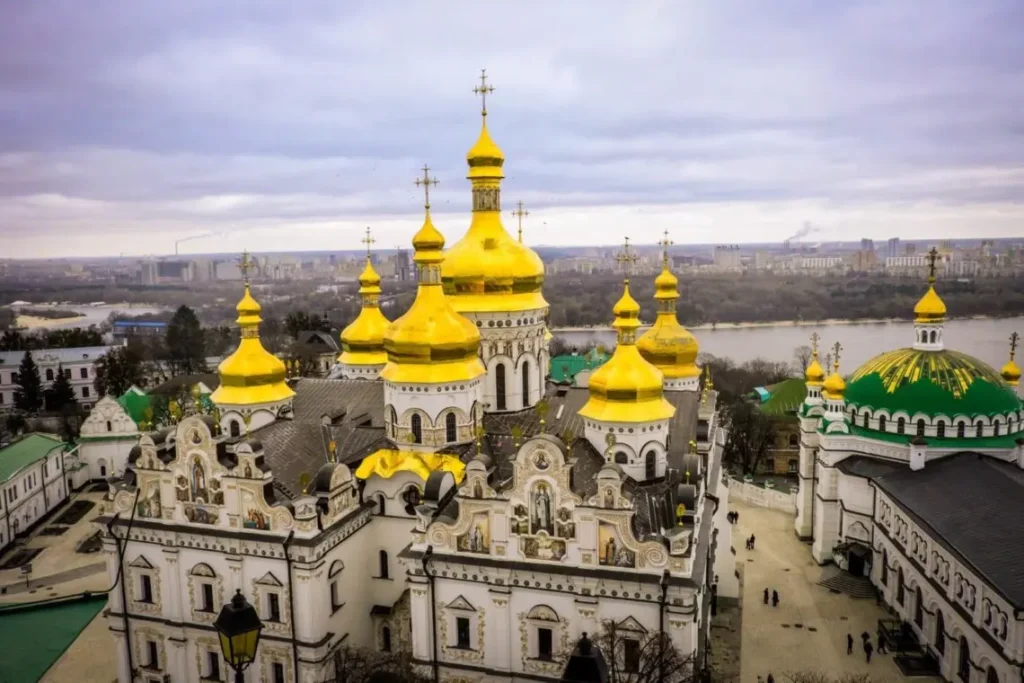
Photographs of the burning Dormition Cathedral that Ukrainian President Volodymyr Zelenskyy showed US President Donald Trump at the G7 summit were probably the final push that moved Washington toward firmer support for Ukraine, according to Politico. The outlet cited three G7 officials who described the private exchange in Evian-les-Bains on 16 June.
The sight of the cathedral's golden domes in flames visibly affected Trump, one of the officials said. Russia's strike set the roof of the church—the central shrine of Kyiv's Pechersk Lavra—ablaze during a mass missile and drone assault on 15 June.
French President Emmanuel Macron, the summit host, had spent months working out how to appeal to the American leader, Politico reported. At a dinner the night before, G7 leaders tailored their case to Trump's view of the war, casting Ukraine as the side winning and Russia as the side losing.
The leaders told Trump that Zelenskyy was winning because Russian forces could not break through the front and were even losing ground, a European diplomat told the outlet. Macron, caught on a hot mic the next day, described the conversation with Zelenskyy as difficult.
The approach produced results. The G7, including the United States, agreed to expand military support for Kyiv and backed new sanctions on Russia, pledging "unwavering support" in its 17 June statement and citing Ukraine's momentum on the battlefield.
In its 17 June joint statement, the G7 agreed to send Ukraine more air defense, interceptor missiles, and long-range capabilities, and said it was ready to consider letting Ukraine produce them domestically — but the language commits only to "consider," with no timeline, system, or manufacturer named.
The summit doubled as a sanctions moment. Canada imposed new measures on 162 Russian individuals, entities, and vessels on 16 June, announced after Carney met Zelenskyy on the sidelines and condemned the Lavra strike. Britain's £210 million ($282 million) enriched-uranium deal to feed Energoatom came packaged with fresh sanctions on Russia's oil trade, pushing UK shadow-fleet designations toward 600 vessels.
Diplomats cautioned that the gains could prove fragile. A single phone call between Trump and Russian President Vladimir Putin could undo them, the European diplomat said, noting that the US president shifts position often.
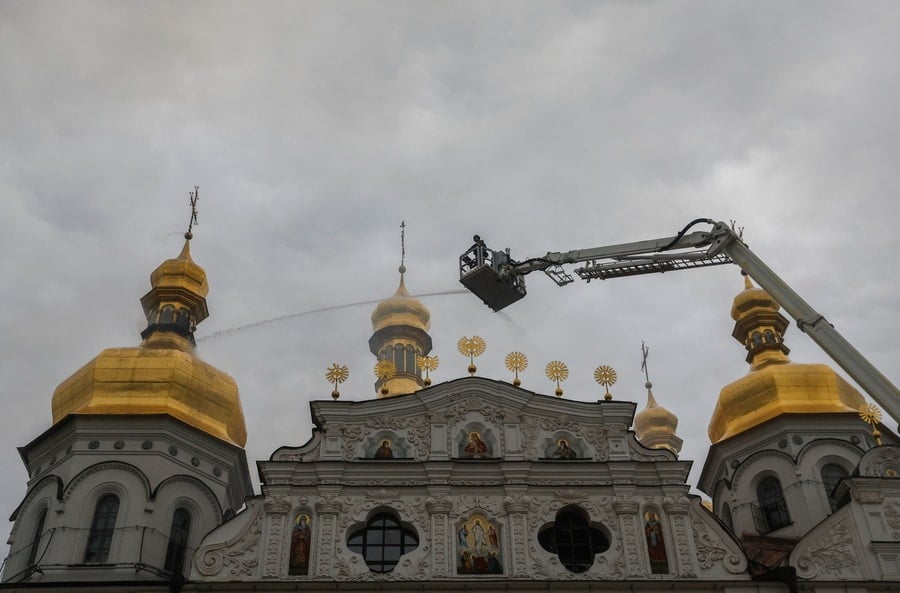
Greece has pledged support for restoration studies at Kyiv-Pechersk Lavra after the historic Orthodox Christian site was damaged during a Russian strike on Ukraine. Credit: Sergey Dolzhenko/EPA-AMNA.
Greece will support restoration efforts at Kyiv-Pechersk Lavra after Ukraine said a Russian drone strike damaged one of Eastern Europe’s most important Orthodox Christian sites and a UNESCO World Heritage landmark.
Greek Culture Minister Lina Mendoni sent a letter to Ukraine’s Culture Minister Tetyana Berezhna to express Greece’s condolences and solidarity after the June 15 attack, which damaged the historic monastic complex in Kyiv.
Mendoni condemned the damage to a site of exceptional architectural, historical, cultural, and religious value. She also stressed that armies must not target cultural heritage or use it as an instrument during armed conflict.
The Greek Culture Ministry said Greece intends to cover the cost of restoration studies for Kyiv-Pechersk Lavra. Athens also plans to move forward with a memorandum of cooperation between the European Center for Byzantine and Post-Byzantine Monuments and Ukraine’s Ministry of Culture.
The agreement will support specialized training workshops in Thessaloniki for Ukrainian conservators of antiquities and works of art. Through the initiative, Greece aims to strengthen cooperation with Ukraine in the protection of cultural heritage.
Greece moves to support Kyiv’s orthodox christian cathedral Lavra
The Greek initiative follows reports of a fire at the Assumption Cathedral, also known as the Dormition Cathedral, inside Kyiv-Pechersk Lavra during a major overnight Russian missile and drone attack, Ukrainian officials said.
The Lavra, also known as the Monastery of the Caves, ranks among the most revered Orthodox Christian monastic complexes in Eastern Europe. The damage to the cathedral has renewed concern over the protection of Ukraine’s religious and cultural heritage during the war.
According to representatives of Ukraine’s Air Force, Russia launched 70 missiles and 611 drones during the overnight assault, with Kyiv among the main targets. Ukrainian air defense units intercepted 50 missiles and 582 drones.
Despite those interceptions, the barrage killed at least nine people and damaged parts of the Ukrainian capital, including the renowned Orthodox Christian cathedral where officials reported the fire.
The attack also prompted renewed calls from Kyiv for stronger air defense support from Western allies, as Ukraine continues to face large-scale missile and drone barrages against its cities and infrastructure.
Russia denies hitting orthodox christian cathedral at Kyiv’s Lavra
Russia’s Defense Ministry denied that its forces targeted the Assumption Cathedral or the Kyiv-Pechersk Lavra complex.
Moscow claimed that a missile from a US-made Patriot air defense system operated by Ukraine struck the site. The Russian ministry also alleged that the incident may have resulted from a malfunction involving expired missiles supplied to Kyiv by Western allies.
Ukraine has accused Russia of carrying out the large-scale overnight attack, while Moscow has rejected responsibility for the damage to the historic religious site.
Why Kyiv-Pechersk Lavra matters
Monks founded Kyiv-Pechersk Lavra in 1051, making it one of the oldest and most important monasteries associated with Kyivan Rus. For many Ukrainians, it remains a major spiritual and cultural center, as well as an important pilgrimage destination.
The complex includes several historic landmarks, including the Great Lavra Bell Tower, which rises to 96.5 meters and stands as one of Kyiv’s most recognizable symbols.
The site also includes the Gate Church of the Trinity, the Assumption Cathedral, the Museum of Historical Treasures of Ukraine, the Museum of Miniatures, the Lavra Library, the Metropolitan’s Residence, and Ukraine’s Museum of Theater, Music, and Cinema Arts.
The Lavra’s underground cave system remains one of its most distinctive features. The caves extend for several hundred meters beneath the complex. In the 11th and 12th centuries, monks lived in these underground passages. Today, visitors can walk through the narrow tunnels, see the modest monastic cells, and view sacred relics preserved there.
UNESCO lists Kyiv-Pechersk Lavra as world heritage in danger
Kyiv-Pechersk Lavra forms part of a UNESCO World Heritage Site. In 2023, UNESCO added it to the List of World Heritage in Danger because Russia’s war against Ukraine created a direct threat to the monument.
UNESCO describes the complex as a masterpiece of Ukrainian art and notes that its builders designed it to rival Hagia Sophia in Constantinople.
The organization also presents the Lavra as a product of cultural interaction among Kyivan Rus, the Byzantine Empire, and Western Europe. The Assumption Cathedral later served as a model for similar churches across Eastern Europe from the 12th to the 15th centuries, giving the monument lasting spiritual influence across the region.

 Login
Login