Reading view

Monemvasia: Europe’s Oldest Continuously Inhabited Castle Town Is in Greece
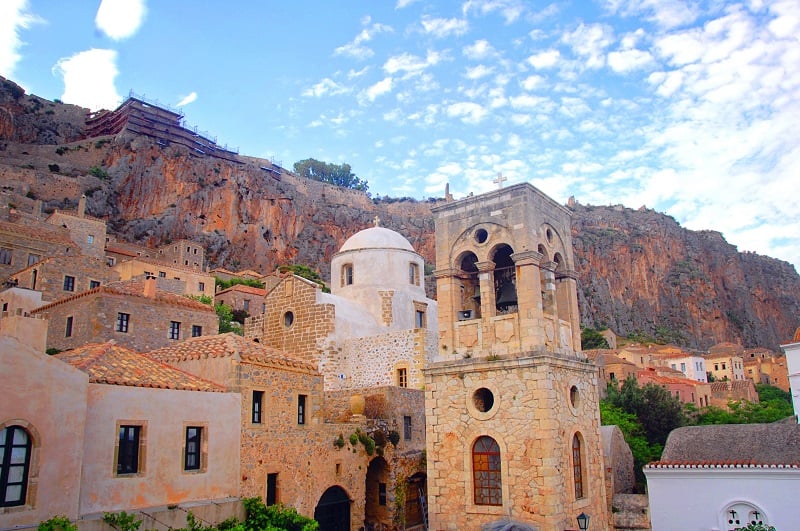
Monemvasia castle town Greece
Few places in Greece possess the combined charms, natural beauty, and historical significance to the extent that Monemvasia has to offer. Public Domain

Monemvasia, on the southeastern shores of the Peloponnese, Greece is Europe’s oldest continuously inhabited castle town.

Founded in 583 by inhabitants of the mainland seeking refuge from the Slavic and the Avaric invasion of Greece and surrounded by the Myrtoan Sea, Monemvasia is located on an island about half a mile long.

A man-made road and stone bridge leads to the castle gate and main entrance of the majestic castle town and onward through the colorful and lively citadel offering all who visit her both stunning views and an unforgettable ‘ambiance’ of times past.
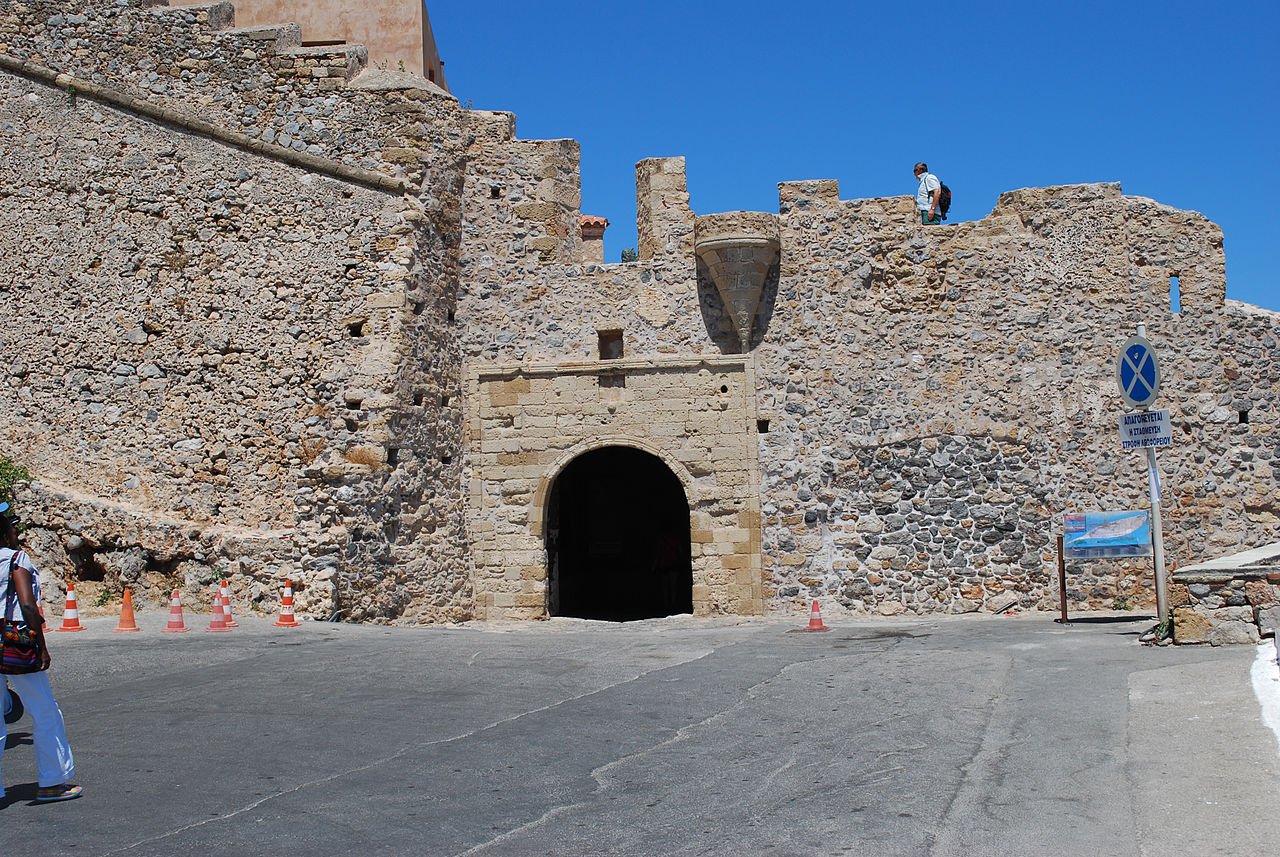
Monemvasia entry gate
The entrance to the medieval castle town of Monemvasia. Credit: Jean Housen, CC BY-SA 3.0/Wikipedia

The fortress’ stone walls protected the citadel of Monemvasia from various invaders throughout its history. Invasions by the Crusaders, Venetians, and lastly, by the Ottomans have all left an indelible cultural and architectural mark, granting the citadel a unique charm and romantic atmosphere second to none.

Few places in Greece possess the combined charm, natural beauty, and historical significance to the extent that Monemvasia does.

The town’s name is derived from two Greek words, mone and emvasia, meaning “single entrance.” The “Gibraltar of the East” or a “stone ship” about to set sail, as the famous Greek poet Yannis Ritsos described his birthplace, beckons you for a journey through time, wandering through vaulted alleyways and past churches and aristocratic mansions.

Ritsos is buried in Monemvasia’s cemetery. His pompadoured bust stares at the sea from the courtyard of his childhood home in the lower town.

Ritsos’s verses, including the poem “Monemvasiotisses,” which was published in 1987 and is devoted to the town’s women, sometimes referred to this lonely rock with the single entrance. In its resilience, he celebrated freedom.

“So many years, besieged by mainland and by sea,” he wrote in his 1945 epic poem Romiosini. “They’ve all been hungry, all been killed, and yet—not a single one is dead,” Ritsos wrote.

Monemvasia: A trade center that withstood invasions

From the 10th century AD the town developed into an important trade and maritime center. The fortress withstood the Arab and Norman invasions of 1147; farm fields that fed up to thirty men were tilled inside the fortress.

By 1193 Monemvasia was a major city in the Peloponnese. Ships sailing between Constantinople (now Istanbul) and what is now Italy stopped there, giving rest to aristocrats and high-ranking church members and loading Greek exports like olive oil and wine headed for the West.

William II of Villehardouin took it in 1248, on honorable terms after three years of siege; in 1259 William was captured by the Greeks after the Battle of Pelagonia, and in 1262, Monemvasia was retroceded to Byzantine Emperor Michael VIII Palaiologos as part of William’s ransom.
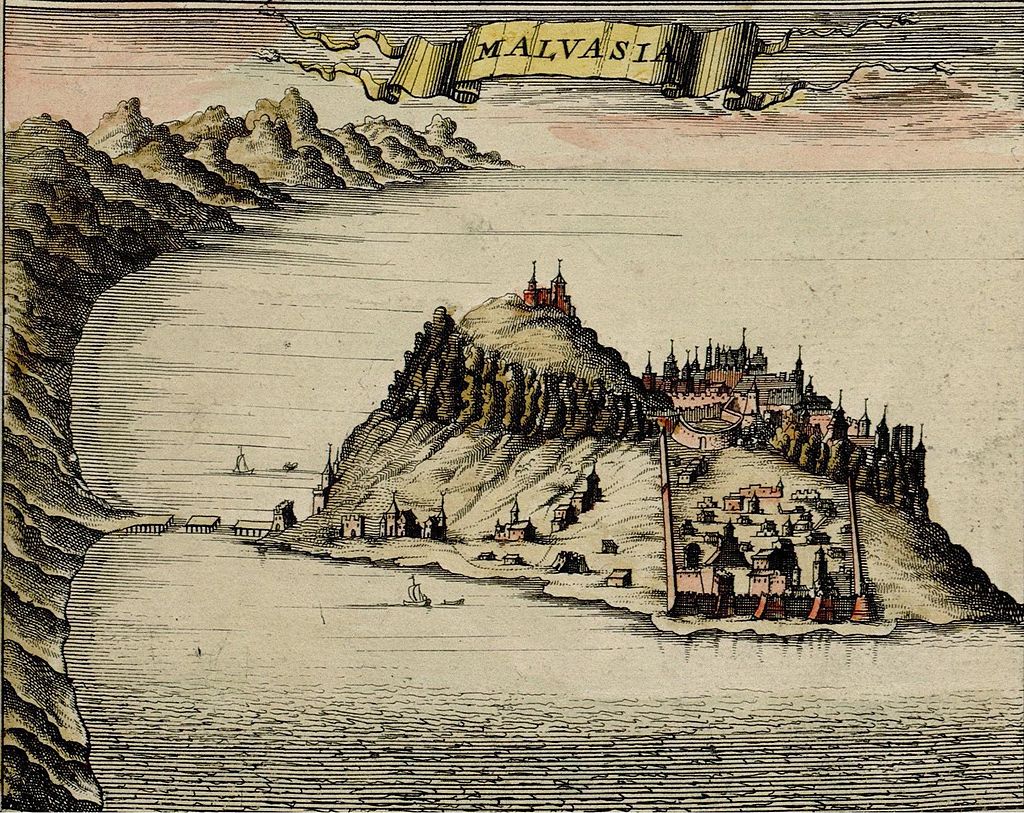
Monemvasia
Map of Monemvasia made by F. de Witt, Amsterdam, 1680. Public Domain

It remained part of the Byzantine Empire until 1460, becoming the seat of an imperial governor, a landing place for Byzantine operations against the Franks, the main port of shipment (if not always production) for Malmsey wine, and one of the most dangerous lairs of corsairs in the Levant.

After the fall of Constantinople in 1453 Monemvasia held out against the threats of Sultan Mehmed II in 1458 and 1460, when it became the only remaining domain of the Despot of the Morea, Thomas Palaiologos, the claimant to the Imperial throne. He had no forces to defend it; he offered it to the Sultan and finally sold it to the Pope.

The town was liberated from Ottoman rule on July 23, 1821 by Tzannetakis Grigorakis who entered the town with his private army during the Greek War of Independence. In 1822 it became the seat of the first national assembly.

The resurgence of the Greek castle town
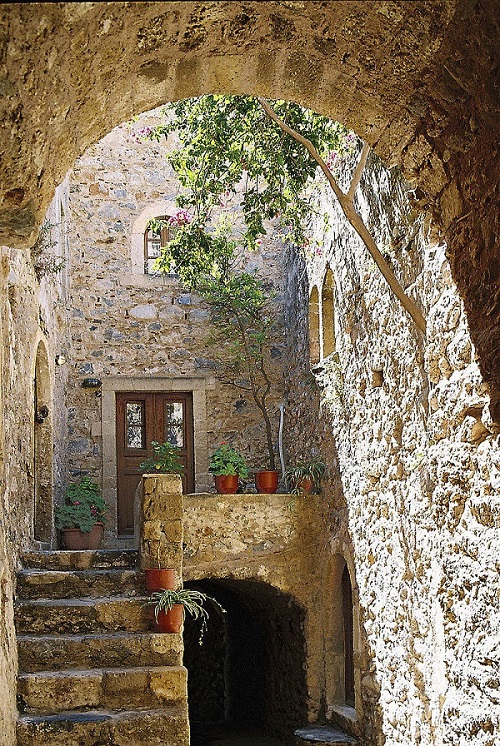
Monemvasia
A restored house in Monemvasia. Credit: ulrichstill , CC BY-SA 2.0 de/Wikipedia

In more recent history, the castle town has seen a resurgence in importance with increasing numbers of tourists visiting the site and the region.

The charming town of Monemvasia is made up of a labyrinth of winding cobblestoned streets that can only be traveled by foot. The medieval buildings have been restored, and many of them converted to hotels, artisans shops, boutiques, cafés and restaurants.

It has become an ideal romantic hideaway and honeymoon destination. Boutique bed & breakfasts and luxury hotels with suites boasting Turkish baths, mosaic floors and flowering courtyards will transport the visitor to another time without stinting on modern comforts. In the dimly lit rooms with their vaulted ceilings and handmade wooden furniture, visitors will live their own fairy tale.

Lower town of Monemvasia

The lower castle town’s cobblestoned principal lane is lined with tall, slim, earthy-stone houses with arched doorways and vaulted rooms. The narrower buildings have older foundations while the wider buildings are newer, dating to the 18th or 19th centuries with modern touches, such as wrought-iron balconies.

In the lower part of the town, one can explore the ruins of the historic buildings situated there—among which the Muslim Mosque, a preserved 16th century building housing the Archaeological Museum, is located along with some magnificent Byzantine churches. Twenty-four temples and churches with Byzantine elements remain from the forty that once existed.

The oldest is Elkomenos Christos, located in the main square of the Lower Town. It was probably built sometime in the 6th or 7th century and has undergone numerous transformations. Its sparse exterior does not prepare visitors for what is on display inside, namely a massive icon of the Crucifixion that dates from the Palaeologan Renaissance (a short but culturally vibrant period during which the Palaeologos dynasty sought to restore the Byzantine Empire’s glory).

It is a stunning piece of ecclesiastical art that was looted and, after undergoing several adventures, eventually made its way back to Monemvasia.

Other churches worth seeing are Panagia Chrysafitissa, Agios Nikolaos, and Panagia tin Kritikia (Myrtidiotissa).

Upper town
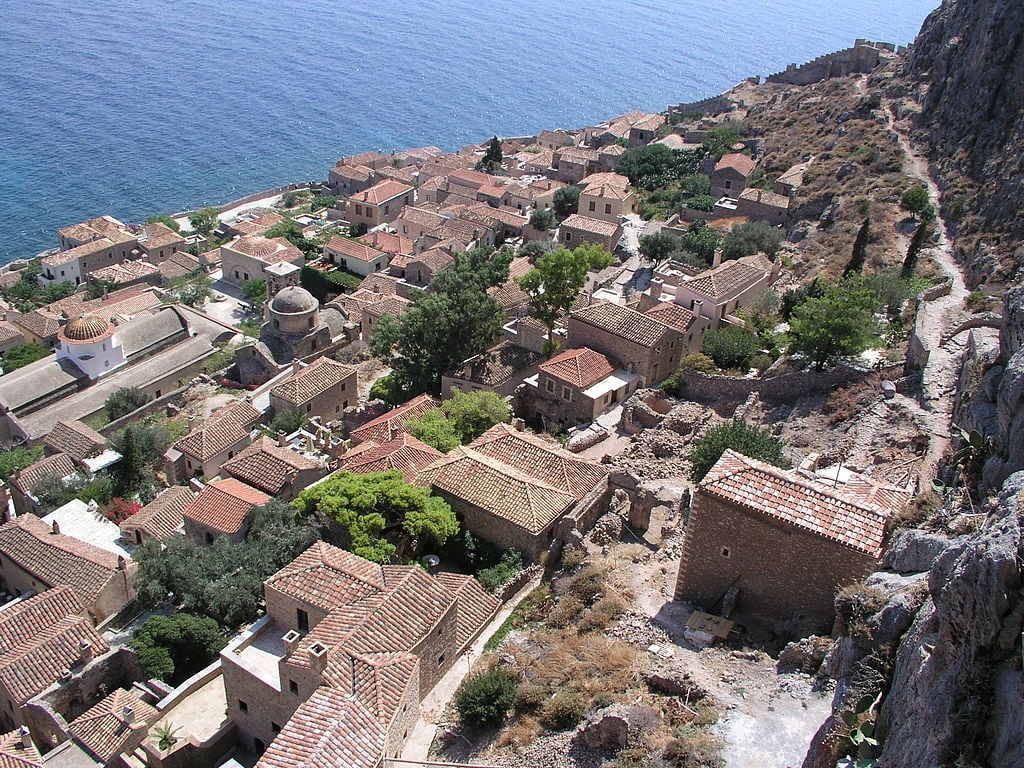
Monemvasia castle town
Rhe upper town offers panoramic views of the lower town and the sea. Credit: Dnalor 01, CC BY-SA 3.0/Wikipedia

The uninhabited upper part of the town was home to the Venetian aristocracy and, although it’s a steep climb to reach the beautiful mansions (in the 17th-century, travelers once counted 500), you’ll be rewarded with panoramic views of the whole area.

The highest peak in the upper town is about 656 feet above sea level.

The half-Byzantine, half-Venetian church of Agia Sofia clings to the side of the cliff and is one of the most significant attractions in Monemvasia. Once inside, you’ll be awe-struck by its magnificent octagonal dome.

Monemvasia castle town
The church of Agia Sofia. Credit: Jeroenu, CC BY-SA 4.0/Wikipedia

Historic lighthouse of Monemvasia

One of the most historic and imposing lighthouses in Greece is located at Monemvasia in the Peloponnese.

Built by the British in 1896 and automated in 1960, the lighthouse has recently been renovated. It sits on an iceberg-like slab of rock with sheer cliffs rising hundreds of meters from the sea.

The tower is seven meters (23 feet) tall, and its focal plane is at 15 meters (49 feet).

The British writer Brian W. Aldiss once described Monevmasia as a “wonderful place,” where “only eagles and artists” should be allowed.


  •  

Levissi: The Ghost Village in Turkey Once Home to 10,000 Greeks

Levissi: The Abandoned Greek Village
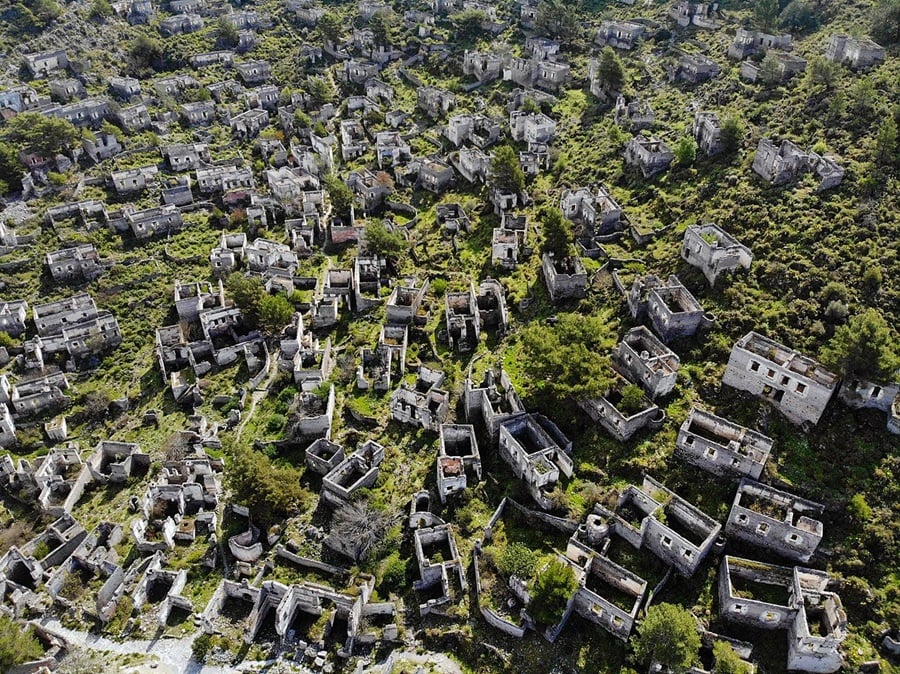
Greeks of the 5,000-year-old village were ethnically cleansed and then forcibly expelled in 1922. Credit: Wikitestaccountlogin, CC BY-SA 4.0/Wikipedia

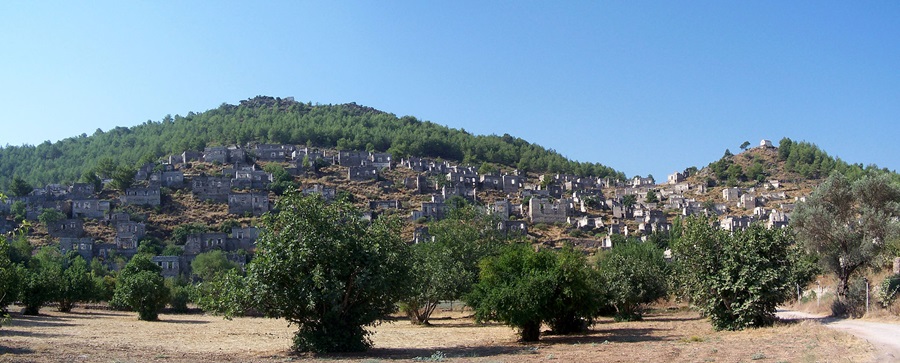
The ghost village of Levissi (known today as Kayaköy) was once a bustling Greek village on the slopes of a hill in the district of Fethiye, Turkey.

It was practically right across from the island of Rhodes.

Greeks of the 5,000-year-old village were ethnically cleansed and then forcibly expelled in 1922, causing 10,000 people to leave behind the land of their heritage.

It was anciently known in Greek as Karmylessos. In late antiquity, the inhabitants of the region had become Christian, and, following the East-West Schism with the Church of Rome in 1054 AD, they came to be called Greek Orthodox Christians.

These Greek-speaking Christian subjects and their Turkish-speaking Muslim Ottoman rulers lived in relative harmony from the end of the turbulent Ottoman conquest of the region in the 14th century until the early 20th century.

The massacres of Greeks and other Christian minorities in the Ottoman Empire during World War I (1914–1918) led to the almost total depopulation of the town’s 6,500 Greek inhabitants by 1918. These former inhabitants were deprived of their properties and became refugees in Greece, or they died in Ottoman forced labor battalions.

Following the Greco-Turkish War of 1919–1922 and the subsequent Treaty of Lausanne in 1923, the town’s Greek Orthodox residents were exiled.

Levissi: The Abandoned Greek Village
A panoramic photo of the abandoned village. Credit: Darwinek, CC BY-SA 3.0/Wikipedia

Greek ghost town

Since then, the homes have remained vacant, left to decay after being further damaged by a huge earthquake in 1957.

Houses and churches in the area have been used for summer festivals. However, plans to lease the area and auction it off for commercial interests have caused local Turks as well as Greeks with roots in the area to protest. They are worried that the investors could further ruin the authenticity of the area.

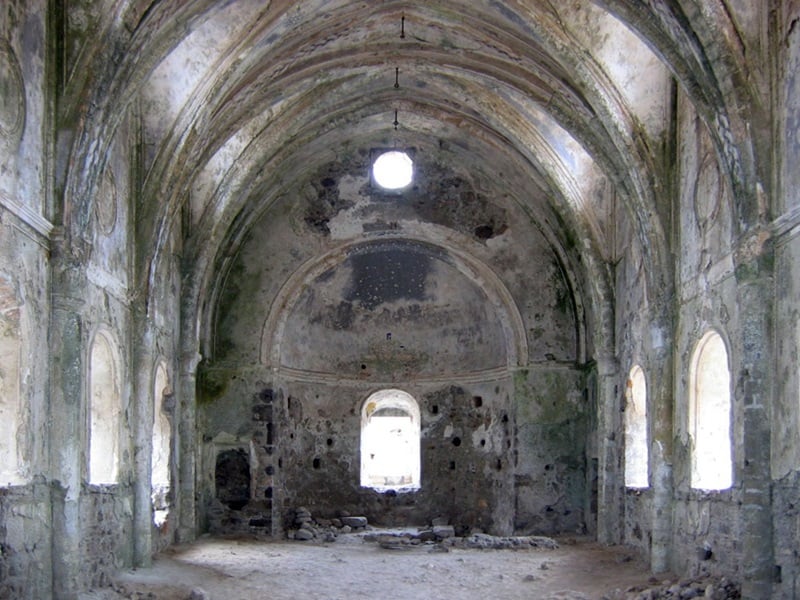
Levissi: The Abandoned Greek Village
An abandoned church. Credit: Orderinchaos , CC BY-SA 3.0/Wikipedia

The ghost town, now preserved as a museum village, consists of hundreds of rundown but still mostly standing Greek-style houses and churches that cover a small mountainside and serve as a stopping place for tourists visiting Fethiye and nearby Ölüdeniz.

The village is now empty except for tour groups and roadside vendors selling handmade goods. There are a few houses which have been restored and are currently occupied.

American filmmaker Joerg Schodl set out to document what is left of the ghost town in his documentary, “Ghosts of Levissi.”

Schodl tells the tale of the small Greek community in Asia Minor that was torn apart during the final days of the Ottoman Empire. It focuses on the disappearance of the population practically overnight thanks to campaigns, designed to scare Greeks from Levissi and nearby Macri (known as Fethiye), including offensives by Turks. The site Greek Genocide reports that women were raped and their clothes and shoes taken from them.

When making the film, Schodl had the help of members of the Greek community in Melbourne, Adelaide, Sydney, Perth and Brisbane and he was able to find thirteen descendants of Levissi families.

More descendants were found in Toronto, Rhodes, London, Athens and Istanbul.

  •  

The Greek Philosophers ‘Hiding’ in Raphael’s School of Athens

The Greek Philosophers 'Hiding' in Raphael's "School of Athens"
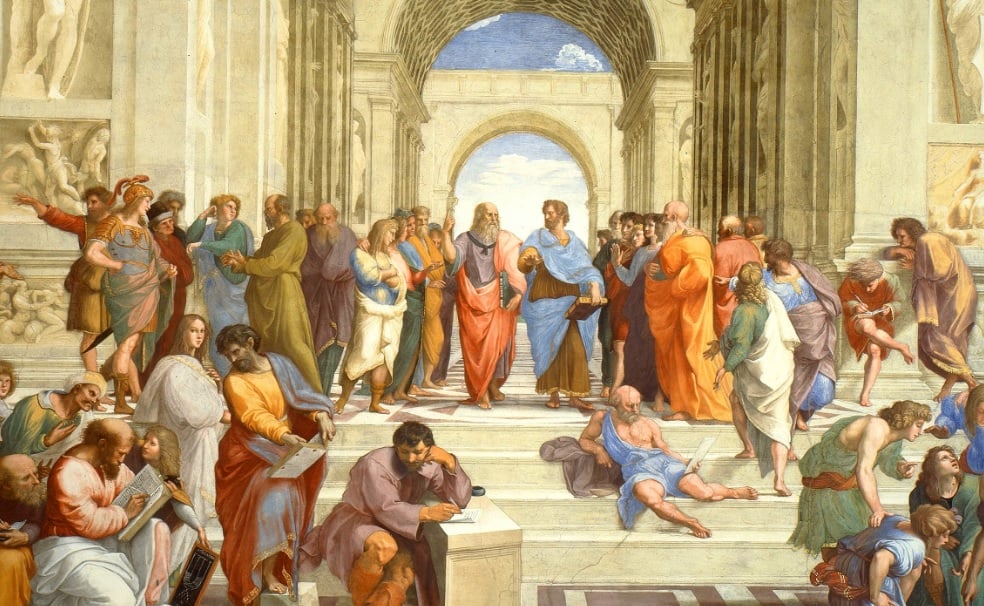
“The School of Athens,” depicting some of the Ancient Greek philosophers, by Raphael. Vatican Museums. Credit: Public domain

Several of the most influential Greek philosophers and thinkers are portrayed in Raphael’s masterpiece the School of Athens, which adorns the Apostolic Palace in the Vatican.

Painted between 1509 and 1511, it portrays a congregation of philosophers, mathematicians, and scientists from Ancient Greece, including Plato and Aristotle. But did you know that, in addition to the two philosophers in the center of the painting, there are six more “hiding”?

In his work, Raphael desired to pay his deepest tribute to the greatest philosophers in history, several of whom had tried throughout their lives to discover the prime mover, or cause, in the universe, a branch of thought known as the “knowledge of the first causes.”

It also shows sculptures of the Greek gods Athena, portrayed as the Roman goddess Minerva, representing Wisdom, and Apollo, representing Light and Music, in a direct nod to the greatness of Greek mythology and its contributions to the Western world. In short, Raphael’s painting is the Who’s Who of ancient Greek culture.

Who are the ancient Greek philosophers in Raphael’s painting?

Plato and Aristotle

Plato and Aristotle, the Greek philosophers "hiding" in Raphael's School of Athens
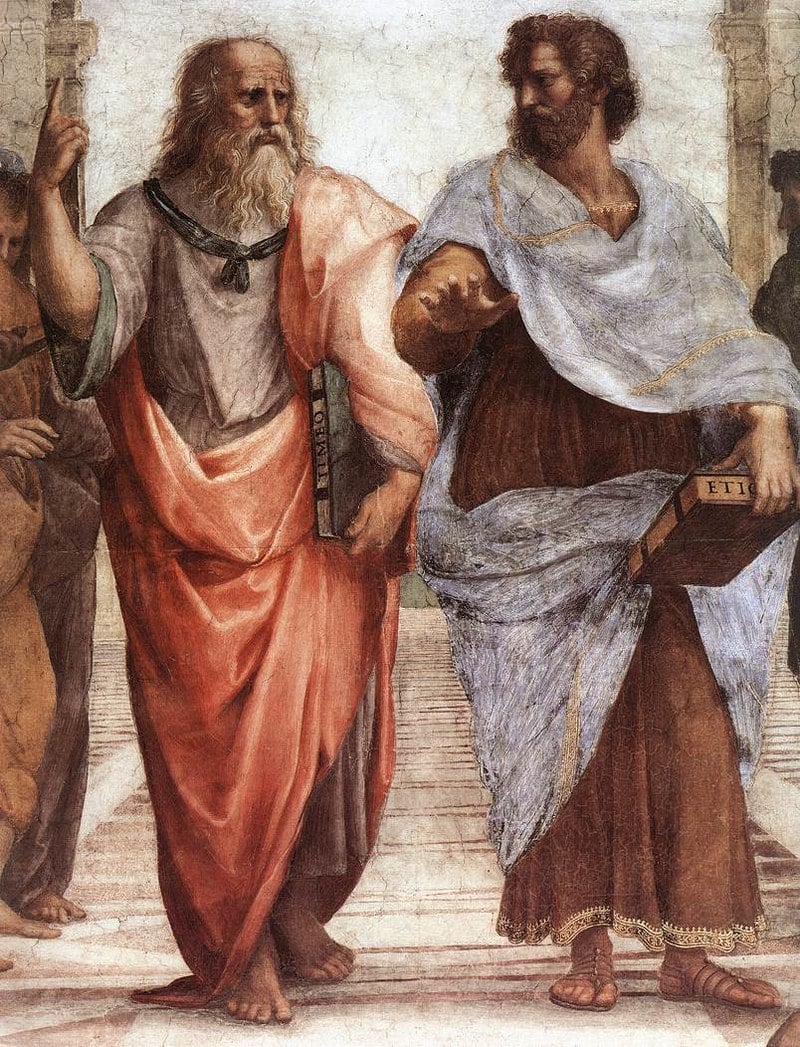
Plato and Aristotle, The School of Athens. Credit: Public Domain

The two main figures in the work are placed directly under the archway and in the fresco’s vanishing point, a compositional trick meant to draw the viewer’s eye to the most important part of the painting. Here, we see two men who effectively represent the different schools of philosophy—Plato and Aristotle.

An elderly Plato stands on the left, pointing his finger to the sky. Beside him is his student, Aristotle. In a display of superb foreshortening, Aristotle reaches his right arm directly out toward the viewer. Each man holds a copy of their books in their left hand—Timaeus for Plato and Nicomachean Ethics for Aristotle.

Socrates, the founder of Western philosophy

Socrates, the Greek philosopher "hiding" in Raphael's School of Athens
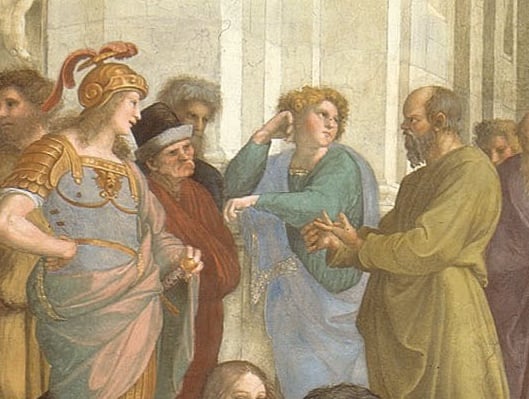
Socrates depicted lecturing his students. Credit: Public Domain

To the left of Plato, Socrates is recognizable thanks to his distinct features. It is said that Raphael was able to use an ancient portrait bust of the philosopher as his guide.

Among the crowd surrounding Socrates are his students, including the general Alcibiades and Aeschines of Sphettus.

Socrates is credited as the founder of Western philosophy and was among the first moral philosophers of the ethical tradition of thought.

Pythagoras, the theorist of metempsychosis

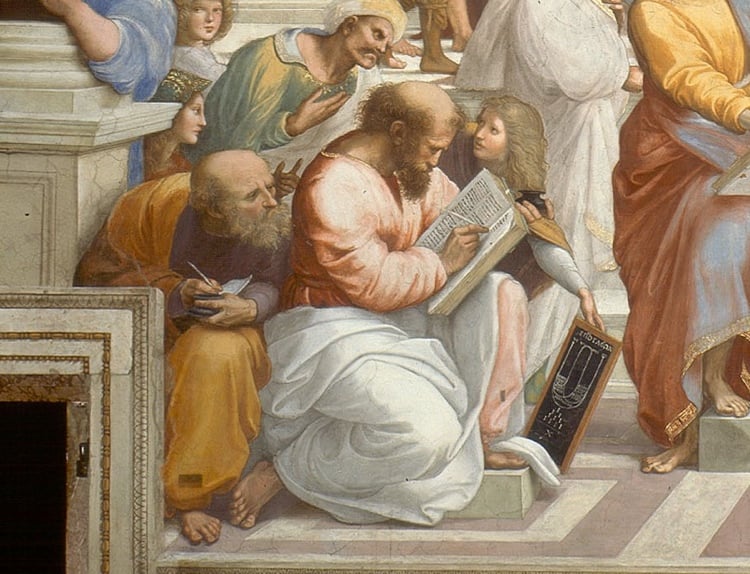
Pythagoras, another Greek philosopher "hiding" in Raphael's School of Athens
Pythagoras’ philosophy influenced Plato and Aristotle.  Public Domain

In the foreground, Pythagoras sits with a book and an inkwell, also surrounded by students.

The influence of Pythagoras in mathematics and philosophy remains indisputable to this day. His philosophy influenced both Plato and Aristotle, and through them, his ideas became fundamental to Western philosophy.

The teaching most securely identified with Pythagoras is metempsychosis, or the “transmigration of souls,” which holds that every soul is immortal and, upon death, enters into a new body.

Euclid, the father of geometry

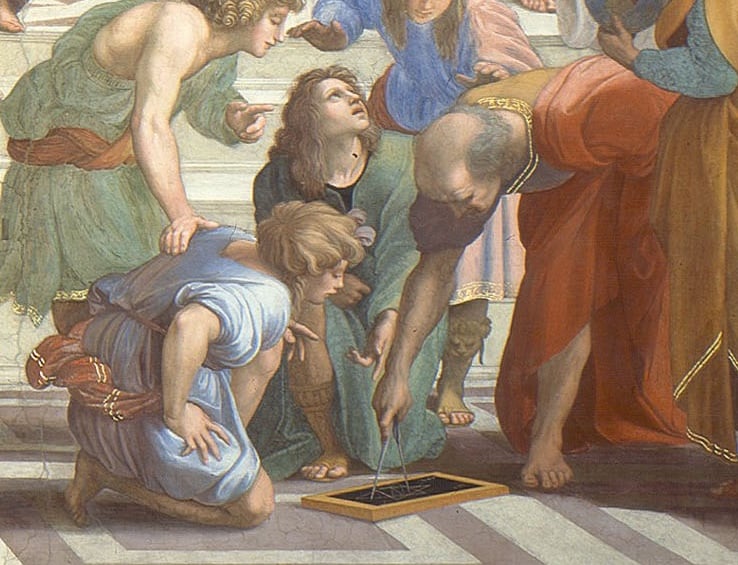
Euclid, who established the foundations of geometry, "hiding" in Raphael's School of Athens
Euclid established the foundations of geometry. Credit: Public Domain

Mirroring Pythagoras’ position on the other side, Euclid, considered the “father of geometry,” is bent over demonstrating something with a compass. His young students eagerly try to grasp the lessons he’s teaching them.

Euclid is chiefly known for the Elements treatise, which established the foundations of geometry that largely dominated the field until the early 19th century.

Ptolemy, the great mathematician and astronomer

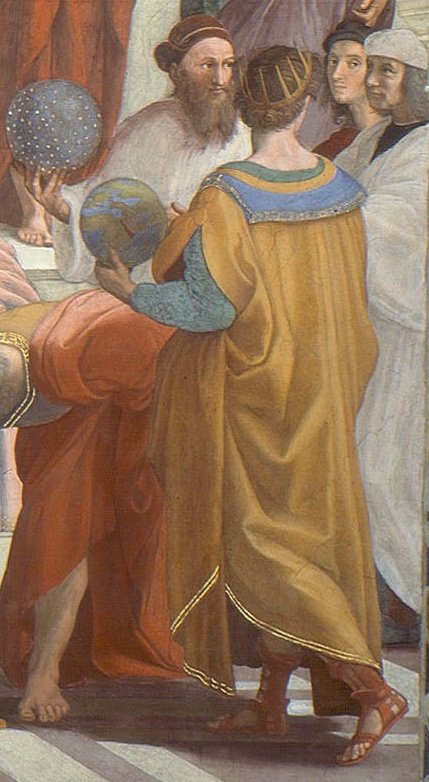
Ptolemy, a great mathematician of Ancient Greece, "hiding" in Raphael's School of Athens painting
Ptolemy was a great mathematician. Credit: Public Domain

The great mathematician and astronomer Ptolemy is right next to Euclid, with his back to the viewer. Wearing a yellow robe, he holds a terrestrial globe in his hand. It is believed that the bearded man standing in front of him holding a celestial globe is the astronomer Zoroaster.

Ptolemy wrote about a dozen scientific treatises, some of which were of importance to later Byzantine, Islamic, and Western European science.

Diogenes: The ancient Greek philosopher of cynicism

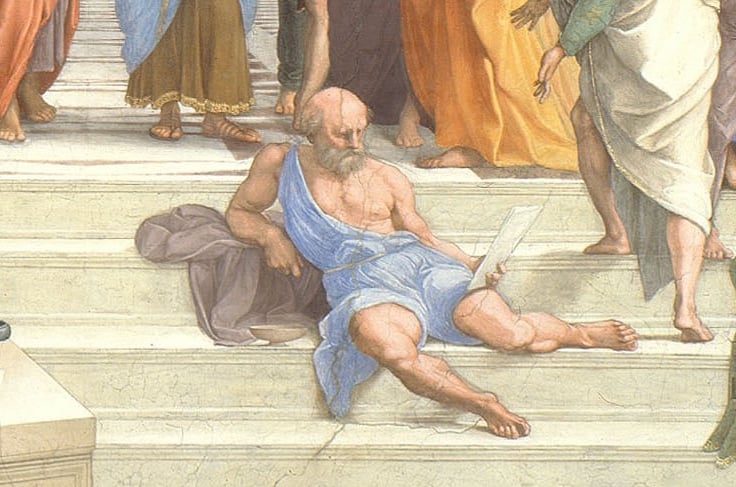
Diogenis, "hiding" in Raphael's "School of Athens"
Diogenes was a homeless man by choice whose life goal was the search for wisdom. Credit: Public Domain

Diogenes was the founder of the philosophy of Cynicism and was a controversial figure in his day, living a simple life and criticizing cultural conventions.

Diogenes the Cynic (also known as Diogenes of Sinope) could have been the first anarchist, absurdist, satirist, or naturalist—depending on the reader’s point of view. By today’s standards, Diogenes was a homeless man by choice, and his life goal was the search for wisdom.

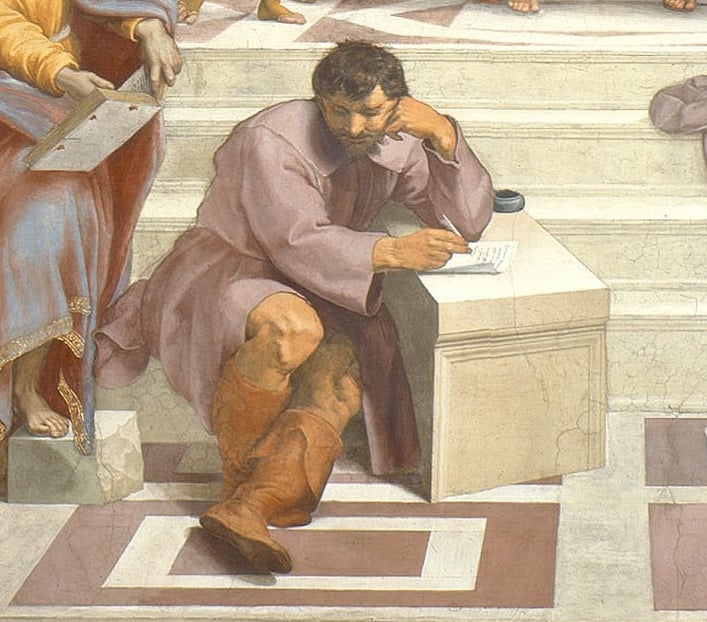
Heraclitus: The Greek philosopher of wisdom

Heraclitus, one of the ancient Greek philosophers "hiding" in Raphael's School of Life
“No man ever steps in the same river twice,” Heraclitus famously said. Credit: Public Domain

Heraclitus was an ancient Greek pre-Socratic philosopher from the city of Ephesus, then part of the Persian Empire. He saw the world as constantly in flux, changing as it remained the same, and expressed this in saying, “No man ever steps in the same river twice.”

He was a self-taught pioneer of wisdom and a melancholy character who did not enjoy the company of others, making him one of the few isolated characters in the fresco.

  •  
❌