
Reading view

Ioannis Sykoutris: A Teacher of the Ancient Greek Heroic Ideal in a Conservative Age

A historic photograph of Ioannis Sykoutris from around 1935.
Sykoutris viewed the heroic ideal not as blind defiance but as a conscious affirmation of meaning in the face of suffering. Credit: Photo Credit: Ioannis Sykoutris, c. 1935 – ELIA / Hellenic Literary and Historical Archive. Source: SearchCulture.gr. CC BY 4.0.

Ioannis Sykoutris, born in Smyrna in 1901, is one of the most tragic yet heroic figures of 20th-century Greek intellectual history. His life was marked by brilliance, deep philosophical inquiry, and, ultimately, a heartbreaking end.

On September 21, 1937 at the young age of 36, Sykoutris took his own life in Corinth. It was a tragic event that sent shockwaves through the Greek intellectual community. Though his life was cut short, his intellectual legacy and philosophical views continue to resonate to this day.

Philosophical views and his interpretation of Plato

Sykoutris was born into a humble family of Chios descent, and his early years were shaped by the struggles of a post-Ottoman world. After completing his studies at the University of Athens, he moved to Germany. There, he further honed his intellectual capabilities at universities such as Leipzig and Berlin.

Upon returning to Greece in 1929, Sykoutris took up a position as a lecturer at the University of Athens, where he made significant contributions to Greek philosophy and literature. His work spanned various areas, including the translation and analysis of classical texts, most notably Aristotle’s Poetics and Plato’s Symposium. These works established him as one of Greece’s leading intellectuals, and his translations, in particular, gained international recognition.

Sykoutris was deeply drawn to the works of the Greek philosopher Plato, particularly to The Symposium. His interpretation of the dialogue explored the nature of love and eroticism in Ancient Greek society. He especially focused on the acceptance of homosexuality as a cultural and social phenomenon in classical Greece.

While his intellectual rigor and deep insight into these themes were recognized, his perspectives also invited controversy. Conservative circles, for instance, tended to criticize his ideas on love and relationships. Sykoutris emphasized the philosophical and intellectual aspects of love, challenging the moralistic views of his time and revealing his progressive stance on issues considered taboo in his era.

His work on Plato was not limited to translations. Sykoutris believed that Plato’s philosophical ideas held the key to understanding the soul and the nature of human existence. He viewed Plato’s dialogues as a guide to achieving higher states of being through philosophical contemplation.

The heroic ideal: Sykoutris and the heroic human

Sykoutris drew on German idealism to shape his understanding of Greek thought, insisting that philosophy must transform the moral and intellectual character of individuals and society. He grounded his philosophical framework in the concept of the heroic human, which he identified as a central idea in both Greek philosophy and the modern intellectual landscape.

He viewed the “heroic human” as one who transcends conventional societal norms, embracing personal suffering and intellectual struggle in pursuit of higher ideals. For Sykoutris, the heroic individual was not just a figure of physical strength or military prowess. Instead, this was a person of profound philosophical depth who embodied the struggle for self-perfection.

In many ways, Sykoutris viewed philosophy as a means of rebellion against the oppressive social structures of his time. He admired the courage of individuals who resisted conformity. This theme echoes in his interpretation of ancient Greek heroes who defied the gods and societal expectations.

His vision of the heroic ideal was also influenced by his reading of Nietzsche and German idealism, which placed the individual at the center of philosophical inquiry and moral struggle. Sykoutris’ own life can be seen as an embodiment of such a heroic ideal. He was an intellectual who chose to live authentically, confronting both external social pressures and his own inner demons.

An artistic representation of Plato's Symposium.
An artistic representation of Plato’s Symposium. Credit: Anselm Feuerbach, Wikimedia Commons, Public Domain

The tragedy of his death

A complex interplay of personal, professional, and societal factors marked the circumstances surrounding Sykoutris’ suicide. Despite his intellectual achievements, Sykoutris felt a profound sense of isolation and disillusionment, particularly due to the fierce criticism he faced from religious and conservative factions in Greek society.

His progressive ideas were at odds with the prevailing norms, and this conflict led to personal and emotional strain. The attacks against him, especially concerning his views on love and sexuality, likely contributed to his feelings of alienation.

Sykoutris’ death was not just a personal tragedy but a cultural one, as well. It marked the loss of one of Greece’s most promising philosophers at a time when the country was undergoing significant political and social transformation. His suicide raised questions as to the psychological toll of intellectual rebellion and the cost of living as an outsider in a society unwilling to embrace change.

Trojan war hero ajax ancient greece
Sykoutris chose to end his life like the Trojan war hero Ajax. Credit: Wikimedia Commons, Public Domain

Legacy and influence

Despite his short life, Ioannis Sykoutris left behind a profound intellectual legacy that continues to shape modern Greek thought. His writings on Plato, Greek philosophy, and the nature of love continue to be studied and discussed in academic circles, and his work offers valuable insights into the tensions between tradition and modernity, on the one hand, and intellectualism and societal conformity on the other. He remains a symbol of intellectual courage, a figure who dared to challenge the status quo in the pursuit of truth.

Sykoutris’s tragic death only added to his mystique, transforming him into a martyr for the intellectual and cultural causes he championed. His legacy is not just one of academic achievement but also of moral and philosophical courage. These qualities remain an inspiration for those who seek to transcend the limitations of their time and pursue a higher, more meaningful life.

Ioannis Sykoutris was a man ahead of his time, whose intellectual journey continues to inspire scholars and philosophers alike. His views on Plato and the heroic ideal reflect a deep commitment to the power of philosophy as a tool for personal and societal transformation. While his life ended in tragedy, his philosophical contributions endure, and his legacy as a heroic intellectual remains a vital part of Greece’s cultural history.
  •  

Ancient Greek Warriors Used Spiderwebs to Heal Their Battle Wounds

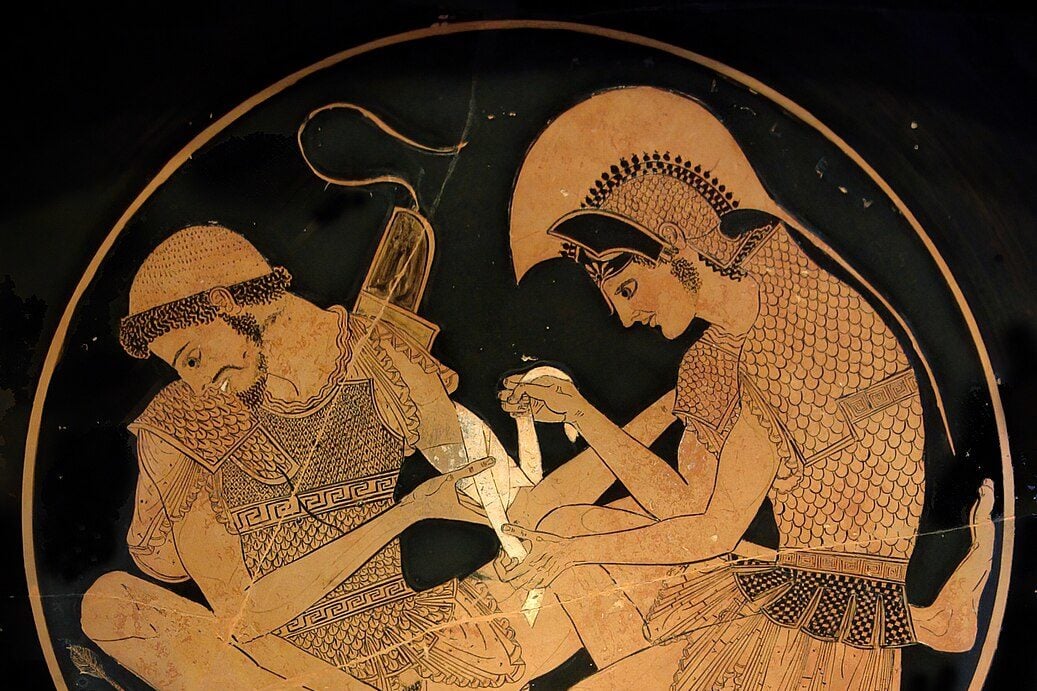
Image of Achilles tending to Patroclus' wound on an Ancient Greek vase from Vulci, 500 BC
Ancient Greeks and Romans used spiderwebs in medicine, believing their natural fibers could stop bleeding and protect wounds from infection. Credit: Wikimedia Commons, public domain

Among the most intriguing practices in Ancient Greek medicine was the use of spiderwebs—and even live spiders—in healing treatments. Ancient medicine often surprises modern readers with remedies that seem unusual at first glance, yet many of these traditional approaches contained a practical logic beneath layers of symbolism and inherited belief.

Greek and Roman physicians placed particular emphasis on controlling bleeding, especially in the context of warfare and surgery. Soldiers frequently sustained deep wounds from swords, spears, and arrows, while physicians had no access to modern antiseptics or advanced surgical instruments. In response, healers continuously experimented with natural materials that could help stop blood flow and protect exposed tissue. One of the more unusual solutions they turned to was spiderwebs.

Ancient Greek and Roman medical writers do, in fact, refer to the use of spiderwebs in medicine. Spider silk was observed to have properties that made it unexpectedly effective for wound care. Physicians noted its ability to absorb blood, cover injuries, and support the clotting process. While they lacked any understanding of modern biochemistry, their meticulous attention to such effects often led them to surprisingly effective medical practices.

Pliny the Elder and natural remedies, such as the use of spiderwebs, in the medicine of Ancient Greece and Rome

The Roman author Pliny the Elder offers some of the clearest references to spider-based medicine in his encyclopedic work Natural History. He describes a range of remedies involving both spiderwebs and actual spiders, noting that the former could help stop bleeding and support healing when applied directly to wounds. He also made mention that spiders were believed to serve as effective remedies for a variety of diseases and injuries in antiquity.

For Ancient Greek healers, spiderwebs appeared naturally suited for wound treatment. Their soft, fibrous texture allowed them to cover cuts with ease, while their adhesive qualities helped seal damaged tissue and protect it. Ancient warfare produced particularly severe injuries. Greek hoplites and Roman soldiers fought in brutal close combat, where swords and spears regularly tore flesh open. Even relatively minor wounds could turn fatal due to blood loss or infection. Physicians accompanying armies therefore required treatments that acted quickly and could be easily carried onto the battlefield.

The use of spiderwebs among the Ancient Romans and Greeks provided several practical advantages in medicine. They were lightweight, widely available in nature, and naturally adhesive when applied to skin. Healers thus collected cobwebs and preserved them for medical use, and soldiers are sometimes described as carrying small containers filled with spiderwebs during military campaigns.

Long before the development of modern antibiotics, healers frequently relied on natural substances that appeared to reduce infection risk and support faster healing.

Galen and Ancient Greek traditions in medicine

The great Greek physician Galen likewise discussed spider cobwebs in his work On the Powers of Simple Remedies in which he refers to their Ancient Greek medicinal applications in the treatment of injuries and the control of bleeding. Because gladiators suffered frequent injuries, Galen gained extensive experience treating wounds and preventing infection. Greek medicine placed strong emphasis on observation and practical effectiveness, so physicians often tested remedies repeatedly under real and demanding conditions.

This connection makes historical sense. Ancient doctors valued materials that combined absorbency, flexibility, and ease of application. Spider silk possessed all three qualities. Furthermore, physicians in antiquity often preferred natural substances that were readily available in military environments, where medical resources were limited.

Modern science helps explain why ancient healers valued spiderwebs. Spider silk is composed of strong protein fibers capable of forming protective coverings over wounds. The silk also absorbs moisture effectively and creates a temporary barrier against dirt and contaminants. Additionally, spiderwebs may exhibit mild antiseptic properties due to natural compounds present within the silk. Although ancient physicians could not observe bacteria, they recognized through experience that some treatments reduced infection more effectively than others.

Many people also associate spiderwebs with clotting because webs can contain traces of vitamin K from insect remains and environmental material. Vitamin K is a nutrient that contributes to blood coagulation in the human body. Most importantly, however, the web itself functions physically as a mesh. When pressed against a wound, the fibers help gather blood and support clot formation.

Modern medicine even studies spider silk for advanced surgical materials due to its exceptional strength and biocompatibility. Ironically, contemporary science now investigates properties that ancient healers observed intuitively thousands of years ago. Thus, ancient healers may have developed practical wound-care techniques through centuries of observation rather than theoretical science.

Greek physician Galen, the pioneering Greek physician who influenced Western medicine through the 1700s. Portrait by Pierre-Roch Vigneron.
Galen, the pioneering Greek physician who influenced Western medicine through the 1700s. Portrait by Pierre-Roch Vigneron. Credit: Wikimedia Commons Public Domain

Ancient medicine and empirical knowledge

The use of spiderwebs highlights a central feature of ancient medicine, namely that Greek and Roman physicians often relied on empirical observation rather than formal scientific theory. They closely observed which remedies appeared effective and preserved those methods within medical tradition.

Greek physicians, in particular, placed great value on careful observation. The Hippocratic tradition encouraged doctors to study symptoms, environments, diets, and physical responses in detail. As a result, treatments survived not because they were theoretically justified but because they produced visible and consistent results. In this context, spiderwebs were valued because their silk fibers formed a natural covering over wounds while also helping to control blood flow. Folk medicine across many cultures likewise used cobwebs as anti-fungal and antiseptic remedies for cuts and open injuries.

Spiderwebs likely entered medical practice through precisely this kind of experiential process. Healers observed reduced bleeding and improved healing following their application, and over time, the practice spread across regions and generations. Cobwebs were part of a much broader landscape of natural medicine in antiquity. Ancient healers regularly used honey, wine, herbs, oils, vinegar, and minerals in wound care and general treatment.

Many of these substances also possessed genuine antibacterial or medicinal properties. Honey, for instance, inhibits bacterial growth and is still used in certain modern wound treatments. Wine and vinegar functioned as early disinfectants due to their alcohol and acid content. Within this framework, spiderwebs would not have seemed unusual to ancient physicians. Instead, they represented another readily available natural material with observable healing potential. Greek and Roman medicine thus consistently explored the relationship between nature and health, making use of natural resources, including even something so peculiar to modern eyes as spiderwebs.

Mad honey, a unique type of honey produced by bees feeding on the nectar of rhododendron flowers, contains toxins that can cause hallucinations and intoxication.
Honey was used by the Ancient Greeks in medicine as well. Credit: The Drug Users Bible, CC BY SA, 2.0

The symbolic dimension of spiderwebs and their silk in Ancient Greece

Ancient cultures attached rich symbolic meaning to spiders and the act of weaving, and in Greek tradition, these associations carried particular weight. Mythology linked weaving to intelligence, fate, and skilled craftsmanship through figures such as Athena and Arachne, embedding it within a broader cultural framework that connected material creation with order, skill, and even divine influence. Spider silk itself likely appeared mysterious and almost otherworldly, given its delicate structure and surprising strength—qualities that blurred the boundary between natural substance and something almost magical.

This symbolic dimension may have reinforced confidence in cobweb-based remedies, since ancient medicine often operated at the intersection of practical treatment and cultural meaning. In battlefield contexts especially, where speed and improvisation were essential, surgeons had to remove arrows, close wounds, cauterize bleeding, and stabilize fractures under extreme conditions with limited equipment, relying heavily on whatever materials were immediately available. Spiderwebs fit this environment well, both practically and symbolically, as soldiers or assistants could gather them quickly from camps, caves, or buildings, requiring no preparation and allowing for rapid application under pressure.

Even when cobwebs were not perfectly effective, they could still provide a basic protective layer that was often better than leaving wounds exposed, which would have only allowed dirt and uncontrolled bleeding to pose immediate risks to survival. In many cases, this simple barrier alone may have made a meaningful difference in outcomes. Today, the same material that once carried symbolic and practical value in antiquity is again attracting scientific interest, as researchers explore spider silk for potential applications in surgery, tissue engineering, and regenerative medicine.

  •  

Did Paleolithic People Eat Bread?  

Assorted bread rolls with different seed toppings in a wicker basket.
New archaeological evidence suggests that Paleolithic humans may have baked simple types of bread as early as 30,000 years ago. Credit: 2368zauber, Wikimedia Commons, CC-BY-SA-3.0

For decades, conventional wisdom held that bread didn’t exist among Paleolithic people and was a relatively recent human innovation, an agricultural byproduct that emerged with the rise of farming in the Neolithic era, roughly 10,000 years ago. Recent archaeological discoveries have radically challenged this view, however, pushing the timeline of breadmaking back by at least 20,000 years.

In what can only be described as a groundbreaking study, a team of Italian researchers has revealed that Paleolithic hunter-gatherers in Europe not only consumed wild plants but also processed them into flour and baked a primitive flatbread. These findings were published in the prestigious journal Proceedings of the National Academy of Sciences (PNAS). They suggest that the roots of culinary innovation run far deeper than previously imagined.

Grinding stones and starch residue

At the heart of this discovery are ancient grinding stones. The archaeologists unearthed these flat stone slabs and pestle-like tools at sites across Italy, Russia, and the Czech Republic. The tools, dated to around 30,000 years ago, were originally assumed to have been used for processing pigments or crushing seeds. Nevertheless, when researchers Anna Revedin and Laura Longo of the Italian Institute of Prehistory and Early History in Florence conducted a detailed microscopic analysis, they uncovered traces of starch granules embedded in the stone surfaces.

The starches were identified as those of cattails, ferns, and other starchy wild plants, which would have required careful preparation to be rendered digestible. Revedin’s team concluded that these Paleolithic humans had not only harvested the plants but had dried, ground, and mixed them with water to form a kind of dough. Additionally, they likely cooked the resulting paste on hot stones near the fire, producing an early version of unleavened bread.

Rethinking the Paleolithic diet

The ancient Greeks themselves had a clear grasp of the evolution of human diet. Hippocrates, the father of medicine, wrote in his work On Ancient Medicine:

“It is for this reason, I believe, that people sought out food more suited to human nature, and eventually discovered the kind we now use. From wheat, after soaking, grinding, kneading, sifting, and baking, they made bread; from barley, they made flatcakes. After many efforts, they cooked, baked, mixed, and blended foods, diluting the strong and raw with milder ingredients, shaping everything according to human nature and capacity.”

The implications are profound. Until now, the standard narrative of Paleolithic diets emphasized a reliance on animal protein. This included meat and fish, with foraged fruits and plants playing only a minor role. The recent discovery challenges that model, however. Moreover, the implication is that these early humans were actually greatly skilled in the complex processing of wild plant foods. In other words, they also possessed the sophisticated ability to cook.

Furthermore, the evidence of flour production long before the advent of agriculture hints at a continuity of knowledge. The leap from gathering and grinding wild plants to cultivating domesticated grains may not have been as abrupt or revolutionary as once believed. Paleolithic peoples were far from passive consumers of raw resources, and the rise of farming could in fact have been the result of millennia of experimentation, habit, and accumulated expertise.

Ancient Greek bread
Ancient Greek woman taking bread out of the oven. Terracotta figure found in Tanagra, Greece. Credit: Marie-Lan Nguyen CC BY 2.5

A quiet revolution

Perhaps most striking is what this discovery on bread reveals about Paleolithic ingenuity. The production of flour and bread is not simply a dietary choice. It reflects planning, patience, and an understanding of food chemistry. Drying plant roots, grinding them into powder, and then baking them requires more than survival instinct. It also requires culture.

As more research sheds light on the lives of our Paleolithic ancestors, it becomes increasingly clear that they were not the brutish cave-dwellers of outdated caricatures. They were observant, resourceful, and remarkably sophisticated in their interaction with the natural world.

Bread, it turns out, is not just the food of civilization. It may have been the food of pre-civilization, as well.

  •  
❌