Reading view

Christian farming communities under siege as US report names Fulani militants Nigeria's deadliest threat

JOHANNESBURG — An estimated 30,000 mostly Muslim Fulani militants are operating in Nigeria, causing "worsening insecurity and religious freedom violations," according to an influential new report.

The report, by the U.S. Commission on International Religious Freedom (USCIRF), states "violence by Fulani militants caused the highest number of deaths among all religious communities in Nigeria over the last year, as compared to attacks by organized insurgent groups and criminal gangs."

The Fulanis, so-called herders of livestock, have, according to the USCIRF report, "targeted Christian (farming) communities in the Middle Belt and, increasingly, the South, burning homes and churches as well as kidnapping, raping, and murdering."

CHRISTIANS TARGETED IN SYSTEMATIC KIDNAPPING CAMPAIGN IN NIGERIA BY JIHADI HERDSMEN, EXPERTS SAY

But a former counterterrorism expert at the State Department told Fox News Digital that the kind of strikes the U.S., working with Nigerian government forces, have recently carried out in Nigeria’s North against Islamist terrorist organizations such as Boko Haram and Islamic State, wouldn’t work against the Fulanis in the predominantly Christian central areas of the country.

Sterling Tilley, former acting director within the Bureau of Counterterrorism, who has worked in Nigeria for the State Department, said that the U.S. "militarily dealing with the farmer-herder conflict is not advisable because it is likely to bring more instability in the country." Tilley, now director of the Thomas R. Pickering Graduate Foreign Affairs Fellowship at Howard University, added, "There are some steps that can be taken to quell the violence, but there must be Nigerian political will to do so."

This week, Secretary of War Pete Hegseth commented on the recent strikes ordered by President Donald Trump on Nigeria, saying, "Maybe a year ago, [the president] heard the call of Nigerian Christians who were being targeted and killed by ISIS. And he said, 'Pete, I want the War Department to focus on ensuring that we do everything we can to protect those Christians.'"

NIGERIA NAMED EPICENTER OF GLOBAL KILLINGS OF CHRISTIANS OVER FAITH IN 2025, REPORT SAYS

Christians make up approximately 48%, and the Fulanis, the report says, represent around 6%, or 14.5 million of Nigeria’s population. Fulani militants, the USCIRF report stated, "have often carried out operations during Christian holidays such as Christmas or Easter to further maximize the psychological impact, terrifying those communities from gathering to celebrate or worship. During attacks, assailants sometimes utter slogans with religious connotations, such as "Allahu Akbar" (Arabic for "God is great"). 

But, according to the report, Muslims are being attacked too. "Fulani assailants have not spared Muslims, raiding herders’ cattle and violently attacking non-Fulani Muslim communities," the report added.

"Violence at the hands of militants from the Fulani tribe far outnumbers violence from all other militant groups such as Boko Haram or ISWAP (Islamic State West African Province)," Henrietta Blyth, CEO of Open Doors UK & Ireland, an organization that highlights the persecution of Christians, told Fox News Digital.  

While her organization was not part of the report, she said, "My heart has been broken as I have heard stories from women and men who have seen their beloved family members butchered in front of them or carried off into a life of slavery." 

AFRICAN UNION CHIEF DENIES GENOCIDE CLAIMS AGAINST CHRISTIANS AS CRUZ WARNS NIGERIAN OFFICIALS

Blyth added: "The situation is complicated, and as the report concludes, it is too simplistic to say all perpetrators are religiously motivated. What is undisputable is that Christians are highly vulnerable and often the victims, paying the price in blood. They desperately need protection and, for hundreds of thousands driven from their homes, the chance to heal and rebuild their lives."

The USCIRF report also stated, "Criticism of responses to Fulani militant violence from federal and state authorities has often described their responses as unsatisfactory at best and complicit at worst."

Tilley told Fox News Digital that elections are to be held in Nigeria next year, and "the Fulani do have considerable political influence as a voting bloc. Thus, the Nigerian government seems reluctant to take actions necessary to quell the violence for fear that they could lose their base of support in the North and Middle Belt."

CLICK HERE TO DOWNLOAD THE FOX NEWS APP

Fox News Digital reached out to the Nigerian government for comment but did not receive a response by publication time.

  •  

How Roman Emperor Julian Fought Christianity to Save the Ancient Greek Gods

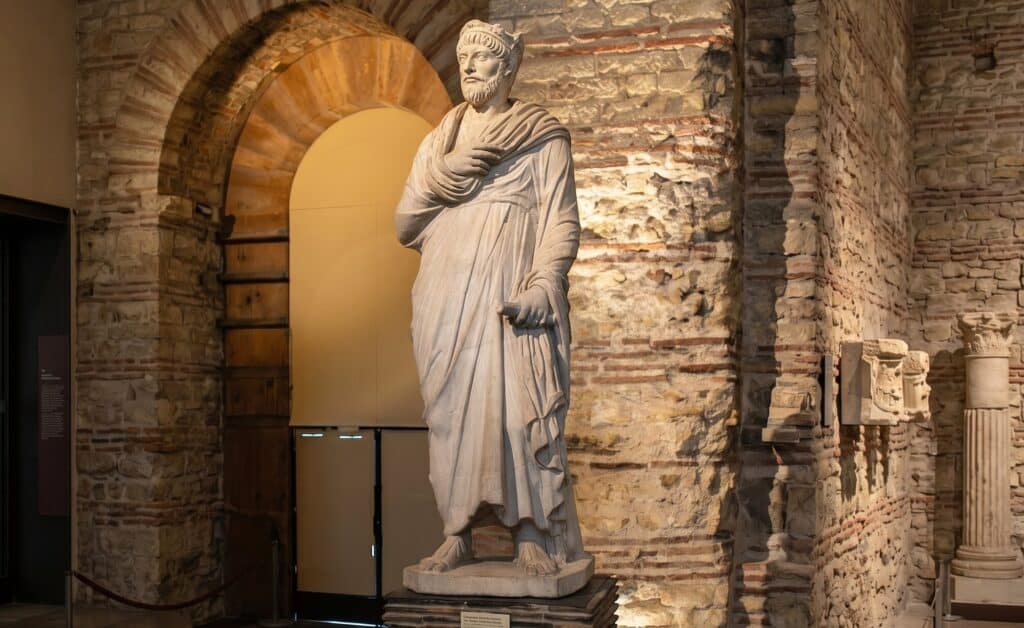
A full-length marble statue of a bearded man draped in a traditional Roman cloak and holding a scroll stands within a stone gallery.
The depiction of Julian in this classical guise shows his commitment to Neoplatonism and Greek culture over the rapidly spreading Christian faith. Credit: Ash Crow, Wikimedia Commons, CC BY-SA 4.0

Few figures in late antiquity present as compelling a historical debate as Julian the Apostate’s attempt to restore the Greek gods in opposition to Christianity in the Roman Empire.

During his brief but highly consequential reign in the fourth century AD, the Roman Empire stood at a profound religious crossroads. For a short period, Julian attempted to slow the empire’s accelerating Christianization, launching a sweeping effort to revive the ancient Olympian pantheon and return Rome to its traditional pagan practices. His sudden death on the battlefield has led historians to debate how dramatically the cultural trajectory of Western civilization might have shifted had his reforms endured.

Julian was born into the heart of the Constantinian dynasty, a family that had only recently converted to Christianity. Nonetheless, he became the last Roman emperor to openly support and worship the traditional Greek gods. He ruled for only about two years from 361 to 363 AD, but he acted with urgency and purpose. Julian the Apostate initiated an extensive program of philosophical and religious reform, aiming to reverse the Christian expansion advanced by his predecessors. To the growing Christian population, he was seen as a traitor to the new religious order, but to those who still admired the intellectual and cultural legacy of the classical world, he appeared as a philosopher-king attempting to restore an older vision of Rome.

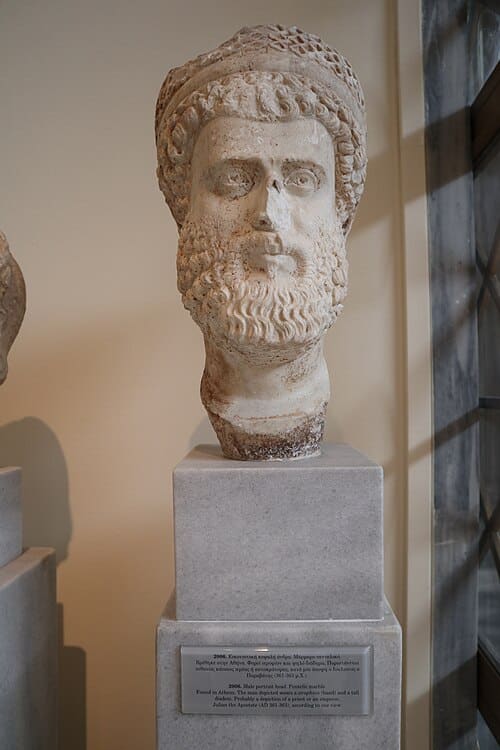
A sculpted marble portrait head of a bearded man wearing a diadem rests upon a stone pedestal inside a museum.
This marble head from Athens is widely believed to be a rare surviving portrait of the Roman Emperor Julian the Apostate. Credit: George Koronaios, Wikimedia Commons, CC BY-SA 4.0

Julian the Apostate’s early life

Julian did not experience the typical sheltered upbringing of an imperial heir. He grew up constantly looking over his shoulder, surviving political purges that eliminated many members of his own family. Although he was raised in a strict Christian environment under the supervision of powerful bishops, he is often understood to have developed a private intellectual attraction to classical texts and traditions associated with the ancient world.

His life took a decisive turn when he went to study in Athens. There, he was secretly initiated into the Eleusinian Mysteries, an experience that deeply shaped his philosophical outlook and strengthened his commitment to rejecting Christianity in favor of Neoplatonism. This forced dual existence helped form a uniquely strategic mindset. He became familiar with the inner workings of the Church, knowledge he later leveraged in support of his own religious and philosophical aims. By the time his troops in Gaul unexpectedly proclaimed him emperor, Julian was convinced that the gods themselves had chosen him to restore the ancient order.

Julian the Apostate as Emperor and the worship of the Ancient Greek gods in the Roman Empire

When he finally took power, Julian did not launch the kind of widespread, violent persecutions often associated with earlier periods of religious conflict. Instead, he pursued a more calculated cultural strategy. His approach focused on weakening Christian influence within imperial institutions while strengthening traditional religious structures. Julian the Apostate reduced the privileges and state support enjoyed by Christian clergy and redirected resources and prestige toward the priesthood of the traditional Greco-Roman religion centered on the Greek gods.

In a particularly controversial move, he restricted Christians from teaching classical literature. His reasoning was that those who rejected the traditional religious framework of Homer and Hesiod should not profit from instructing it. At the same time, Julian sought to make traditional religion more socially competitive by encouraging pagan priests to adopt public charitable functions, including aid for the poor and the establishment of hospitals—areas in which Christianity had been especially successful in gaining support. He appears to have believed that traditional worship had declined not because of its inherent weakness but because its institutions had failed to match the organizational and charitable presence of Christianity.

In practice, many historians argue that this cultural and intellectual strategy posed a different kind of challenge to early Christianity than outright violence. While persecution could strengthen Christian identity through martyr narratives, Julian the Apostate’s policies instead aimed to limit the social structures that supported its continued expansion while restoring the worship of the Ancient Greek gods within the broader Greco-Roman religious tradition.

A weathered page from an illuminated manuscript features three stacked, colorful panels showing medieval figures in royal and religious garments amidst dramatic interactions.
This illuminated manuscript page depicts vivid scenes of Emperor Julian ordering the arrest of a Christian bishop and overseeing acts of persecution. Credit: Wikimedia Commons, Public Domain

Unfortunately for his beliefs, that grand vision of such a revived Greco-Roman empire came to an abrupt end in the arid regions of Persia. During a military campaign, Julian was struck in the side by a spear, cutting his reign tragically short. Ancient sources and later traditions continue to debate the circumstances of his death, with some attributing the blow to a Persian soldier and others speculating—without evidence—that it may have come from within his own ranks. The true origin remains uncertain.

A well-known tradition holds that, as he lay dying, Julian the Apostate is said to have declared, “Thou hast conquered, O Galilean,” acknowledging the perceived triumph of Christianity. Whether or not he actually spoke these words, his brief reign left a lasting imprint on Roman and Western history. His efforts to restore the Ancient Greek gods within the Roman world continue to be discussed by historians as a striking moment in the empire’s religious transformation. Even in modern Greek cultural memory, echoes of this tension can still be felt in the broader contrast between the rational legacy of ancient philosophy and the spiritual tradition of Orthodox Christianity.

  •  

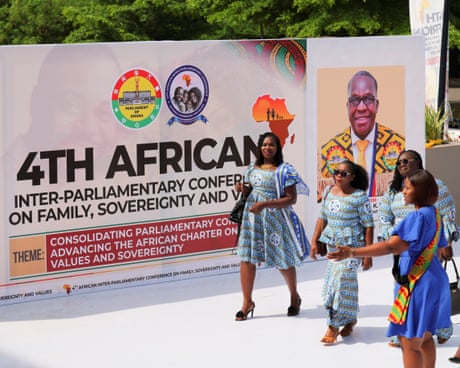
‘Family values’ African charter condemned by rights groups as regressive and dangerous

Draft treaty claims sexual and reproductive health and rights are an existential threat to the African family

An African treaty that rejects longstanding international human rights obligations moved a step closer to becoming policy this week as governments across the continent met in Ghana.

The draft African charter on family, sovereignty and values, seen by the Guardian, asserts that African values and culture are under attack from “foreign ideologies” and urges states to withdraw from any agreements that do not align with the principles of the charter, including the 2003 Maputo protocol, which promotes gender equality and protects the reproductive and health rights of women and girls.

Continue reading...

© Photograph: Francis Kokoroko/Reuters

© Photograph: Francis Kokoroko/Reuters

© Photograph: Francis Kokoroko/Reuters

  •  
❌