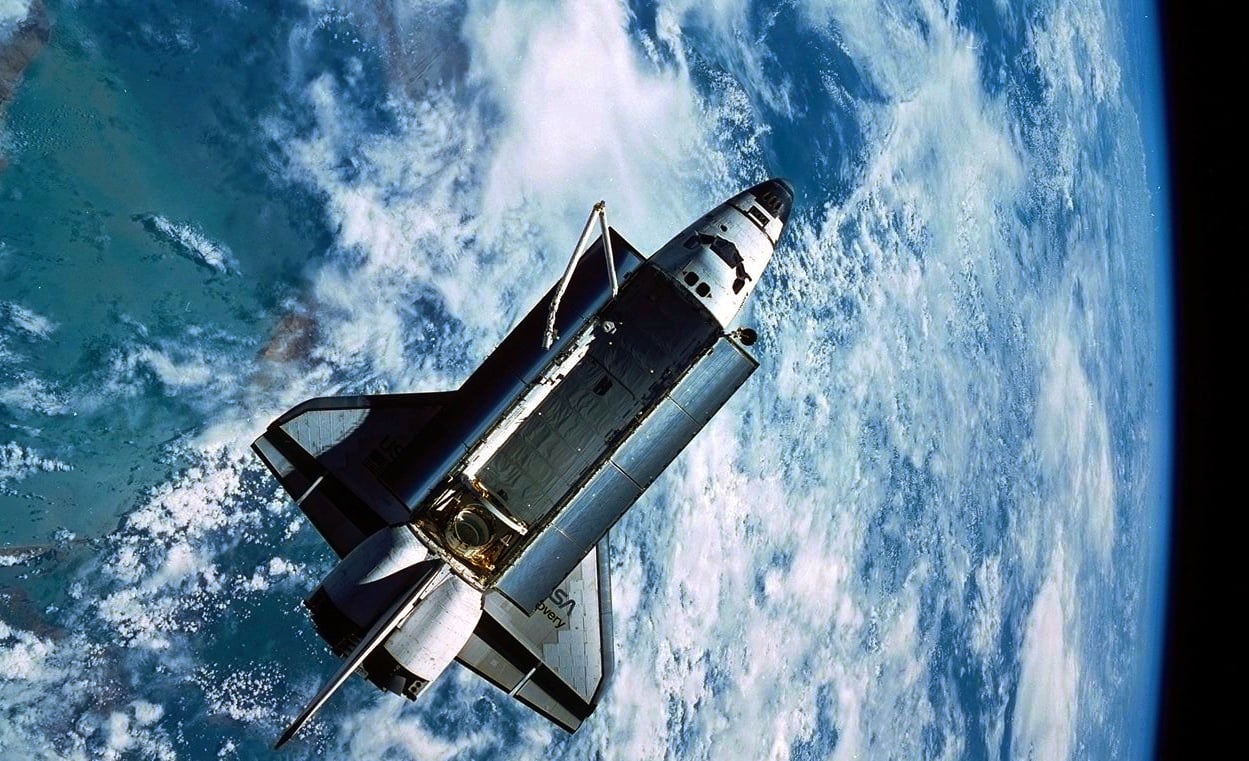
The shuttle “Discovery” orbiting the Earth. Ancient Greek mathematician, Eratosthenes, measured the circumference of the Earth in antiquity. Credit: Public Domain
Ancient Greeks made some of the most impressive astronomical discoveries in history, including Eratosthenes’ calculation of the circumference of the Earth.
It wasn’t until the mid-20th century that we managed to launch satellites into space and determine the exact kilometers of the circumference of the Earth: 40,030.2 kilometers.
But how, then, could the ancient Greek mathematician, Eratosthenes, manage to find pretty much the exact same number without having any pictures of Earth from space or even proper measuring tools?
Amazingly, Eratosthenes didn’t have much more than a stick and his brain when he made the amazing discovery.
How Eratosthenes discovered the circumference of the Earth
Born in Cyrene, an ancient Greek colony in modern-day Libya in 276 BC, Eratosthenes was a polymath, meaning that he had vast knowledge of many different subjects, including mathematics, astronomy, music theory, and poetry.
Over two thousand years ago, Eratosthenes heard that in Syene, a town south of Alexandria in Egypt, no vertical shadows were cast at noon on the summer solstice, as the sun was directly overhead.
The Greek mathematician wondered if this was the case in Alexandria, too, a few hundreds of miles to the north of Syene.
He decided to conduct an experiment. On June 21st, he went to Alexandria and put a stick directly in the ground and waited to see if a shadow would be cast at noon.
It turns out there was one, and he tried to measure it. The shadow cast measured to about seven degrees.
After conducting the experiment, Eratosthenes came to a very logical conclusion that if the sun’s rays are coming in at the same angle at the same time of day and a stick in Alexandria casts a shadow of seven degrees while the stick in Syene does not cast a shadow at all, it must mean that the Earth’s surface is curved.
Carl Sagan, the American astronomer, author, and science communicator was renowned for making difficult scientific concepts understandable to the millions; he did exactly this at the beginning of his renowned series Cosmos by explaining the thought process of Eratosthenes.
His calculation
The idea of a spherical Earth was already known by Pythagoras around 500 BC and validated by Aristotle a few centuries later.
If the Ancient Greeks before him were right, and the Earth was a sphere, Eratosthenes could use his observations to calculate the circumference of our planet.
After hiring a man to pace the distance between Syene and Alexandria, he found out that the two cities were five thousand stadia apart, which is about eight hundred kilometers.
He could then use simple proportions to find the Earth’s circumference—7.2 degrees is 1/50 of 360 degrees, so 800 times 50 equals 40,000 kilometers.
And just like that, an ancient Greek calculated precisely the circumference of our entire planet with just a stick and his brain over two thousand years ago.
Eratosthenes accomplished many feats throughout his life, including the creation of a chronology of Greek history, an algorithm to find every prime number, and the first global projection of the Earth.
The shuttle “Discovery” orbiting the Earth. Ancient Greek mathematician, Eratosthenes, measured the circumference of the Earth in antiquity. Credit: Public Domain
Ancient Greeks made some of the most impressive astronomical discoveries in history, including Eratosthenes’ calculation of the circumference of the Earth.
It wasn’t until the mid-20th century that we managed to launch satellites into space and determine the exact kilometers of the circumference of the Earth: 40,030.2 kilometers.
But how, then, could the ancient Greek mathematician, Eratosthenes, manage to find pretty much the exact same number without having any pictures of Earth from space or even proper measuring tools?
Amazingly, Eratosthenes didn’t have much more than a stick and his brain when he made the amazing discovery.
How Eratosthenes discovered the circumference of the Earth
Born in Cyrene, an ancient Greek colony in modern-day Libya in 276 BC, Eratosthenes was a polymath, meaning that he had vast knowledge of many different subjects, including mathematics, astronomy, music theory, and poetry.
Over two thousand years ago, Eratosthenes heard that in Syene, a town south of Alexandria in Egypt, no vertical shadows were cast at noon on the summer solstice, as the sun was directly overhead.
The Greek mathematician wondered if this was the case in Alexandria, too, a few hundreds of miles to the north of Syene.
He decided to conduct an experiment. On June 21st, he went to Alexandria and put a stick directly in the ground and waited to see if a shadow would be cast at noon.
It turns out there was one, and he tried to measure it. The shadow cast measured to about seven degrees.
After conducting the experiment, Eratosthenes came to a very logical conclusion that if the sun’s rays are coming in at the same angle at the same time of day and a stick in Alexandria casts a shadow of seven degrees while the stick in Syene does not cast a shadow at all, it must mean that the Earth’s surface is curved.
Carl Sagan, the American astronomer, author, and science communicator was renowned for making difficult scientific concepts understandable to the millions; he did exactly this at the beginning of his renowned series Cosmos by explaining the thought process of Eratosthenes.
His calculation
The idea of a spherical Earth was already known by Pythagoras around 500 BC and validated by Aristotle a few centuries later.
If the Ancient Greeks before him were right, and the Earth was a sphere, Eratosthenes could use his observations to calculate the circumference of our planet.
After hiring a man to pace the distance between Syene and Alexandria, he found out that the two cities were five thousand stadia apart, which is about eight hundred kilometers.
He could then use simple proportions to find the Earth’s circumference—7.2 degrees is 1/50 of 360 degrees, so 800 times 50 equals 40,000 kilometers.
And just like that, an ancient Greek calculated precisely the circumference of our entire planet with just a stick and his brain over two thousand years ago.
Eratosthenes accomplished many feats throughout his life, including the creation of a chronology of Greek history, an algorithm to find every prime number, and the first global projection of the Earth.
Two Times tech reporters and their editor talk about assessing the sky-high valuation of the rocket and satellite maker, the potential economic impact of its public debut and the role of the world’s richest man in it all.
Elon Musk’s rocket company said it would sell more than 555 million shares at $135 each in its blockbuster initial public offering, which is set to begin trading on Friday.
Elon Musk’s rocket company is spending big and losing money. That has raised questions about whether it can justify its valuation for its blockbuster initial public offering.
SpaceX has set an initial public offering price of $135 a share, which would value it at $1.77 trillion. Some investors are skeptical that the valuation is justified.
Investors who bought the automaker’s shares in its initial public offering became rich. As a result, many have a deep faith in Elon Musk, the chief executive of Tesla and SpaceX.
Antonio Gracias, left, and Elon Musk at a political event in Green Bay, Wis., last spring. Mr. Gracias and his private equity firm control a $65 billion stake in SpaceX.
While Elon Musk may soon become a trillionaire, his rocket company’s market debut is set to the change the lives of its current and former employees, too.
NASA’s next mission in its effort to return humans to the moon will be led by an all-male crew. Three of them have extensive experience in space, while the other was a backup on Artemis II.
The crew of Artemis III, from left: Commander Randy Bresnik; pilot Luca Parmitano of the European Space Agency; mission specialist Frank Rubio; and mission specialist Andre Douglas.
An artist’s concept released by Blue Origin of its large, crew-carrying Mark 2 moon lander. Neither Blue Origin nor SpaceX, contracted by NASA, have completed development of a lunar lander.
Brendan Carr, the chairman of the Federal Communications Commission, has greenlighted regulatory requests for the company’s Starlink satellite internet service and lavished praise on its chief executive.

 Login
Login