Домашние животные иногда становятся источником редких инфекций, о которых медики знают мало. Так, в 2019 году в Германии 63-летний мужчина умер после того, как его облизала собака. В слюне животного находилась бактерия Capnocytophaga canimorsus, вызвавшая у пациента сепсис и полиорганную недостаточность.
По данным издания N+1, недавно в Словении женщина с тяжелым иммунодефицитом заразилась бактерией Mycoplasma arginini после укуса домашнего кота. Это привело к воспалению лучезапястного сустава и тканей вокруг него.
Диагностика инфекции потребовала применения ПЦР, так как подобные случаи у людей крайне редки. После десяти недель антибиотикотерапии пациентка полностью выздоровела.
В рамках специального выпуска «Перст Фомы» авторы Андрей Коняев и Ирина Воробьева обсуждают необычные инфекции от домашних питомцев и их влияние на здоровье.
Nesta sexta-feira (12), o governo do Brasil realiza mais uma liberação imediata de recursos do Novo PAC Saúde. Em Pernambuco, os repasses garantirão 10 novas unidades de saúde e a retomada de 12 obras destinadas ao atendimento de pacientes do Sistema Único de Saíde (SUS) no Estado, como Unidades Básica de Saúde (UBS), Centros de Atenção Psicossocial (Caps) e Centros Especializados em Reabilitação do SUS (CERs).
A ação ocorre simultaneamente em 25 Estados, com ampliação da capacidade de atendimento em mais de 185 municípios, construção de 204 novas unidades de saúde e 189 ressarcimentos de obras concluídas em todo o País, que faziam parte do Pacto Nacional de Retomada de Obras.
No Recife, a cerimônia será realizada na Superintendência do Ministério da Saúde em Pernambuco, na Av. Parnamirim, nº 295, às 10h, e contará com a presença do superintendente do Ministério da Saúde no estado, Rosano Freire.
No mesmo dia, às 15h, em Abreu e Lima (PE), o secretário de Atenção Especializada à Saúde do Ministério da Saúde, Mozart Sales, o diretor do Departamento de Atenção Hospitalar, Domiciliar e de Urgência do Ministério da Saúde, Fernando Figueira, e o superintendente, Rosano Freire, anunciam o início dos atendimentos da carreta de saúde da mulher do programa Agora Tem Especialistas, do Governo do Brasil.
Voltada para o diagnóstico precoce de câncer de mama e do colo do útero, a unidade móvel de saúde ofertará consultas ginecológicas especializadas, mamografias, ultrassonografias pélvicas e transvaginais, além de biópsias, para pacientes do SUS agendadas e encaminhadas pela secretaria de saúde local.
A carreta está posicionada próximo ao Mercado Municipal de Abreu e Lima, local onde o lançamento vai ocorrer.
O programa Agora Tem Especialistas reúne ações voltadas à ampliação da oferta de consultas, exames e cirurgias no SUS, com o objetivo de reduzir o tempo de espera por atendimento.
On June 7, parliamentary elections were held in Armenia, as a result of which the ruling party can form a new government. What distinguished the 2026 elections, and is a parliamentary crisis looming? Crisis and frustration after military defeats After the defeat in the 44-day war in 2020 and the complete loss of control over […]
Com apoio logístico dos Correios, 5.655 veículos do PAC Saúde serão distribuídos para todos os estados e o Distrito Federal. O objetivo é ampliar a capacidade de atendimento do Sistema Único de Saúde (SUS) e reforçar os serviços de saúde em regiões urbanas, rurais e de difícil acesso.
A frota inclui ambulâncias, unidades odontológicas móveis, vans e micro-ônibus que ajudarão estados e municípios a ampliar o transporte de pacientes e a oferta de atendimentos médicos e odontológicos.
A primeira etapa da operação começou na última semana de maio, quando motoristas dos Correios coletaram 68 veículos em montadoras localizadas em Lauro de Freitas (BA), São Mateus (ES) e Sorocaba (SP). Os veículos foram levados ao Hospital das Clínicas da USP, em Ribeirão Preto (SP), antes de seguirem para os destinos finais.
A distribuição mobiliza a estrutura logística nacional dos Correios, responsável por coordenar rotas e entregas simultaneamente em diferentes regiões do país. A operação é considerada estratégica para garantir que os veículos cheguem aos municípios beneficiados, inclusive em localidades remotas.
Com a chegada dos novos veículos, a expectativa é ampliar o acesso da população aos serviços de saúde, reduzir dificuldades de deslocamento para consultas e tratamentos e fortalecer o atendimento prestado pelo SUS.
O PAC Saúde integra o Novo Programa de Aceleração do Crescimento (Novo PAC) e reúne investimentos voltados à modernização e expansão da infraestrutura da saúde pública. Entre as ações previstas estão a aquisição de veículos e equipamentos, além da ampliação da rede de atendimento em todo o país.
Com apoio logístico dos Correios, 5.655 veículos do PAC Saúde serão distribuídos para todos os estados e o Distrito Federal. O objetivo é ampliar a capacidade de atendimento do Sistema Único de Saúde (SUS) e reforçar os serviços de saúde em regiões urbanas, rurais e de difícil acesso.
A frota inclui ambulâncias, unidades odontológicas móveis, vans e micro-ônibus que ajudarão estados e municípios a ampliar o transporte de pacientes e a oferta de atendimentos médicos e odontológicos.
A primeira etapa da operação começou na última semana de maio, quando motoristas dos Correios coletaram 68 veículos em montadoras localizadas em Lauro de Freitas (BA), São Mateus (ES) e Sorocaba (SP). Os veículos foram levados ao Hospital das Clínicas da USP, em Ribeirão Preto (SP), antes de seguirem para os destinos finais.
A distribuição mobiliza a estrutura logística nacional dos Correios, responsável por coordenar rotas e entregas simultaneamente em diferentes regiões do país. A operação é considerada estratégica para garantir que os veículos cheguem aos municípios beneficiados, inclusive em localidades remotas.
Com a chegada dos novos veículos, a expectativa é ampliar o acesso da população aos serviços de saúde, reduzir dificuldades de deslocamento para consultas e tratamentos e fortalecer o atendimento prestado pelo SUS.
O PAC Saúde integra o Novo Programa de Aceleração do Crescimento (Novo PAC) e reúne investimentos voltados à modernização e expansão da infraestrutura da saúde pública. Entre as ações previstas estão a aquisição de veículos e equipamentos, além da ampliação da rede de atendimento em todo o país.
O estado do Rio de Janeiro recebeu nesta quarta-feira (10) 50 profissionais do Projeto Mais Médicos Especialistas. A ação integra o Programa Agora Tem Especialistas que visa reduzir o tempo de espera da população a consultas, exames e cirurgias especializadas no Sistema Único de Saúde (SUS).
Com os 18 médicos que começaram no ano passado, o estado soma 68 profissionais oriundos do Mais Médicos Especialistas. Eles atuarão nos municípios fluminenses reforçando a assistência especializada e a capacidade de atendimento da rede pública de saúde no estado.
A coordenadora-geral de Formação e Inovação para o Provimento Profissional do Ministério da Saúde, Thais Maranhão, explica que o programa buscar aprimorar médicos que já são especialistas para poderem se atualizar, desenvolver outras habilidades. O médico faz um atendimento de 16 horas para a população do SUS e quatro horas de formação da sua área.
“Em primeiro lugar, os gestores veem onde estão os gargalos e as filas, e eles nos apontam os serviços que eles têm mais necessidade. A gente faz um edital de chamamento público para os médicos. Eles participam de um processo de seleção em que eles dizem para onde querem ir. Há um deslocamento de médicos entre estados”, disse Thais.
No Brasil, o Projeto Mais Médicos Especialistas tem 1501 profissionais e a perspectiva é chegar até o final do ano em 2 mil médicos.
O secretário estadual de Saúde, Ronaldo Damião, disse que o Rio ainda vive as sequelas da pandemia de covid-19 em 2020 e 2021, em que milhares de cirurgias deixaram ser feitas por causa ocupação dos hospitais naquela ocasião.
“As filas e o tempo de espera aumentaram. Essa proposta visa reduzir o tempo de espera principalmente na alta complexidade. Especialistas em áreas cruciais como oncologia, cirurgia cardiovascular, radioterapia puderam se apresentar. Hospital Universitário Pedro Ernesto, Hospital Universitário da UFRJ, da UFF, da UniRio têm a possibilidade de ajudar bastante. O gargalo maior é na cidade do Rio e na região metropolitana”, disse o secretário.
A ginecologista Lorena Rodrigues Nascimento, de 30 anos, de Juiz de Fora optou pela cidade de Maricá, no Rio, por ser mais pacata e bonita. Ela começou a atuar em abril em um centro de diagnóstico de atenção secundária onde ela faz o exame de colposcopia que analisa o colo do útero, a vagina e a vulva usando um aparelho com lente de aumento feito após o exame preventivo.
“Eu tive uma experiência muito marcante com um familiar no SUS. Depois desse dia, eu decidi que queria trabalhar no SUS novamente e me sinto muito grata. É uma oportunidade de devolver um pouco da minha formação ao SUS”, afirmou a médica.
O estado do Rio de Janeiro recebeu nesta quarta-feira (10) 50 profissionais do Projeto Mais Médicos Especialistas. A ação integra o Programa Agora Tem Especialistas que visa reduzir o tempo de espera da população a consultas, exames e cirurgias especializadas no Sistema Único de Saúde (SUS).
Com os 18 médicos que começaram no ano passado, o estado soma 68 profissionais oriundos do Mais Médicos Especialistas. Eles atuarão nos municípios fluminenses reforçando a assistência especializada e a capacidade de atendimento da rede pública de saúde no estado.
A coordenadora-geral de Formação e Inovação para o Provimento Profissional do Ministério da Saúde, Thais Maranhão, explica que o programa buscar aprimorar médicos que já são especialistas para poderem se atualizar, desenvolver outras habilidades. O médico faz um atendimento de 16 horas para a população do SUS e quatro horas de formação da sua área.
“Em primeiro lugar, os gestores veem onde estão os gargalos e as filas, e eles nos apontam os serviços que eles têm mais necessidade. A gente faz um edital de chamamento público para os médicos. Eles participam de um processo de seleção em que eles dizem para onde querem ir. Há um deslocamento de médicos entre estados”, disse Thais.
No Brasil, o Projeto Mais Médicos Especialistas tem 1501 profissionais e a perspectiva é chegar até o final do ano em 2 mil médicos.
O secretário estadual de Saúde, Ronaldo Damião, disse que o Rio ainda vive as sequelas da pandemia de covid-19 em 2020 e 2021, em que milhares de cirurgias deixaram ser feitas por causa ocupação dos hospitais naquela ocasião.
“As filas e o tempo de espera aumentaram. Essa proposta visa reduzir o tempo de espera principalmente na alta complexidade. Especialistas em áreas cruciais como oncologia, cirurgia cardiovascular, radioterapia puderam se apresentar. Hospital Universitário Pedro Ernesto, Hospital Universitário da UFRJ, da UFF, da UniRio têm a possibilidade de ajudar bastante. O gargalo maior é na cidade do Rio e na região metropolitana”, disse o secretário.
A ginecologista Lorena Rodrigues Nascimento, de 30 anos, de Juiz de Fora optou pela cidade de Maricá, no Rio, por ser mais pacata e bonita. Ela começou a atuar em abril em um centro de diagnóstico de atenção secundária onde ela faz o exame de colposcopia que analisa o colo do útero, a vagina e a vulva usando um aparelho com lente de aumento feito após o exame preventivo.
“Eu tive uma experiência muito marcante com um familiar no SUS. Depois desse dia, eu decidi que queria trabalhar no SUS novamente e me sinto muito grata. É uma oportunidade de devolver um pouco da minha formação ao SUS”, afirmou a médica.
A Política Nacional de Qualidade e Segurança do Paciente no âmbito do Sistema Único de Saúde (SUS) começa a ser implementada nesta quarta-feira (10) em todo o país. A medida visa à melhoria contínua do atendimento, com foco na redução de riscos e danos evitáveis, além da promoção do cuidado mais eficiente e centrado no cidadão.
A nova política, publicada no Diário Oficial da União de hoje, estabelece diretrizes que deverão ser adotadas de forma progressiva por serviços públicos e privados, incluindo instituições filantrópicas, civis e militares, além de unidades de ensino e pesquisa vinculadas ao SUS.
Entre os principais objetivos está a redução de incidentes e eventos adversos relacionados à assistência em saúde. A proposta também prevê a integração entre os diferentes níveis de atendimento.
Outro eixo central é o incentivo à participação ativa de pacientes, familiares e cuidadores nas decisões clínicas.
Entre as diretrizes, destacam-se:
a integração da qualidade e da segurança do paciente aos instrumentos de planejamento e financiamento do SUS;
o fortalecimento da governança interfederativa;
a incorporação de tecnologias digitais e inovação no cuidado em saúde.
Implementação
A medida será implantada a partir de dimensões estratégicas que envolvem governança, gestão institucional, práticas assistenciais, educação em saúde e uso de dados. Essas dimensões se desdobram em eixos de ação que orientam a execução da política em todos os níveis de atenção.
A portaria também define áreas prioritárias:
segurança na atenção primária, hospitalar, serviços de urgência e atendimento domiciliar;
uso seguro de medicamentos;
prevenção de infecções;
identificação correta do paciente
comunicação entre equipes.
Monitoramento
A implementação da política será compartilhada, de forma progressiva, entre União, estados, Distrito Federal e municípios. O Ministério da Saúde ficará responsável por coordenar a estratégia nacional, definir indicadores, apoiar tecnicamente os entes federativos e promover ações de capacitação e sensibilização.
A finalidade é alinhar ações já existentes, como o Programa Nacional de Segurança do Paciente, e promover avanço estruturado na qualidade do atendimento.
A Política Nacional de Qualidade e Segurança do Paciente no âmbito do Sistema Único de Saúde (SUS) começa a ser implementada nesta quarta-feira (10) em todo o país. A medida visa à melhoria contínua do atendimento, com foco na redução de riscos e danos evitáveis, além da promoção do cuidado mais eficiente e centrado no cidadão.
A nova política, publicada no Diário Oficial da União de hoje, estabelece diretrizes que deverão ser adotadas de forma progressiva por serviços públicos e privados, incluindo instituições filantrópicas, civis e militares, além de unidades de ensino e pesquisa vinculadas ao SUS.
Entre os principais objetivos está a redução de incidentes e eventos adversos relacionados à assistência em saúde. A proposta também prevê a integração entre os diferentes níveis de atendimento.
Outro eixo central é o incentivo à participação ativa de pacientes, familiares e cuidadores nas decisões clínicas.
Entre as diretrizes, destacam-se:
a integração da qualidade e da segurança do paciente aos instrumentos de planejamento e financiamento do SUS;
o fortalecimento da governança interfederativa;
a incorporação de tecnologias digitais e inovação no cuidado em saúde.
Implementação
A medida será implantada a partir de dimensões estratégicas que envolvem governança, gestão institucional, práticas assistenciais, educação em saúde e uso de dados. Essas dimensões se desdobram em eixos de ação que orientam a execução da política em todos os níveis de atenção.
A portaria também define áreas prioritárias:
segurança na atenção primária, hospitalar, serviços de urgência e atendimento domiciliar;
uso seguro de medicamentos;
prevenção de infecções;
identificação correta do paciente
comunicação entre equipes.
Monitoramento
A implementação da política será compartilhada, de forma progressiva, entre União, estados, Distrito Federal e municípios. O Ministério da Saúde ficará responsável por coordenar a estratégia nacional, definir indicadores, apoiar tecnicamente os entes federativos e promover ações de capacitação e sensibilização.
A finalidade é alinhar ações já existentes, como o Programa Nacional de Segurança do Paciente, e promover avanço estruturado na qualidade do atendimento.
Hermogenes of Tarsus developed the seven ancient Greek styles of speech to explain how rhetoric shapes clarity, emotion, persuasion, character, and intellectual power. Credit: GreekReporter archive.
Among the greatest rhetorical theorists stood Hermogenes of Tarsus, an Ancient Greek sophist and rhetorician who lived during the second century AD and developed a sophisticated theory of style that categorized speech according to seven major rhetorical qualities or styles of speech. These included Clarity (saphēneia), Grandeur (megethos), Beauty (kallos or omorphia), Rapidity (gorgotēs), Ethos, Sincerity, and Force (deinotēs).
Although many people mistakenly associate these rhetorical categories with the rhetorician Demosthenes, the systematic classification belongs to Hermogenes himself. Together, these categories formed a complete philosophy of expression. Hermogenes did not view rhetoric as ornamental alone. Instead, he treated speech as a living art capable of shaping thought, emotion, and public action.
The Ancient Greek Hermogenes and the art of rhetoric qualities or styles of speech
Ancient Greek rhetoric shaped political life, education, philosophy, and literature for centuries. Public speech held enormous importance in the Greek world because success in courts, assemblies, and intellectual debates depended upon persuasive expression. As rhetoric evolved, Greek thinkers attempted to classify the qualities that made speech effective, elegant, and emotionally powerful.
Hermogenes of Tarsus gained fame at a very young age. He was a rhetorical prodigy whose abilities astonished teachers and audiences alike, and he later composed several influential rhetorical treatises, especially On Types of Style. This work became one of the most significant manuals of rhetoric in late antiquity and Byzantium. Byzantine scholars such as George of Trebizond studied Hermogenes extensively, and introduced his theories in the West during the Renaissance.
Unlike simpler rhetorical systems, Hermogenes established a highly nuanced approach. He understood that persuasive speech requires flexibility rather than rigid formulas. Differing situations demand different styles, tones, and emotional effects. For this reason, his seven categories of styles of speech function less as isolated techniques and more as interconnected dimensions of expression.
“Clarity,” or Saphēneia, as a critical style of speech according to the Ancient Greek Hermogenes
Hermogenes considered clarity the foundation of all effective speech. Without clarity, audiences are unable to follow arguments or comprehend meaning. A speaker may possess intelligence and passion, yet confusion eradicates persuasion. Clarity therefore requires precise vocabulary, logical structure, and direct expression. Sentences should communicate ideas without unnecessary obscurity.
Nevertheless, Hermogenes did not reduce clarity to simplicity alone. Clear speech can still remain elegant and intellectually sophisticated. The goal involves illumination rather than oversimplification.
Greek philosophers also highly valued clarity. The philosopher Plato often criticized sophists who concealed weak arguments beneath decorative language. Similarly, Aristotle emphasized intelligibility as an essential feature of rhetoric. Hermogenes continued this tradition while developing a more refined stylistic analysis.
Plato criticized the sophists in his work “Gorgias.” Credit: Sebastian Bertrand. flickr
“Grandeur” as one of the most significant rhetorical qualities
Grandeur introduces elevation, dignity, and majesty into speech. This style suits heroic themes, political crises, moral exhortation, and public ceremonies. A grand style expands language through emotional intensity, powerful imagery, and elevated rhythm. Speakers using grandeur aim to inspire awe and admiration. Demosthenes often exemplified this quality in his speeches against Philip of Macedon. His rhetoric combined patriotic urgency with emotional force.
However, Hermogenes warned against excess. Grandeur must remain controlled. Otherwise, speech becomes inflated and artificial. True grandeur emerges from harmony between content and expression. Noble themes require compatible, equally noble language, yet authentic emotion must guide rhetorical elevation.
Statue of Greek God Zeus. Credit: flickr / Richard Mortel CC BY 2.0
The speech style of “Beauty,” or Omorphia
Beauty in rhetoric concerns elegance, harmony, and aesthetic pleasure. Hermogenes believed that beautiful speech delights audiences through rhythm, imagery, and balanced structure. This quality resembles artistic composition in poetry, sculpture, or music. Beautiful speech flows smoothly and creates emotional resonance through sound and proportion.
Greek culture deeply associated beauty with order and harmony. Philosophers often linked external beauty with inner balance. Hermogenes applies this principle directly to language. A beautiful style does not merely persuade intellectually. It also captivates emotionally and aesthetically.
Writers achieve beauty through careful word choice, graceful transitions, and balanced phrasing. Metaphors, cadence, and musicality all contribute to this effect. Nonetheless, Hermogenes again emphasizes moderation. Excessive ornament weakens rhetorical effectiveness. Beauty must support meaning rather than overwhelm it.
Doryphoros statue. Roman copy of the late 1st century BC — early 1st century AD, replica of a Greek bronze original by Polykleitos of the 5th century. Credit: flickr / Sergey Sosnovskiy cc by 2.0
The speech style of “Rapidity,” or Gorgotēs
Rapidity injects speech with energy, movement, and urgency. Hermogenes used the term gorgotēs to describe swift and dynamic expression that propels audiences forward. This style relies upon shorter clauses, quick transitions, and vigorous pacing. Rapid speech creates excitement and emotional momentum.
Orators often utilized this technique during moments of tension or conflict. Fast-moving rhetoric can produce feelings of urgency, danger, or passionate conviction. At the same time, rapidity demands careful control. If speech moves too quickly, audiences lose comprehension. Therefore, speakers must balance speed with clarity.
Hermogenes admired speakers who could accelerate rhythm without sacrificing coherence. Rapidity also reflects psychological intensity. Passionate conviction naturally produces energetic language and movement.
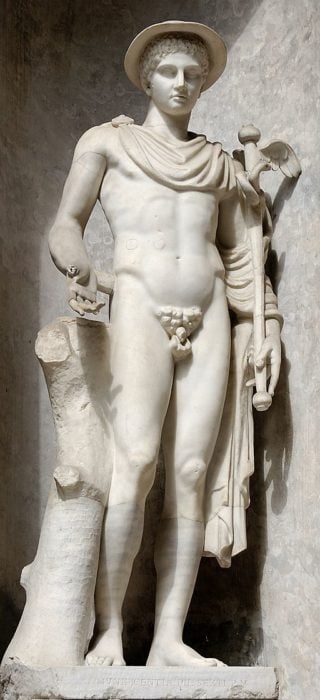
Hermes Logios was the god that protected rhetoricians. Courtesy of Vatican Museums. Credit: Public domain, via Wikimedia Commons
Styles of speech, “Ethos,” and “Sincerity”
Ethos concerns character and moral presence within speech. Aristotle had already emphasized ethos as one of the three pillars of persuasion. Hermogenes expanded this concept stylistically. A speaker’s language reveals personality, values, and emotional disposition. Audiences trust speakers who appear honorable, wise, and sincere.
Ethos therefore demands moral credibility and emotional authenticity. Differing rhetorical situations also require varying forms of ethos. A judge, philosopher, general, or grieving citizen each projects distinct moral qualities through speech.
Hermogenes understood that persuasion depends heavily upon the audience’s perception of character. Even brilliant arguments fail when listeners distrust the speaker. Thus, rhetorical success involves ethical presence as much as intellectual ability.
Sincerity is another trait that creates emotional truthfulness and human immediacy. Hermogenes recognized that audiences respond deeply to speech that feels genuine. A sincere speaker avoids excessive theatricality or artificial ornament. Instead, sincerity emerges through direct emotional connection and honest expression. This style often appears in personal appeals, lamentations, or moral reflections. Sincere rhetoric results in intimacy between the speaker and audience.
Greek tragedy frequently employed this quality during scenes of grief or confession. Philosophers also valued sincerity because truth required alignment between speech and inner conviction. Hermogenes therefore treated sincerity as a rhetorical strength rather than weakness. Genuine emotion can persuade more powerfully than technical brilliance alone. Nonetheless, sincerity still requires artistic control. Raw emotion without structure can become chaotic or ineffective.
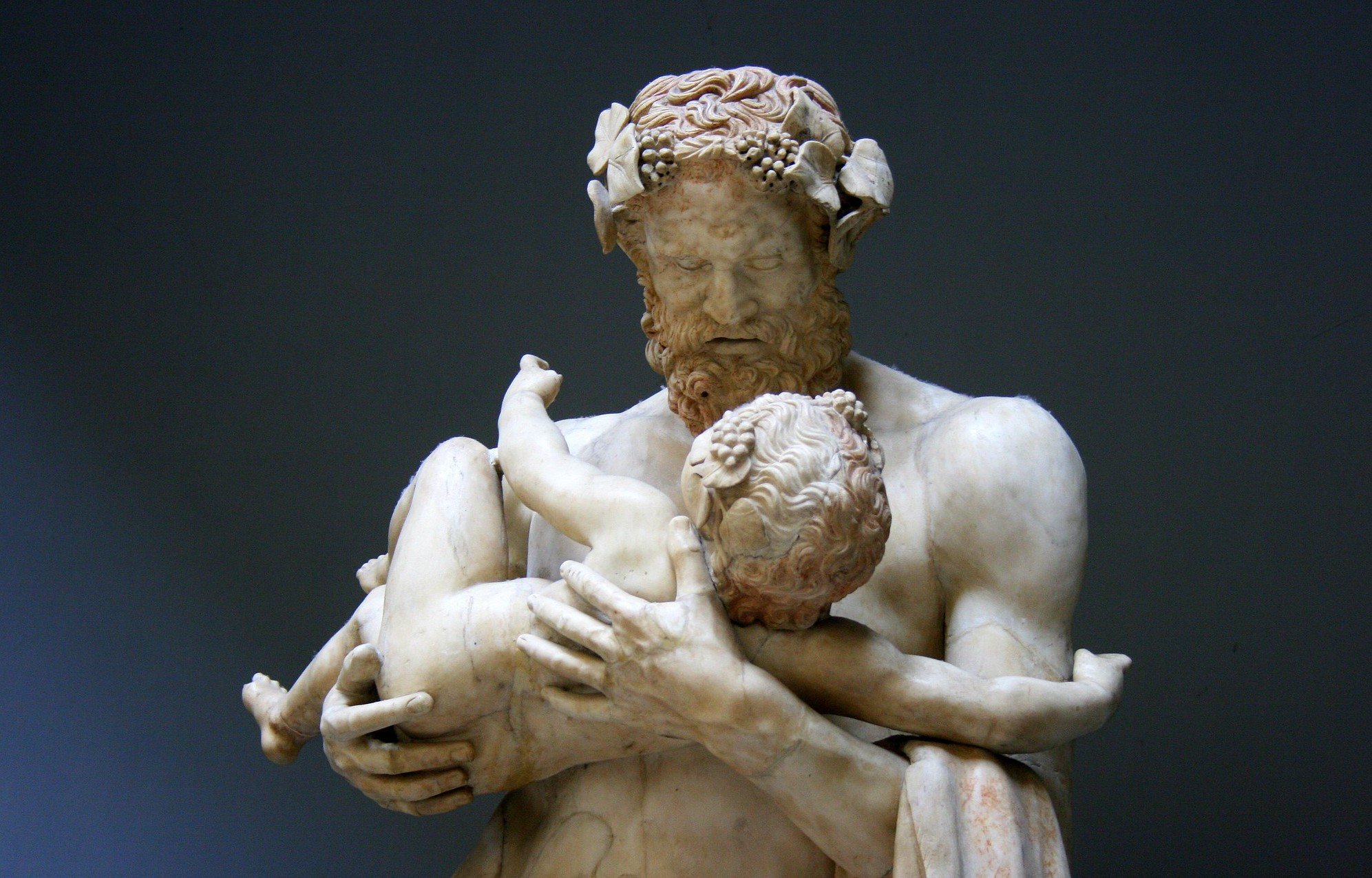
According to the philosopher Plutarch, Dionysus was also the god of sincerity. Credit: just.Luc / Flickr CC BY 2.0
“Force,” or Deinotēs, as the seventh of the major Ancient Greek styles of speech
Force represents the culmination of rhetorical power. Hermogenes viewed deinotēs as the ability to overwhelm audiences through intensity, authority, and commanding presence. This style combines emotional energy, intellectual precision, and persuasive momentum. Forceful rhetoric strikes listeners with irresistible impact. Demosthenes often embodied this quality during political speeches. His words carried urgency, moral conviction, and strategic precision simultaneously.
Force differs from mere aggression. True rhetorical force arises from mastery over every dimension of speech. Clarity, grandeur, rhythm, sincerity, and ethos all contribute to it. Hermogenes considered this quality extremely challenging to achieve, and only highly skilled speakers could combine all rhetorical elements harmoniously. Force therefore represented the highest form of rhetorical excellence.
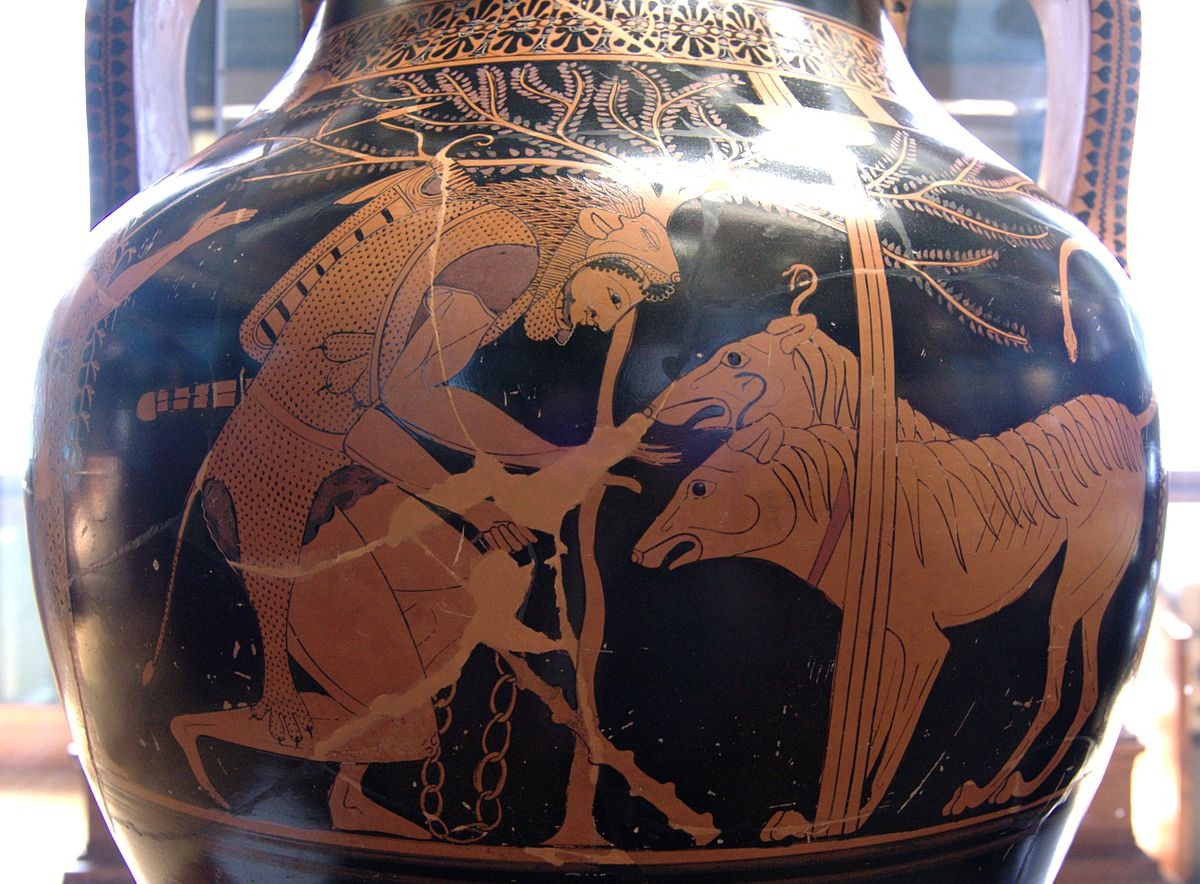
Heracles, the strongest hero depicted on red-figure style Ancient Greek pottery. Credit: Louvre Museum / Public domain / Wikimedia Commons
The unity of the seven styles of speech
Hermogenes never intended these categories to function separately. Great rhetoric combines multiple styles according to circumstance. A political speech may require grandeur during patriotic appeals, clarity during argumentation, sincerity during emotional moments, and force during conclusions. This flexibility explains the lasting influence of Hermogenes. His system recognized the complexity of human communication.
Hermogenes of Tarsus shaped rhetorical education for more than a thousand years. Byzantine scholarship practically treated his works as sacred manuals of eloquence. Renaissance humanists later read his theories and incorporated them into European education. His influence extended beyond rhetoric into theology, literature, and philosophy. Christian preachers especially valued his understanding of emotional and ethical persuasion.
Even today, modern communication still reflects principles Hermogenes identified centuries ago in his seven styles of speeches. Political speeches, courtroom arguments, literature, and public debates all rely upon clarity, emotional force, sincerity, and character.
YEREVAN, Armenia — The best of a bad lot was how many Armenians described victorious Prime Minister Nikol Pashinyan ahead of Sunday's pivotal election — the first since the bitter defeat in the Nagorno-Karabakh conflict with neighboring Azerbaijan.
While the election has frequently been framed outside Armenia as
Rui Marote Em 2024 o Funchal Noticias alertou em três reportagens para o estado dos jardins do Centro de Saúde do Bom Jesus. Em Setembro de 2024 dizíamos “Jardin do Centro de Saúde do Bom Jesus exigem cuidados urgentes”. A 26 de Outubro, “Junta de Freguesia de Santa Luzia “acode” Centro do Bom Jesus”. A […]
Russian Foreign Ministry spokesperson Maria Zakharova claimed the vote had taken place "amidst severe repression" and that democratic procedures were "grossly violated."
Lei publicada nesta segunda-feira (8) define diretrizes básicas para a melhoria do atendimento de saúde a pessoas que convivem com a dor e institui 5 de julho o Dia Nacional de Conscientização e Enfrentamento da Dor Crônica.
A norma assegura atendimento integral no Sistema Único de Saúde (SUS) e prevê orientações prévias sobre riscos e possíveis efeitos adversos dos tratamentos.
De acordo com a Associação Internacional para o Estudo da Dor, dor crônica é aquela com duração maior que 30 dias.
Campanhas anuais
A data será representada pela cor verde e deverá mobilizar o Poder Público na promoção de campanhas de conscientização todos os anos.
A iniciativa busca ampliar o acesso a informações qualificadas sobre opções terapêuticas disponíveis no SUS, combater o preconceito e estimular gestores de saúde a adotarem abordagens multiprofissionais humanizadas e eficazes.
Impacto na população
Estima-se que a dor crônica afete cerca de 60 milhões de brasileiros. Ao reconhecer a dimensão do problema, a lei pretende fortalecer políticas públicas voltadas ao diagnóstico, tratamento e acompanhamento desses pacientes.
Lei publicada nesta segunda-feira (8) define diretrizes básicas para a melhoria do atendimento de saúde a pessoas que convivem com a dor e institui 5 de julho o Dia Nacional de Conscientização e Enfrentamento da Dor Crônica.
A norma assegura atendimento integral no Sistema Único de Saúde (SUS) e prevê orientações prévias sobre riscos e possíveis efeitos adversos dos tratamentos.
De acordo com a Associação Internacional para o Estudo da Dor, dor crônica é aquela com duração maior que 30 dias.
Campanhas anuais
A data será representada pela cor verde e deverá mobilizar o Poder Público na promoção de campanhas de conscientização todos os anos.
A iniciativa busca ampliar o acesso a informações qualificadas sobre opções terapêuticas disponíveis no SUS, combater o preconceito e estimular gestores de saúde a adotarem abordagens multiprofissionais humanizadas e eficazes.
Impacto na população
Estima-se que a dor crônica afete cerca de 60 milhões de brasileiros. Ao reconhecer a dimensão do problema, a lei pretende fortalecer políticas públicas voltadas ao diagnóstico, tratamento e acompanhamento desses pacientes.
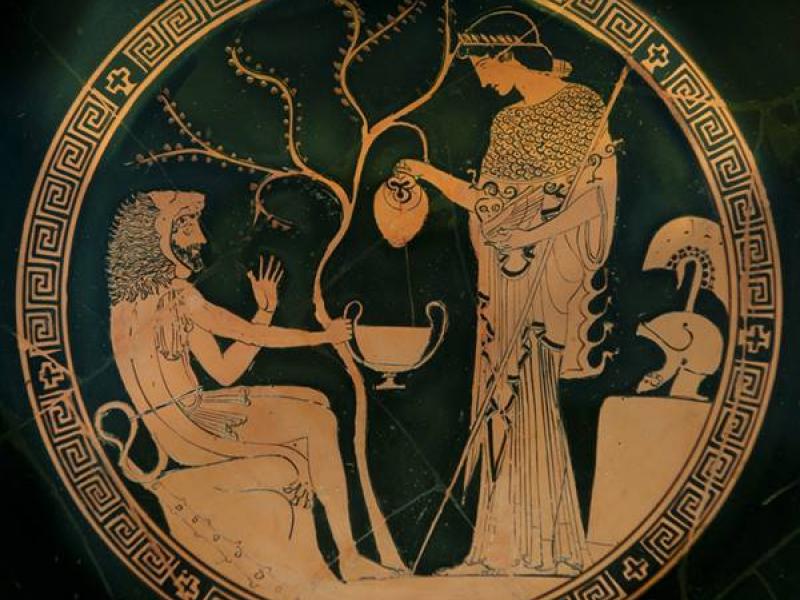
Hercules is offered wine in this depiction of a scene from his Twelve Labors. Public Domain
The recorded history of wine in Ancient Greece begins around the 15th century BC, while viticulture appears to have existed as early as the Neolithic era, 6,500 years ago.
Ancient Greece is also the place where modern wine culture began, as wine consumption stopped being solely a sacred act, as it had been when priests and rulers controlled the vineyards.
By the early Bronze Age, vineyard cultivation of grapes was widespread in ancient Greece, and by the time of the rise of the Minoan and Mycenaean civilizations, wine was part of everyday life, for consumption and/or production.
By that time in Greek society, wine was an economically important business.
Wine and commerce in ancient Greece
There was substantial interaction between the Mycenaean and Minoan cultures, based mainly on commerce.
Around 1200 BC, people from northern Greece invaded the southern Mycenaean area, which was a monarchy.
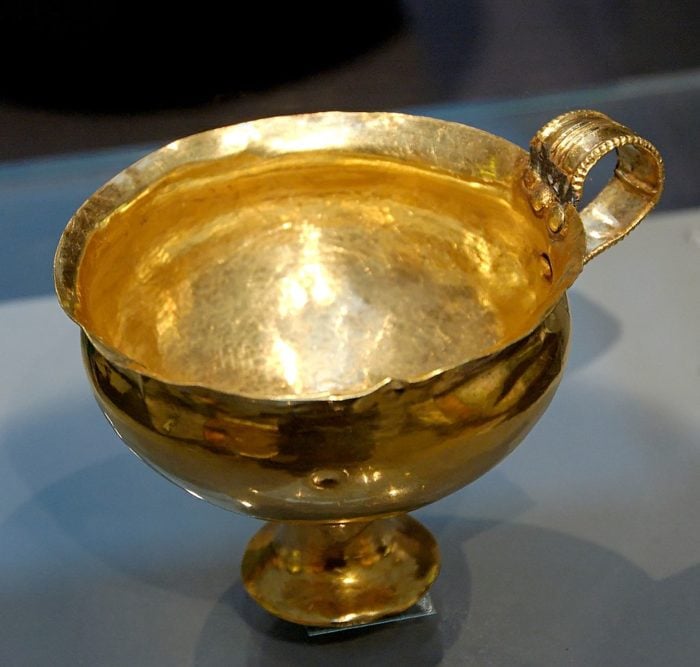
Golden goblet from the Mycenaean period. Public Domain
The war devastated the Mycenaean lands, generating thousands of poor refugee families who escaped to fortified cities for protection.
In order to consolidate their powers, the invaders gave more privileges to the common people, thus undermining the power of monarchs and aristocrats.
The new, democratic city-states were slowly created over time with the common people having more freedoms and opportunities.
Gradually, the common people started cultivating plots of land, with vineyards and olive groves being the most plentiful and lucrative.
People could thus own vineyards, cultivate them, and trade and drink their own wine. A new class of merchants, albeit a small one, was born.
At the same time, more and more people in ancient Greece began to drink wine for pleasure rather than as a sacred ritual.
Colonization and trade expansion
The Greek city-states then began to establish colonies throughout the Mediterranean. The settlers, already experienced in vine cultivation, brought grapevines with them and were able to better cultivate already-existing vineyards.
Moving west, Sicily and southern Italy were the first colonies established by ancient Greeks. Greeks even called the southern part of the Italian Peninsula Oenotria (“the land of vines”).
Other Greeks settled in Massalia (Marseille) in southern France while others moved east all the way to the shores of the Black Sea.
The colonies provided more opportunities for wine merchants. The Greeks could now introduce their wines as far as the western part of France and to the Black Sea in the east.
Athens was a large and lucrative market for wine, as the climate in the Attica region was ideal for vines, and production was substantial. Wine from Attica was traded in all the lands along the eastern Mediterranean Sea.
Other areas famous for wine in ancient Greece were the islands of Santorini and Thasos. This is especially true in Santorini, where the rich volcanic soil produced exceptional grapes. Ancient Greeks were very particular about the origin of their wines.
Major trading partners for wine in ancient Greece were Crimea, Egypt, Scythia, and Etruria among others, as the Greeks traded their knowledge of viticulture and winemaking.
Indicative of the lucrative trade of wine from Greece is a shipwreck discovered off the coast of southern France that held nearly 10,000 amphorae containing almost 300,000 liters (79,000 US gallons) of Greek wine.
Diluted wine
The wine in ancient Greece was unlike what we know today. It was not left undiluted but was mixed with water in precise proportions in a vessel called a krater.
The mixing of water and wine was for the drinker to enable him or herself to maintain composure and self-control, traits that were highly valued in ancient Greek society.
In fact, ancient Greeks seemed to believe that only barbarians—in most cases that simply meant non-Greeks—drank unmixed wine, got drunk and behaved like…barbarians.
Modern wine culture begins in Greece
Along with their wine, Greeks had exported their way of life, including vine-growing, winemaking, and enjoying wine, to almost every port in the Mediterranean basin.
“Wine moistens and tempers the spirit and lulls the cares of the mind to rest. It revives our joys and is oil to the dying flame of life.”
Plato also praised the fruit of the vine:
“What is better adapted than the festive use of wine in the first place to test, and in the second place to train, the character of a man, if care be taken in the use of it? What is there cheaper or more innocent?
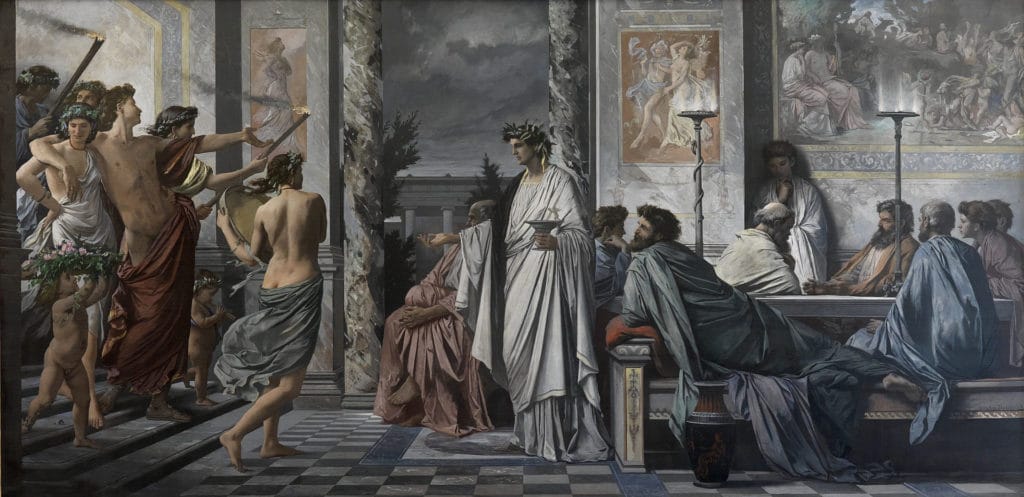
The ubiquitousness of the word “symposium” in ancient Greece, which literally means “drinking with others”—meant that ancient Greeks loved to get together, eat, drink, and converse during and after the meal.
Plato’s Symposium, by Anselm Feuerbach (1829-1880). Public Domain
It was a favorite pastime for well-to-do ancient Greeks to eat, drink, discuss, and, occasionally, philosophize, at these symposia.
Such convivial get-togethers have been illustrated on many types of Greek vases and sculptures. Examples of discussions that took place in symposia can be found in Plato’s Symposium and Xenophon’s Symposium.
Usually, symposia were hosted by aristocratic men for their peers. They would relax in recliners called klinai and drink from terracotta or, depending on how rich the host was, from bronze, silver, even gold, cups.
Wine was also used for medicinal purposes in ancient Greece. The great physician Hippocrates prescribed different wines depending on the disease.
Ancient Greeks also had a god of wine, the mischievous Dionysus. The god of the grape harvest, winemaking, fertility, orchards, fruit, vegetation, insanity, and ritual madness, he was also the god of religious ecstasy and festivity; overall, it was he who embodied the colorful, vibrant life of ancient Greece.
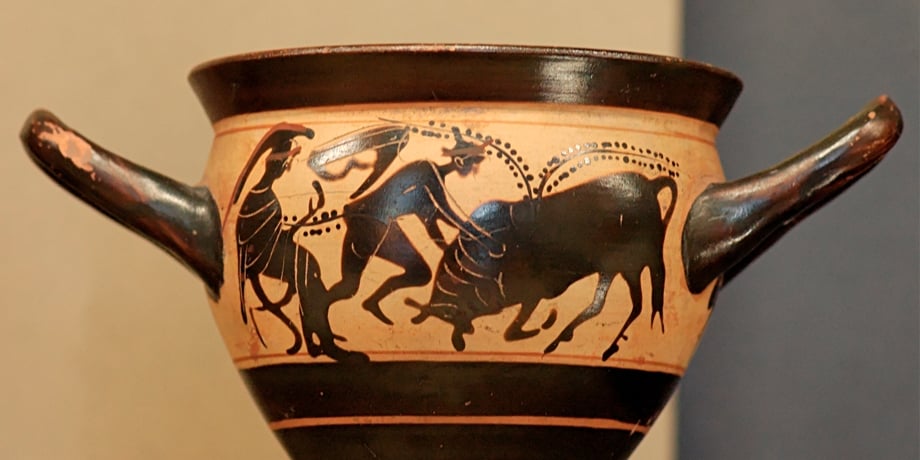
In ancient Athens, there was a custom of sacrificing an ox in the Sanctuary of Zeus Polieus. Credit: Capillon, Public Domain
In ancient Greece, the killing of an ox was prohibited by law due to its vital role in daily life. However, a peculiar and ‘unlawful’ custom saw priests performing the sacrifice of an ox at the Sanctuary of Zeus, the king of the gods, located on the hill of the Acropolis, just a few meters from the Parthenon.
The Diipoleia, also known as Buphonia, was an ancient festival of the Athenians held towards the end of every June. It was also celebrated separately in other Greek cities during antiquity.
The Buphonia ritual and its origin
According to tradition, to justify the sacrifice, a group of oxen was led to the temple. There, the priest would place a type of bread offering made of wheat and barley on the altar. The first ox to eat from this area would be considered to have committed blasphemy, as it was believed to have consumed the offering meant for the god, and therefore had to be killed.
The priest chosen to perform the killing did so in isolation, without any witnesses present, and would then flee the city.
However, since ox sacrifices were forbidden at the time, an “investigation” was launched to identify the culprit. When the rest of the priests gathered to determine who had performed the sacrifice, the guilty priest was missing. In the end, the only evidence left would be the axe used for the killing, which would eventually be thrown into the sea.
How the ritual was performed
Ancient Greek geographer and traveler, Pausanias, provides further details in his account:
“There is a statue of Zeus—one by Leochares and another called Polieus. Concerning the established practices for the sacrifice and the reason said to justify them, I will not record them here.
For Zeus Polieus, they would place barley mixed with wheat on the altar without any kind of guard. The ox, which they have prepared for the sacrifice and kept under watch, approaches the altar and begins eating the grain. A member of the Thalonid family sacrifices the animal that eats from the sacred offerings with a double-headed axe.
They then summon a priest, called the ‘ox-slayer’ (buphonos), who kills the ox and, in accordance with the law, throws away the axe and flees. Since the identity of the person who committed the act remains unknown, they bring the axe to trial instead. Afterwards, they enter the temple that they call the Parthenon.”
The Buphonos and the trial of the axe
It was believed that the ancestor of the Thalonids, Thalon, was the first to strike the ox. Neoplatonic philosopher Porphyry, attributes the first buphonia to a foreigner named Sopater. He also provides a shorter version of the story, in which the priest of Zeus, Diomos, “murdered” the animal.The others then cut up the sacrificial victim and ate it.
Afterwards, they would hold a trial to determine the guilty party responsible for the killing. The buphonos (ox-slayer) did not appear, while those who participated in the sacrifice accused one another. They shifted responsibility for the killing from one man to the other.
The participants included the water carriers who brought water for the sacrificial tools, those who sharpened the knife and axe, as well as individuals responsible for carrying the tools.
Ultimately, they would accuse the knife, condemn it, and toss it into the sea. The ox’s hide was stuffed with straw and yoked to a plow. They did this to create the illusion that the animal was still alive.
The entire ritual permeated participants with intense feelings of guilt over the slaughter of the animal, and it was regarded as an act of murder.
The entire ritual permeated participants with intense feelings of guilt over the slaughter of the animal. Credit: Wikimedia commons, Public Domain
Rituals, beliefs, and symbolism
It is noteworthy that, according to Porphyry, after the buphonos Sopater fled to Crete and before the establishment of the festival in Athens, a plague struck the city. The plague only ceased after Sopater’s return and the institution of the festival.
Additionally, as part of the measures to address the plague, the Oracle of Delphi deemed the establishment of the ritual involving the stuffing of the animal’s hide as necessary.
To avoid the pollution (miasma) of the murder, they made efforts to eliminate the act of murder itself. When this was not sufficient, they attempted to justify the act, for example, by claiming that the defilement resulted from impiety.
Finally, they shifted human responsibility by attributing the miasma to an inanimate tool, which became the scapegoat of the entire ritual. This object absorbed the miasma and was then removed from the city.
The ox, which they have prepared for the sacrifice and kept under watch, approaches the altar and begins consuming the grain. A member of the Thalonid family sacrifices the animal that is fed from the sacred offerings with a double-headed axe. Credit: Wikimedia Commons, Public Domain
Spiritual significance and agricultural connections
According to ancient Greek philosopher Theophrastus, the remains of the ox were buried. Presumably, this was so as to prevent its spirit from seeking revenge on the city. It is important to note that, in this ritual, the value attributed to the spirit of the animal is equivalent to that given to a human.
British classical scholar and linguist Jane Harrison, connects the use of offerings to attract the animal to the altar with the rites of Dionysus Zagreus and Isodaites. Furthermore, the yoking of the stuffed hide of the ox to the plow associates the festival with fertility rituals, which pertain to chthonic deities.
This ritual of purification and averting evil was initially connected to the need to ensure an abundance of game in a pre-agricultural society. Later on, an agricultural society adopted it, shifting the focus to the fertility of the land.
A 34ª Marcha para Jesus reúne milhares de fiéis nas ruas de São Paulo nesta quinta-feira (04/06). O evento religioso começou às 10h da manhã, com uma caminhada que partiu das estações Luz e Tiradentes, na região central. O destino é a Praça Heróis da Força Expedicionária Brasileira (FEB), na zona norte.
O evento é organizado pelo apóstolo Estevam Hernandes, líder da igreja Renascer em Cristo. O tema do ano é: “Todo joelho se dobrará e toda língua confessará que Jesus é o Senhor”, trecho da carta de Filipenses, capítulo 2, versículo 10.
O evento religioso assume contornos políticos ao receber personalidades da direita brasileira e nomes ligados ao governo federal, como o ministro da AGU, Jorge Messias. No mesmo trio elétrico estavam Flávio Bolsonaro (PL) e Tarcísio de Freitas (Republicanos).
O ministro destacou que compareceu à manifestação a pedido de Lula. “O presidente me pediu pra vir trazer o abraço dele a todos os irmãos. E ele me pediu uma coisa: ‘Messias, vá à marcha para louvar e adorar. A marcha não é lugar de comício, a marcha é lugar de louvor e adoração a Deus’”, acrescentou.
Flávio tentou ser comedido na possibilidade de politizar a agenda. Disse que o evento é uma resposta ao “mundo do mal”, que estaria no comando do governo brasileiro. “Vamos orar pelo nosso Brasil. Essa guerra é espiritual e hoje é a maior resposta que nós podemos dar ao mundo do mal, que vai ser expulso do governo desse Brasil esse ano”, disse.
A programação musical traz Thalles Roberto (14h25), André & Felipe (15h), Eli Soares (15h25), Jefferson & Suellen (16h), Ton Carfi (17h), Maria Marçal (18h45), Renascer Praise (19h20), Anderson Freire (19h55) e Gabriela Rocha (20h30).
European policy in the South Caucasus is increasingly caught between proclaimed values and pragmatic interests. While headlines often portray Azerbaijan’s suspension of parliamentary cooperation with the European Parliament as a routine diplomatic spat between Brussels and Baku, the move reveals something more significant: a profound transformation in Europe’s relations with the post-Soviet space—one increasingly defined […]

 Login
Login