
Reading view

The Rio-Antirrio Bridge: An Engineering Marvel That Changed Greece
Rio-Antirrio Bridge
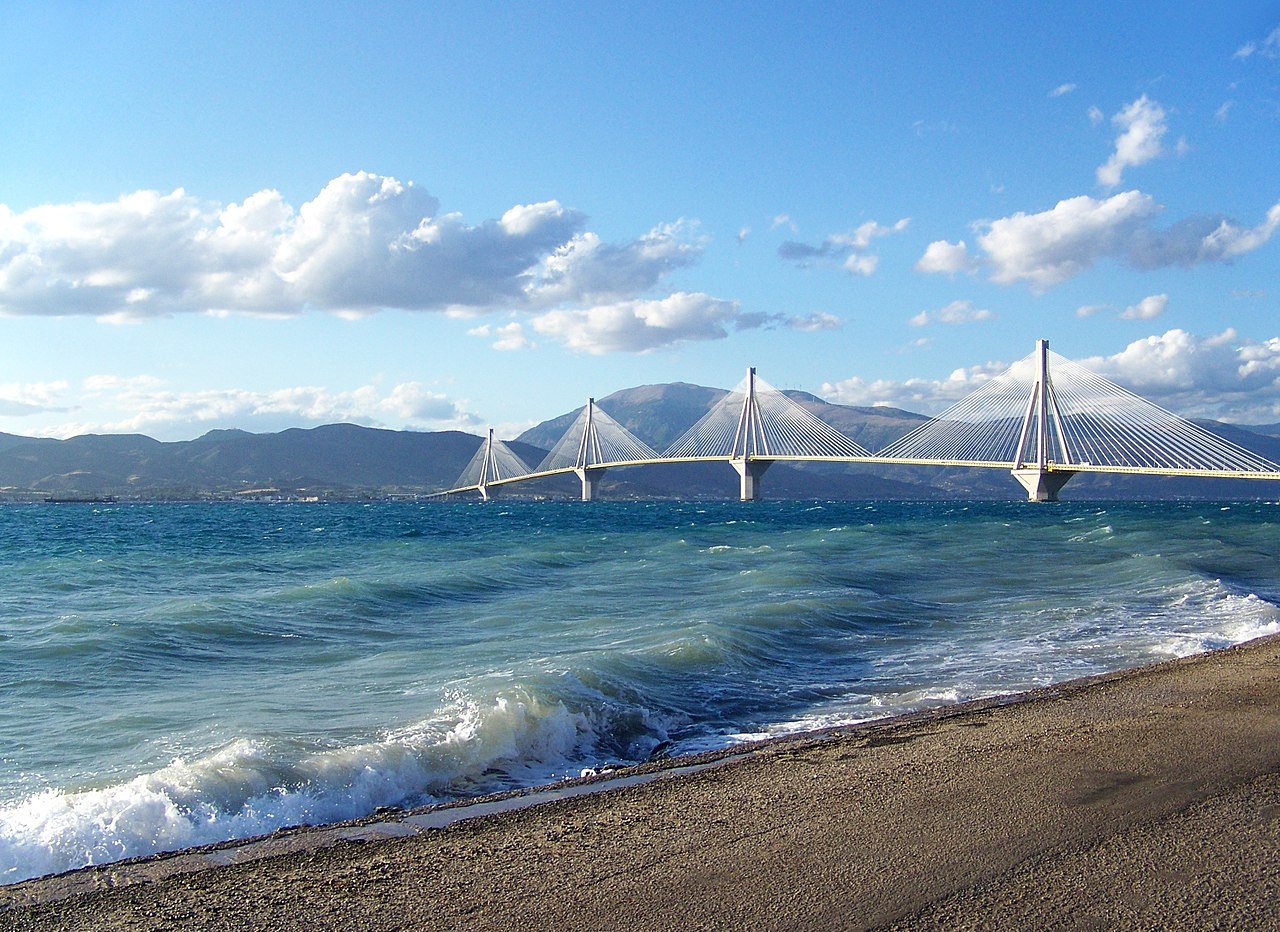
The Rio-Antirrio Bridge in Western Greece is one of the world’s longest multi-span, cable-stayed bridges. Credit: Eusebius, Eusebius CC BY-SA 3.0/ Wikipedia

The Rio-Antirrio Bridge was inaugurated on August 7, 2004, one week before the opening of the 2004 Summer Olympics in Athens.

Within two decades, it changed the economic landscape in Greece. The Rio-Antirrio Bridge, which connects the Peloponnese with Central Greece, had the aim of making the transport of passengers and cargo much easier. That has certainly been achieved.

The opening of the bridge was a celebration, with the first people to officially cross it being none other than the Olympic torchbearers of the 2004 Olympics. One member of that group was Otto Rehhagel, the German football coach who had led the Greek national team to their triumph in the Euro 2004 Cup just a month earlier.

The official name of the bridge is the Charilaos Trikoupis Bridge, named after the nineteenth-century prime minister of Greece, who was the first man to envision such a span connecting the Peloponnese with Central Greece. Unfortunately, state finances at the time did not allow for such a large-scale project.

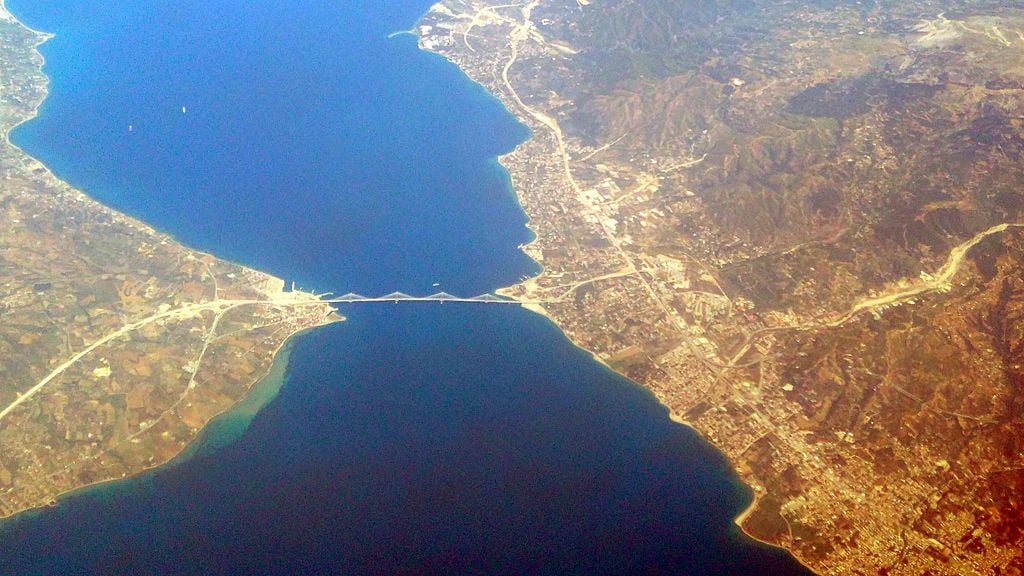
The 2,380-meter (approximately 1.8-mile) long bridge is one of the longest cable-stay bridges in the entire world. It improves access to and from the Peloponnese, which could previously only be reached by ferry or via the Isthmus of Corinth.
Rio-Antirrio Bridge
The bridge connects Peloponnese with western Greece. Public Domain

According to a recent study by the Observatory of Road Networks in Western Greece and the Peloponnese, the construction of the graceful white cable-stay bridge has already resulted in enormous financial benefits. To date, this amount is estimated to be over 400 million euros.

The experts believe that the total amount of funds the bridge’s construction will bring to the area will be more than one billion euros during the period of 2017 to 2032.

Tourist flows have also improved, which is especially noted with arrivals coming into the area from the north from the port of Patras. Travelers heading for the Ionian Sea islands and areas in Central Greece can now easily and swiftly cross through the central area of the country and back again.

The study also noted that the bridge has already had a positive effect on property values in the northern region, which has led to a significant rise in land prices. This has given added value to an area that had been largely underdeveloped, attracting investment.

Traffic flows have also benefited immensely from the creation of the Charilaos Trikoupis Bridge. It not only connects two major motorways, the Ionian Odos and Olympia Odos, but transport connections between Epirus and Aitoloakarnania have been greatly improved, as well.

Before the construction of the new span, Aitoloakarnania had basically been almost completely cut off from the rest of the country.

Rio-Antirrio Bridge considered an engineering masterpiece

The construction of the imposing cable-stay bridge is widely considered to be an engineering masterpiece, owing to several solutions applied to overcome difficulties caused by its location and the geology of the region.

These difficulties included the especially deep waters of the river, the once-unstable underlying ground under the bases of the bridge, seismic activity, the probability of tsunamis, and the expansion of the Gulf of Corinth due to plate tectonics.

The seabed was first reinforced and stabilized by driving two hundred hollow steel pipes into the ground beneath each pier. The pier footings themselves were not driven into the seabed; they rest on a bed of gravel meticulously leveled to an even surface (a difficult endeavor at this depth).

During an earthquake, the piers are able to move laterally along the sea floor, with the gravel bed absorbing the energy. The bridge decking is also connected to the pylons using special jacks and dampers designed to absorb any movement.

View the fascinating video below to see all the special features of this unique and beautiful cable-stay bridge, which has already contributed immensely to the economy of the country.

  •  

The 3,000-Year-Old Ancient Greek Vine of Pausanias

Pausanias vine
The Vine of Pausanias is tangled and about 100 meters long. Foresters believe it to be about 3,000 years old. Photo credit: Kalavryta Municipality

When ancient Greek geographer Pausanias sat down to rest beneath the shade of the giant vine, he was unaware it was probably the oldest in the world.

It was approximately 160 AD when Pausanias (110-180 AD) enjoyed the shade of the ancient vine (Vitis vinifera) in the modern-day Peloponnesian community of Sella Pagrati on the Tripoli-Kalavryta national highway.

Today, the Vine of Pausanias is a tourist attraction on the border of the Arcadia and Achaia prefectures within the courtyard of the Agios Nikolaos church. According to agriculturalists, it is estimated to be about three thousand years old.

In the book, Food and History, Vol 11 (pp. 27-34) by Boursiquot, Lacombe, Laucou, and Bakasietas, there is a description of the ancient Greek vine:

“In order to contribute to the development of knowledge on the ampelographic heritage and the viticultural genetic resources of Greece, we have characterized the so-called ‘Pausanias’ vine at the ampelographic and molecular level. This vine is located in the center of the Peloponnese (village of Pagrati, Prefecture of Achaia). It is named and listed under the name of ‘Vine of Pausanias,’ Greek geographer of the 2nd century AD, even if its origin and its real age are not really known. The results of the analyses show that it is not an ancient Greek grape variety but a lambrusca (Vitis vinifera subsp. sylvestris), whose specificity lies in the fact that the strain has been maintained naturally for a very long time, and probably for several centuries, without any particular human intervention. In this respect, and by its spectacular development, it is certainly a unique and quite exceptional example.”

Although it blooms every May, the vine no longer produces fruit. It is about 100 meters (328 feet) long and has 9 shoots (trunks), which spread in a grove of hollow oak bushes (Quercus coccifera). Many of its branches have even climbed the oak bushes. It should be noted that, according to the villagers, many of the shoots were cut by the Germans during the 1941-1944 Occupation.

Pausanias went for the trout

In his book Arcadika (8.21.2), Pausanias claims he had visited the area to see if the rumor that the trout of the Aroanios River sang like the song thrush bird was true: “…here the fish of the Aroanios River are so delicious that they sing like thrushes.” (Greek: “εἰσὶ δὲ ἰχθῦς ἐν τῷ Ἀροανίῳ καὶ ἄλλοι καὶ οἱ ποικιλίαι καλούμενοι: τούτους λέγουσι τοὺς ποικιλίας φθέγγεσθαι κίχλῃ τῇ ὄρνιθι ἐοικός.”)

The ancient Greek geographer discovered that local gourmands had a metaphor to describe the flavorful Aroanios River trout. Later on, he sought the shade of the vine, which he found impressive. The villagers hosted him, providing him with a trout meal and offering him water from the nearby spring.

Ancient legends connect the Vine of Pausanias with the third of the twelve labors of Heracles, which was to capture the Ceryneian Hind, the golden-horned deer sacred to Artemis. According to the legend, while the hero was on the hunt for the deer, it reached the vine, and its long horns became tangled, enabling Heracles to capture it. Due to this myth, the location of the Vine of Pausanias had also been named Kynigari (Greek: Κυνηγάρι), meaning “hunting place” in Greek.

Protected national monument

The vine was declared a Protected Natural Monument in 1975 (Government Gazette 738/B/1975). Regarding the vine’s physical condition, the scientific committee of the ECOCITY NGO estimates that the original trunks of the plant have disappeared due to the natural deterioration of time, while their remaining lower parts, which are one to one and a half meters high and at least 50 centimeters in diameter, have dried out.

Many other shoots have emerged from the numerous branches of the roots, climbing the tree-like oak bush forms. However, ECOCITY estimates that the condition of these “trunk shoots” seems almost hopeless, suggesting that the unique natural monument could potentially permanently disappear after about three thousand years.

To avoid destruction of the Vine of Pausanias, ECOCITY has long since forwarded a request to the competent services responsible for its preservation and maintenance. This in relation to the desired cooperation with the Viticulture and Arboriculture Laboratories of the Agricultural University of Athens so that they may take immediate action to improve the vine’s physical condition and prevent its complete demise.

In May 2014, with permission granted by the Ministry of Environment, Energy, and Climate Change, the members of the scientific committee of the Western Greece Sector of ECOCITY visited the Vine of Pausanias. They extracted samples from the trunks to determine precise dating. The team consisted of foresters and agriculturalists who then sent the samples to the head of the Archaeometry Laboratory of the NCSR “Demokritos.”

Unique and distinctive genotype

Genetic analysis of the Vine of Pausanias was carried out. Twenty microsatellite markers distributed throughout the genome were studied for this purpose, and comparison with 119 Greek varieties and 762 species of wild vines was performed.

The comparison to all the varieties in the Vassal collection (over 3000) proved that the vine’s profile is of a unique and distinctive genotype.

Its age is estimated to be several centuries old, but the number cannot be definitively determined. Its flowers are only ‘male,’ meaning the vine is not fruit-bearing.

Compared to other representatives of Vitis vinifera, wild or cultivated, that exist today in the world, the Vine of Pausanias is of a particularly original genotype, probably resulting from a limited number of sexual generations which have also undergone only few cycles of vegetative multiplication. In this regard, it is certainly a fascinating model for studies on the evolution and dynamics of the vine genome.

  •  
❌