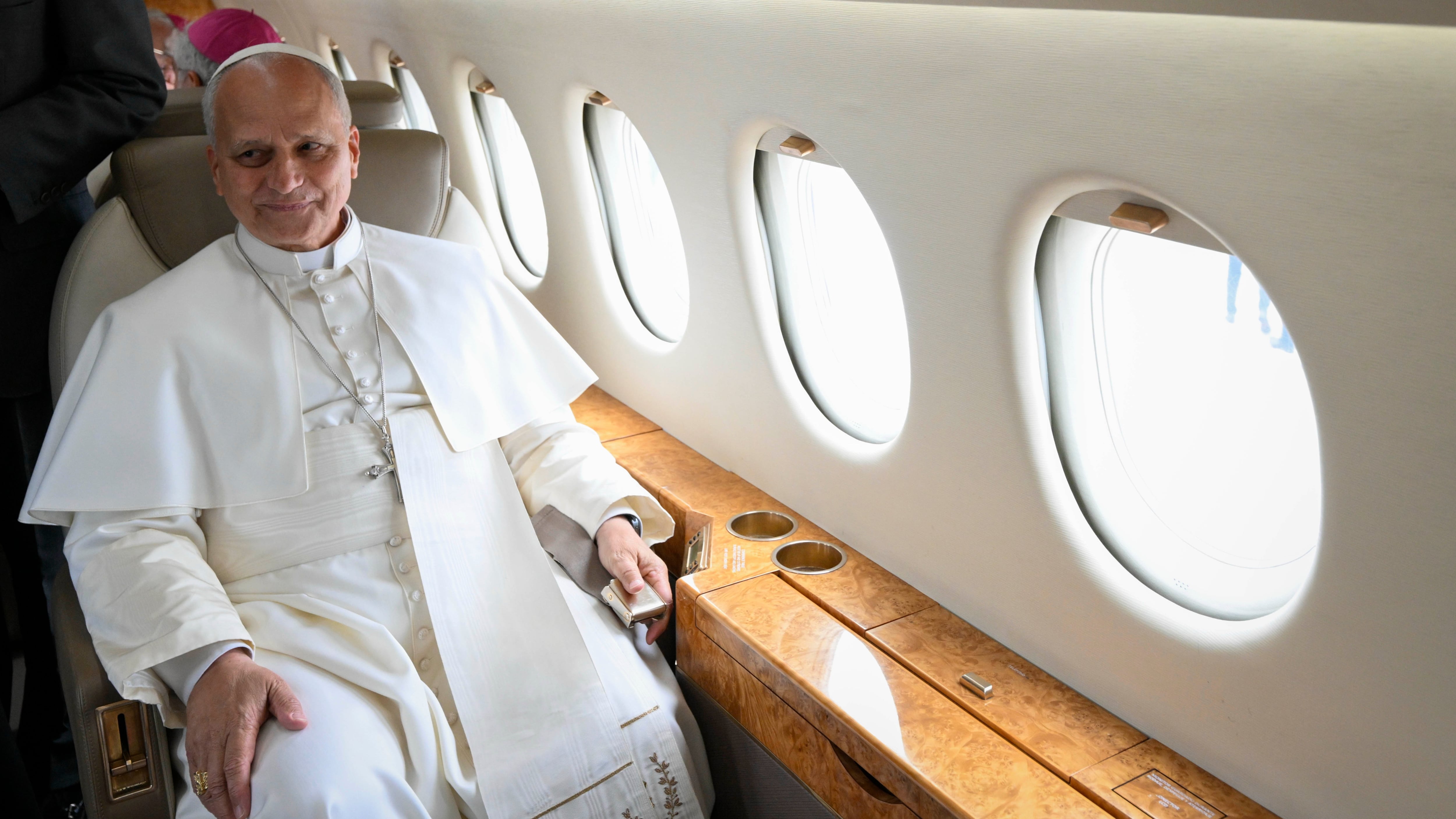
El periplo de León XIV por España se ha cerrado con un inconveniente técnico en el avión de Iberia en el que estaba previsto que viajara desde Tenerife, su última etapa del viaje, hacia Roma. El Papa ha embarcado finalmente en un avión Falcon del Grupo 45 del Ejército del Aire que se encontraba ya en Canarias, para viajar en dirección a Italia. La aeronave ha sido cedida por el Rey, y ha emprendido vuelo a las 18.09 (hora local canaria), donde está previsto que aterrice en torno a las 23.00 (hora de Roma). El Ejército del Aire enviará otro avión a Canarias para recoger a Felipe VI.
The atrium of Roman House (domus) No. 1 at Empuries (Emporiae/Emporion), Spain. 1st century BC – 1st century AD. Credit: Mark Cartwright, World History Encyclopedia, CC BY-NC-SA 4.0
The Greeks were famous in antiquity for their adventurous and curious spirit, which led to the establishment of numerous Greek colonies across the Mediterranean and beyond. Tucked away on Spain’s beautiful Costa Brava, one of these ancient Greek colonies, called Emporion, was a truly remarkable Greek settlement that thrived far from metropolitan Greece on the other side of the Mediterranean.
Emporion is an excellent example of early Greek expansion, as it became a place where Greek traders and settlers converged to establish a bastion of Greece at the far western end of the Mediterranean.
Emporion became a thriving hub that, for centuries, played a crucial role in shaping the foundations of early European exchange and people’s movements. When discussing Greek colonies, we normally focus on Asia Minor and the Italian Peninsula. However, here on the Iberian Peninsula, these ancient Greek explorers left their unique mark, proving that the ancient Greeks were, in fact, quite the adventurers.
Emporion was a Greek gem on Spanish soil
The story of Emporion started around 575 BC, when Greek seafarers from Phocaea, a Greek city in Asia Minor (modern-day Turkey), set their sights on the western horizon, seeking more land to expand their opportunities. These people were the same adventurous men and women who founded Massalia (today’s Marseille) on the opposite side of Emporion, on today’s Mediterranean coast of France.
Their initial settlement, the “Palaiapolis” or Old City, was cleverly positioned on a small island, now comfortably part of the mainland, due to thousands of years of land reclaiming in the broader area. We can only imagine the spectacle of Greek ships filled with exquisite pottery, fine olive oil, and the kind of wine that only ancient Greeks could produce, setting foot on Iberia.
What was different at that time was that these people weren’t just there to exchange goods and sell their produce; they were there to stay permanently, injecting Greek culture into the local populations, importing fresh ideas, and the unique “Greek spirit” into the local area.
A Greek mosaic in the Neapolis. The Greek word “Ηδύκοιτος” (“the pleasure of lying down”) is at the top. Credit AugusteBlanqui, Wikimedia Commons, CC BY-SA 4.0
The very name they gave to the city, “Emporion,” means “market” or “trading post” in Greek. It leaves no room for doubt about its core purpose and the reason why this settlement was named after the Greek word for trade. Emporion was intended to become a cosmopolitan crossroads, a vibrant meeting point where Greek merchants met local Iberian populations, thereby establishing a robust trade route in a wide range of goods, from precious metals to essential food supplies.
What is particularly fascinating about Emporion is the relationship that developed between the Greek colonists in the area and the local Iberian tribes, especially the Indiketes. Initially, there was a clear divide—a literal wall separated the Greek and Iberian communities, as is often the case with newly established colonies throughout history.
But as often happens, shared interests and a healthy dose of realism slowly eroded those barriers, bringing locals and settlers together. Over time, mutual benefit led them to achieve a remarkable degree of cultural exchange, resulting in a truly blended society that contributed to the development of a unique community with its own strengths and characteristics.
A Greek vessel found in Emporion. Credit: Kontrollstellekund, Wikimedia Commons, CC BY-SA 2.0
This community thrived through commerce and cultural exchanges. Centuries later, during the Roman era, Emporion’s strategic value became undeniable. During the tumultuous Punic Wars, Emporion became a crucial landing point for Roman legions, demonstrating its geopolitical importance. The Romans, ever efficient, established their adjacent settlement, which eventually merged with the pre-existing Greek city. The collective name, Emporiae, perfectly encapsulates this dual Greco-Roman identity and heritage, where two powerful cultures merged on one remarkable site.
Today, what truly makes Empúries a must-see is the extraordinary chance it offers to walk through both Greek and Roman streets in a single visit. It’s not every day you get to stand where an ancient agora once buzzed with philosophical debate, and just right next to it, you can envision a Roman forum alive with political drama that only the Romans could offer.
The ongoing excavations, which commenced in 1908, continue to unearth incredible treasures—from formidable city walls and elegant temples, including one dedicated to Asclepius, the Greek god of medicine (perhaps an early version of a Greek health resort), to private homes adorned with breathtaking Roman mosaics.
The next time you visit northeastern Spain and Catalonia, be sure to visit this site of ancient Greek heritage on the Iberian Peninsula. Admire what is now known as Empúries, a name closely resembling its original one.
For a more detailed description of what led to the Greek colonization of the area, read here.
The atrium of Roman House (domus) No. 1 at Empuries (Emporiae/Emporion), Spain. 1st century BC – 1st century AD. Credit: Mark Cartwright, World History Encyclopedia, CC BY-NC-SA 4.0
The Greeks were famous in antiquity for their adventurous and curious spirit, which led to the establishment of numerous Greek colonies across the Mediterranean and beyond. Tucked away on Spain’s beautiful Costa Brava, one of these ancient Greek colonies, called Emporion, was a truly remarkable Greek settlement that thrived far from metropolitan Greece on the other side of the Mediterranean.
Emporion is an excellent example of early Greek expansion, as it became a place where Greek traders and settlers converged to establish a bastion of Greece at the far western end of the Mediterranean.
Emporion became a thriving hub that, for centuries, played a crucial role in shaping the foundations of early European exchange and people’s movements. When discussing Greek colonies, we normally focus on Asia Minor and the Italian Peninsula. However, here on the Iberian Peninsula, these ancient Greek explorers left their unique mark, proving that the ancient Greeks were, in fact, quite the adventurers.
Emporion was a Greek gem on Spanish soil
The story of Emporion started around 575 BC, when Greek seafarers from Phocaea, a Greek city in Asia Minor (modern-day Turkey), set their sights on the western horizon, seeking more land to expand their opportunities. These people were the same adventurous men and women who founded Massalia (today’s Marseille) on the opposite side of Emporion, on today’s Mediterranean coast of France.
Their initial settlement, the “Palaiapolis” or Old City, was cleverly positioned on a small island, now comfortably part of the mainland, due to thousands of years of land reclaiming in the broader area. We can only imagine the spectacle of Greek ships filled with exquisite pottery, fine olive oil, and the kind of wine that only ancient Greeks could produce, setting foot on Iberia.
What was different at that time was that these people weren’t just there to exchange goods and sell their produce; they were there to stay permanently, injecting Greek culture into the local populations, importing fresh ideas, and the unique “Greek spirit” into the local area.
A Greek mosaic in the Neapolis. The Greek word “Ηδύκοιτος” (“the pleasure of lying down”) is at the top. Credit AugusteBlanqui, Wikimedia Commons, CC BY-SA 4.0
The very name they gave to the city, “Emporion,” means “market” or “trading post” in Greek. It leaves no room for doubt about its core purpose and the reason why this settlement was named after the Greek word for trade. Emporion was intended to become a cosmopolitan crossroads, a vibrant meeting point where Greek merchants met local Iberian populations, thereby establishing a robust trade route in a wide range of goods, from precious metals to essential food supplies.
What is particularly fascinating about Emporion is the relationship that developed between the Greek colonists in the area and the local Iberian tribes, especially the Indiketes. Initially, there was a clear divide—a literal wall separated the Greek and Iberian communities, as is often the case with newly established colonies throughout history.
But as often happens, shared interests and a healthy dose of realism slowly eroded those barriers, bringing locals and settlers together. Over time, mutual benefit led them to achieve a remarkable degree of cultural exchange, resulting in a truly blended society that contributed to the development of a unique community with its own strengths and characteristics.
A Greek vessel found in Emporion. Credit: Kontrollstellekund, Wikimedia Commons, CC BY-SA 2.0
This community thrived through commerce and cultural exchanges. Centuries later, during the Roman era, Emporion’s strategic value became undeniable. During the tumultuous Punic Wars, Emporion became a crucial landing point for Roman legions, demonstrating its geopolitical importance. The Romans, ever efficient, established their adjacent settlement, which eventually merged with the pre-existing Greek city. The collective name, Emporiae, perfectly encapsulates this dual Greco-Roman identity and heritage, where two powerful cultures merged on one remarkable site.
Today, what truly makes Empúries a must-see is the extraordinary chance it offers to walk through both Greek and Roman streets in a single visit. It’s not every day you get to stand where an ancient agora once buzzed with philosophical debate, and just right next to it, you can envision a Roman forum alive with political drama that only the Romans could offer.
The ongoing excavations, which commenced in 1908, continue to unearth incredible treasures—from formidable city walls and elegant temples, including one dedicated to Asclepius, the Greek god of medicine (perhaps an early version of a Greek health resort), to private homes adorned with breathtaking Roman mosaics.
The next time you visit northeastern Spain and Catalonia, be sure to visit this site of ancient Greek heritage on the Iberian Peninsula. Admire what is now known as Empúries, a name closely resembling its original one.
For a more detailed description of what led to the Greek colonization of the area, read here.
Madrid, 11 jun (Prensa Latina) La aerolínea bandera de España, Iberia, sumará una frecuencia adicional entre Madrid y Ciudad de Panamá de julio a septiembre, informó en un comunicado.
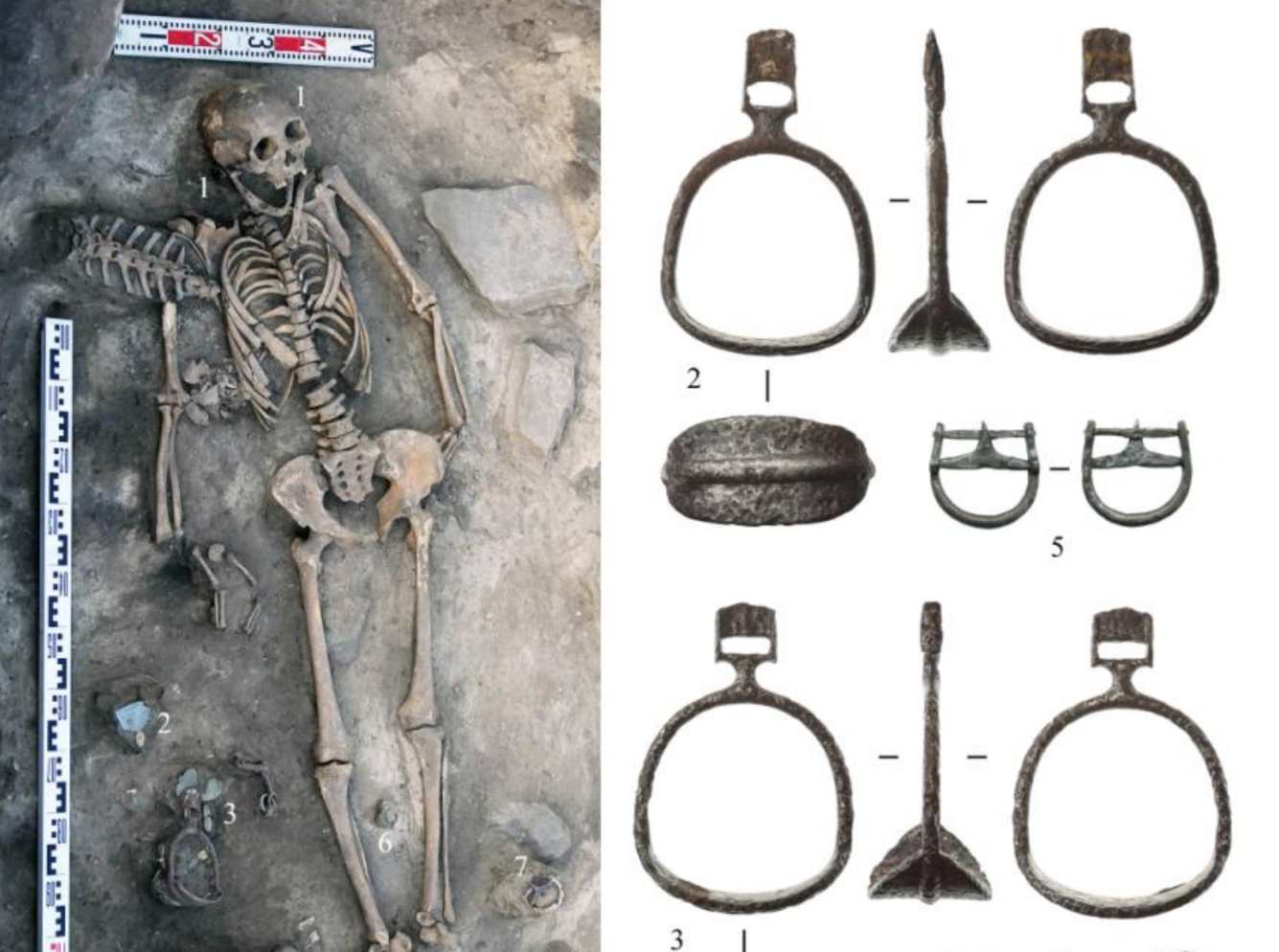
The burial of an elite medieval woman at the Sayany-Pogranichnoye-4 cemetery in southern Siberia. Credit: Amzarakov P.B. et al. / CC BY 4.0
A pair of gold-plated earrings discovered in a burial is offering archaeologists a rare glimpse into the lives of elite women on the medieval Eurasian steppe in southern Siberia.
The burial, found in southern Siberia’s Sayan Mountains, contained a remarkable collection of objects that point to wealth, social status, and long-distance cultural connections stretching across Inner Asia more than 1,000 years ago.
Researchers uncovered the grave at the Sayany-Pogranichnoye-4 cemetery near the Idzhim River in Russia’s Krasnoyarsk region. The burial contained the remains of an adult woman and a newborn child, along with jewelry, a knife, a spindle whorl, a Chinese-style mirror fragment, and an extensive collection of horse equipment.
According to researchers from the Institute for the History of Material Culture of the Russian Academy of Sciences, Novosibirsk State University, and Archaeology of Khakassia, the grave belongs to a rare category of elite medieval burials. Only a few dozen comparable examples have been documented across the Sayan-Altai region.
Earrings mark social standing
The most personal items in the burial were a pair of gold-plated earrings found near the woman’s skull, suggesting she was buried wearing them.
The earrings were made of bronze with traces of gilding and featured ring-shaped hoops, hanging pendants, and bead-like terminals.
Laboratory analysis revealed a sophisticated design. The main ring and upper bead were made from copper alloyed with tin and lead, while the lower bead contained mostly silver along with smaller amounts of copper, gold, and lead. Researchers believe it may have been crafted to resemble a pearl.
Similar earrings have been found in elite female burials in the Altai Mountains and Mongolia, particularly among ancient Turkic communities. Researchers say these ornaments likely served as visible symbols of rank and identity.
Horse equipment reflects wealth and prestige
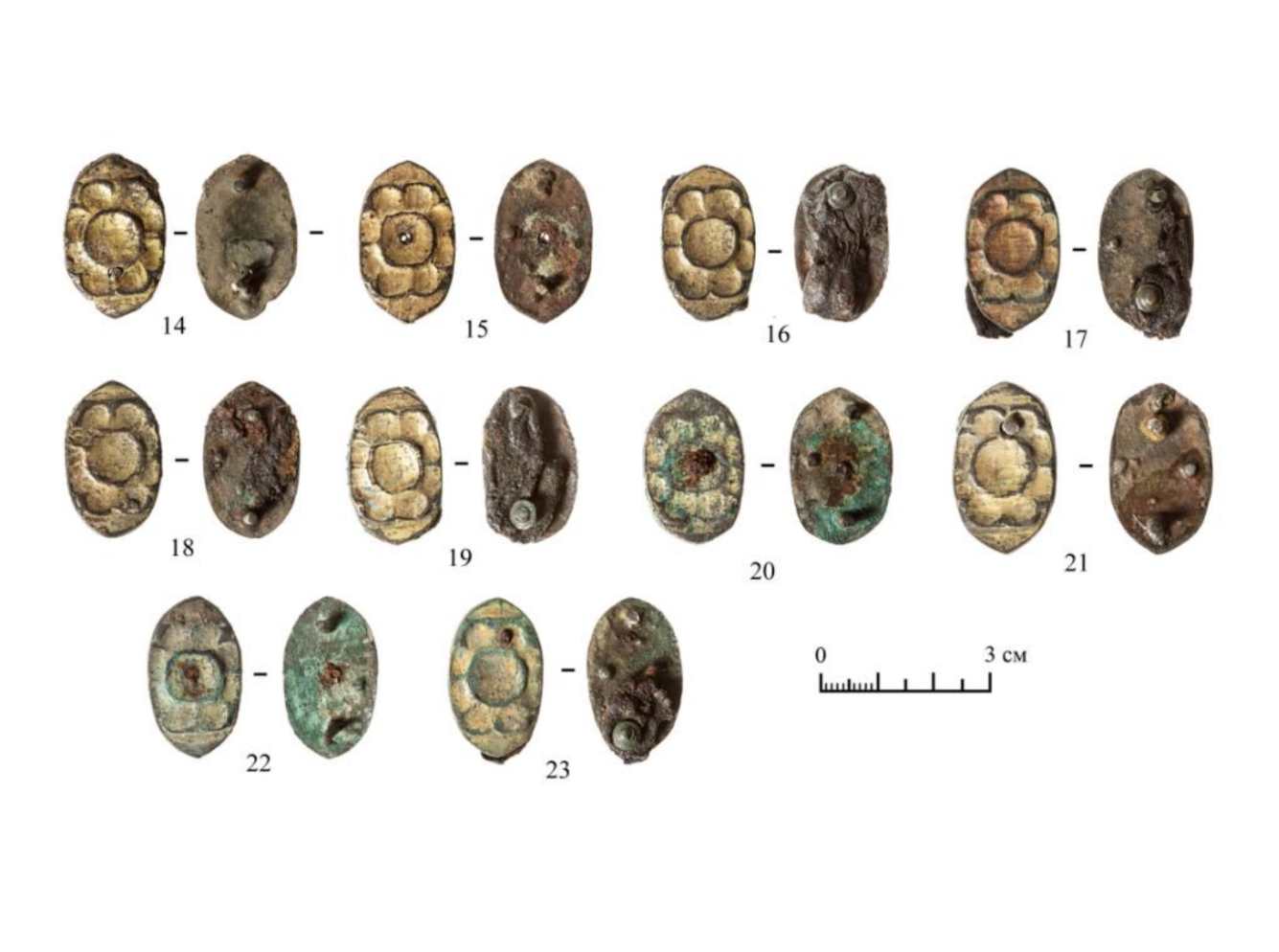
Gilded bronze artifacts in Sayany-Pogranichnoye-4 cemetery. Credit: Amzarakov P.B. et al. / CC BY 4.0
The burial also contained an impressive collection of horse gear, including stirrups, iron bits, gilded bronze fittings, bridle decorations, buckles, plaques, and pendants. A horse-skin deposit, consisting of the animal’s skull and limbs, placed with its hide, accompanied the grave. Such deposits are commonly associated with high-status nomadic burials.
One stirrup attracted particular attention. Decorated with silver wire inlay on iron, a technique known as damascening, it displayed intricate patterns across its neck, arch, and footrest. Researchers said the design closely resembles decorative styles used in China during the late Tang Dynasty between the late ninth and early 10th centuries.
A second stirrup was undecorated. Archaeologists suggest this difference may have been intentional, with the ornate stirrup displayed on the horse’s more visible side as part of a public display of status.
Chinese mirror points to distant connections
Another notable object was a fragment of a cast metal mirror decorated with a traditional Chinese “grape” motif featuring vines, leaves, grape clusters, and a bird. Mirrors of this type were popular among Tang aristocrats during the seventh and eighth centuries.
Although broken, the mirror fragment appears to have been curated for a long period before burial. Its worn edges suggest it retained symbolic value even after it could no longer function as a mirror. Across Eurasia, mirrors often carried ritual, protective, or ceremonial meanings.
A rare portrait of elite life
Radiocarbon dating places the burial broadly between the late ninth and early 13th centuries. However, the styles of the earrings, mirror, and horse equipment indicate the woman was most likely buried during the second half of the ninth century or the 10th century.
For archaeologists, the grave is significant because it combines evidence of personal identity with the ceremonial importance of horses in steppe society. Together, the artifacts reveal a world where social prestige, mobility, and cultural exchange were closely connected.
More than a millennium after her burial, the woman’s gold-plated earrings remain a powerful reminder of the status and influence she carried during life.
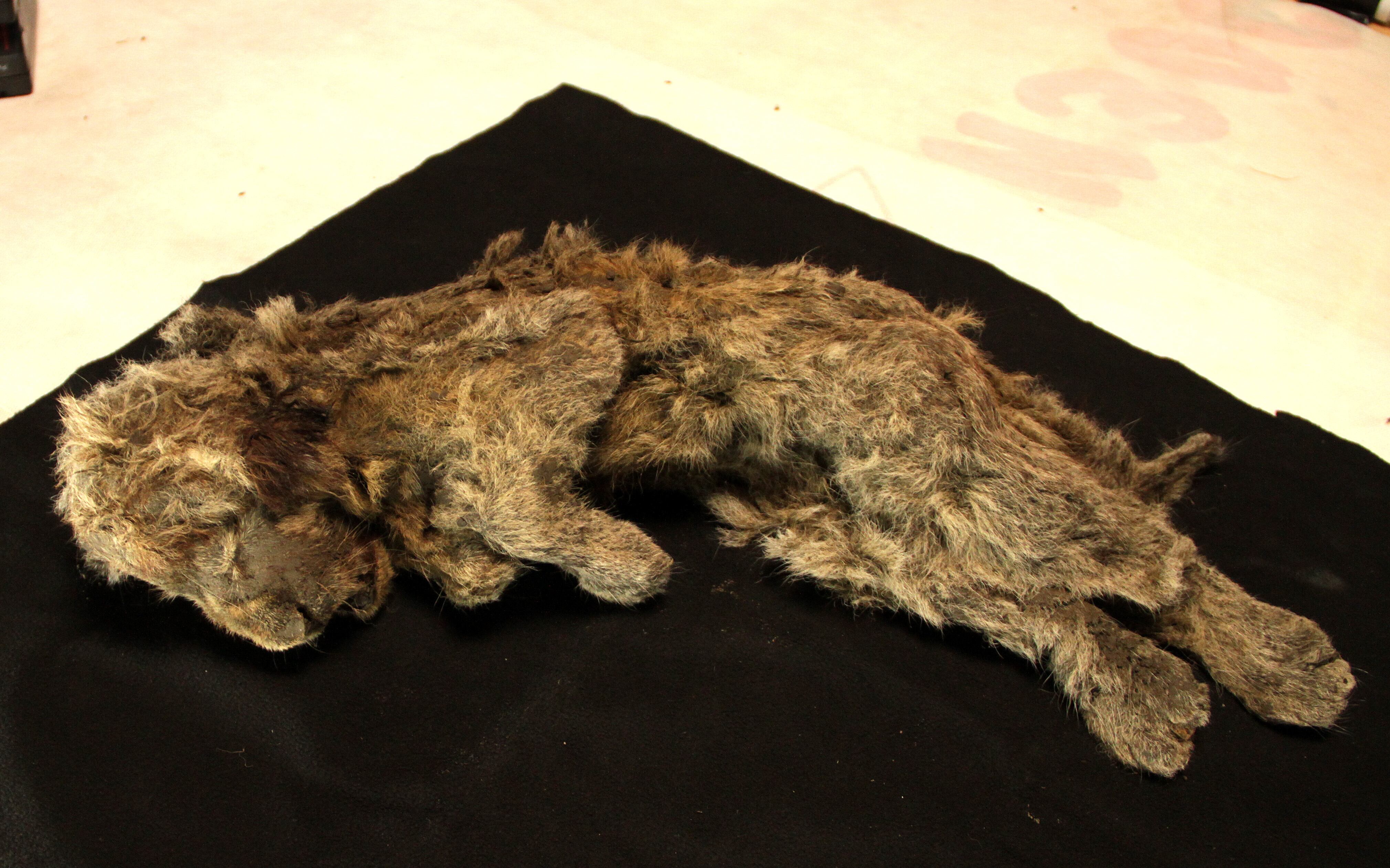
In 2018, Russian paleontologists discovered in Siberia the almost perfectly preserved frozen body of a cave lion cub. They named her Sparta. She was 32,000 years old, with blond fur, perfectly intact claws, and she looked as if she were asleep. What no one knew at the time was that Sparta carried a secret in her cells that would take years to decode: she and her kind were not, as previously thought, simply a larger, furrier version of the African lion, but something far more extraordinary.

 Login
Login