Login
Login
The 3,000-Year-Old Ancient Greek Vine of Pausanias

When ancient Greek geographer Pausanias sat down to rest beneath the shade of the giant vine, he was unaware it was probably the oldest in the world.
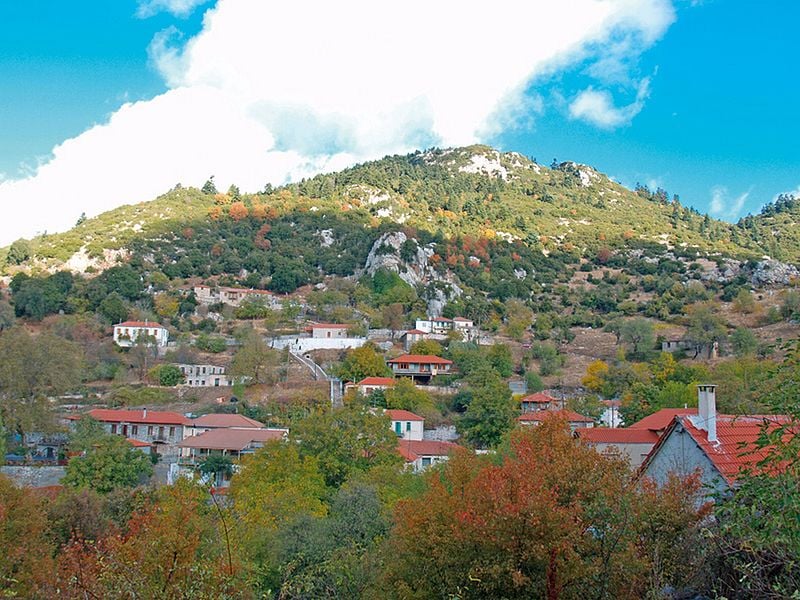
It was approximately 160 AD when Pausanias (110-180 AD) enjoyed the shade of the ancient vine (Vitis vinifera) in the modern-day Peloponnesian community of Sella Pagrati on the Tripoli-Kalavryta national highway.
Today, the Vine of Pausanias is a tourist attraction on the border of the Arcadia and Achaia prefectures within the courtyard of the Agios Nikolaos church. According to agriculturalists, it is estimated to be about three thousand years old.
In the book, Food and History, Vol 11 (pp. 27-34) by Boursiquot, Lacombe, Laucou, and Bakasietas, there is a description of the ancient Greek vine:
“In order to contribute to the development of knowledge on the ampelographic heritage and the viticultural genetic resources of Greece, we have characterized the so-called ‘Pausanias’ vine at the ampelographic and molecular level. This vine is located in the center of the Peloponnese (village of Pagrati, Prefecture of Achaia). It is named and listed under the name of ‘Vine of Pausanias,’ Greek geographer of the 2nd century AD, even if its origin and its real age are not really known. The results of the analyses show that it is not an ancient Greek grape variety but a lambrusca (Vitis vinifera subsp. sylvestris), whose specificity lies in the fact that the strain has been maintained naturally for a very long time, and probably for several centuries, without any particular human intervention. In this respect, and by its spectacular development, it is certainly a unique and quite exceptional example.”
Although it blooms every May, the vine no longer produces fruit. It is about 100 meters (328 feet) long and has 9 shoots (trunks), which spread in a grove of hollow oak bushes (Quercus coccifera). Many of its branches have even climbed the oak bushes. It should be noted that, according to the villagers, many of the shoots were cut by the Germans during the 1941-1944 Occupation.
Pausanias went for the trout
In his book Arcadika (8.21.2), Pausanias claims he had visited the area to see if the rumor that the trout of the Aroanios River sang like the song thrush bird was true: “…here the fish of the Aroanios River are so delicious that they sing like thrushes.” (Greek: “εἰσὶ δὲ ἰχθῦς ἐν τῷ Ἀροανίῳ καὶ ἄλλοι καὶ οἱ ποικιλίαι καλούμενοι: τούτους λέγουσι τοὺς ποικιλίας φθέγγεσθαι κίχλῃ τῇ ὄρνιθι ἐοικός.”)
The ancient Greek geographer discovered that local gourmands had a metaphor to describe the flavorful Aroanios River trout. Later on, he sought the shade of the vine, which he found impressive. The villagers hosted him, providing him with a trout meal and offering him water from the nearby spring.
Ancient legends connect the Vine of Pausanias with the third of the twelve labors of Heracles, which was to capture the Ceryneian Hind, the golden-horned deer sacred to Artemis. According to the legend, while the hero was on the hunt for the deer, it reached the vine, and its long horns became tangled, enabling Heracles to capture it. Due to this myth, the location of the Vine of Pausanias had also been named Kynigari (Greek: Κυνηγάρι), meaning “hunting place” in Greek.
Protected national monument
The vine was declared a Protected Natural Monument in 1975 (Government Gazette 738/B/1975). Regarding the vine’s physical condition, the scientific committee of the ECOCITY NGO estimates that the original trunks of the plant have disappeared due to the natural deterioration of time, while their remaining lower parts, which are one to one and a half meters high and at least 50 centimeters in diameter, have dried out.
Many other shoots have emerged from the numerous branches of the roots, climbing the tree-like oak bush forms. However, ECOCITY estimates that the condition of these “trunk shoots” seems almost hopeless, suggesting that the unique natural monument could potentially permanently disappear after about three thousand years.
To avoid destruction of the Vine of Pausanias, ECOCITY has long since forwarded a request to the competent services responsible for its preservation and maintenance. This in relation to the desired cooperation with the Viticulture and Arboriculture Laboratories of the Agricultural University of Athens so that they may take immediate action to improve the vine’s physical condition and prevent its complete demise.
In May 2014, with permission granted by the Ministry of Environment, Energy, and Climate Change, the members of the scientific committee of the Western Greece Sector of ECOCITY visited the Vine of Pausanias. They extracted samples from the trunks to determine precise dating. The team consisted of foresters and agriculturalists who then sent the samples to the head of the Archaeometry Laboratory of the NCSR “Demokritos.”
Unique and distinctive genotype
Genetic analysis of the Vine of Pausanias was carried out. Twenty microsatellite markers distributed throughout the genome were studied for this purpose, and comparison with 119 Greek varieties and 762 species of wild vines was performed.
The comparison to all the varieties in the Vassal collection (over 3000) proved that the vine’s profile is of a unique and distinctive genotype.
Its age is estimated to be several centuries old, but the number cannot be definitively determined. Its flowers are only ‘male,’ meaning the vine is not fruit-bearing.
Compared to other representatives of Vitis vinifera, wild or cultivated, that exist today in the world, the Vine of Pausanias is of a particularly original genotype, probably resulting from a limited number of sexual generations which have also undergone only few cycles of vegetative multiplication. In this regard, it is certainly a fascinating model for studies on the evolution and dynamics of the vine genome.