Portugal cumpre primeiro treino em Miami após uma longa viagem de Portugal aos EUA com portas abertas a centenas de pessoas. Ainda, vamos ter jogaço no duelo entre Brasil-Marrocos?
Portugal cumpre primeiro treino em Miami após uma longa viagem de Portugal aos EUA com portas abertas a centenas de pessoas. Ainda, vamos ter jogaço no duelo entre Brasil-Marrocos?
Brazil’s elites have long treated drug violence as inevitable – like 19th-century slavery. But with banks and gas stations now feeling the pinch, will national pride finally force action where moral outrage never could?
In Um rio chamado Atlântico [A River Called Atlantic], the Brazilian diplomat and Africanist Alberto da Costa e Silva (1931 – 1923) addresses the history of the end of the slave trafficking in Brazil in a very interesting way. As is known, England in the 19th century positioned herself as the moral bulwark of the world, and this included a true crusade against the transatlantic slave trade. On the other hand, Brazil, according to our Africanist, was dependent on the forced immigration of Africans to populate this vast territory, given the small size of Portugal and the precarious technical condition of the Amerindians.
That English humanitarianism was merely a pretext, no one serious can doubt. After all, one only needs to see how inhumane the British chartered company’s dominion over India was, or consider the fact that English sympathies leaned towards the South during the American Civil War. From an economic standpoint, there is the issue of the competitiveness of Brazilian sugar produced by slave labor, but the most important thing, according to Costa e Silva, was this: the financial suffocation of the free African kingdoms.
Since the African kingdoms capitalized in the 19th century by selling slaves to the Americas, closing the Atlantic would cause these kingdoms to collapse, and thus, English merchants could try to replicate there the model of domination implemented in India. And, in fact, after the closing of the Atlantic, some African leaders began to imitate the Anglo-American plantation model to sell palm oil to the English, who used it for purposes as diverse as soap making and public lighting. The slave trade to the Americas ended and was replaced by African domestic slavery.
According to Alberto da Costa e Silva, the slave trafficking ended in Brazil because Brazil wanted it to. Even today, in the 21st century, we use in Brazil the expression “so that the English can see it”. The origin of this expression is the Feijó Law of 1831, a law of the Empire of Brazil that prohibited the transatlantic slave trade, imitating the English law of 1807. Brazil had been pressured by England to pass such a law since its Independence (1822). However, since the Brazilian authorities did not want to end this slave trade, the law was simply not applied: it was made so that the English can see it. To this day, Brazilians say that such a thing is “so that the English can see it” when they want to say that it is an empty formality. The slave trafficking in Brazil ended when Brazil wanted it to end. This occurred in 1850, when Brazil approved the Eusébio de Queiroz Law. From this, Alberto da Costa e Silva concludes: the trade ended because Brazil wanted it to end, and not because England wanted it to.
I have doubts. What would have happened if England had not pressured Brazil to end the slave trade? It’s impossible to answer historical counterfactual questions with certainty, but it seems to me that English arrogance, pointing the finger at us, may very well have driven our ancestors to action. After all, Brazilian society is both proud and conformist: we can spend decades complaining about the same problems as if for sport, but if a foreigner points the finger at us, then we become truly outraged.
Slavery was never a beautiful thing in Brazil. In Black Rednecks and White Liberals, Thomas Sowell contrasted the reaction of the Ottoman and Brazilian peoples to the end of slavery: there, with revolt and protest; here, with public celebrations. In the 19th century, there were even those who imported scientific racism from Protestant countries to justify slavery – but, as Costa e Silva showed, both the pro- and anti-slavery sides had arguments for and against Negroes. Just as there were those who defended the end of slavery because they believed that Negroes did not deserve such a fate, there were those who wanted to end slavery hoping to purge Brazil of Negroes (in the same way that Anglophones created Sierra Leone and Liberia to “return” them to Africa). On the other hand, there were those who justified slavery based on white superiority, but also those who thought that the influence of Negroes in Brazil was too beneficial for slavery, however bad, to have an immediate end.
Given that most of Brazil was illiterate and had no reason to adhere to the racist fashions of the educated, and given that the Brazilian population actually celebrated Abolition (1888) en masse after a large public campaign against the interests of a slave-owning minority, we can assume that the latter position – simultaneously anti-racist and resigned to slavery – reflected Brazilian common sense. I believe that, without external pressure to offend our pride, we could still be lamenting the wickedness of slavery while saying that it was necessary. Furthermore, just 5 years before the Eusébio de Queiroz Law, England passed the Aberdeen Act, which authorized their navy to seize Brazilian ships suspected of slave trafficking. It was an offense, and it was also a cause of losses, since it made the cost of imported slaves unsustainable.
It seems unlikely, then, that just five years later, and with the increased cost of imported slaves, Brazil would have decided on its own to end the trade. It does not follow, however, that England is a saint and that the Aberdeen Act did not harm Brazil in a dishonest way. As Alberto da Costa e Silva reports, Brazil had already developed legitimate trade with the free African kingdoms (which sold us palm oil and fabrics), but England ended up closing the Atlantic.
I think this situation is similar to that of present-day Brazil with drug trafficking and Donald Trump pointing the finger at us. Almost every Brazilian agrees that urban violence caused by drug trafficking is a major problem, and that the territorial control exercised by factions is a very wrong thing. (I say almost every, because there is always the delusional leftist.) However, the elites treat the problem as if it were a phenomenon as natural as rain: Brazilians complain and have no prospect of solving the problem. In Brazil, Marxism ended up translating into a kind of scientific conformism, in which the sociologist looks at the ills and explains why everything is the way it is – in the same way that an English social Darwinist proceeded in the face of the ills of the poor.
Like 19th-century England, Donald Trump is far from being a saint. He has already shown that he feels entitled to invade countries under the pretext of fighting drug trafficking, and the U.S. experience in Colombia, Ecuador, and Afghanistan gives no rational reason for Brazilians to root for armed intervention thinking that this will put an end to drug trafficking. The United States also does not seem committed to ending drug trafficking on its own soil, since it has a colossal surveillance capacity and continues to be the largest consumer of cocaine on the planet. (It is true that U.S. population is large, but it doesn’t compare to China’s. It’s noteworthy that two English-speaking countries – Australia and New Zealand – are the largest per capita consumers according to the UN.)
Just like the Aberdeen Act, the classification by the United States of the two largest Brazilian transnational drug trafficking organizations – the PCC of São Paulo and the Red Commando of Rio de Janeiro – as terrorist organizations certainly stirs the pride of Brazilians. Only a delusional middle-class leftist will claim that this classification is inappropriate. Even so, Brazil has an idiotic anti-terrorism law, made with the purpose of considering terrorism only actions motivated by politically incorrect ideas (see here). By this law, it is impossible to consider PCC and Red Commando terrorist organizations – even though PCC already caused panic in the state of São Paulo in 2006, and there are no nice explanations for the attacks having ceased. Just as Brazil did not end the slave trade in 1830 because it did not want to, Brazil does not end the drug traffickers’ empire today because it does not want to.
Brazil has never considered the PCC a terrorist organization, but the new classification has already prompted Lula to publish an “Administration Note” on his official Twitter profile alluding to the PCC and Red Commando as entities that “practice terrorism in the territories where millions of families live.” I have no record of a note from a PT (Workers’ Party) federal administration alluding to drug traffickers in these terms. The government is then in a complicated position to say that the PCC and Red Commando are organizations that practice terrorism that intimidates millions of families but are not terrorist organizations. And even more: that Brazil is a sovereign country in which non-terrorist organizations practice terrorism against millions of families, because this sovereign country does not have sovereignty over large portions of its own territory! After all, the government’s rhetoric is that Trump’s attack against these organizations is an attack on Brazilian sovereignty orchestrated by Bolsonaristas who betrayed the homeland, since the announcement of the measure occurred shortly after Flávio Bolsonaro’s visit to the White House.
But there is a great dissimilarity between the slave trafficking and the drug trafficking empire: slavery in general is a millennial institution, and the transatlantic trade in particular was as old as Brazil itself. It was reasonable for Brazilians to think that slavery was inevitable, because its end contradicted all previous experience. The drug trafficking empire, on the other hand, is only about 20 years old for most of Brazil. I am only 36 years old and I remember a time when there were no crack addicts: a completely different reality, which seems like a utopia to today’s teenagers. Furthermore, slavery in 19th-century urban Brazil allowed for social ascension, and slaves could realistically dream of freedom and enrichment. The drug trafficking empire, however, haunts Brazilians as long as they are in a Brazilian large city: even if they become rich and leave the slums, they could lose their lives at any moment to a stray bullet, or to a crack addict who stabs them in the street for no reason.
Therefore, the role of the mystifying sociologist is important among us. The rhetoric of Open Society and Ford Foundation – the racist rhetoric that insists on blackness as essentially linked to crime and drug addiction – presents the drug trafficking empire as natural and inevitable. One good thing about Trump’s classification is that now the sectors of the Brazilian economy that were bothered are starting to show their faces: banks, fintechs, and gas stations.
Hopefully, these sectors will now feel ashamed, and Brazil will finally decide to end the drug trafficking empire in its national territory.
Suspensão ocorreu poucos dias depois da Anthropic ter disponibilizado aos assinantes do serviço Claude o modelo Fable 5. Empresa assumiu antes do lançamento que ferramenta é "demasiado poderosa".
Empresa de Inteligência Artificial recorreu aos tribunais em março para impedir que o Pentágono a adicione à ‘lista negra’ de riscos para a segurança nacional
Suspensão ocorreu poucos dias depois da Anthropic ter disponibilizado aos assinantes do serviço Claude o modelo Fable 5. Empresa assumiu antes do lançamento que ferramenta é "demasiado poderosa".
Empresa de Inteligência Artificial recorreu aos tribunais em março para impedir que o Pentágono a adicione à ‘lista negra’ de riscos para a segurança nacional
Madalena Mayer Resende admite que Irão e EUA podem estar perto de fechar um entendimento claro. Sublinha, no entanto, a questão nuclear ainda pendente.
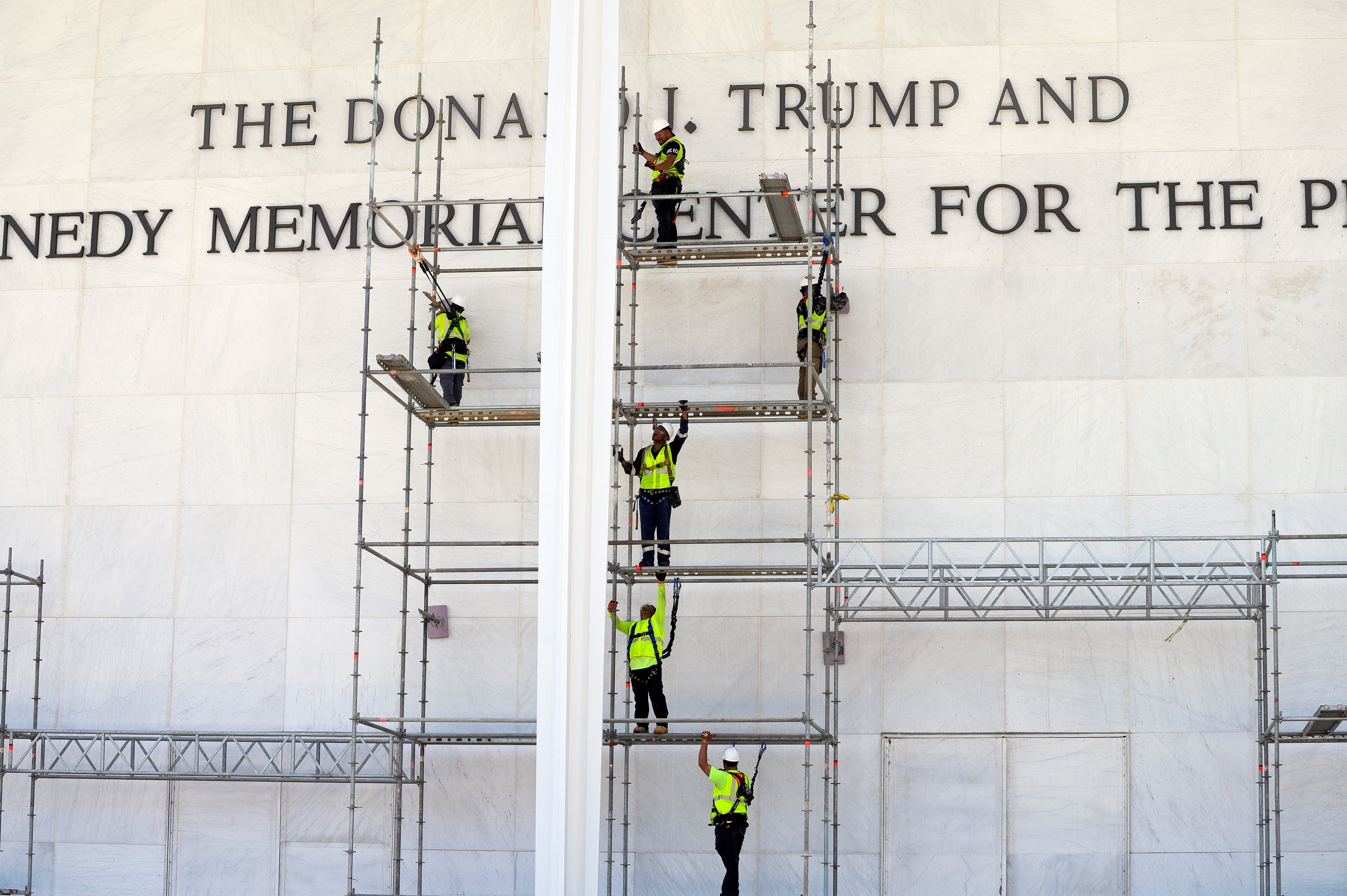
Tribunal tinha ordenado a retirada do nome do atual Presidente e centro cultural pediu a prorrogação do prazo para a realização dos trabalhos, que já terão ficado concluídos este sábado.
Work began in the early hours after the Department of Justice said the government would miss a court-ordered deadline to take Trump’s name off the Washington venue.
Work began in the early hours after the Department of Justice said the government would miss a court-ordered deadline to take Trump’s name off the Washington venue.
Madalena Mayer Resende admite que Irão e EUA podem estar perto de fechar um entendimento claro. Sublinha, no entanto, a questão nuclear ainda pendente.
Los tiempos extraordinarios que vive Washington exigen medidas extraordinarias. Por ejemplo, la retransmisión en directo, a través de YouTube y de las webs de varios medios de comunicación, de la anodina operación de levantar un andamio para que unos obreros, subidos a él, retiren las letras de molde de una fachada.
Tribunal tinha ordenado a retirada do nome do atual Presidente e centro cultural pediu a prorrogação do prazo para a realização dos trabalhos, que já terão ficado concluídos este sábado.
A época balnear está oficialmente aberta em todo o país, segundo a Agência Portuguesa do Ambiente. Ainda neste jornal, damos destaque ao possível acordo entre Irão e Estados Unidos.
Most tourists just pass through Botafogo, but they’re missing out, says Gordon Thomson. He suggests visitors stay a couple of days to explore the intriguing history, lively food scene and passionate football culture
A época balnear está oficialmente aberta em todo o país, segundo a Agência Portuguesa do Ambiente. Ainda neste jornal, damos destaque ao possível acordo entre Irão e Estados Unidos.
Alfama volta a vencer as Marchas de Lisboa, 8 anos depois. Ainda, o embaixador de Portugal na NATO garante que o compromisso dos Estados Unidos com o artigo 5.º não está em causa.
Alfama volta a vencer as Marchas de Lisboa, 8 anos depois. Ainda, o embaixador de Portugal na NATO garante que o compromisso dos Estados Unidos com o artigo 5.º não está em causa.
 Login
Login