Reform UK leader used private meeting at Bank of England to urge governor to drop plans for state-run cryptocurrency
Nigel Farage has been trying to block a Bank of England cryptocurrency plan that could be costly for the billionaire bankrolling his party.
The Reform UK leader has said Christopher Harborne wants nothing in exchange for the millions he has donated to the party and the undeclared £5m personal gift to Farage that the Guardian revealed in April.
La suerte política del Reino Unido está este jueves en las manos de 76.000 votantes. Desde primera hora de la mañana han abierto las urnas en todas las medianas y pequeñas ciudades y villas del distrito electoral de Makerfield, al noroeste de Inglaterra. Una zona pegada a Mánchester, cuyo alcalde, el laborista Andy Burnham, está decidido, si gana estas elecciones, a desafiar el liderazgo del actual primer ministro, Keir Starmer, para tomar él las riendas del país.
Does the Bible, the best-selling and most translated book in all of history, mention Greek mythology’s Atlantis? Map of lost Atlantis. Credit: Public Domain
In the fourth century BCE, Plato wrote about the legend of Atlantis. The general belief is that he was the very first person to write about it. This has led many to claim that Plato invented the story. However, is it possible that the Bible makes reference to the story of Atlantis, too?
The Minoan Theory of Atlantis
One common theory about the origin of Atlantis is that it comes from distorted accounts of the Minoan civilization. This was a Bronze Age naval civilization centered on Crete. The Minoans had control over several other islands, and they also had colonies on the Anatolian mainland. This is just as Plato described the civilization of Atlantis. Various other similarities exist between the Minoans and Atlantis.
Although this Minoan theory is not universally accepted, there are many scholars who support it. It is even mentioned in the Encyclopedia Britannica as a possible source of the legend. However, one issue that has been brought against this theory is that Atlantis was said to have engaged in violent conquest. Plato describes how the men of Atlantis waged war against several of the Mediterranean nations.
Regarding the Minoans, archaeologists know that they did engage in war against the Greeks. However, while they had a grand trading empire, there is little evidence they engaged in violent conquest.
Nonetheless, the Bible provides support for this Atlantis theory by recording certain information pertaining to the activities of the Minoans. Let us examine what this evidence is and how it shows that the Bible does, in effect, mention Atlantis.
Caphtor, the Atlantis of the Bible
The Bible mentions the Minoans in that it references the Cretans of the Bronze Age. The ancient Hebrew name for Crete was Caphtor. This seems to be related to the ancient Egyptian name for Crete, which was Keftiu.
The Bible only mentions the Caphtorim, that is, the people of Caphtor, a handful of times. One of these mentions in the Bible may well be related to Plato’s story of Atlantis. It appears in the Book of Deuteronomy. The account is set in the time of Moses, who lived around 1500 BCE.
This was the era of the Minoan civilization and was only shortly before the Mycenaean Greeks overthrew it. The account itself describes events that occurred sometime before Moses’ day although it does not say exactly when they happened.
The Bible’s account of Minoan conquerors
On the left is a fresco depicting a Minoan women and on the right, a plaster cast of a Mycenaean woman. Take note of the distinctive colors of the Mycenaean plaster, which may be representative of preferences for makeup. Credit: I Sailko / CC BY-SA 3.0 / Sharon Mollerus / CC BY 2.0 / Wikimedia Commons
The beginning of the Book of Deuteronomy provides an overview of the Promised Land, that is, the land of Canaan. In Deuteronomy 2:23, we find the following information about a certain region of it:
“As for the Avvim, they had dwelled in settlements as far as Gaza until the Caphtorim, who came out from Caphtor, annihilated them and settled in their place.”
According to this, the Caphtorim had “annihilated” the Avvim in southwestern Canaan and taken over their territory. It should be kept in mind that the Caphtorim are the men of Crete, and this account is set around 1500 BCE.
This would mean that the Caphtorim mentioned here are actually the Minoans. In other words, the Minoan civilization is identified with Atlantis. This is quite a significant assumption. It would mean that the Bible describes the Minoans attacking and conquering part of the mainland on the Mediterranean coast.
How the Bible supports the Minoan theory of Atlantis
This strongly supports the Minoan theory of Atlantis. It disproves the notion that the Minoans were not known conquerors. Even if the Bible is rejected as a historical source, as many would have it, this demonstrates at the very least that there was a tradition of the Minoans engaging in conquest during the Bronze Age.
There is, in fact, some archaeological evidence supporting Minoan presence in Canaan in that era and even earlier. One example is the presence of Minoan Kamares ware in the city of Ashkelon dating to around 1800 BCE.
However, regardless of historical facts, the Bible proves that the Bronze Age Minoans were remembered for being violent conquerors, which is the important thing when it comes to the legend of Atlantis. This provides strong support for the theory that the Minoans were the likely origin of the legend of Atlantis. This being the case, it would mean that the real Atlantis is indeed mentioned in the Bible.
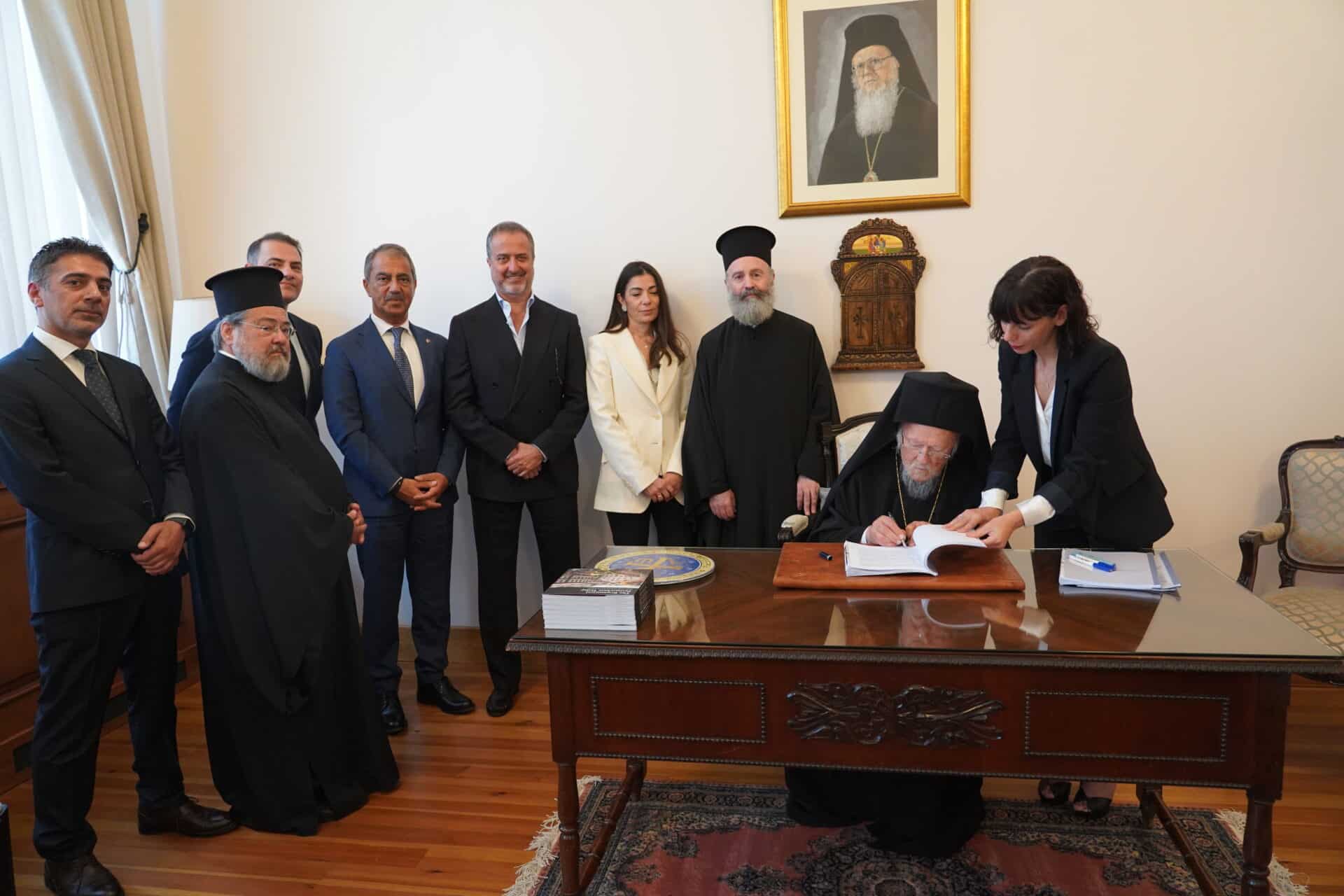
Ecumenical Patriarch Bartholomew signs the agreement for the Prinkipo Orphanage. Seen are Archbishop Makarios of Australia, chairman of the committee, Metropolitan Theoliptos of Iconium, and other representatives. Credit: Ecumenical Patriarchate/ Nikos Papachristou
The Ecumenical Patriarchate has signed an agreement with Turkish and Greek investment companies for the redevelopment of the historic Prinkipo Greek Orphanage on the island of Prinkipo (Buyukada), paving the way for the restoration and conversion of the landmark building into a high-end hotel.
The agreement was signed on June 15 by Ecumenical Patriarch Bartholomew and Serdar Bilgili, Chairman of Bilgili Holding, a leading Turkish real estate investment company, in the presence of Costantza Sbokou-Konstantakopoulou, representing ENSOFI Holding, a Greek company active in sustainable tourism development and real estate investments.
According to an announcement issued by the Ecumenical Patriarchate, the agreement concerns the management and redevelopment of the historic property, which has remained unused and deteriorating for decades.
The signing ceremony took place at the Maraslios School in the Phanar. Among those present were Archbishop Makarios of Australia, Chairman of the Special Committee of the Ecumenical Patriarchate that studied and finalized the agreement.
The historic Prinkipo Greek Orphanage on the island of Prinkipo. Credit: Zamir Saglikoglu CC BY-SA-4.0
The history of the Prinkipo Greek Orphanage
The Prinkipo Greek Orphanage is one of the most significant historic properties associated with the Ecumenical Patriarchate. Constructed at the end of the nineteenth century as the intended “Prinkipo Palace” hotel, the building was never used for that purpose. In 1903, it was donated to the Patriarchate by the benefactress Eleni Zarifi and subsequently operated as an orphanage and residence for children until 1964, when it was closed by Turkish authorities.
For decades, the future of the massive wooden structure remained uncertain. In 2010, following an appeal by the Ecumenical Patriarchate, the European Court of Human Rights ruled in favor of the Patriarchate and recognized its ownership rights over the property after a lengthy legal dispute with the Turkish state.
That landmark decision enabled the Patriarchate to pursue options for preserving and restoring the historic building. However, efforts to restore it did not yield a solution because the cost of full restoration remained exceptionally high, and parts of the wooden edifice had already suffered severe collapses. According to the Patriarchate, the newly signed agreement represents the culmination of years of efforts to secure a sustainable future for the property while preserving its historical and cultural significance.
The Prinkipo Greek Orphanage is widely regarded as one of the largest wooden buildings in Europe and remains one of the most recognizable symbols of the historic Greek presence in Constantinople.

 Login
Login