Normal view

Molon Lave: The Ancient Greek Phrase of Defiance Turned Global Marketing Tool

13 June 2026 at 16:10
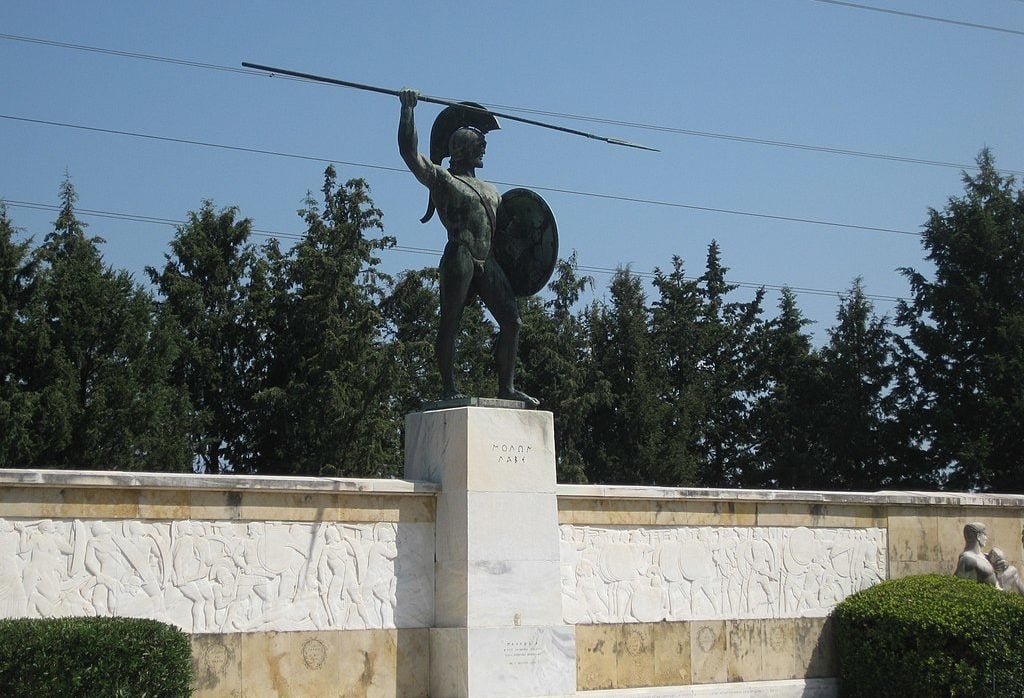
staue of Leonidas king of sparta
Statue of Leonidas of Sparta, Greece. Credit: Dmpexr/Wikimedia Commons/CC BY-SA 4.0

It was in 480 BC during the second Persian invasion of Greece, when King Leonidas of Sparta ahead of the legendary Battle of Thermopylae responded by the phrase “Molon Lave” (‘Come and Take Them’ in ancient Greek) to Persian King Xerxes’ demand that the Spartan army lay down their weapons and surrender to his army. The outnumbered Greeks were eventually annihilated, though they held Thermopylae for three days and inflicted serious damage to the Persians, while delaying them from reaching Athens.

That’s how the story ended back then. But little did King Leonidas know that over 2,500 years later, his “Molon Lave” phrase (also spelled “Molon Labe” by many) would not only become immortalized through the centuries but moreover, it would thrive as a global marketing tool -linked to the sale of weapons, wine, olive oil, expensive watches and even cigars.

King Leonidas I reigned the ancient city-state of Sparta, a warrior society, from 489 to 480 BC. Subjected to military drills since early manhood, the Spartans had become one of the most feared and formidable military forces in the ancient Greek world, attaining legendary status in their wars against Persia. At the height of Sparta’s power, between the 6th and 4th centuries BC, according to Peter Connolly, a British historian and the scholar of the ancient world, other Greeks commonly accepted that “one Spartan was worth several men of any other state.”

“The appeal of Molon Lave comes from its Spartan origins,” Effie Delimarkos-Fletcher, a Greek-American communications expert and marketing strategist tells Greek Reporter. “Spartans themselves have come to symbolize power, strength, resolve, and defiance, which was catapulted into the mainstream with the debut movie of ‘300.’ As a result, aligning with the phrase “Molon Lave” is a distinct way for a brand to signal strength and prowess in an area worth defending.”

Moreover, there are few other phrases like “Molon Lave,” where two single, short words are able to convey all that, perhaps the most famous military last stand of all time, embodies -defiance, strength and resolve. Spartans were expected to be men of few words, famous for using “laconic phrases,” named after Laconia, the region of Greece, including the city of Sparta, whose ancient inhabitants had a reputation for verbal austerity. A laconic phrase was used for efficiency (as during military training and operations), for emphasis or to deflate a pompous speaker.

Molon Lave marketing knife
The company has applied for and successfully registered the ‘Molon Lave’ brand in Greek, as seen on the handle of the knife. Credit: Panther Wholesale
Molon Lave marketing cigars
Another Florida-based company named “Molon Labe” is selling high-quality cigars, spirits and coffee, and as with most other businesses, is also using a Spartan helmet on its logo. Credit: Molon Labe Official Instagram Account

Military, the industry where Molon Lave has the largest appeal as a brand

From tactical patches and other military paraphernalia sold online, to assault rifles sold in stores across the United States, the phrase “Molon Lave” graces thousands of military-related products.

According to Delimarkos-Fletcher, Molon Lave and its English translation “Come and Take Them” has been present in the country’s early DNA as it is said to have been used as far back as the Revolutionary War. Even so, it is better known for its connection to the Texas Revolutionary War, when the phrase was stitched onto a flag that has come to be associated with the defiant spirit of the state. In more recent times, many U.S.-based militia groups and paramilitary organizations have taken the phrase “Molon Lave,” and often the depiction of a Spartan helmet, signaling defiance for gun regulations.

“Because Molon Lave has been adopted by militia-type groups in the United States, securing the Molon Lave trademark is done by companies looking to appeal to that target,” Delimarkos-Fletcher says.

And that’s exactly what at least one US.-based company had done. A short Greek Reporter investigation revealed that, while there are hundreds of knives and weapons with the phrase “Molon Lave” appearing on them in different variations, in 2015 this one company has gone as far as to apply for and successfully register a year later a trademark for the original Molon Lave phrase in Greek (ΜΟΛΩΝ ΛΑΒΕ) for one of its knives selection. The company, advertises the knives on its website by stating “It takes a bold individual to make a statement of defiance like ‘Come and Take Them (Molon Labe),’ we provide the knives that re-enforce the bravado.”

But can a company apply and secure a trademark for the use of a common, ancient phrase like Molon Lave, that seems almost free for anyone to use?

According to Pamela Koslyn, a Los Angeles-based attorney specializing in intellectual property law, U.S. legislation allows a company to successfully apply for a trademark for a brand new phrase, or an “ancient” phrase or an invented word/phrase, with the age and origin of the phrase being irrelevant.

“A trademark isn’t a monopoly on a phrase, it’s a source identifier of some phrase associated with some goods or services. Like knives. Or olive oil. Or wine. These are all actual “live or pending marks of Molon Lave…There’s also a Chinese textile seller called Molon Lave,” Koslyn tells Greek Reporter. “If a user has a registered trademark on a phrase in a particular class, e.g. knives, that means the user own the exclusive right to use their mark in association with their goods or services and can theoretically successfully sue and enjoin any competitor who infringes those rights by using the same or confusingly similar mark for the same or confusingly similar goods or services.”

Still, Koslyn notes, that one in two trademark applications to the United States Patent and Trademark Office (USPTO) fail not only because they’re not viable or available but moreover because of the complexity of the law and the time needed to find out if an application has been approved by USPTO -a process that could take months if not years.

Molon Lave marketing taverna
On its website, the restaurant says that it’s “based on the Spartan epic saying Molon Lave, which means ‘Come and Get Them,'” and has a mission “to celebrate and share Greek cuisine and culture.”Credit: Molon Lave Taverna Official Instagram Account

The famous ancient Greek phrase many want to own

But few actually register the phrase in order to enhance their branding or make their products stand out more. Given the enormous competition among companies to win the hearts of consumers, proper branding and marketing could mean the difference between life and death for a company. And given its global fame, that’s exactly what “Molon Lave” does.

Nowhere is this more obvious than in the United States, the beating heart of global consumerism. A family-owned farm winery in Virginia was established in 2009 under the name “Molon Lave.” Aside from informing its customers that it also produces “kokkineli,” a traditional Greek style rose, the winery fully explains on its website the origins of its name, noting that “‘Molon Lave’ is a phrase that has inspired throughout the centuries a sense of dignity and pride, and a unique perception of life.”

Another Florida-based company named “Molon Labe” is selling high-quality cigars, spirits and coffee, as with most other businesses, also using a Spartan helmet on its logo. Moreover, the cigars are wrapped in paper bearing the phrase in Greek. The company on its website gives no explanation as to why it chose the specific name.

Molon Lave marketing watches
A consumer browsing the handmade watches of the UK-based company. Credit: Greek Reporter

Greek Reporter’s investigation also found a watch company with the name “Molon Labe” based in the UK, selling handmade, military watches inspired by the phrase, with some having a price tag of over $1,500. There’s also a global security company named “Molon Lave,” an information technology service activity company in the UK and a gym in Cyprus, featuring on its premises the bust of a muscular Spartan soldier alongside the “Molon Lave” phrase, which is showcased in ancient Greek type. The list goes on.

With a fortitude reminiscent of the very people it once represented, the phrase “Molon Lave” survived to this day as one of the few expressions that so efficiently evoke an immediate connection not only to power but also to Greece.

It is no wonder the phrase has also been adopted as the name of a “small, Greek authentic restaurant” in Ontario, Canada, which on its website says that it’s “based on the Spartan epic saying Molon Lave, which means ‘Come and Get Them,'” and has a mission “to celebrate and share Greek cuisine and culture.”

At the same time, a thriving Greek olive oil brand named “Molon Lave” based in Sparta, the place where King Leonidas and his Spartan warriors once lived, is probably one of the more successful examples using the phrase as a marketing tool.

Delimarkos-Fletcher says many using the phrase may not even know its true origins so it is refreshing to see Greek-related businesses reclaiming Molon Lave as they “seek to evoke a connection to the best known story of Greek strength and prowess.”

“Other brands are just using ‘Molon Lave’ as shorthand for having something powerful enough that others want for their own,” Delimarkos-Fletcher tells Greek Reporter.
Molon Lave marketing wine
The winery explains on its website the origins of its name, noting that “‘Molon Lave’ is a phrase that has inspired throughout the centuries a sense of dignity and pride, and a unique perception of life.”Credit: Molon Lave Vineyards Official Instagram Account


Poland Officially Recognizes Greeks as National Minority

13 June 2026 at 16:03
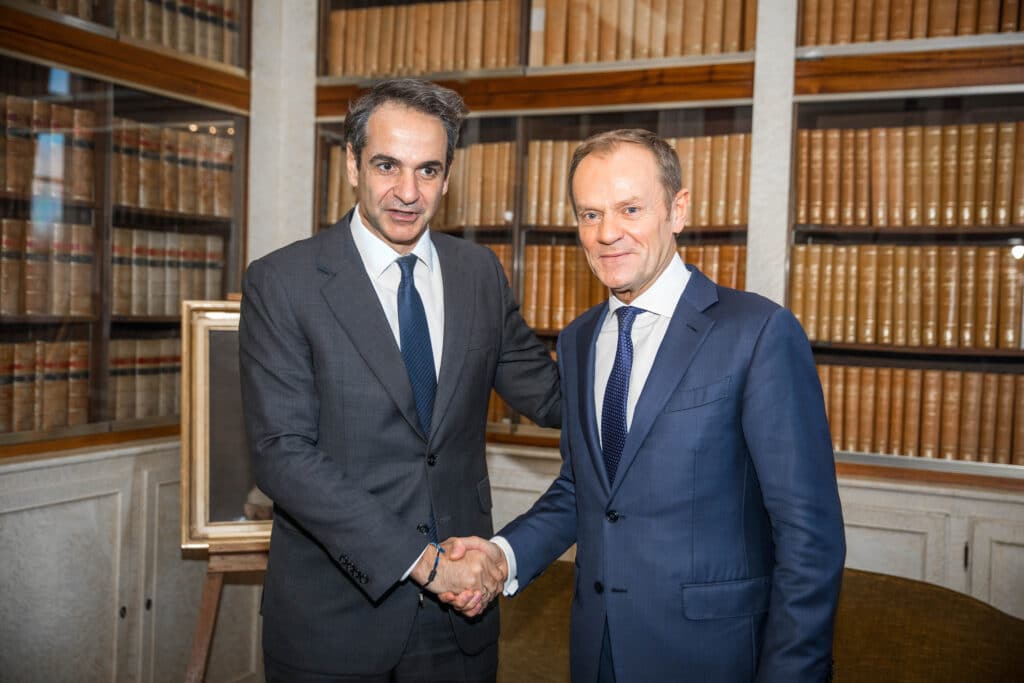
Prime Minister of Greece Kyriakos Mitsotakis with Prime Minister of Poland Donald Tusk. Greeks were officially recognized as a minority in Poland.
Prime Minister of Greece Kyriakos Mitsotakis with Prime Minister of Poland Donald Tusk. Credit: connect@epp.eu. CC BY 2.0/flickr

The Greek community in Poland has now officially been recognized as a national minority following the signing of a legislative amendment by the President of Poland, Karol Nawrocki.

According to an announcement by the Embassy of Greece in Warsaw, the process of amending the law concerning national and ethnic minorities and regional languages ​​was finalized, with the result being that the Greek community is now included in the recognized national minorities of Poland.

There are currently 3,600 to 4,000 Greeks living in Poland, according to Greece’s Ministry of Foreign Affairs, with the Greek presence in the country going back to the Middle Ages. The new demographic development makes Greeks the tenth recognized national minority in Poland and established a new institutional framework for the operation and development of Greek communities.

Provisions for acquiring national minority status in Poland

Under the provisions of the 2005 Act in Article 2(1), a community can be recognized as a national minority in Poland after fulfilling all of the following conditions:

  • Is smaller in number than the rest of the population of the Republic of Poland
  • Is significantly different from other citizens in terms of language, culture, or traditions
  • Strives to preserve its language, culture, or traditions
  • Is aware of its own historical national community and is oriented towards its expression and protection
  • Its ancestors have inhabited the present territory of the Republic of Poland for at least 100 years
  • It identifies with the nation organized in its own state (Polish Parliament, 2005)

The Greek community in Poland meets all the criteria and is therefore now an official national minority.

Rights and benefits for Greek minority in Poland

With the implementation of the new law, Greek associations and organizations gain access to state funding programs through the Ministry of the Interior and Administration of Poland. At the same time, support is provided for cultural activities and structures, such as libraries, museums, cultural centers, festivals, and media related to the Greek presence in the country.

Particular emphasis is also attributed to education. The Polish public education system will be able to organize programs in the instruction of the Greek language, history, and culture for students of Greek origin. The new framework also provides for the possibility of using traditional Greek script in the personal details of community members in official documents, where this is permitted by law.

Political representation

Recognition as a national minority is also accompanied by special political provisions. These include the exemption of the electoral committees of the Greek community from the five percent electoral threshold in the elections for the Polish Parliament (Sejm), as is the case for other recognized minorities.

In a statement, the Embassy of Greece in Warsaw thanked the Polish institutions for the decision, making special reference to the Lower House, the Senate, and the President of the Republic. At the same time, it underlined the contribution of the Greek community itself and the diaspora, noting that after many years of efforts by Greeks, its members contributed to achieving recognition. The legislative amendment is expected to go into effect six months after its publication in the Polish Government Gazette.

Greece Inaugurates First Armed Forces Factory Dedicated to Drone Production

13 June 2026 at 16:19
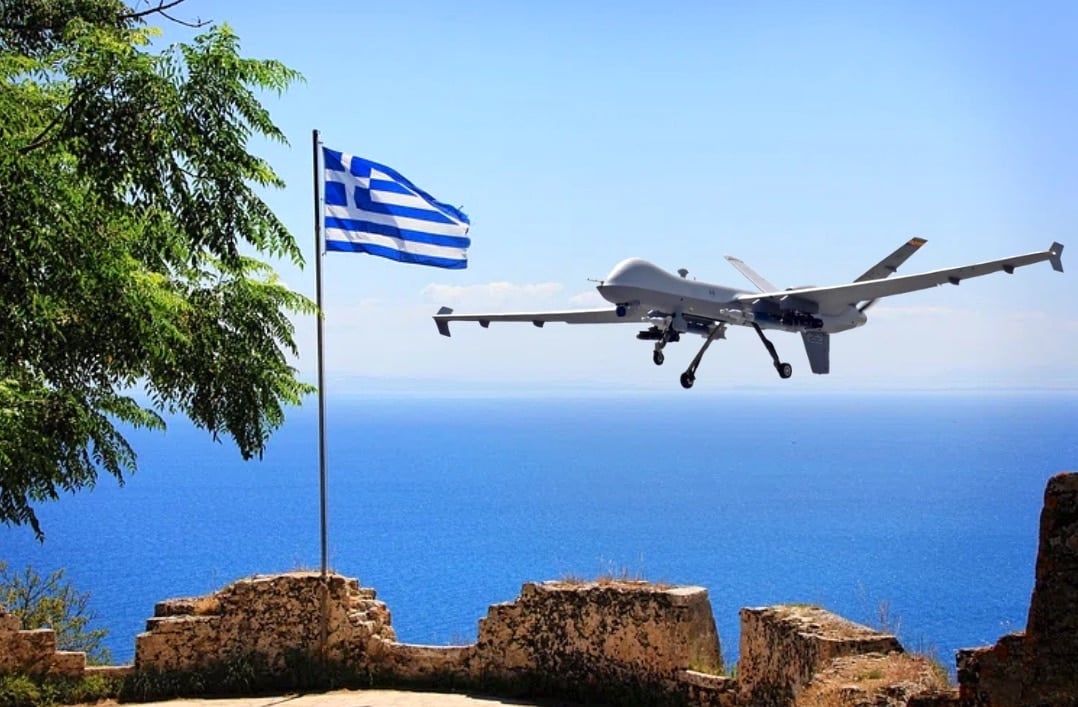
drone greece
Greece launched a new plant to increase the industrial-scale production of drones. Credit: GreekReporter Archive

Greece inaugurated a new manufacturing plant on Friday to upgrade the production of drones (Unmanned Aerial Vehicles, or UAVs) on an industrial scale. Greek Minister of National Defense, Nikos Dendias led the inauguration ceremony of the 309th Unmanned Aerial Vehicle Systems Manufacturing Plant in Malakasa in Greater Athens (Attica).

“Unmanned Systems and Unmanned Countermeasure Systems, i.e. anti-drones, are an integral part of the new operational concept of the Armed Forces,” Dendias stated. “The new Unmanned Systems Manufacturing Factory is coming to transform an initial capability into an industrial-scale production. It is the first large industrial installation of the Greek Armed Forces that is completely specialized in the manufacturing of Unmanned Vehicles.”

The project inaugurated includes two distinct interventions in the Armed Forces Camp: complete reconstruction and modernization of the old facilities of the camp with restoration of its static adequacy as well as external and internal damages. The facilities will be converted into modern production, support, and technical work areas and cover an area of ​​2,800 square meters (almost 30,140 sq ft). The necessary steps are currently being taken so that work on the 309th Factory can begin within 2026.

Greek Defense Minister Nikos Dendias, who inaugurated a new drone manufacturing and R&D facility.
Greek Defense Minister Nikos Dendias inaugurated a new drone manufacturing and R&D facility. Photo credit: AMNA

More production lines and RD facilities

The Greek Defense Minister spoke about the new facility being part of the new Armed Forces project:

“The ‘2030 Agenda’ is a holistic program for the protection of our homeland with a specific design. The ‘Achilles Shield’ project…extends to the sea, on land, in the air, but now also in cyberspace and space. And it has a basic concept, a basic parameter: the change of everything as we know it. Today’s ceremony marks this program. Unmanned Systems and Systems for Countering Unmanned Systems, i.e. anti-drones, are an integral part of the new concept of operations. Autonomous Systems in the air, at sea, and on land, are the organic element of the modern operational environment, across the entire spectrum of missions.”

Dendias also touched on the importance of the Greek Armed Forces being prepared to respond to international threats: “A country that has received an active threat against it, does not have the luxury of passively monitoring what is happening.” The new facilities in Greece will develop production lines for: class I and II drones, research and development of class III drones, Unmanned Ground Vehicles, Unmanned Surface Vessels, Unmanned Underwater Systems, and anti-drone manufacturing.

“A leap forward” in drone production in Greece

According to the Defense Minister, the goal is to increase the annual production of class I drones to at least ten thousand from the current four thousand, the annual production of at least three hundred class II drones, as well as three hundred ground vehicles and an equal number of anti-drones, while building up the capabilities for Research and Development of Surface Vessels and Submarine Vessels.

The second major intervention is the construction of a new building with a total area of ​​3,600 square meters (38,750 sq ft) to develop on two levels. This will constitute the core of the complex, housing advanced production lines, Research and Development areas, Laboratories and Test Centers.

In addition to an increase in production, its construction will also allow for new specialized R&D capabilities as well as close cooperation with the defense industry and the country’s research institutions.

“Today,” Dendias emphasized, “we are taking a big step forward. I dare say, a leap. This new Unmanned Systems Manufacturing Factory is coming to transform an initial capability into an industrial-scale production. It is the first large industrial installation of the Greek Armed Forces, which is completely specialized in the manufacturing of Unmanned Vehicles. The 309th Unmanned Vehicle Systems Factory.”

Levissi: The Ghost Village in Turkey Once Home to 10,000 Greeks

13 June 2026 at 11:01
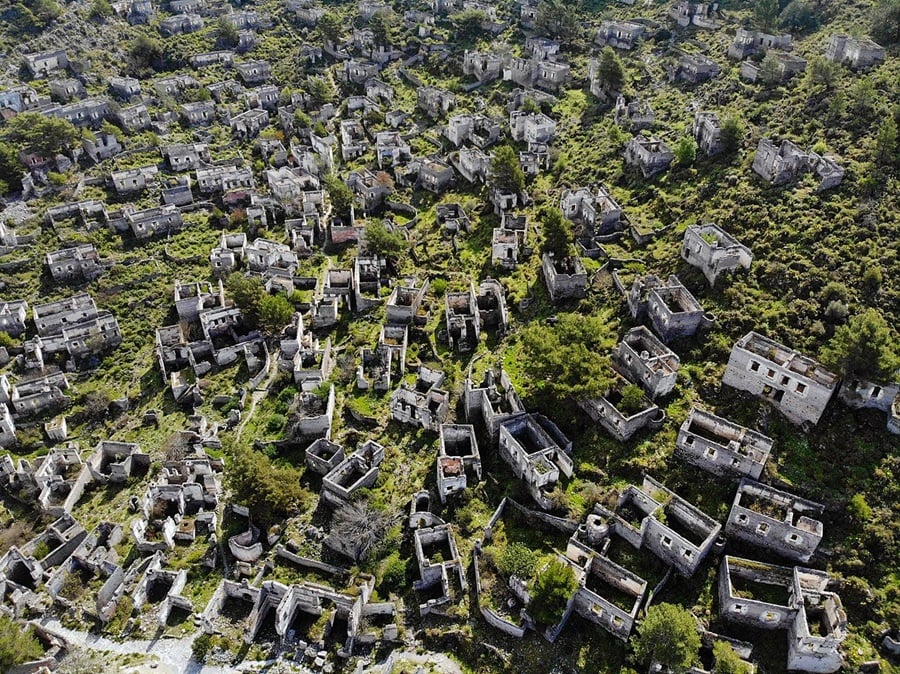
Levissi: The Abandoned Greek Village
Greeks of the 5,000-year-old village were ethnically cleansed and then forcibly expelled in 1922. Credit: Wikitestaccountlogin, CC BY-SA 4.0/Wikipedia

The ghost village of Levissi (known today as Kayaköy) was once a bustling Greek village on the slopes of a hill in the district of Fethiye, Turkey.

It was practically right across from the island of Rhodes.

Greeks of the 5,000-year-old village were ethnically cleansed and then forcibly expelled in 1922, causing 10,000 people to leave behind the land of their heritage.

It was anciently known in Greek as Karmylessos. In late antiquity, the inhabitants of the region had become Christian, and, following the East-West Schism with the Church of Rome in 1054 AD, they came to be called Greek Orthodox Christians.

These Greek-speaking Christian subjects and their Turkish-speaking Muslim Ottoman rulers lived in relative harmony from the end of the turbulent Ottoman conquest of the region in the 14th century until the early 20th century.

The massacres of Greeks and other Christian minorities in the Ottoman Empire during World War I (1914–1918) led to the almost total depopulation of the town’s 6,500 Greek inhabitants by 1918. These former inhabitants were deprived of their properties and became refugees in Greece, or they died in Ottoman forced labor battalions.

Following the Greco-Turkish War of 1919–1922 and the subsequent Treaty of Lausanne in 1923, the town’s Greek Orthodox residents were exiled.

Levissi: The Abandoned Greek Village
A panoramic photo of the abandoned village. Credit: Darwinek, CC BY-SA 3.0/Wikipedia

Greek ghost town

Since then, the homes have remained vacant, left to decay after being further damaged by a huge earthquake in 1957.

Houses and churches in the area have been used for summer festivals. However, plans to lease the area and auction it off for commercial interests have caused local Turks as well as Greeks with roots in the area to protest. They are worried that the investors could further ruin the authenticity of the area.

Levissi: The Abandoned Greek Village
An abandoned church. Credit: Orderinchaos , CC BY-SA 3.0/Wikipedia

The ghost town, now preserved as a museum village, consists of hundreds of rundown but still mostly standing Greek-style houses and churches that cover a small mountainside and serve as a stopping place for tourists visiting Fethiye and nearby Ölüdeniz.

The village is now empty except for tour groups and roadside vendors selling handmade goods. There are a few houses which have been restored and are currently occupied.

American filmmaker Joerg Schodl set out to document what is left of the ghost town in his documentary, “Ghosts of Levissi.”

Schodl tells the tale of the small Greek community in Asia Minor that was torn apart during the final days of the Ottoman Empire. It focuses on the disappearance of the population practically overnight thanks to campaigns, designed to scare Greeks from Levissi and nearby Macri (known as Fethiye), including offensives by Turks. The site Greek Genocide reports that women were raped and their clothes and shoes taken from them.

When making the film, Schodl had the help of members of the Greek community in Melbourne, Adelaide, Sydney, Perth and Brisbane and he was able to find thirteen descendants of Levissi families.

More descendants were found in Toronto, Rhodes, London, Athens and Istanbul.

The Julius Caesar and Cleopatra’s Love Affair Revisited

By: guest
13 June 2026 at 02:02
Julius Caesar and Cleopatra's love affair
Caesar giving Cleopatra the Throne of Egypt. Public Domain

The Greek queen of Egypt Cleopatra is associated with a very public love affair with Roman leader Julius Caesar apart from her glamorous beauty routines, deadly snake bites, and lavish banquets. But their “situationship” was complex, according to two historians.

By Charlotte Dunn and Jayne Knight

This doomed romance ended abruptly in 44 BC when Caesar was quite literally stabbed in the back (and from all sides) by his enemies in Rome. And she pretty soon hooked up with one of his closest allies.

When Caesar met Cleopatra, he was 52 and had a wife back in Rome. But something about the 21-year-old Cleopatra caught his eye.

Perhaps it was her charming banter and impressive mind. The ancient author Plutarch reports Cleopatra was an irresistible conversation partner, and fluent in nine languages.

Things really got started when Caesar got involved in a family feud involving Cleopatra and her royal relatives.

Cleopatra came from a long line of dramatic and ruthless kings and queens, which we now call the Ptolemies.

The Ptolemies had ruled Egypt since about 305 or 304 BC. They didn’t always get along but they were very close. As in, genetically close.

The Ptolemies had practiced brother-sister marriages (and other in-the-family marriages as well) for several generations.

According to this tradition, Cleopatra was probably married to her ten-year-old brother Ptolemy XIII when their father died and they became co-rulers of Egypt.

Cleopatra pursued Julius Caesar

Cleopatra VII
Left: a Roman sculpture of Cleopatra VII wearing a royal diadem, mid-1st century BC (around the time of her visits to Rome in 46–44 BC). Right: A posthumous painted portrait of Cleopatra VII of Ptolemaic Egypt from Roman Herculaneum, made during the 1st century AD. Credit: Louis le Grand / Public domain / Wikimedia Commons (right) / Ángel M / Public Domain / Wikimedia Commons

So in pursuing Caesar, you might say Cleopatra was going against the family trend by dating outside her siblings.

Cleopatra’s union with her little brother was not a happy one: the young Ptolemy, alongside his advisors, had managed to run Cleopatra out of Egypt, wanting to rule the kingdom without her interfering.

While Cleopatra was busy raising an army to reclaim her place on the throne, Caesar arrived at the royal palace at Alexandria in 48 BC.

Caesar had his own political woes. He was in the middle of a civil war and was pursuing his rival Gnaeus Pompey (also known as Pompey the Great) after defeating his army in Greece.

Ptolemy, completely misreading the situation, greeted Caesar with a gruesome and unexpected gift: Pompey’s severed head.

Outraged and disgusted, Caesar demanded Cleopatra and her brother reconcile, but Cleopatra had other plans.

Plutarch says she hid herself in a bed sack and got smuggled into the palace to meet and charm Caesar.

Was it true love?

The young Cleopatra was ambitious, and there’s no denying a connection with Caesar was politically advantageous.

Caesar also had plenty of other affairs, including one with another queen, Eunoë of Mauretania.

But there may well have been a true connection with Cleopatra. Caesar, after all, was also very well educated and ruthlessly ambitious, and the ancient author Suetonius states Cleopatra was Caesar’s most passionate love affair.

But whatever sparks flew, Cleopatra couldn’t fully escape her family responsibilities.

Caesar put her back on the throne but arranged for her to marry her youngest brother, Ptolemy XIV after her previous brother-husband (Ptolemy XIII) drowned.

Nothing spells romance like your lover ordering you to marry your 12-year-old brother, but Cleopatra needed Caesar’s help to secure her position on the throne.

Being older and ambitious, she seemingly had no trouble taking the lead in running their kingdom, pushing Ptolemy XIV to one side.

Cleopatra
Cleopatra is famed for her lovers, but beyond romantic interests, these were important political allies. Credit: Lawrence Alma Tadema / Public Domain / Wikimedia Commons

Cleopatra and Julius Caesar take a luxurious cruise down the Nile

Some sources say Cleopatra and Caesar celebrated their success at smoothing things over in Alexandria by taking a luxurious cruise down the Nile, accompanied by 400 ships.

This promoted their partnership and alliance, and by this time there was something else to celebrate: Cleopatra was pregnant with Caesar’s son, something she wanted to advertise as the future of her dynasty.

Cleopatra and Caesar’s son was nicknamed Caesarion, meaning “little Caesar”, although he is also known as Ptolemy Caesar or Ptolemy XV.

Caesarion’s existence was a bit of a problem. Caesar probably acknowledged the boy as his son, but Roman law did not, because Roman men were not allowed to marry foreign women.

There was also of course the matter that Caesar was still married at the time, to a Roman woman named Calpurnia.

The fiercely republican Romans of this era did not have much love for monarchy, and Caesar’s dalliance with Cleopatra probably made his fellow Romans even more suspicious about his own grand plans.

When in Rome

Despite many Romans disapproving of the relationship, the Egyptian queen spent about 18 months living on Caesar’s estate in Rome.

While there, Caesar seems to have done nothing to dispel the rumours about his situationship with Cleopatra, and he may have even dedicated a golden statue of Cleopatra as Venus in the temple of Venus Genetrix.

The famous orator Cicero was not impressed, writing in a letter to a friend “reginam odi” or “I hate the queen.”

After Caesar’s assassination, Cleopatra returned to Egypt.

But she soon began a love affair with Marc Antony, Caesar’s right-hand man and would-be successor to his power, if 19-year-old Octavian (who would eventually become the first emperor Augustus) had not been named heir in Caesar’s will.

Antony and Cleopatra’s relationship flourished but ended in tragedy when Octavian’s political rivalry with Antony intensified, and Octavian used their relationship as fuel for anti-Antony propaganda.

The lovers were eventually pursued and defeated by Octavian’s forces. Both took their own lives – he stabbed himself with a sword and she, according to one version of the tale, by compelling a snake to bite her.

Charlotte Dunn is a Lecturer in Classics, the University of Tasmania

Jayne Knight is a Senior Lecturer in Classics, the University of Tasmania

The article was published in The Conversation and is republished under a Creative Commons License

❌