Normal view

Wegovy weight-loss pills to be available for patients in UK to buy

Regulator approval means patients who meet criteria will be able to purchase tablets with private prescription

Patients in the UK will soon be able to buy the Wegovy weight-loss pill, the medicines regulator announced on Thursday.

It is the first GLP-1 receptor agonist tablet for weight-loss to be approved by the Medicines and Healthcare products Regulatory Agency (MHRA), making the UK the third country to authorise the pills, behind the US and the United Arab Emirates.

Continue reading...

© Photograph: Bloomberg/Getty Images

© Photograph: Bloomberg/Getty Images

© Photograph: Bloomberg/Getty Images

London council seizes social housing flat rented by Sierra Leone first lady

11 June 2026 at 16:19

Fatima Jabbe-Bio kept tenancy in Southwark despite living for much of year at presidential lodge in Freetown

A social housing flat rented by Sierra Leone’s first lady has been seized by a London council.

Southwark council confirmed it had repossessed the two-bedroom home in Walworth previously occupied by Fatima Jabbe-Bio, whose tenancy was reported by the Times last year.

Continue reading...

© Photograph: Ahmed Jallanzo/EPA

© Photograph: Ahmed Jallanzo/EPA

© Photograph: Ahmed Jallanzo/EPA

Russian Hockey Player Yegor Yadykin Dies in Hunting Accident

11 June 2026 at 16:04
Russian hockey player Yegor Yadykin, a graduate of Avangard Omsk's youth system, died in the city of Salavat in the Republic of Bashkortostan following a tragic hunting accident. Fatal Accident During Hunting Trip According to reports, the 21-year-old athlete was traveling to a forested area with his grandfather. At one point, Yadykin, who was seated in the back seat of the vehicle, reached toward the front seat when a shotgun accidentally discharged. The blast struck him in the face, causing catastrophic injuries. He later died as a result of those injuries.

AI wealth boom sending San Francisco home prices surging: ‘It’s ridiculous’

11 June 2026 at 15:00

Employees at artificial intelligence companies are coming into gargantuan sums of money amid boom in IPOs

Home prices in the San Francisco Bay Area’s already expensive market are skyrocketing as employees at leading artificial intelligence companies come into gargantuan sums of money thanks to a boom in initial public offerings.

With San Francisco’s OpenAI and Anthropic, as well as SpaceX, which operates a major facility in the Los Angeles area, eyeing debuts on the stock market, the hot housing market may not abate soon. If their initial public offering (IPO) is well-received, the companies’ multibillion-dollar valuations are poised to produce massive wealth for employees and executives holding shares, which experts say could trigger an uptick in demand for the Bay Area’s limited housing stock.

Continue reading...

© Photograph: Ethan Swope/Getty Images

© Photograph: Ethan Swope/Getty Images

© Photograph: Ethan Swope/Getty Images

Care worker fears being parted from unborn child and family after Home Office ‘go home’ letters

11 June 2026 at 18:52

Pregnant woman in Scotland ‘stressed’ and unsure what will happen as result of UK government’s visa clampdown

A heavily pregnant mother legally living and working in the UK fears the Home Office could try to separate her from her unborn baby after her husband and first child were sent “go home” letters.

Sachintha Warnakulasuriya lives in Scotland with her husband, Indika Kumara, and their six-year-old daughter, Heily. Warnakulasuriya, 36, has a visa permitting her to work in the UK as a care worker and is sponsored by her employer. Her husband, also 36, and daughter are legally entitled to live in the UK as her dependents.

Continue reading...

© Photograph: supplied

© Photograph: supplied

© Photograph: supplied

Fuel Shortages Hit Novorossiysk as Drivers Face Empty Pumps and Long Queues

11 June 2026 at 13:25
Residents of Novorossiysk in Southern Russia reported fuel shortages across the city, with several gas stations running out of both gasoline and diesel and motorists facing long waits in hopes of refueling their vehicles. Locals first noticed the problem on June 10, when a number of filling stations reportedly stopped selling fuel. One resident said that she attempted to refuel her car at a station on Kunikova Street but found no fuel available. She then drove to stations on Dzerzhinsky Street and Suvorovskaya Street, where she encountered long lines of vehicles.

Former Novosibirsk Vice Governor Detained in Moscow With Drugs

11 June 2026 at 11:30
Former Novosibirsk Region Vice Governor Yuri Petukhov was detained in Moscow with narcotics, according to the Telegram channel Mash. At the time of his detention, the 58-year-old former official was reportedly under the influence of cocaine. During a search, law enforcement officers allegedly discovered several packages containing prohibited substances in his possession. According to the report, Petukhov admitted guilt and is cooperating with investigators.

Two children die from measles as England data shows 100 new infections

London, the east of England and the West Midlands have highest number of cases, as UKHSA urges families to get children vaccinated

Two children in England have died from measles, health officials say, as data shows more than 100 new reported cases in the last fortnight.

The UK Health Security Agency (UKHSA) said on Thursday that two children had died this year, one from “acute measles” and the other from the “late effects of measles”.

Continue reading...

© Photograph: Lourdes Balduque/Getty Images

© Photograph: Lourdes Balduque/Getty Images

© Photograph: Lourdes Balduque/Getty Images

Brazil: From the Vaccine Revolt to COVID-19 vaccination for babies

By: A A
11 June 2026 at 11:00

Instead of protesting and communicating with the people, the intermediate classes of Brazil have preferred to say amen to the government so as not to look bad.

Join us on TelegramTwitter, and VK.

Contact us: info@strategic-culture.su

In my previous article, I pointed out a certain Brazilian social conformism that sometimes prevents us from dealing with major national problems without foreign pressure. In this one, I want to nuance this issue a bit, showing the importance of the intermediate classes between the government and the people.

Let’s start with the conformist aspect: since the advent of republican propaganda, the Brazilian people, which lived under Monarchy, had a reputation for being passive. In theory, the Republic is the government of the People, while the Monarchy is the government of the nobility. With these definitions, the simple fact that the Brazilian people are not enthusiastic about the Republic already makes them foolish. And since Brazil was the only monarchy in the Americas, surrounded by Spanish-speaking republics founded on Masonic and Enlightenment ideals of freedom, the Brazilian people were especially foolish. Until the last decade, we Brazilians looked at our Argentine neighbors, who were always banging pots and pans in front of the Casa Rosada, and lamented our passivity – as if the Argentine “critical spirit” had given them a good destiny.

In 1889, with a clumsy military revolt led by a monarchist marshal, the Republic was proclaimed in Brazil in spite of the will of the people. A great Brazilian historian, José Murilo de Carvalho (1939 – 2023), used the memory of a republican militant to give a title to his book about the first years of the Republic: Os Bestializados [The Bestialized Crowd]. The people watched the proclamation of the Republic bewildered, without understanding what was happening, thinking it was a military parade. And the common people – the vagrants, the prostitutes, the capoeira fighters – were overwhelmingly monarchist in the decades following the implementation of the Republic. The Abolition of slavery made the deposed Emperor loved above all by the poor blacks of Brazil.

According to what was stated in books and pamphlets, the Republic was supposed to be the apotheosis of the People, but the people didn’t care at all. It then became usual for the journalistic class to complain about the passivity of the Brazilian people. There was a major event that made the Brazilian people show their worth – and the illiterate protesters interviewed by journalists expressed themselves in these terms. This event was the Vaccine Revolt, which took place in Rio de Janeiro in 1904.

As José Murilo de Carvalho explains, this revolt has social causes that are different from the vaccine itself, or its side effects. There is an institution that is said to be specifically Brazilian: that of the law that sticks or doesn’t stick. The government can pass a law and the law “doesn’t stick.” In the case of the slave trade, which we saw in the previous article text, the government can even pass a law with the purpose of not applying it – the law “so that the Englishman can see.” In the case of the law that doesn’t stick, there is a resistance to the government that is diffuse, tacit, and anonymous. No one openly confronts the authority, nor does anyone take responsibility. The law simply “didn’t stick,” as if it were a given of nature, a plant that could have sprouted but didn’t. Everyone says “okay” to the State, but nobody obeys. Or they only obey a bit, for five minutes, “so that the Englishman can see.” And the ruler does nothing, because he doesn’t want to become unpopular.

This explains a lot about Brazilian public life to this day: Brazilians are used to seeing the government pass crazy laws, but they don’t worry until they see that the law sticks. An example of Brazilian disregard for the law is that, from 1894 to 2025, the inhabitants of the municipality of Rio Claro, São Paulo, were illegally buying and selling watermelons. In 1894, sanitary physicians were certain that watermelon transmitted yellow fever and, in Rio Claro, they managed to pass a law prohibiting the sale of watermelon. The law was so rejected by the public that people forgot about it, and only in 2025 did a city councilor take the initiative to repeal it.

In the case of the Vaccine Revolt, the government insisted on radically imposing a law that didn’t stick at all. As José Murilo de Carvalho recounts in Os Bestializados, the Jenner vaccine, against smallpox, had been administered in Brazil since 1801. In 1831, the Empire of Brazil made it mandatory for children in its capital, Rio de Janeiro. In 1884, the vaccine became mandatory for everyone throughout the Empire; at the end of 1889, shortly after the proclamation of the Republic, the government made it mandatory for all children, and in 1903 a series of decrees expanded the vaccination requirement to a number of categories. In 1904, the sanitary physician Oswaldo Cruz drafted a bill, leaked to the press, which decreed what we called a vaccination passport during the pandemic. Even to stay in hotels or to work as a domestic employee, it would be necessary to present proof of vaccination.

There were other important social components. The people were already bothered by the intrusion of the government’s sanitary physicians. Since 1903, they had been organizing brigades to inspect the hygiene and sanitation of the homes of the poor. During the inspection, the resident was forced to wait outside and then received orders to put tiles in the kitchen, or other things. This was offensive to the people.

As the Republic was incipient and poorly organized, the positivists, who had many members in the Army, wanted to stage another coup d’état. Thus, through public speeches and newspapers, they fueled this discontent. The inviolability of the home was very important and popular. In this vein, a politician even gave a speech saying that only a Messalina would bare her arms to the health agent, never the wives and daughters of respectable people. (Brazilians are not special connoiseurs of Roman history; Messalina’s name just became a slur.) According to José Murilo de Carvalho, the opinion of the positivist newspapers even reached the old black ladies, who couldn’t read but said that it was in the newspaper that the vaccine was a naughtiness. During the revolt, the vaccination rate plummeted: the smallpox vaccine was known by the public for long, but, with its politicization and effective imposition, it began to be rejected by those who formerly took it. In the end, the popular rebels were victorious, as Oswaldo Cruz did not insist on the bill.

We can assume, then, that the greatest Brazilian popular revolt was due to a rare conjunction between popular sentiment and the instigation of powerful middle-class leaders against a government action. If the positivists had not made the issue a battle cry, it is quite possible that Oswaldo Cruz’s vaccination impetus would have had the same fate as the anti-watermelon fury in Rio Claro. Between public power and the Brazilian people, there is a dynamic reminiscent of that of the King in The Little Prince, who only gave reasonable orders: he ordered the sun to rise early in the morning and the sun to set in the evening. In the case of an unreasonable order, we have a law that does not stick.

Balance

The problem with this dynamic is that the people, in the face of the government, are always in a reactive position, never demanding anything. Public infrastructure is not delivered, public employees who don’t show up, drug trafficking dominating the cities: everything stays the same.

On the other hand, the Argentine example shows that rebelling is no guarantee of anything. To ascertain whether Brazilians are especially peaceful, José Murilo de Carvalho compared the numbers of dead and wounded in the French popular revolts to those of the Vaccine Revolt and concluded that the latter is small potatoes compared to the French ones. Now, the French still break things for more random reasons. If Brazil wins the World Cup, Brazilians celebrate. If France wins the World Cup, the French set fire to cars. Certainly, peoples have different collective psychologies, and the Brazilian people are of a much more peaceful nature than the French and Argentine people. We even tend towards conformism, except when it is within our reach to offer passive resistance.

Comparison with the Russians

A Brazilian might pick up a Soviet humor book and identify with jokes against the government, such as “they pretend to pay us, we pretend to work.” There’s so much in common in spirit that this same joke appears in the mouth of the soccer player Vampeta: “they pretend to pay me, I pretend to play.” Contrary to what the translators of the jokes intend, this doesn’t mean that Brazil lives under a regime similar to the Soviet one, but that Brazilians have a disposition similar to that of Russians when dealing with the state. After all, Russians made jokes against the Tsar before making jokes against the Soviets; they are just less well-known because there wasn’t a global anti-Tsarist propaganda, but rather an anti-communist propaganda willing to publish Soviet jokes in various languages. The anecdotes show that, instead of breaking everything like the French or banging pots and pans in the Kremlin like the Argentinians, Russians drag their feet and tell jokes, like Brazilians. I just don’t know if they have “laws that don’t stick.”

The Communist Revolution itself suggests a greater similarity between Russia and Brazil than between Russia and France. If Brazilian republicans were frustrated with the Proclamation because they had a romantic and Frenchified idea of ​​the people, Lenin, in Russia, did not nurture such expectations: he created the theory of revolution carried out by a vanguard. In Italy, Mussolini created a right-wing Leninism and also had spectacular success. It would be easier to conclude that the idealization of the people is a particularity of peoples prone to romanticism (French and Germans) and should not be universalized.

The problem in Brazil is not that the people don’t break everything nor bang pots and pans. The problem in present-day Brazil is, firstly, the poor quality of its elites, and secondly, the omission of the intermediate classes. Let’s take a concrete case: mandatory Covid vaccination for children (and babies) from 6 months of age. This is a unique case in the whole world, and can only be explained by the absolute imbecility of the Brazilian political elites. Did this law stick? No. Most parents don’t want to give this vaccine to their kids; schools, even public ones, generally don’t require it; public health centers, due to lack of demand, don’t order more vaccines, so the crazy parent who wants to give this thing to his child can’t even get it – and the TV, aligned with the government, denounces it.

Instead of protesting and communicating with the people, the intermediate classes of Brazil have preferred to say amen to the government so as not to look bad (even if they don’t get the vaccine, nor give it to their children). That’s where the biggest problem lies.

Do Greek Schools Get the Longest Summer Break in Europe?

11 June 2026 at 10:45
Greece summer
Most schools in Greece close mid-June for their summer break . Credit A.P. / Greek Reporter

Schools are about to close for summer in Greece! But did you know that if you’re a child who goes to school in Greece, you’re likely enjoying a much longer break than your peers in other parts of Europe?

Schoolchildren in Greece have some of the most generous summer breaks on the continent. These summer breaks typically stretch from mid-June (normally around the 15th of June in elementary schools) to the 11th of September, for a leisurely 12 to 14 weeks of fun in the sun.

So why do Greek children and teenagers get such an extended break compared to their neighbors in central and northern Europe? Well, it turns out there are a few key reasons for this.

The long summer breaks of Greece

Historically, the long summer break period in Greece was meant to allow children to help out with agricultural work during the busiest farming months. These traditions go back in time hundreds of years. We should never forget that, particularly in the past, the majority of Greek families were involved in farming and food production. Thus, it made sense for them to give children a break to pitch in during the peak season out in the fields.

Another main reason for the extended summer breaks is Greece’s sweltering summer climate. With temperatures soaring into the 40s Celsius in June, July, and August, it’s simply too hot to expect children (or teachers!) to concentrate and focus on their learning in stuffy classrooms under the extreme heat of the Greek summers. An extended break during the dog days of summer is a practical necessity for them all and is not only a Greek tradition.

On top of this all, we also have the Greek Orthodox calendar which plays a role. With many important religious holidays peppered throughout the year, a longer summer break helps balance out the school schedule for teachers to ensure that all students still get a proper all-rounded education.

map
Summer school breaks across the EU. Credit: Eurydice EU

The rest of Europe

But how does the Greek summer break compare to that of other European countries? On average, most European students enjoy a slightly shorter 10 to 12-week holiday. However, there’s significant variation between not only individual countries but also regions within the same country.

Southern European countries such as Italy, Spain, and Portugal follow very similar patterns to that of Greece. These Mediterranean and southern European nations embrace a long summer with breaks often exceeding 12 weeks. It must be all that sunshine, anyway!

Meanwhile, Scandinavian countries, Germany, the UK, and Ireland keep things much more studious with a modest average of a 6-week summer break. Ex-Soviet countries of Eastern Europe, such as Poland and Romania, fall somewhere in the middle with 8 to 10 weeks of summer fun for our little friends.

Interestingly, the UK and Ireland—two countries notoriously known for their less than balmy summers—also have relatively short six to seven-week breaks. Perhaps the British dedication to academics trumps the desire for a prolonged escape from the classroom, one might say. Others would argue that since the weather in this part of Europe is so often miserable and grey, there is not great motivation to get out of the classroom anyway!

On a more serious note, however, there are experts who argue that longer summer breaks can lead to “learning loss.” This could be particularly true in cases in which students forget key academic skills and knowledge during these extended breaks as a result of their losing contact with their schools. Countries with shorter summers tend to spread out breaks more evenly throughout the year. This may support more efficient and continuous learning. In England, for example, children normally get six weeks of summer break, three weeks of half-term breaks (one week at a time), two weeks for Christmas, and two more weeks for Easter.

However, research shows that the quality of instruction and total teaching hours matter more than the exact length of the summer holiday and the period that this is offered. Hence, while Greek students may indeed spend more days on the beach, as long as they put in the work during the school year in its entirety, they’ll still come out ahead.

At the end of the day, there is no one-size-fits-all approach to the education of our children, especially when it comes to structuring the school year. Nonetheless, students in Greece and other southern European countries have a long tradition of enjoying a long summer break, as it is a beloved and cherished tradition that’s here to stay. It is, after all, a tradition embedded within the cultures of these nations. Really, who can even argue against more time soaking up the Mediterranean sun?

Thus, as the final bells rang and Greek children left school for their three-month adventure, they felt lucky to live in a country that prioritizes a healthy balance of work and play. School may be out, but the learning never stops—whether it’s through travel, spending time with family and friends, or simply relaxing and recharging one’s batteries. Lastly, when September rolls around, kids will be ready to once again walk the school hallways they left behind this June.

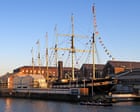
Brunel’s SS Great Britain site drops historical name in ‘cool’ rebrand

11 June 2026 at 00:01

New name, Bristol Dockyards, and museum revamp aimed at becoming more rooted in community, says chief executive

One of the UK’s maritime landmarks is being renamed as part of a drive to make it “cooler” and more inclusive.

For a decade, the dockland site in Bristol that houses the ocean liner SS Great Britain, which was designed by the Victorian engineer Isambard Kingdom Brunel, has been promoted as Brunel’s SS Great Britain.

Continue reading...

© Photograph: Tony Smith/Alamy

© Photograph: Tony Smith/Alamy

© Photograph: Tony Smith/Alamy

❌