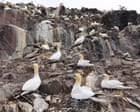
Annual killing of infant gannets has been carried out on a remote Scottish island for at least 400 years
Animal welfare campaigners have called for talks on phasing out the “inhumane” hunt for infant gannets known as guga, which are killed by hunters on a remote Scottish island once a year.
OneKind and the League Against Cruel Sports said it should be slowly phased out in dialogue with the Hebridean islanders who see the hunt, which has been carried out for at least 400 years, as a cultural pursuit and as sustainable food harvesting.
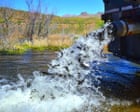
Wildlife department says drought conditions and water released from dam led to ‘major fish kill’ at San Carlos Lake
Arizona officials have indefinitely closed a popular lake to visitors after its entire population of fish died recently.
The recreation and wildlife department that maintains San Carlos Lake said in a Facebook statement on Friday that drought conditions as well as water released from a dam there “resulted in a major fish kill affecting approximately 100% of the fish population”.
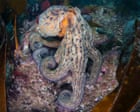
Record numbers linked to warming waters is mixed news for fishers, with shellfish catches down but octopus catches booming
Record numbers of octopuses found off the south-west coast of England last year have now spread as far as Scotland and Wales and are transforming the fishing industry and the marine ecosystem, according to a study.
The surge in sightings of one of the world’s most intelligent invertebrates was first recorded in 2025 off the south coast of Devon and Cornwall.
With the participation of artists from Greece and the diaspora, and with the active involvement of the local community, Near & Far continues to build a new cultural tradition. Kastellorizo. Credit: Greek Reporter
On the remote island of Kastellorizo, the Near & Far Festival, the world’s only cultural event dedicated entirely to the Greek diaspora, returns for its second edition from June 25 to 28, 2026, transforming this historic island into a vibrant crossroads of cultures, people, and experiences.
Spanning four days, this multi-themed festival bridges the “Near” and the “Far,” connecting Greece with its global diaspora, the local community with international audiences, and art with society. The festival is the brainchild of Pericles Kanaris, a New York-based artist with an acclaimed international career. Driven by his vision to create a platform for Greek artists excelling worldwide, Kanaris has turned this ambitious concept into a reality.
Following its spectacular 2025 debut, which local authorities recorded as the highest-attended cultural event in Kastellorizo’s history, the festival returns even stronger, boasting a distinct identity and an expanded program.
Last year’s inaugural event was defined by the exceptional caliber of its performers, the blending of diverse musical traditions, and, most movingly, the active participation of the island’s children—a beautiful legacy that continues this year. Furthermore, a global radio broadcast via ERT’s “Voice of Greece” shattered geographical boundaries, amplifying the festival’s international reach.
In 2026, Near & Far is aiming even higher. This year, the festival aspires to livestream the entire Kastellorizo experience via real-time video to global audiences, forging new bonds with the Greek diaspora and international communities. The event proudly continues its collaboration with the Hellenic Ministry of Culture and the Ministry of Foreign Affairs (General Secretariat for Greeks Abroad and Public Diplomacy).
Concert Program: 4 Themed Nights
Thursday, June 25 | 21:00 Bridges — ERINI “Fos: An Asia Minor Story”
Credit: Kastellorizo International Festival
ERINI, based in the United States with roots from Crete and Asia Minor, presents a musical journey blending traditions and contemporary influences, in collaboration with musicians from Greece.
Friday, June 26 | 21:00 Far Voices — Mario’s Toumbas Jazz Trio “East of the Sun”
Credit: Kastellorizo International Festival
Pianist Mario Toumbas and his trio present original compositions and jazz standards in an evening that resonates with the global sound of jazz.
Saturday, June 27 | 21:00 Together — Pericles Kanaris Quartet featuring Andriana Babali, George Karavelatzis & Kastellorizo Kids
Credit: Kastellorizo International Festival
Original compositions and arrangements by Pericles Kanaris in a special collaboration with the island’s children. Joining them are beloved singer Andriana Babali and oud player George Karavelatzis, a specialist in the local musical tradition of Kastellorizo.
Sunday, June 28 | 21:00 Near Roots — Costa Latsos “Pappou’s Grammophone”
Credit: Kastellorizo International Festival
Tenor Costa Latso, born in Australia to Kastellorizian parents and based in Berlin, presents a program moving between opera, Broadway, and crossover, accompanied by accordionist Thanos Stavridis.
Workshops, activities & parallel Program of the Kastellorizo festival
The Near & Far 2026 festival expands beyond concerts, incorporating educational, experiential, and participatory activities for all ages.
Educational & Creative Workshops (Children)
Visual arts workshop with Heike Kummer (June 25, 11:00–13:00)
Music workshop with Mario Toumbas (June 26, 13:30–15:00)
Wellness & Experiential Activities
Meditation and sound healing sessions for adults (June 27 & 28, 11:00–13:00)
Lecture
Talk by Alexandros Kitroeff on the Greek Diaspora (June 27, 20:00–21:00)
A festival that connects
Near & Far is more than just a festival. It is an open platform for connection, where art becomes a catalyst for bringing people, places, and generations together. A space where Kastellorizo is not on the edge, but at the center of a global cultural dialogue.
With the participation of artists from Greece and the diaspora, and with the active involvement of the local community, Near & Far continues to build a new cultural tradition—vibrant, participatory, and outward-looking.
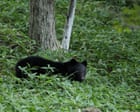
Police and hunters in Utsunomiya, 100km north of the capital, resume their search for animal that is not usually seen so close to Tokyo
A city in Japan has closed all its 94 primary and secondary schools after a bear was spotted in the municipality for the first time.
Officials in Utsunomiya, a city of half a million people about 100km (62 miles) north of Tokyo, took action after a medium-sized black bear – estimated to be about one-metre-long – was seen near a park in the city on Saturday. The bear was spotted again on CCTV running just in front of two startled young men in the city centre, in the early hours of Sunday.
Thousands of treasure hunters look for past riches in Greece. Photo courtesy of Antonis Vlachos
Armed with metal detectors, treasure hunters roam the landscapes of Greece, where myth and history intertwine. Drawn by whispered legends, ancient texts and the promise of lost riches they delve into the mountains, islands, and forgotten ruins in pursuit of gold, relics and long-lost artifacts.
Treasure hunters are often drawn to locations of great historical significance, with the rugged mountainous regions of Greece being among their preferred destinations. These landscapes, steeped in history and mystery, have long served as silent witnesses to war, upheaval, and human resilience.
Treasure hunters in Greece target mountainous areas
During World War II and the subsequent Greek Civil War (1946–1949), many villagers, fearing for their lives and possessions, resorted to hiding their valuables in secret caches. With no access to banks or secure storage facilities in these remote areas, people buried gold coins, jewelry, and family heirlooms deep within the earth or concealed them inside natural enclosures such as caves, stone walls, and hollowed-out tree trunks.
However, the brutal conflicts claimed countless lives and many of those who had hidden their treasures never survived to retrieve them. Over the decades, these hidden fortunes have become the stuff of local folklore, fueling speculation and inspiring generations of treasure hunters to embark on daring quests to uncover the lost wealth of the past.
Even today, rumors persist of forgotten hoards waiting to be discovered, buried beneath the very ground where history was once shaped by war and survival.
Antonis Vlachos stands out among treasure hunters. Not only does he own one of the few specialized shops in Greece that sell sophisticated metal detectors, but he also collaborates closely with the police to prevent illegal activities, such as the unauthorized excavation of ancient artifacts. For him, treasure hunting is more than just a business—it’s a passion, a lifelong hobby that combines adventure with a deep respect for history and the law.
He is also the only one of the treasure hunters who was willing to speak to Greek Reporter.
“Treasure hunters are in their thousands all over Greece. Perhaps most of the activity takes place the Peloponnese, Epirus, and Northern Greece,” he says.
“People have made money out of this activity and understandably they keep a low profile. It’s like winning the lotto. Nobody wants to reveal their identity and the value of the treasure they found.”
A location of a supposed treasure find that was a hoax. Photo courtesy of Antonis Vlachos
The legend of the Ali Pasha treasure
For decades treasure hunters searched for the so-called riches supposedly left behind by Ali Pasha, an Ottoman ruler of Ioannina known for his atrocities (1740–1822).
According to local folklore, Ali Pasha, anticipating his eventual fall from power, concealed vast amounts of treasure in various secret locations across Epirus, Thessaly and western Greece. His personal wealth came from heavy taxation, trade, extortion and alliances with foreign powers (including the British and the French).
Treasure hunters from all over the world began searching for his fortune to no avail. The first organized operation to find the treasure took place in 1913, with the liberation of Ioannina, by an Italian company. For five whole years its workers excavated the surrounding areas without result.
The latest highly publicized case was that of a Greek-Australian treasure hunter, Vangelis Dimas, who financed an excavation to locate the hoard in 2012 in Thessaly.
“It remains a topic of speculation among people, as historically, there is no concrete evidence that such a treasure ever existed,” Vlachos notes.
“Some believe that one of Ali Pasha’s sons took the wealth and fled, but the details of what truly happened—and how—remain unknown. Over time, numerous legends and myths have emerged, though only a small portion of them may be based on actual events,” he adds.
The legend of Ali Pasha is just one of many—“in every coffee shop in the country there is talk of a lost treasure that is supposedly somewhere nearby.”
Maps supposedly showing lost treasures in Greece
Vlachos is not prepared to divulge the value of the treasures that have been unearthed in Greece over the recent decades, but he insists that many people make a good living out of their endeavors. Some people—he says—go to the beaches at night and use metal detectors to search for jewelry lost by bathers in the previous days or even months.
A map supposedly showing the location of a treasure in Greece. Photo courtesy of Antonis Vlachos
He reveals that maps of supposed buried treasures are circulating among treasure hunters. They are made in a way that makes them look old, to give the impression that they are authentic. “Various crafty people make them and sell them to naive people, from 1,000 euros. I have even heard a price of 15,000 euros.”
Vlachos also says that most gold hunters operate within a legal framework and that illegals are a minority.
To proceed with an excavation, one must have three permits. A permit to possess a metal detector, then they must obtain a research permit, issued by the Ministry of Culture and the local Antiquities Ephorates. For the permit to be issued, a process that can take from three months to a year, the proposed search area must not be located within a designated archeological site.
If any findings emerge during the search, an excavation request is submitted to the appropriate authorities.

 Login
Login