YEREVAN, Armenia — The best of a bad lot was how many Armenians described victorious Prime Minister Nikol Pashinyan ahead of Sunday's pivotal election — the first since the bitter defeat in the Nagorno-Karabakh conflict with neighboring Azerbaijan.
While the election has frequently been framed outside Armenia as
Rui Marote Em 2024 o Funchal Noticias alertou em três reportagens para o estado dos jardins do Centro de Saúde do Bom Jesus. Em Setembro de 2024 dizíamos “Jardin do Centro de Saúde do Bom Jesus exigem cuidados urgentes”. A 26 de Outubro, “Junta de Freguesia de Santa Luzia “acode” Centro do Bom Jesus”. A […]
Russian Foreign Ministry spokesperson Maria Zakharova claimed the vote had taken place "amidst severe repression" and that democratic procedures were "grossly violated."
Lei publicada nesta segunda-feira (8) define diretrizes básicas para a melhoria do atendimento de saúde a pessoas que convivem com a dor e institui 5 de julho o Dia Nacional de Conscientização e Enfrentamento da Dor Crônica.
A norma assegura atendimento integral no Sistema Único de Saúde (SUS) e prevê orientações prévias sobre riscos e possíveis efeitos adversos dos tratamentos.
De acordo com a Associação Internacional para o Estudo da Dor, dor crônica é aquela com duração maior que 30 dias.
Campanhas anuais
A data será representada pela cor verde e deverá mobilizar o Poder Público na promoção de campanhas de conscientização todos os anos.
A iniciativa busca ampliar o acesso a informações qualificadas sobre opções terapêuticas disponíveis no SUS, combater o preconceito e estimular gestores de saúde a adotarem abordagens multiprofissionais humanizadas e eficazes.
Impacto na população
Estima-se que a dor crônica afete cerca de 60 milhões de brasileiros. Ao reconhecer a dimensão do problema, a lei pretende fortalecer políticas públicas voltadas ao diagnóstico, tratamento e acompanhamento desses pacientes.
Lei publicada nesta segunda-feira (8) define diretrizes básicas para a melhoria do atendimento de saúde a pessoas que convivem com a dor e institui 5 de julho o Dia Nacional de Conscientização e Enfrentamento da Dor Crônica.
A norma assegura atendimento integral no Sistema Único de Saúde (SUS) e prevê orientações prévias sobre riscos e possíveis efeitos adversos dos tratamentos.
De acordo com a Associação Internacional para o Estudo da Dor, dor crônica é aquela com duração maior que 30 dias.
Campanhas anuais
A data será representada pela cor verde e deverá mobilizar o Poder Público na promoção de campanhas de conscientização todos os anos.
A iniciativa busca ampliar o acesso a informações qualificadas sobre opções terapêuticas disponíveis no SUS, combater o preconceito e estimular gestores de saúde a adotarem abordagens multiprofissionais humanizadas e eficazes.
Impacto na população
Estima-se que a dor crônica afete cerca de 60 milhões de brasileiros. Ao reconhecer a dimensão do problema, a lei pretende fortalecer políticas públicas voltadas ao diagnóstico, tratamento e acompanhamento desses pacientes.
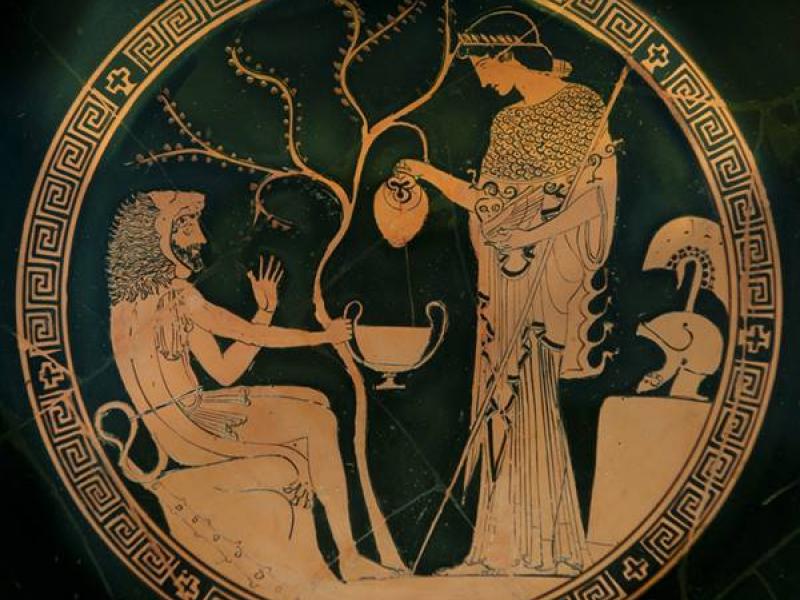
Hercules is offered wine in this depiction of a scene from his Twelve Labors. Public Domain
The recorded history of wine in Ancient Greece begins around the 15th century BC, while viticulture appears to have existed as early as the Neolithic era, 6,500 years ago.
Ancient Greece is also the place where modern wine culture began, as wine consumption stopped being solely a sacred act, as it had been when priests and rulers controlled the vineyards.
By the early Bronze Age, vineyard cultivation of grapes was widespread in ancient Greece, and by the time of the rise of the Minoan and Mycenaean civilizations, wine was part of everyday life, for consumption and/or production.
By that time in Greek society, wine was an economically important business.
Wine and commerce in ancient Greece
There was substantial interaction between the Mycenaean and Minoan cultures, based mainly on commerce.
Around 1200 BC, people from northern Greece invaded the southern Mycenaean area, which was a monarchy.
Golden goblet from the Mycenaean period. Public Domain
The war devastated the Mycenaean lands, generating thousands of poor refugee families who escaped to fortified cities for protection.
In order to consolidate their powers, the invaders gave more privileges to the common people, thus undermining the power of monarchs and aristocrats.
The new, democratic city-states were slowly created over time with the common people having more freedoms and opportunities.
Gradually, the common people started cultivating plots of land, with vineyards and olive groves being the most plentiful and lucrative.
People could thus own vineyards, cultivate them, and trade and drink their own wine. A new class of merchants, albeit a small one, was born.
At the same time, more and more people in ancient Greece began to drink wine for pleasure rather than as a sacred ritual.
Colonization and trade expansion
The Greek city-states then began to establish colonies throughout the Mediterranean. The settlers, already experienced in vine cultivation, brought grapevines with them and were able to better cultivate already-existing vineyards.
Moving west, Sicily and southern Italy were the first colonies established by ancient Greeks. Greeks even called the southern part of the Italian Peninsula Oenotria (“the land of vines”).
Other Greeks settled in Massalia (Marseille) in southern France while others moved east all the way to the shores of the Black Sea.
The colonies provided more opportunities for wine merchants. The Greeks could now introduce their wines as far as the western part of France and to the Black Sea in the east.
Athens was a large and lucrative market for wine, as the climate in the Attica region was ideal for vines, and production was substantial. Wine from Attica was traded in all the lands along the eastern Mediterranean Sea.
Other areas famous for wine in ancient Greece were the islands of Santorini and Thasos. This is especially true in Santorini, where the rich volcanic soil produced exceptional grapes. Ancient Greeks were very particular about the origin of their wines.
Major trading partners for wine in ancient Greece were Crimea, Egypt, Scythia, and Etruria among others, as the Greeks traded their knowledge of viticulture and winemaking.
Indicative of the lucrative trade of wine from Greece is a shipwreck discovered off the coast of southern France that held nearly 10,000 amphorae containing almost 300,000 liters (79,000 US gallons) of Greek wine.
Diluted wine
The wine in ancient Greece was unlike what we know today. It was not left undiluted but was mixed with water in precise proportions in a vessel called a krater.
The mixing of water and wine was for the drinker to enable him or herself to maintain composure and self-control, traits that were highly valued in ancient Greek society.
In fact, ancient Greeks seemed to believe that only barbarians—in most cases that simply meant non-Greeks—drank unmixed wine, got drunk and behaved like…barbarians.
Modern wine culture begins in Greece
Along with their wine, Greeks had exported their way of life, including vine-growing, winemaking, and enjoying wine, to almost every port in the Mediterranean basin.
“Wine moistens and tempers the spirit and lulls the cares of the mind to rest. It revives our joys and is oil to the dying flame of life.”
Plato also praised the fruit of the vine:
“What is better adapted than the festive use of wine in the first place to test, and in the second place to train, the character of a man, if care be taken in the use of it? What is there cheaper or more innocent?
The ubiquitousness of the word “symposium” in ancient Greece, which literally means “drinking with others”—meant that ancient Greeks loved to get together, eat, drink, and converse during and after the meal.
Plato’s Symposium, by Anselm Feuerbach (1829-1880). Public Domain
It was a favorite pastime for well-to-do ancient Greeks to eat, drink, discuss, and, occasionally, philosophize, at these symposia.
Such convivial get-togethers have been illustrated on many types of Greek vases and sculptures. Examples of discussions that took place in symposia can be found in Plato’s Symposium and Xenophon’s Symposium.
Usually, symposia were hosted by aristocratic men for their peers. They would relax in recliners called klinai and drink from terracotta or, depending on how rich the host was, from bronze, silver, even gold, cups.
Wine was also used for medicinal purposes in ancient Greece. The great physician Hippocrates prescribed different wines depending on the disease.
Ancient Greeks also had a god of wine, the mischievous Dionysus. The god of the grape harvest, winemaking, fertility, orchards, fruit, vegetation, insanity, and ritual madness, he was also the god of religious ecstasy and festivity; overall, it was he who embodied the colorful, vibrant life of ancient Greece.

 Login
Login