Login
LoginMichael Saylor Sells, While BTC Levels Signal Margin Call Territory; Gold to $10K – Ed Dowd
6 June 2026 at 18:30
from ITM TRADING, INC.: TRUTH LIVES on at https://sgtreport.tv/



A long trade war looms. Trump’s scattershot protectionism, chaotic tariffs and belligerence against our natural allies guarantees that US trade policy will remain a hot mess
We are in for a long trade war.
In the months since “Liberation Day” last year, when Donald Trump let loose a volley of tariffs against imports from everywhere, countries have rushed to build new relationships in the hope of maybe circumventing the US to protect the global trading system.
Continue reading...
© Composite: The Guardian/Getty Images
© Composite: The Guardian/Getty Images
© Composite: The Guardian/Getty Images
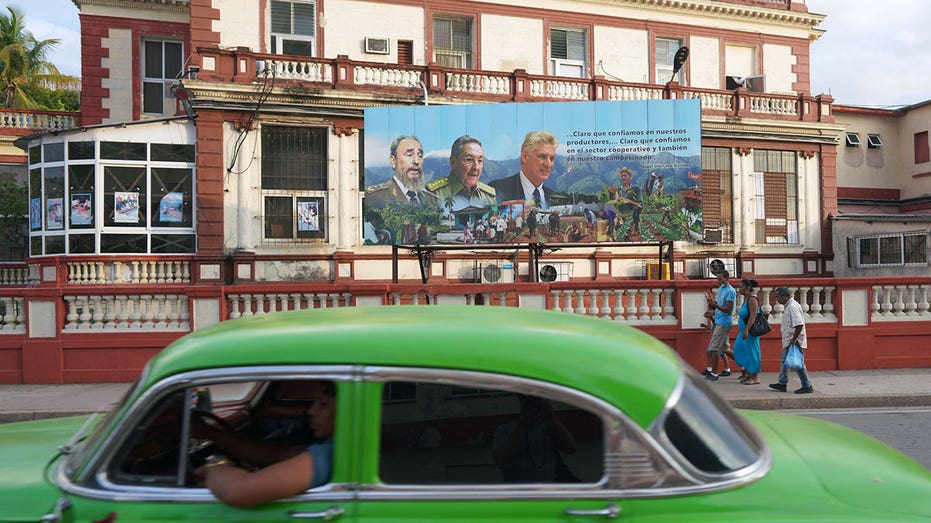
The Trump administration is rolling out what experts describe as the most significant expansion of U.S. sanctions on Cuba in decades.
The administration is attempting what supporters say is the first broad application of Cuba-related secondary sanctions against foreign firms, aiming not only at Havana itself but also at foreign companies and banks that continue doing business with the island’s military-linked economic empire.
The new framework, established under an executive order signed by President Donald Trump May 1, applies pressure beyond U.S. companies for the first time, threatening foreign firms with sanctions exposure if they continue operating in key sectors of the Cuban economy linked to Grupo de Administración Empresarial S.A., or GAESA.
TRUMP ADMINISTRATION PRESSED TO CLOSE CUBA EMBARGO LOOPHOLE AS OIL SET TO RUN OUT WITHIN DAYS
Supporters say the move closes a loophole that allowed foreign investors to sustain Cuba’s communist regime while the longstanding U.S. embargo largely restricted Americans.
Critics argue the measures risk worsening an already severe humanitarian crisis on the island without meaningfully weakening the government.
"At the top of the month, what the Trump administration did was for the first time extend the application of U.S. sanctions from just prohibiting trade between U.S. firms and U.S. persons and the Cuban island to third-party countries and enablers," Max Meizlish, a former Treasury Department official now serving as a research fellow at the Foundation for Defense of Democracies, told Fox News Digital in an interview.
"For the first time ever in a truly unprecedented fashion, that’s the same logic that the administration is now applying to Cuba," he said.
The sanctions focus heavily on GAESA, a sprawling military-linked conglomerate that analysts estimate controls between 40% and 70% of Cuba’s economy, including tourism, mining, retail, ports and financial services.
A recent Foundation for Defense of Democracies report authored by Meizlish and Connor Pfeiffer argued that foreign companies doing business in Cuba are effectively helping sustain the regime’s military and political leadership.
The State Department sanctioned GAESA and several affiliated entities in May under the new authorities, opening the door for potential penalties against foreign companies and financial institutions that continue dealings with them after a June 5 wind-down deadline.
Meizlish argued previous sanctions regimes failed because they isolated American companies while allowing foreign actors to continue financing the Cuban state.
"There’s a lot of Spanish firms, for instance, that have invested millions of dollars in luxury hotel properties, villa properties in Cuba that partner with GAESA, all funding this military enterprise at the expense of the Cuban people," he said.
He also pointed to Canadian involvement in Cuba’s nickel and cobalt sectors, saying foreign investment has generated "huge amounts of money for the regime."
"A lot of people think about the U.S. embargo over the years is actually being responsible for a lot of the problems on the Cuban island, but they don't give consideration to the fact that GAESA, this newly sanctioned entity, has been sitting on an estimated $20 billion in assets and cash over the year while depriving the people of Cuba," Meizlish told Fox News Digital.
But critics of the policy warn the economic fallout could land the hardest on ordinary Cubans.
William LeoGrande, a longtime Cuba expert at American University, said the May 1 measures represent a major escalation because they specifically target foreign businesses rather than just Americans and aim to deter foreign companies from doing business with GAESA by threatening sanctions exposure.
LeoGrande acknowledged the measures could deprive the Cuban government of revenue but argued the broader population is likely to suffer most.
CUBA'S ENTIRE ELECTRICAL GRID COLLAPSES, LEAVING WHOLE ISLAND WITHOUT POWER
"This would potentially deprive the Cuban government of funds, but the impact will fall mainly on ordinary citizens because it means the government has fewer resources to import food, medicine and fuel," he said.
The debate comes as Cuba faces its deepest economic and humanitarian crisis in years.
The World Food Programme says food insecurity is worsening amid fuel shortages, inflation and declining access to imported goods, while U.N. officials have warned that electricity shortages and blackouts are disrupting hospitals, vaccination programs and food distribution networks across the island.
LeoGrande also warned tougher sanctions could contribute to another migration crisis.
NICARAGUA BLOCKS PATHWAY USED BY CUBAN MIGRANTS TO REACH THE US
"Another unintended effect is that by making living conditions in Cuba even more desperate, tougher sanctions could trigger a mass migration like we saw in 1980 or 1994," LeoGrande said.
On background, a U.S. official rejected arguments that American sanctions are responsible for Cuba’s humanitarian crisis.
"The suffering of the Cuban people is not caused by the U.S. embargo but by the Cuban dictatorship’s failed Communist policies and human rights violations," the official told Fox News Digital. "The embargo does not prohibit Cuba’s access to world markets or trade with third countries."
The official added that U.S. law explicitly permits exports of food, medicine and medical equipment to Cuba and accused the regime of hiding "billions in overseas bank accounts instead of investing in electricity, infrastructure and the daily needs of its people."
The debate mirrors long-standing arguments surrounding U.S. sanctions on countries like Iran and Venezuela, where supporters view economic pressure as a tool to weaken authoritarian governments while critics argue regimes often survive and civilians absorb the economic damage.
CLICK HERE TO DOWNLOAD THE FOX NEWS APP
Meizlish argued sanctions should not be judged simply by whether they immediately topple governments.
"The problem isn’t that the embargo went too far," he said. "It’s that it didn’t go far enough."
Fox News Digital reached out to the Cuban Embassy in Washington for comment but did not receive a response by the time of publication.
The Greek government is reportedly finalizing legislation to impose a 15% tax on capital gains derived from cryptocurrencies, aiming to formally integrate digital assets into the national tax code. According to government officials who spoke to Reuters on Friday, the Ministry of National Economy and Finance in Greece is drafting the bill, which authorities expect to submit to Parliament for approval in the coming months.
Under the proposed financial framework, the initial 500 euros of cryptocurrency profits will remain exempt from the new tax to shield small-scale retail investors. Any capital gains exceeding this threshold will face a flat 15% rate, aligning the taxation of digital assets with traditional securities sales in Greece.
It is believed that people engaged in personal cryptocurrency mining will not face taxation on their yields. However, if the mining operation functions as a registered corporate entity, standard business tax rules will apply.
At present, Greece operates without a comprehensive legal framework specifically targeting cryptocurrency profits and people making a living out of them. This regulatory gap reflects a broader inconsistency across the European Union, where member states currently lack a unified fiscal system for the rapidly expanding sector. Across the continent, tax rates on digital capital gains vary significantly, ranging from an 8% low in neighboring Cyprus to 30% in France. The upcoming Greek legislation seeks to close domestic loopholes and bring Athens in line with European peers that have already established clear rules for digital investors.
The legislative move coincides with a wider European push to curb tax evasion and financial opacity within the digital space. The European Union recently introduced the Markets in Crypto-Assets (MiCA) Regulation and the DAC8 Directive, which mandate strict reporting standards and demand that crypto-asset service providers share user transaction data with national tax authorities. Greece’s updated tax code will operate in tandem with these measures on a European level.
Despite the planned implementation, government sources acknowledged severe difficulties in measuring the actual size of the domestic cryptocurrency market. The vast majority of Greek investors execute their trades through international, offshore platforms rather than locally registered exchanges. This decentralized structure makes it nearly impossible for financial authorities to accurately track the total volume of digital assets held by people. Consequently, the Ministry of Finance has not yet published any specific projections regarding the exact state revenues the 15% tax might generate.
Until the proposed legislation officially becomes law, cryptocurrency profits remain largely undeclared in Greece, leaving a substantial pool of potential state revenue untapped.