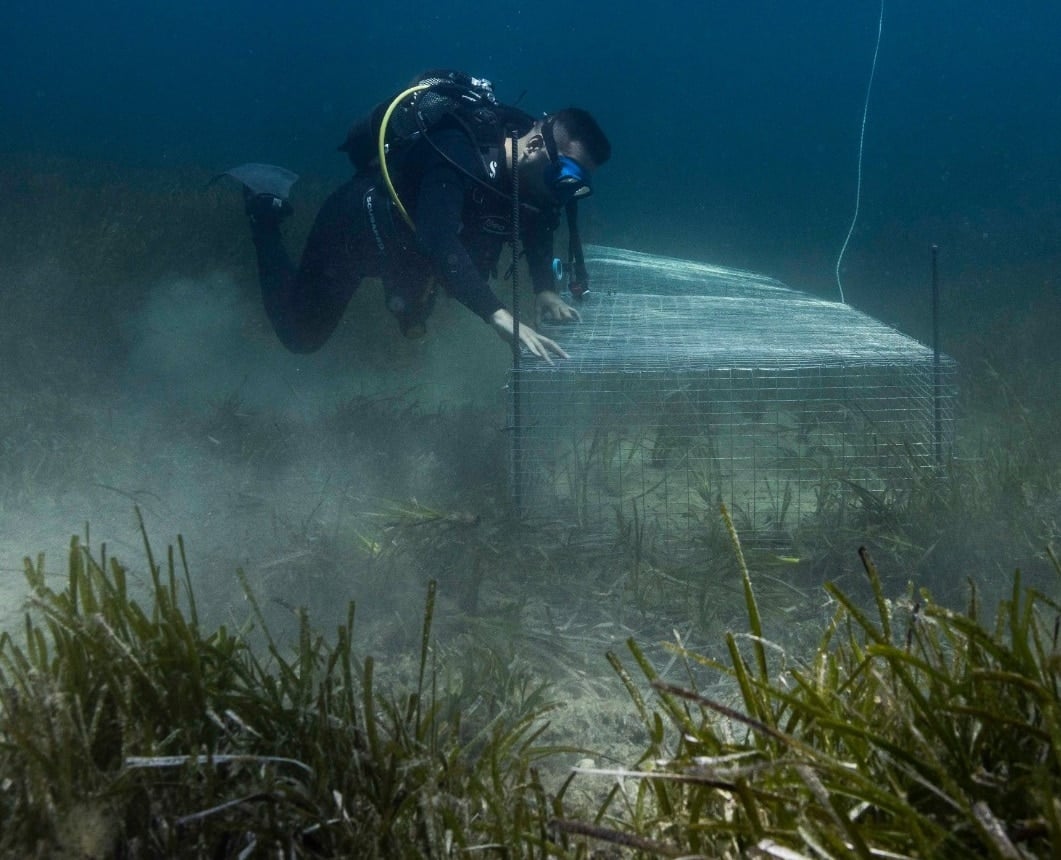
The Posidonia sanctuary holds over 270,000 tons of stored carbon dioxide. Credit: iSea
The environmental organization iSea, in collaboration with the Hellenic Ornithological Society and the Municipality of Lemnos, has launched an ambitious project to restore the Eastern Mediterranean’s largest marine meadow—a 140-square-kilometer Posidonia sanctuary off the coast of Lemnos, widely known as the region’s “Amazon.”
This massive underwater ecosystem serves as a vital carbon sink, holding over 270,000 tons of stored carbon dioxide and effectively absorbing the annual emissions produced by the vehicles of an entire small city.
To mark World Environment Day 2026, the project partners are celebrating the completion of the initiative’s pilot phase under the “Reviving Lemnos” program, which successfully transplanted more than 250 posidonia shoots.
A Vital Marine Ecosystem
Posidonia oceanica is not an algae, but a flowering marine plant (seagrass) that forms dense underwater meadows. These meadows act as a crucial sanctuary for an abundance of marine life. While most people recognize it from the long, brown “seaweed” leaves that wash ashore, its true value lies beneath the surface.
The Lemnos marine meadow thrives at depths of up to 30 meters and stretches over 20 kilometers long, extending beyond the boundaries of the Natura 2000 Protected Area and into international waters. According to data from iSea, this single ecosystem hosts more than 66 species of marine organisms.
Looking Ahead: The “Reviving Lemnos” Project
During this pilot phase, the transplanted shoots have been secured inside protective metal cages to shield them until they mature, and they will remain under close scientific monitoring.
This initial phase sets the foundation for a much larger effort: restoring more than 10,000 posidonia rhizomes across a 400-square-meter area over the coming years.
“The knowledge gained from monitoring this pilot application will provide a valuable roadmap for completing our restoration actions and ensuring the long-term success of ecosystem conservation in Lemnos,” said Nikoletta Sidiropoulou, Project Manager at iSea.
The “Reviving Lemnos” project is one of seven large-scale initiatives funded by the international Endangered Landscapes & Seascapes Programme.
Good news about the state of the planet might seem to be in short supply, but it's out there. Each week, DW's environment desk brings you what went right.
More than 1 million people advised to evacuate homes amid 80mph winds and heavy rain
Typhoon Jangmi (also known as Typhoon No 6) moved northwards over the course of this week. From Okinawa to mainland Japan, prolonged and heavy rainfall led to landslide warnings and the flooding of rivers, with Japan issuing level 4 warnings for some rivers, signalling a risk of overflowing. This level is high enough for municipalities to issue evacuation orders. Three-hourly rainfall totals on Wednesday reached 105mm in Chiyoda, Tokyo, which was a record high for the month. Sustained wind speeds of 80mph (130kph) were recorded on Monday – making it a category 1 typhoon – bringing damage and disruption to businesses, transport, infrastructure and the environment.
By Wednesday, 23 people had been injured, 17 of whom were in Okinawa. The typhoon damaged 57 homes and led to 60,000 homes losing electricity. In addition to this, 1.52 million people were advised to evacuate by authorities. The typhoon damaged the exterior wall of Himeji Castle, a Unesco world heritage site in western Japan. The maximum recorded wind speed at Himeji was 56mph, according to the Japan Meteorological Agency. The typhoon has now weakened into a tropical depression and has moved eastwards, away from the islands.
Portugal has one of the lowest per capita greenhouse gas (GHG) emissions in Europe and generates a ‘high amount’ of renewable energy – but this performance is undermined by its
Observed every year on June 5, World Environment Day is the United Nations’ main global platform for raising awareness and mobilizing action to protect the natural world. Credit: Greek Reporter
Greece is marking World Environment Day 2026 with a nationwide program of events that brings the global call for climate action down to the local level—from protected areas and wetlands to city galleries, museums, and island beaches.
Observed every year on June 5, World Environment Day is the United Nations’ main global platform for raising awareness and mobilizing action to protect the natural world. First celebrated in 1973, the day has grown into an international campaign involving governments, organizations, schools, communities and citizens around the world.
In Greece, the Natural Environment and Climate Change Agency, NECCA, is at the center of the program, organizing 65 events across the country. Activities include guided nature walks, biodiversity recording, wildlife observation, educational games, workshops, public information events and volunteer cleanups, many of them in or near protected areas.
Greece’s government highlights achievements on World Environment Day
Greece’s Minister of Environment and Energy, Stavros Papastavrou, highlighted some of the government’s environmental policies and key achievements over the past seven years.
Expanded Marine Protection: Moving forward from commitments made at global ocean conferences (2024 in Athens and 2025 at the UN), Greece is establishing two new large National Marine Parks in the Ionian and South Aegean seas. This will double protected waters to 36% of territorial waters, surpassing the EU’s 30% target well ahead of 2030.
Banning Industrial Fishing: Greece is pioneering marine conservation internationally by completely banning bottom trawling in all national marine parks.
Renewable Energy Zoning Restrictions: New regulations prohibit the installation of solar farms in all Natura areas, forests, and woodlands, and ban wind farms at altitudes above 1,200 meters (3,937 ft).
“Untrodden” Landscapes: Greece has introduced pioneering designations for strict ecological preservation, establishing thirteen “Untrodden Mountains” and 250 highly protected “Untrodden Beaches” to limit human development in sensitive ecosystems.
Targeted Species & Habitat Conservation: Twelve National Action Plans have been launched to protect endangered species (including the brown bear, Mediterranean monk seal, Loggerhead sea turtle, and bearded vulture). Additionally, all major wetlands (Ramsar sites) and Key Biodiversity Areas are now placed under strict legislative protection.
BANGKOK — Seven hundred days after activists from the environmental group Mother Nature Cambodia were imprisoned on charges widely regarded as retaliatory for their activism, 73 international and Cambodian civil society organizations have renewed calls for their unconditional release. After a trial lasting just over a month, 10 activists from Mother Nature Cambodia were sentenced on July 2, 2024, to between six and eight years in prison. Only five of the defendants attended the hearings, which saw Long Kuntha, 28, Ly Chandaravuth, 26, Phuon Keoraksmey, 25, and Thun Ratha, 34, each sentenced to six years behind bars for plotting against the government; fellow activist Yim Leanghy, 36, received an eight-year sentence for both plotting against the government and insulting the king. The five activists who did not attend the trial were sentenced in absentia. The appeals hearing for all 10 convicted activists was slated to take place on June 2, but has been postponed indefinitely by the Phnom Penh Court of Appeals. “The MNC5 are incarcerated in prisons in overcrowded and harsh living conditions, separated from each other and spread out all across Cambodia, hundreds of kilometers away from their families and legal counsel,” wrote the 73 NGOs in an open letter addressed to Prime Minister Hun Manet. “The … NGOs who have signed this letter sincerely request you take immediate action to ensure the unjust convictions of these five activists are reversed either prior to or at their upcoming appeals court hearing in Phnom Penh, and that their freedom…This article was originally published on Mongabay
The USDA this week confirmed the first known infection of the carnivorous fly larva, which feast on the flesh of living mammals, after the United States eradicated the nightmare bugs in the 1960s.
 Login
Login






.jpg)