Greece, a land of gods and nymphs, has a number of exquisitely beautiful places that appear to have come out of a fairy tale, being formed back in another time and almost in another world. Here are some of Greece’s most haunting places that you won’t believe actually exist.
The most amazing places in Greece
Melissani Cave, Kefalonia
Melissani Cave on the island of Kefalonia, Greece. Credit: Rachid H/CC BY 2.0
A sky-blue lake that was once believed to be the living quarters of nymphs, it is hauntingly beautiful, and legend has it that the nymph Melissani drowned herself due to her unrequited love for the god Pan at the lake. This unique geological phenomenon is created by water’s erosion of calcareous rocks.
Windswept formations transport visitors to a lunar landscape on the volcanic island of Santorini. Sand dunes are created during the winter months, creating interesting formations and sand caves. Occasionally, bulldozers even have to be called in to dig out beach-goers. The abandoned tomato factory nearby and ashen volcanic sand add an eerie quality to the beach.
Greece’s alpine lakes were customarily believed to have been created by dragons throwing stones at each other. The spectacular lakes bear the name of the beasts that created them. Gamila, at 2,050 meters (6,725 feet), the highest point of Mt. Tymfi, lies between the Aoos River and Voidomatis along the North Pindus Range.
Blue Caves, Zakynthos
Blue Caves, Zakynthos, Greece. Credit: Wikipedia/Ρένια Χατζηλευτέρη/CC-BY-SA-4.0
Located at the north coast of Zakynthos, Greece, the caves were created thanks to waves crashing into the limestone cliffs. The sun is apparent on the walls of the tunnels and caves that the waves have carved into the cliffs over the millennia.
Meteora, Thessaly
Monastery of Agiou Nikolaou. Credit: Bgabel/CC BY-SA 3.0
The Holy Monastery of Rousanou is one of six monasteries built on natural sandstone rock pillars at Meteora on the northwestern edge of the Plain of Thessaly in Central Greece.
Established in the middle of the 16th century, it was damaged by Germans during WWII. It is lower in altitude than other monasteries in the region in elevation, but this makes it more accessible. Nuns have occupied the convent since 1988.
The small village of Vasta has acquired fame due to its “miracle church” of Saint Theodora, who lived in the 11th century BC and helped defend her village by disguising herself as a man before she went to fight.
She died a violent death in battle while calling out the oath: “Let my blood become church, my blood a river, my hair the forest.” Built at the site of her grave, a local river rerouted to pass directly under the church, causing seven trees to sprout from its roof. Some believe this was indeed a miracle, attributed to Saint Theodora’s last words.
BELO HORIZONTE, MG (FOLHAPRESS) – A queda de dois helicópteros causou a morte de seis pessoas neste domingo (14) no Rio de Janeiro. O acidente ocorreu na avenida das Américas, na altura do Recreio dos Bandeirantes, zona sudoeste do Rio de Janeiro, de acordo com o Corpo de Bombeiros. A corporação afirmou que relatos indicam que as aeronaves teriam se chocado no ar. Ambas caíram no pátio de estacionamento da concessionária da BYD, de carros elétricos. Em entrevista à GloboNews, um porta-voz dos bombeiros disse que uma aeronave não explodiu e está a cerca de cem metros da outra no pátio. A outra, ainda segundo ele, atingiu em torno de 20 veículos no local. Todas as vítimas eram tripulantes das aeronaves. Cinco delas estavam no helicóptero que explodiu, e na outra, o piloto morreu. A identidade delas ainda não foi informada pelas autoridades. O porta-voz acrescentou que algumas peças foram encontradas a centenas de metros do local, sugerindo que o incêndio resultante da queda teve uma energia muito alta. Os bombeiros foram acionados às 8h59 e atuam no local com apoio de equipes especializadas do Grupo de Operações Aéreas e Especiais (GOEsp). Cerca de 45 militares e 15 viaturas foram empenhados na ocorrência. Moradores relataram ter ouvido uma explosão e visto na sequência algo caindo do céu, seguido do surgimento de fumaça.
O prefeito do Rio de Janeiro, Eduardo Cavaliere (PSD), afirmou que os pilotos dos dois helicópteros que caíram neste domingo (14) na zona sudoeste da cidade eram experientes e instrutores de voo. A suspeita inicial das autoridades é de que as duas aeronaves estavam indo na mesma direção e se chocaram no ar. Elas caíram no pátio de uma concessionária e deixaram seis mortos. “Estamos falando de dois pilotos muito experientes, com muitas horas de voo, com uma longa carreira. Inclusive os dois instrutores de formação de outros pilotos. Então [foi] uma fatalidade, uma tragédia”, disse Cavaliere em frente ao local do acidente. O prefeito não divulgou a identidade das vítimas, mas disse que as famílias foram avisadas e que quatro corpos foram levadas ao IML (Instituto Médico Legal). Ele também disse que ao menos um estrangeiro estava no helicóptero que transportava cinco pessoas e ia para Angra dos Reis. A outra aeronave, onde estava apenas o piloto, havia decolado do aeroporto Santos Dumont e tinha como destino a região serrana para buscar passageiros. Cavaliere confirmou que não se tratavam de voos turísticos ou panorâmicos e que a investigação do acidente cabe às autoridades competentes, como o Cenipa (Centro de Investigação e Prevenção de Acidentes Aeronáuticos). O delegado Alan Luxardo, da Polícia Civil, afirmou que, inicialmente, todas as vítimas são homens. “Houve uma colisão no ar e as aeronaves vieram ao chão”, afirmou ele em entrevista à GloboNews. “Estamos apurando a causa, a princípio parece que houve uma falha humana.” Os helicópteros envolvidos no acidente têm as matrículas PP-MAC e PR-DJJ, segundo a FAB. As duas têm situação normal de aeronavegabilidade e não estão autorizadas a operar com táxi aéreo. A aeronave de prefixo PP-MAC é um Bell 206B, de 1999. A outra, PR-DJJ, é um modelo AS 350 B2, de 2012.
Plato’s father was Ariston, the son of Aristocles, through whom Plato traced his ancestry to Solon, the lawgiver. Credit: Mark Cartwright, CC BY-NC-SA.
Plato, one of the greatest Greek philosophers of all time—with whom one might claim that, along with Aristotle, Greece intellectually conquered the world—traveled widely during his lifetime. Sicily was amongst Plato’s destinations. The question is what was his purpose for his trip to Sicily, and what came of it?
Plato: The man behind the Socratic Dialogues and other legends
He was born in 427 BC. According to Olympiodorus, Plato was of noble origin. His father was Ariston, the son of Aristocles, through whom Plato traced his ancestry to Solon, the lawgiver. His mother, Perictione, was also said by Olympiodorus to be descended from Neleus, the son of Codrus. It is to this heritage that Plato attributes the fact that “with primitive zeal he wrote twelve books on Laws and eleven books on a Republic.”
Olympiodorus relates a legend that was told among the Athenians and the Platonic philosophers of the Academy after Plato’s death. They believed that Plato was actually a philosopher sent by Apollo to mankind to teach them the most Good and Just way of living. According to this legend, an Apollonian specter had a connection with his mother, Perictione, and, appearing to Ariston in the night, commanded him not to sleep with Perictione during her pregnancy.
The Neoplatonic philosopher Proclus talks of:
“…those perpetual attendants of a divine nature called essential heroes. These are impassive and pure, and the bulk of human souls who descend to earth with passivity and impurity. It is necessary that there should be an order of human souls who descend with impassivity and purity.
These souls were called by the ancients terrestrial heroes on account of their high degree of proximity and alliance to such as are essentially heroes. Hercules, Theseus, Pythagoras, Plato, etc., were souls of this kind, who descended into mortality both to benefit other souls and in compliance with that necessity by which all natures inferior to the perpetual attendants of the gods are at times obliged to descend.”
Plato’s early education
When he was a young man, Plato first went to Dionysius, the grammarian, for the purpose of acquiring common education. He mentions Dionysius in his dialogue The Lovers so that even Dionysius, the schoolmaster, might not be passed over in silence by Plato.
After him, Plato employed the Argive Ariston as his instructor in gymnastics, from whom it is said that he derived the name of Plato. Prior to this, he was called Aristocles after his grandfather. He was supposedly called Plato because of the broadness of his chest and forehead, as statues of him reveal.
According to others, however, they called him Plato due to the ample and expansive character of his style.
Plato’s music teacher was Draco, the son of Damon, and he makes mention of this master in his Republic. The Athenians instructed their children in three arts—grammar, music, and gymnastics—and this, it seems, was with great propriety. They taught them grammar to adorn their reasoning, music to tame their anger, and gymnastics to strengthen the weak tone of desire.
Plato’s path to philosophy and his life prior to Sicily
Before beginning his philosophical journey, Plato was first an artist and poet. He composed tragic and dithyrambic poems, along with other poetic pieces, all of which he burned as soon as he began associating with Socrates. At the time, he reportedly quoted the verse: “Vulcan! Draw near; ’tis Plato asks your aid.”
Nietzsche, the German philosopher who was a fierce critic of Socrates, wrote while cursing Socrates’ influence on Plato that had it not been for his influence, Plato would have “become a tragedian that would have surpassed both Aeschylus and Sophocles.”
Pausanias narrates in his Attica:
“Not far from the Academy is the monument of Plato, to whom heaven foretold that he would be the prince of philosophers. The manner of the foretelling was this: On the night before Plato was to become his pupil, Socrates had a dream in which he saw a swan fly into his bosom. Now, the swan is a bird with a reputation for music because, they say, a musician by the name of Swan became king of the Ligyes on the other side of the Eridanus beyond the Celtic territory, and after his death, by the will of Apollo, the Gods transformed him into the bird.”
Most people today view Plato as a great contributor to philosophy, largely due to the fact that he preserved the sayings of Socrates. Indeed, Socrates was the one who “opened fire” to challenge peoples’ views, but Plato was the one who spread these ideas far and wide. Though it is true that in most of the Platonic dialogues Socrates is the protagonist, it would be a grave mistake to view Plato as merely “Socrates’ secretary.” In reality, many things that Plato attributes to Socrates in the dialogues are actually his own views and thoughts, attributed to his tutor out of respect.
This is why Diogenes Laertius tells us:
“They say that, on hearing Plato read the Lysis, Socrates exclaimed, ‘By Heracles, what a number of lies this young man is telling about me!’ For he has included in the dialogue much that Socrates never said.”
Diogenes Laertius also tells us that Plato’s philosophy is a mixture of older philosophical theories, for regarding his views on the world of the senses, he is in agreement with Heraclitus. When it comes to Intellect, he agrees with Pythagoras, and in matters of politics, he aligns with Socrates.
The Greek philosopher’s vision of justice: The republic
But what was it that actually drew the young man so close to Socrates in political matters? What made him honor Socrates to such a degree?
The answer lies within the most well-known and influential book ever written by Plato, the Republic. This work, consisting of ten books, was originally titled On Justice. In the first two books, Socrates debates other philosophers on the true nature of justice. This concept was far from clear for ancient Athenians. Instead, it has been a subject of intellectual conflict from antiquity to modern times.
He disagrees with the traditional view of justice, which had been the mainstream belief in ancient Greece since Homer, and tries to establish an objective perspective on what justice actually is. The first opinion on justice, as expressed by Polemarchus and Adeimantus, was that justice consists of “benefiting your friends and harming your enemies.”
The second view, expressed by the sophist Thrasymachus, claimed that:
“…justice is nothing but the advantage of the strongest” (those in power in all polities). He expressed the position that being unjust (i.e., benefiting yourself at the expense of others) is more beneficial than justice.”
Arguing against both of these points, Socrates claimed that “a just man can never harm, only benefit” and “justice is about the stronger benefiting the weaker.” He further argued that, in order for a man to be truly happy, he must be just, and that justice is an end in itself. In contrast, unjust people are actually unhappy even if they seem successful in achieving their goals.
A just republic would be analogous to a human soul
To convince his interlocutors in the dialogue, Socrates, over the next books of the Republic, tries to establish and imagine what a perfectly just polity would look like. This would be a form of government organic in nature, meaning that the citizens belonging to it would prioritize collective interest above individual interest.
In fact, Socrates made a parallel between such a society and the human soul. According to him, the human soul consists of three parts: the rational part, the irrational part, and the appetitive (or vegetative) part. The first part is responsible for intellect, the second for emotion, and the third for material desires. Socrates claimed that justice consists of a person getting these parts of the soul to work in harmony. In this harmony, the rational part is in control.
Using this analogy, Socrates argued that his ideal polity would function similarly.
It would be a body where the rational part (the best citizens) would govern and seek to unite the entire society just as the mind unites the organs of the body, from the head to the hands and legs. Every part functions for the benefit of the whole, according to its role. The best citizens in this city would be those who excel in virtue and would actually rule as philosophers. This is why Socrates called this form of government an “aristocracy” (literally meaning “rule of the best”).
He divided the polity into three classes, each reflecting a part of the human soul. The philosophers would form the ruling class, representing the “rational” part of the polity. The second class would consist of the guardians, the warriors of the polity. This would correspond to the “spirited” (or emotional) part of the soul.
Lastly, the producers, the vast majority of the people, would be focused on satisfying their material needs, having families, and owning property. The rulers of this polity would ensure that the producers have sufficient goods to meet their needs.
The philosopher-king of the Republic
The class of philosophers would be educated from youth by society and would not even know their parents. The reason for this is that Socrates wanted them to view all the elders of their class as their parents and all the other young men and women as brothers and sisters.
Everything in that class would be common and belong to everyone, while gifted women would receive equal education alongside philosophers and warriors. Children would also receive a shared education. Socrates claims that youth should learn through games. The polity prohibited any form of violence towards them. That is because he believed it is impossible to shape a soul through force.
From this class of individuals, the “king” of the Republic would arise—a philosopher-king who, in addition to governance and the art of war, would be an expert in mathematics, natural sciences, music theory, and, above all, dialectic.
For Socrates, dialectic is the science of sciences. He deemed it as the ability to discover the unity and common foundations of every branch of knowledge within a system of thought that is incorruptible. If a candidate fails to excel in even one of these areas, they reject him. The ideal king should not possess private property. He should abhor power and rule solely through service. Therefore, the more excellent philosophers there are, the better because the burdens of exercising power will be divided into shorter intervals.
Socrates claimed that this polity would be an analogy to the heavenly order. He believed that, just as in the starry heavens, the brightest stars preside over the dimmer ones. The Sun rules over the planets, the Moon, and the Earth. Similarly, the Republic would reflect a similar hierarchy. The philosophers, being the most divine individuals, would reflect the Sun. The guardians would represent the Moon, while the producers are instead likened to the Earth.
The allegory of the cave and the world of forms
While Socrates described this polity to his friends, Glaucon, Plato’s elder cousin, questioned his statements. He asked if such a polity could ever exist. Socrates replied that a just man ought to follow the principles of such a polity. Striving toward this ideal would accomplish much in that direction.
This leads to Socrates introducing the Allegory of the Cave. In this allegory, Plato has Socrates describe a group of individuals who live their entire lives chained to the wall of a cave, facing a blank wall. These people observe the shadows cast on the wall by objects passing in front of a fire behind them and give names to these shadows. For the imprisoned, these shadows represent reality.
Socrates explains that the philosopher is like a prisoner who has released himself from the cave. Such a man understands that the shadows are not the true reality. The philosopher comprehends the true form of reality, distinguishing it from the fabricated reality represented by the shadows.
The prisoners do not wish to leave their prison because they are unaware of a better life. One day, they manage to break their bonds and discover that their reality is not what they thought.
They encounter the sun, which Plato uses as a counterpart to the fire behind them. Just as the fire casts light on the cave walls, the human condition remains captive to the impressions created through the senses. These sensory perceptions bound us, and we are unable to see beyond them.
Even if these interpretations are a distorted view of reality, individuals cannot free themselves from the shackles of their condition. They cannot escape their apparent state, just as prisoners could not break free from their chains.
Socrates explains that the philosopher is like a prisoner who has released himself from the cave. Credit: 4edges, CC BY-SA 4.0
The people of the cavern are actually us
However, if a person could miraculously escape from their slavery, they would find a world that is initially incomprehensible to them. The sun would be bewildering to one who has never seen it. In other words, they would discover another “realm,” an unfathomable place. This would be the source of a higher reality than the one they have always known.
Socrates explains that the prisoners in this cavern are representative of us mortal men. We all live in the world of senses, the material world where everything seems to be the only reality that exists. In truth, however, this is merely an idol of the real that a higher source created. Just like a piece of art, a painting reflects what lies within the soul of the artist.
Using this allegory, Plato has Socrates discuss the world of Forms or “Ideas.” As Pletho Gemistos explains, according to this theory, its proponents:
“…do not suppose that God, in his absolute perfection, is the immediate creator of our universe, but rather of another prior nature and substance, more akin to himself—eternal and incapable of change in perpetuity. God did not create directly by himself but through that substance. This substance comprises an intelligible order. From this order arise the perfect forms or archetypes of everything that exists in the material world.”
For example, when we speak of “man,” we refer to many different kinds of people. Similarly, when we talk about animals like wolves, goats, or even trees, plants, tables, and buildings, we consider different species and individuals of each, each with its own traits. However, the cause of their existence and plurality lies in the intelligible order of divinity, where the ideal archetypes of each are more perfect and beautiful and are also incorruptible. These archetypes are what Plato calls “ideas.”
Plato’s trip to Sicily and his political aspirations
However, Plato didn’t just attribute the theory of Forms to Socrates arbitrarily. He aimed to address the Idea of Justice itself. The form of Justice also exists in the “Ideal World,” while manifesting itself in various forms in our world. This was the purpose of the Republic: to reveal what constitutes justice itself, from which everyone would benefit. The polity in this work represents “Justice” for Plato.
This leads us to Plato’s decision to travel to Sicily and meet Dionysius. As he writes in his 7th Epistle:
“While at first I was filled with eagerness for political action, as I watched everything turn upside down, I was ultimately overcome with dizziness. Of course, I did not cease investigating how it might be possible to correct all that I mentioned, particularly the state in general.
However, I always awaited the right moment for action. Ultimately, I realized that none of our contemporary states is governed properly. Their legislation is, one might say, in a condition that cannot even be healed without serious preparation and the aid of some extraordinary fortune.
Thus, I was compelled to extol true philosophy, asserting that through it, one can see justice everywhere—in the state as well as in individual lives. Consequently, generations of people will continue to suffer unless either those who truly and correctly philosophize take political power into their hands, or political leaders, by divine decree, truly philosophize.”
Tyranny, the worst polity but also the way for the Republic: Dion could be a just ruler?
That is why, Plato in his 7th epistle, feeling outraged by the assassination of his friend and student Dion of Syracuse in Sicily, says:
“These people, by killing the one who wanted to exercise justice, have, despite having immense strength, never wished to apply justice throughout the extent of their power.
If philosophy and political authority had truly united within that power, it would have illuminated all people, Greeks and barbarians alike. It would have clearly shown everyone the right idea: that neither a country nor any individual can ever be happy if they do not live their life with knowledge under the dominion of justice, whether they possess it within themselves or have been raised and educated in the morals of virtuous guides.”
Plato believed that Dion would apply laws to Sicily according to his theories. He believed that if he did, he would show the whole world what justice actually is. Plato’s polity did not support tyranny. In reality, he saw tyranny as the exact opposite of his “aristocracy.” He regarded tyranny as the most unjust and unhappy form of polity.
Nonetheless, he believed tyranny had something in common with his philosopher-king: both acted above written rules and laws. The only difference was that the philosopher-king would act for the sake of justice and the whole of society unlike the tyrant who would act for his own benefit alone.
He believed that only justice leads to happiness. This implies that for a ruler—or anyone—to choose injustice over justice would be due to ignorance. This was in accordance with the teachings of Socrates. No one wants to harm themselves through ignorance of their true interests unless they are mad. In his view, the only way to make someone just is to remove their ignorance. In this way, a tyrant could become a philosopher-king.
Plato’s three trips to Sicily, the application of Plato’s theories
Plato traveled to Sicily three times. As Diogenes Laertius informs us:
“The first time, when Dionysius, the tyrant of Hermocrates, compelled him to mix with him. While discussing tyranny and asserting that it was not better for him to only benefit himself unless he also differed in virtue, he was met with resistance. For Dionysius, enraged, said, ‘Your words are of an old man,’ and added, ‘But yours are tyrannical.'”
As Plato had become indignant, the tyrant of Sicily first attempted to kill him. However, persuaded by Dion and Aristomenes, he did not go through with this but delivered him to Pollis, the Lacedaemonian. Pollis had arrived as an ambassador at the right time to receive him. He took Plato from Sicily to Aegina and sold him as a slave in Cyrene. Anniceris liberated him of Cyrene for twenty minae. He sent him back to Athens to his friends.
The second time Plato traveled to Sicily, he went to the younger Dionysius, asking for land and that the people live according to his polity. However, he did not do this, despite promises. Some say Plato even risked his life persuading Dion and Theodotus about the freedom of Sicily. When Archytas, the Pythagorean, wrote a letter to Dionysius, he urged him to save himself and escape to Athens.
Thirdly, Plato returned to Sicily to negotiate between Dion and Dionysius. Nevertheless, he did not return empty-handed to his homeland. There he did not touch the polity, although he was a statesman, according to what he had written. The reason was that the people were already accustomed to different political regimes.
Final days of Plato’s life
Plato abandoned every trial to occupy himself with politics after his last return to Athens from Sicily. He opened his philosophical school, the Academy. We learn from Olympiodorus that he decided to spend his time there alone as much as possible. He passed away in 347 BC at the age of eighty.
According to a manuscript, he died while listening to flute played by a Thracian girl and simply quietly slept. This was a most suitable death for an artist-philosopher, and he was a musician up to the very last moments of his life. Indeed, he was a man who combined philosophy and poetry, one who to this day guides his readers in seeing the world in an artistic way. As Nietzsche would say, it takes an artist like Plato to hate this world so much that he would look into the “ideal” as inspiration for a better one.
Olympiodorus narrates that to his tomb, the Athenians inscribed the following epitaph:
“From great Apollo paeon sprung. / And Plato too we find. / The savior of the body one. / The other of the mind.”
Plato opened his philosophical school, the Academy. He decided to spend his time there alone as much as possible. Credit: Wikipedia Commons, CC BY-S.A 4.0.
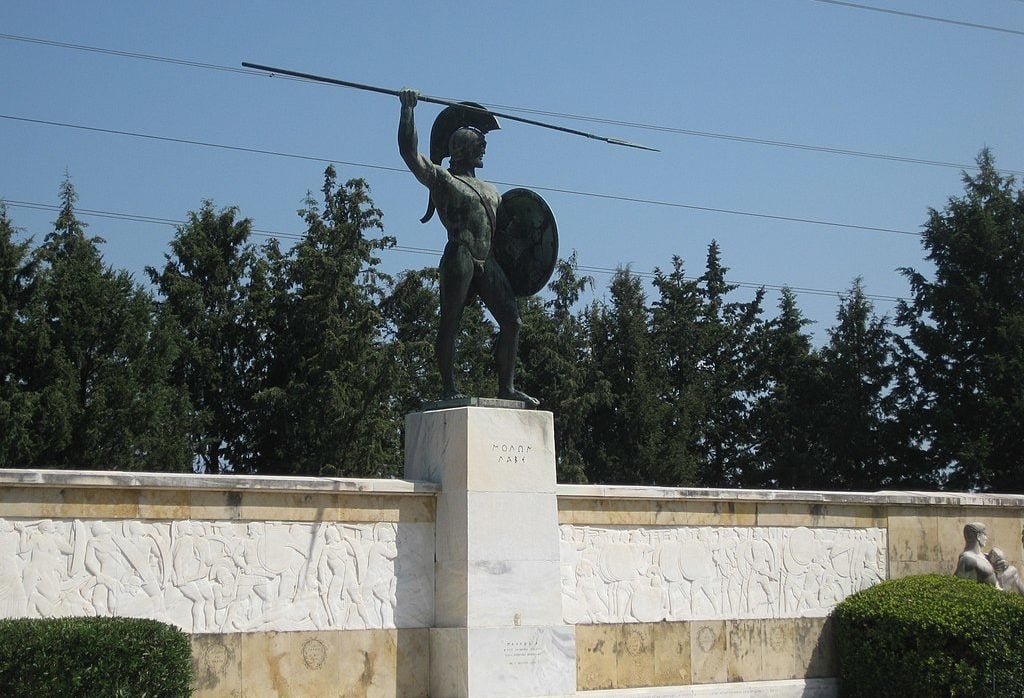
Statue of Leonidas of Sparta, Greece. Credit: Dmpexr/Wikimedia Commons/CC BY-SA 4.0
It was in 480 BC during the second Persian invasion of Greece, when King Leonidas of Sparta ahead of the legendary Battle of Thermopylae responded by the phrase “Molon Lave” (‘Come and Take Them’ in ancient Greek) to Persian King Xerxes’ demand that the Spartan army lay down their weapons and surrender to his army. The outnumbered Greeks were eventually annihilated, though they held Thermopylae for three days and inflicted serious damage to the Persians, while delaying them from reaching Athens.
That’s how the story ended back then. But little did King Leonidas know that over 2,500 years later, his “Molon Lave” phrase (also spelled “Molon Labe” by many) would not only become immortalized through the centuries but moreover, it would thrive as a global marketing tool -linked to the sale of weapons, wine, olive oil, expensive watches and even cigars.
King Leonidas I reigned the ancient city-state of Sparta, a warrior society, from 489 to 480 BC. Subjected to military drills since early manhood, the Spartans had become one of the most feared and formidable military forces in the ancient Greek world, attaining legendary status in their wars against Persia. At the height of Sparta’s power, between the 6th and 4th centuries BC, according to Peter Connolly, a British historian and the scholar of the ancient world, other Greeks commonly accepted that “one Spartan was worth several men of any other state.”
“The appeal of Molon Lave comes from its Spartan origins,” Effie Delimarkos-Fletcher, a Greek-American communications expert and marketing strategist tells Greek Reporter. “Spartans themselves have come to symbolize power, strength, resolve, and defiance, which was catapulted into the mainstream with the debut movie of ‘300.’ As a result, aligning with the phrase “Molon Lave” is a distinct way for a brand to signal strength and prowess in an area worth defending.”
Moreover, there are few other phrases like “Molon Lave,” where two single, short words are able to convey all that, perhaps the most famous military last stand of all time, embodies -defiance, strength and resolve. Spartans were expected to be men of few words, famous for using “laconic phrases,” named after Laconia, the region of Greece, including the city of Sparta, whose ancient inhabitants had a reputation for verbal austerity. A laconic phrase was used for efficiency (as during military training and operations), for emphasis or to deflate a pompous speaker.
The company has applied for and successfully registered the ‘Molon Lave’ brand in Greek, as seen on the handle of the knife. Credit: Panther WholesaleAnother Florida-based company named “Molon Labe” is selling high-quality cigars, spirits and coffee, and as with most other businesses, is also using a Spartan helmet on its logo. Credit: Molon Labe Official Instagram Account
Military, the industry where Molon Lave has the largest appeal as a brand
From tactical patches and other military paraphernalia sold online, to assault rifles sold in stores across the United States, the phrase “Molon Lave” graces thousands of military-related products.
According to Delimarkos-Fletcher, Molon Lave and its English translation “Come and Take Them” has been present in the country’s early DNA as it is said to have been used as far back as the Revolutionary War. Even so, it is better known for its connection to the Texas Revolutionary War, when the phrase was stitched onto a flag that has come to be associated with the defiant spirit of the state. In more recent times, many U.S.-based militia groups and paramilitary organizations have taken the phrase “Molon Lave,” and often the depiction of a Spartan helmet, signaling defiance for gun regulations.
“Because Molon Lave has been adopted by militia-type groups in the United States, securing the Molon Lave trademark is done by companies looking to appeal to that target,” Delimarkos-Fletcher says.
And that’s exactly what at least one US.-based company had done. A short Greek Reporter investigation revealed that, while there are hundreds of knives and weapons with the phrase “Molon Lave” appearing on them in different variations, in 2015 this one company has gone as far as to apply for and successfully register a year later a trademark for the original Molon Lave phrase in Greek (ΜΟΛΩΝ ΛΑΒΕ) for one of its knives selection. The company, advertises the knives on its website by stating “It takes a bold individual to make a statement of defiance like ‘Come and Take Them (Molon Labe),’ we provide the knives that re-enforce the bravado.”
But can a company apply and secure a trademark for the use of a common, ancient phrase like Molon Lave, that seems almost free for anyone to use?
According to Pamela Koslyn, a Los Angeles-based attorney specializing in intellectual property law, U.S. legislation allows a company to successfully apply for a trademark for a brand new phrase, or an “ancient” phrase or an invented word/phrase, with the age and origin of the phrase being irrelevant.
“A trademark isn’t a monopoly on a phrase, it’s a source identifier of some phrase associated with some goods or services. Like knives. Or olive oil. Or wine. These are all actual “live or pending marks of Molon Lave…There’s also a Chinese textile seller called Molon Lave,” Koslyn tells Greek Reporter. “If a user has a registered trademark on a phrase in a particular class, e.g. knives, that means the user own the exclusive right to use their mark in association with their goods or services and can theoretically successfully sue and enjoin any competitor who infringes those rights by using the same or confusingly similar mark for the same or confusingly similar goods or services.”
Still, Koslyn notes, that one in two trademark applications to the United States Patent and Trademark Office (USPTO) fail not only because they’re not viable or available but moreover because of the complexity of the law and the time needed to find out if an application has been approved by USPTO -a process that could take months if not years.
On its website, the restaurant says that it’s “based on the Spartan epic saying Molon Lave, which means ‘Come and Get Them,'” and has a mission “to celebrate and share Greek cuisine and culture.”Credit: Molon Lave Taverna Official Instagram Account
The famous ancient Greek phrase many want to own
But few actually register the phrase in order to enhance their branding or make their products stand out more. Given the enormous competition among companies to win the hearts of consumers, proper branding and marketing could mean the difference between life and death for a company. And given its global fame, that’s exactly what “Molon Lave” does.
Nowhere is this more obvious than in the United States, the beating heart of global consumerism. A family-owned farm winery in Virginia was established in 2009 under the name “Molon Lave.” Aside from informing its customers that it also produces “kokkineli,” a traditional Greek style rose, the winery fully explains on its website the origins of its name, noting that “‘Molon Lave’ is a phrase that has inspired throughout the centuries a sense of dignity and pride, and a unique perception of life.”
Another Florida-based company named “Molon Labe” is selling high-quality cigars, spirits and coffee, as with most other businesses, also using a Spartan helmet on its logo. Moreover, the cigars are wrapped in paper bearing the phrase in Greek. The company on its website gives no explanation as to why it chose the specific name.
A consumer browsing the handmade watches of the UK-based company. Credit: Greek Reporter
Greek Reporter’s investigation also found a watch company with the name “Molon Labe” based in the UK, selling handmade, military watches inspired by the phrase, with some having a price tag of over $1,500. There’s also a global security company named “Molon Lave,” an information technology service activity company in the UK and a gym in Cyprus, featuring on its premises the bust of a muscular Spartan soldier alongside the “Molon Lave” phrase, which is showcased in ancient Greek type. The list goes on.
With a fortitude reminiscent of the very people it once represented, the phrase “Molon Lave” survived to this day as one of the few expressions that so efficiently evoke an immediate connection not only to power but also to Greece.
It is no wonder the phrase has also been adopted as the name of a “small, Greek authentic restaurant” in Ontario, Canada, which on its website says that it’s “based on the Spartan epic saying Molon Lave, which means ‘Come and Get Them,'” and has a mission “to celebrate and share Greek cuisine and culture.”
At the same time, a thriving Greek olive oil brand named “Molon Lave” based in Sparta, the place where King Leonidas and his Spartan warriors once lived, is probably one of the more successful examples using the phrase as a marketing tool.
Delimarkos-Fletcher says many using the phrase may not even know its true origins so it is refreshing to see Greek-related businesses reclaiming Molon Lave as they “seek to evoke a connection to the best known story of Greek strength and prowess.”
“Other brands are just using ‘Molon Lave’ as shorthand for having something powerful enough that others want for their own,” Delimarkos-Fletcher tells Greek Reporter.
The winery explains on its website the origins of its name, noting that “‘Molon Lave’ is a phrase that has inspired throughout the centuries a sense of dignity and pride, and a unique perception of life.”Credit: Molon Lave Vineyards Official Instagram Account
Fincantieri protagonista agli Italian Hydrogen Technology Awards 2026 con il progetto IPCEI Wave 2 The Future
Fincantieri è stata premiata nell’ambito degli Italian Hydrogen Technology Awards 2026, assegnati in occasione di Hydrogen Expo, la manifestazione dedicata alle tecnologie per lo sviluppo della filiera dell’idrogeno tenutasi a Piacenza. Il riconoscimento è stato attribuito al Gruppo per il progetto IPCEI Wave 2 The Future, iniziativa considerata dalla giuria di carattere pionieristico per l’evoluzione della decarbonizzazione nel settore marittimo. Il premio conferma il ruolo di Fincantieri come protagonista dell’innovazione tecnologica e della sostenibilità nella cantieristica navale. Il progetto si inserisce infatti nel percorso strategico del Gruppo guidato dall’amministratore delegato Pierroberto Folgiero, orientato al raggiungimento dell’obiettivo net-zero entro il 2035.
IPCEI Wave 2 The Future punta allo sviluppo di sistemi di propulsione avanzati basati sull’idrogeno e su soluzioni ibride, con l’obiettivo di accelerare la transizione energetica del comparto navale. Tra le tecnologie previste figurano motori a combustione interna alimentati a idrogeno, fuel cell PEM abbinate a batterie al litio e sistemi di controllo energetico di nuova generazione. Il progetto comprende inoltre lo sviluppo di un ciclo combinato gas-vapore a idrogeno ad alta efficienza per la produzione elettrica. A queste soluzioni si affiancano sistemi innovativi di stoccaggio dell’idrogeno a bordo e l’integrazione di fuel cell PEM e SOFC, SolidOxideFuelCell, ampliando ulteriormente la portata tecnologica dell’iniziativa.
Alcune delle tecnologie sviluppate nell’ambito del progetto trovano applicazione su Viking Libra, la prima nave da crociera a integrare un sistema containerizzato alimentato a idrogeno, la cui consegna è prevista alla fine di quest’anno. Su questa unità, l’idrogeno alimenta fuel cell PEM da 6 MW sviluppate da Isotta Fraschini Motori, società parte del GruppoFincantieri, e ottimizzate per il settore crocieristico. Il riconoscimento ottenuto agli Italian Hydrogen Technology Awards sottolinea dunque la capacità di Fincantieri di guidare l’innovazione della cantieristica navale verso una nuova generazione di navi a emissioni ridotte. Una strategia che unisce ricerca, sviluppo industriale e sostenibilità, confermando la visione del Gruppo nella costruzione del futuro del trasporto marittimo.
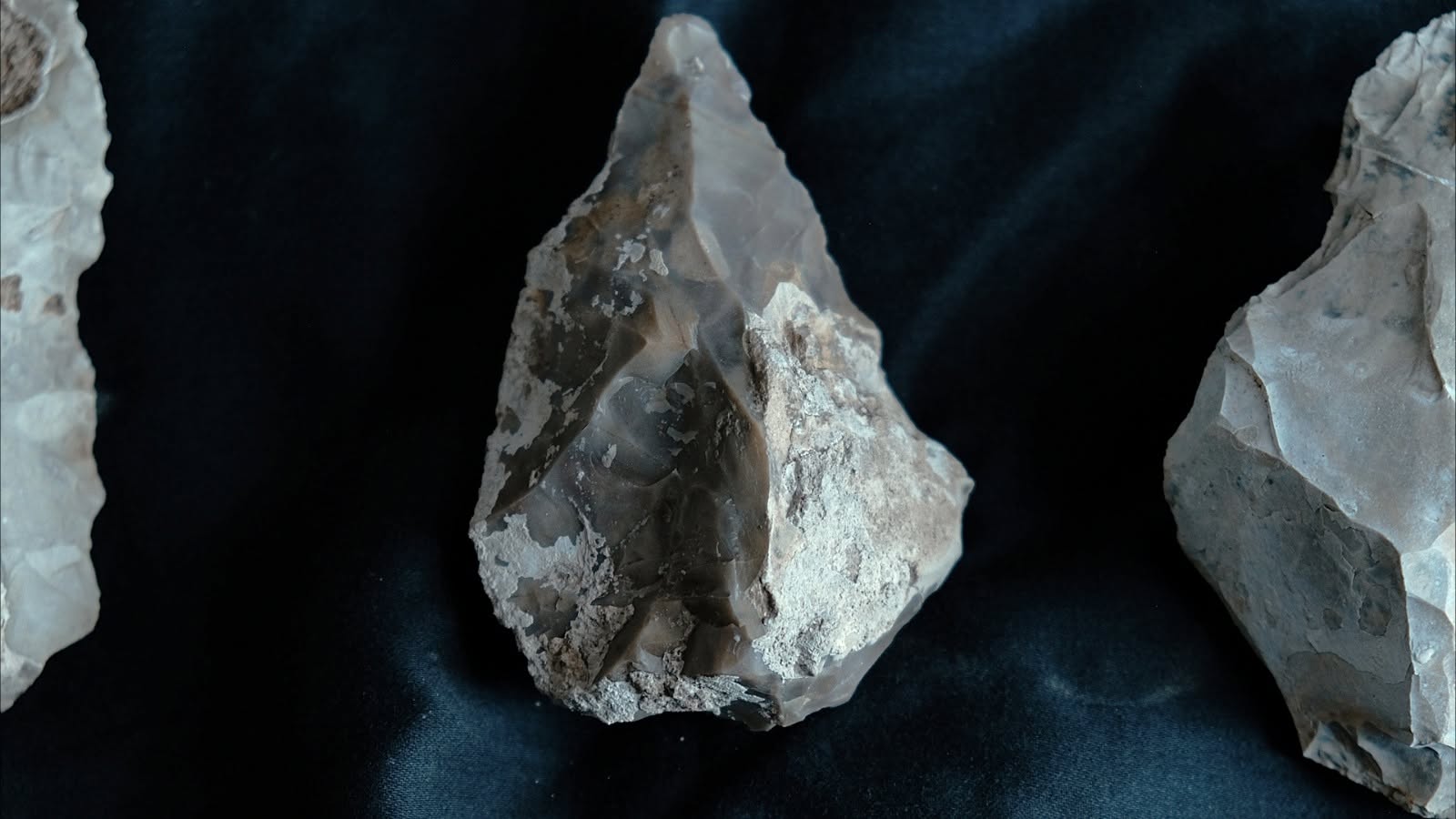
A stone handaxe from the Acheulo-Yabrudian period. Credit: Israel Antiquities Authority
Archaeologists are excavating a prehistoric cave in northern Israel that could provide rare insights into early human life, how they adapted, and developed new technologies hundreds of thousands of years ago.
The cave was discovered on the outskirts of Fureidis, south of Haifa, near the Zichron Ya’acov interchange. The excavation is being led by the Israel Antiquities Authority (IAA) in partnership with researchers from the University of Haifa. Funding for the project is being provided by Ayalon Highways Company.
Researchers date the cave to between 250,000 and 400,000 years ago, placing it within the Acheulo-Yabrudian cultural complex, a group of prehistoric cultures that existed in the Levant during the final stages of the Lower Paleolithic period.
Exceptionally preserved prehistoric site
The site has drawn attention because of its exceptional state of preservation. “It is very rare to find a site in such a state of preservation,” said Dr. Kobi Vardi, head of the IAA’s Prehistory Branch and one of the excavation directors. “Every prehistorian who visits the site is absolutely thrilled.”
Vardi said the cave is comparable in importance to the famous Nahal Me’arot caves in northern Israel, which date to the same period. “The site, which is no less important than the well-known Nahal Me’arot site, and dates to the same period, will allow us to study in high resolution how humans lived at that time,” he said.
Excavations have already uncovered animal bones belonging to fallow deer, gazelles, and ancient horses. Researchers have also found evidence of a nearby water source, suggesting the area may have attracted prehistoric hunter-gatherer groups.
Clues to ancient technology and daily life
The Acheulo-Yabrudian culture is known for advanced stone-tool production. Archaeologists say people living during this period produced carefully crafted flint tools, including handaxes, scrapers, and blades. These technologies reflect an important stage in human development.
Researchers believe the cave may help answer key questions about a period that preceded the rise and spread of both Neanderthals and modern humans.
“We have been fortunate to excavate a unique site of global importance that has been protected from the ravages of time thanks to the exceptional conditions that existed here,” said Prof. Ron Shimelmitz of the University of Haifa.
“This time capsule belongs to a unique period at the end of the Lower Paleolithic era, just before Neanderthals and modern humans became dominant and spread across many regions,” he said.
Evidence of growing social complexity
According to Shimelmitz, the Acheulo-Yabrudian period marked a turning point in human evolution. Gradual changes in technology, social organization, and behavior began to emerge during this era, laying the foundations for more complex societies.
Researchers believe people started living in larger groups and spending longer periods at the same locations. Evidence from similar caves points to repeated use of fire and extended occupation, suggesting increasingly organized camp life and stronger social cooperation.
“These are findings that many researchers associate with the development of social cooperation and the transmission of knowledge, as part of the processes of human evolution,” Shimelmitz said.
Plans for future research
The IAA and the University of Haifa plan to launch a broader research program at the site. Researchers also hope the cave will eventually be opened to the public, allowing residents, students, and visitors to explore one of the region’s most important prehistoric discoveries.
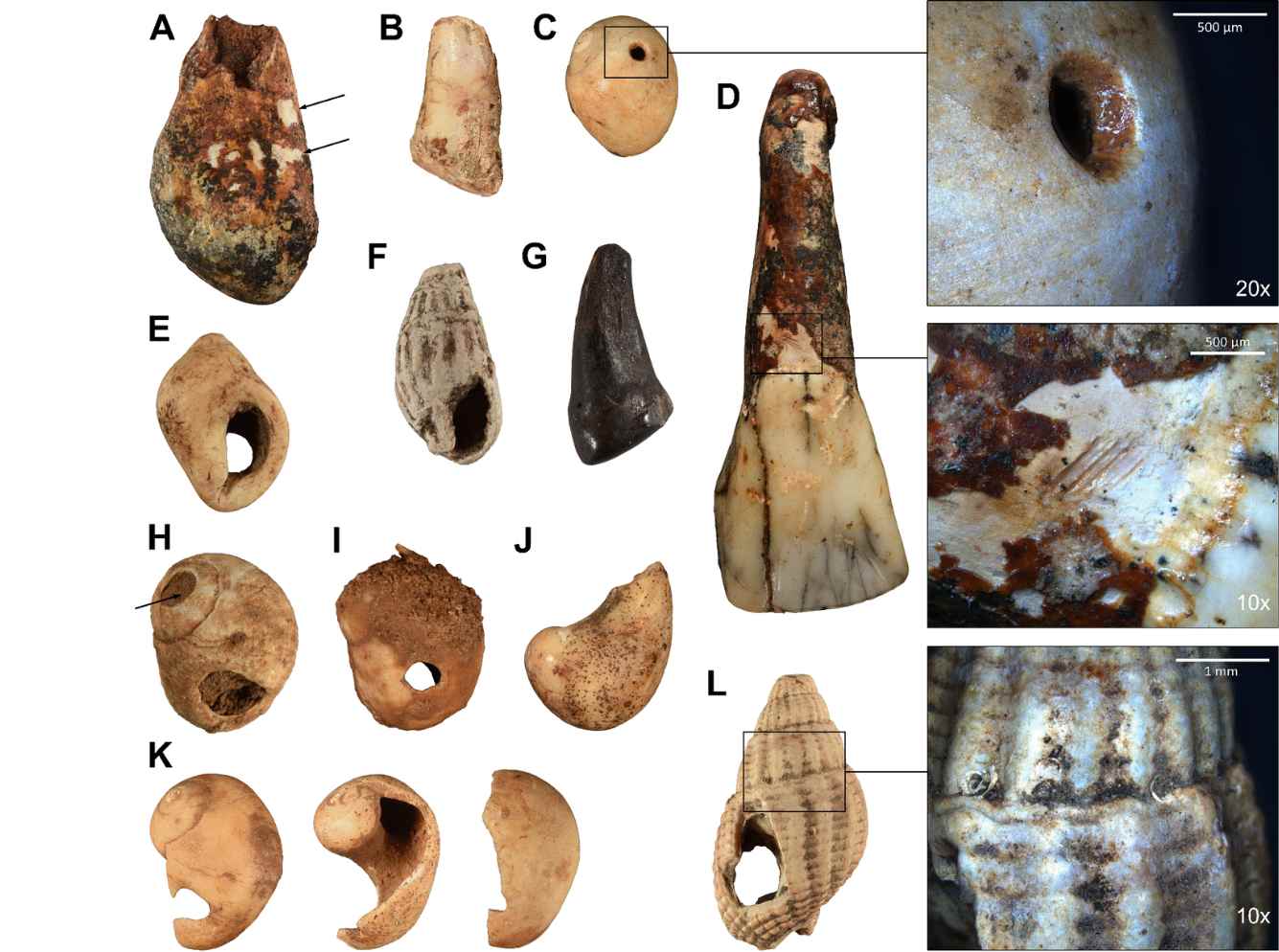
Selected personal ornaments from Llonín Cave in northern Spain. Credit: Daniel Pérez-García de los Salmones et al. / CC BY 4.0
A collection of 22,000-year-old jewelry discovered in northern Spain is offering new insights into how Ice Age hunter-gatherers expressed identity, exchanged ideas, and maintained social networks across vast distances.
Researchers found that people living in and around Llonín Cave used shells, animal teeth, bones, and even fossils to create personal ornaments over thousands of years, revealing changing patterns of social life during the Upper Paleolithic.
The study, led by Daniel Pérez-García de los Salmones and published in PLOS One, analyzed 271 ornaments recovered from Llonín Cave in northern Spain. The cave preserves a long archaeological sequence dating from roughly 23,500 to 11,000 years ago, covering several major cultural periods of the Late Ice Age.
A cave filled with symbolic objects
The ornaments included marine shells, red deer teeth, fish vertebrae, bone fragments, and a fossilized tube worm. Most were intentionally modified and worn as pendants or beads. Researchers identified at least 17 genera and 15 species used in their production. Marine shells made up the largest share of the collection, while red deer canine teeth were the most common animal-derived ornaments.
Microscopic analysis showed that many pieces had been worn for long periods. Friction from cords, clothing, or skin leaves polish marks, grooves, and rounded edges around perforations. More than 90% of the analyzed ornaments displayed signs of use.
A new study from Llonín Cave in northern Spain suggests Ice Age hunter-gatherers used shells, animal teeth, bones, and fossils to create ornaments that expressed identity, marked social ties, and connected communities across long distances.#Archaeology#IceAge#Jewelry#Spainpic.twitter.com/DXcBNuubUJ
— Tom Marvolo Riddle (@tom_riddle2025) June 9, 2026
Researchers also found evidence that some ornaments were made inside the cave. Unfinished deer tooth pendants and partially worked animal teeth suggest that people crafted jewelry on site rather than simply acquiring finished pieces from elsewhere.
Long-distance connections across Ice Age Iberia
One of the most striking discoveries involved shells that likely originated from the Mediterranean coast. The species Tritia mutabilis does not naturally occur along the Cantabrian coast of northern Spain, where Llonín Cave is located.
Its presence suggests that people exchanged objects or maintained contact networks stretching hundreds of kilometers across the Iberian Peninsula.
The cave occupied a strategic position between the Atlantic coast, the Ebro Valley, and routes leading toward the Pyrenees. Researchers argue that these pathways helped facilitate the movement of materials, ornaments, and cultural traditions between distant groups.
From individual identity to group identity
The study found that ornament styles changed over time. During the Upper Solutrean period, around 23,500 to 22,000 years ago, jewelry showed great diversity in materials, manufacturing methods, and designs. Researchers believe these ornaments likely served as markers of individual identity and personal expression.
Later, during the Middle Magdalenian period, ornament production became more standardized. Shell beads were more uniform in size and style, and many appear to have arrived at the cave already finished.
Researchers suggest that this shift reflects larger social gatherings where ornaments may have been used to signal group membership or strengthen alliances among different communities.
A window into Ice Age society
The findings suggest that personal ornaments were far more than decorative objects. They helped communicate identity, social relationships, and cultural connections during a time when hunter-gatherer groups were spread across changing Ice Age landscapes.
According to the researchers, Llonín Cave stands out as an important site for understanding how prehistoric people used jewelry to navigate both everyday life and wider social networks. The collection shows that even 22,000 years ago, people were connected through systems of exchange, shared traditions, and symbolic communication that stretched far beyond their local communities.
Ukrainian Special Operations Forces drone operators have established aerial control over part of the Russian land supply route from occupied Melitopol to Chonhar. The path is the entry point to Crimea, and they are destroying Russian equipment and disrupting Russian military logistics on the road, the 3rd Separate Special Purpose Regiment announces.
Russian forces on the peninsula already depend on a constrained set of supply lines: the Kerch Bridge (under sustained Ukrainian threat since 2022), the rail and road corridor through occupied Donetsk Oblast, and the Melitopol-Chonhar bottleneck. Ukrainian aerial denial of any one of these links compounds pressure on the others.
Squeezing land corridor from both ends
The new operation puts pressure on the land corridor's western end. On 31 May, Mariupol residents reported in local group chats that Russia shut down part of its land corridor from Crimea to occupied Donetsk because of Ukrainian drones.
The Melitopol-Chonhar segment crosses flat steppe with limited cover and funnels Russian convoys through narrow bridge crossings over the Syvash to reach the peninsula, the terrain optimal for drone operators to deny the air with persistent surveillance and strike capability.
SSO drones as the strangulation instrument
The 3rd Separate Special Purpose Regiment is one of Ukraine's veteran Special Operations Forces units, named after the tenth-century Kyivan Rus prince.
The regiment's deployment of drone operators against Russian logistics on the Melitopol-Chonhar route fits within Ukraine's broader "logistics lockdown" approach to occupied territory. Ukraine's Defense Ministry has recently committed $113 million to medium-strike drones designed to target Russian rear logistics.
"Drones of the Special Operations Forces unit are destroying equipment and breaking the enemy's logistics routes on the Melitopol-Chonhar route," the 3rd Regiment said.
What does this change for Russia on peninsula?
Russia's military presence in Crimea depends on a continuous supply of fuel, ammunition, and food, as well as on personnel rotation.
"As a result, the already-difficult logistics for supplying the Russian army and fuel to the peninsula have grown harder," the SSO said.
“Le cave rinaturalizzate non possono essere interessate da attività estrattive né a cielo aperto né in sotterraneo”. Con queste parole nette, scritte il 12 febbraio 2026, ma rese pubbliche solo nei giorni scorsi, la Conferenza dei Servizi indetta per verificare la conformità alla normativa regionale dei Piani Attuativi dei Bacini Estrattivi (PABE) presentati dal Comune di Massa chiude il capitolo della riapertura della cava Cresta degli Amari, nel Parco delle Alpi Apuane. Anche se l’ufficialità arriverà solo al termine del procedimento di approvazione dei PABE, gioiscono gli ambientalisti che si erano schierati a difesa di questo clivo verde nell’area di Pian della Fioba del Parco delle Alpi Apuane, a pochi passi dalla falesia “Campaccio”, attrazione per gli appassionati di arrampicata che vi arrivano da ogni parte d’Italia. “È una vittoria della società civile contro la malapolitica che amministra il territorio, che vede nelle Apuane solo marmo da estrarre e non sa immaginare un futuro diverso per le nostre montagne” commenta a ilFattoquotidiano.it Andrea Ribolini, dell’Associazione Aquilegia, tra i promotori della mobilitazione a difesa della Cresta degli Amari e gestore del limitrofo Orto Botanico delle Alpi Apuane “Pellegrini-Ansaldi”.
L’amministrazione guidata da Francesco Persiani (Lega) ha provato a consentire l’escavazione sotterranea della cava che insisteva nel luogo, chiusa dal 1980, tramite il suo strumento urbanistico (i PABE), nonostante proteste pubbliche e osservazioni formalizzate da ambientalisti e operatori di quell’economia della valorizzazione e tutela della montagna che in quelle zone trovano continui ostacoli per l’inconciliabile convivenza con i siti estrattivi. Con il verbale del 12 febbraio 2026, la Conferenza dei Servizi ha messo la parola fine a queste ambizioni, benché il sindaco Persiani, in un comunicato ufficiale, cerchi di ridimensionare la questione sostenendo che “parlare oggi di bocciatura risulta improprio e fuorviante. Le osservazioni formulate dagli enti (nella Conferenza dei Servizi ndr) vengono analizzate dall’amministrazione proponente (ovvero il Comune di Massa ndr), che può recepirle integralmente, recepirle parzialmente apportando modifiche e approfondimenti al piano, oppure motivatamente non accoglierle”.
Eppure la Conferenza dei Servizi a guida Regione Toscana ha indicato chiaramente che la partita è chiusa e anzi doveva essere già chiusa il 18 dicembre 2023, quando “gli esiti del sopralluogo hanno portato a riconoscere tale cava (Cresta degli Amari ndr), non servita da alcuna viabilità di accesso, come una cava rinaturalizzata”, con la specificità ulteriore di essere “vicina al crinale” e con “sostanziale integrità del versante (…) motivi in più per inserirla tra le cave rinaturalizzate”.
Una bocciatura senza appello quindi, evidenziata anche dal Polo Progressista e di Sinistra di Massa (M5S, RC) guidato dalla consigliera Daniela Bennati, che ha reso pubblica la notizia del verbale. “La posizione della Conferenza dei Servizi ricalca esattamente quanto osservato in sede di approvazione da diverse associazioni e movimenti politici tra cui M5S, CAI e Associazione Aquilegia, bocciato dal Consiglio Comunale – chiarisce il Polo Progressista in un comunicato -. Le valenze paesaggistiche e ambientali delle nostre montagne non possono essere sottomesse al modello estrattivista. Le Apuane sono un bene comune che non può essere sottratto alla collettività per il beneficio di pochi”.
Il Comune di Massa, quindi, ha approvato in Consiglio Comunale a fine 2025 la riapertura della cava rinaturalizzata Cresta degli Amari, seppur per via sotterranea, nonostante la Conferenza dei Servizi ne avesse indicato l’impossibilità giuridica due anni prima. Il riconoscimento amministrativo della rinaturalizzazione delle cave, così come la necessità di evitare escamotage semantici per autorizzare l’attività estrattiva laddove è vietata, sono diventati ormai dirimenti negli iter di approvazione dei Piani Attuativi dei Bacini Estrattivi (PABE) proposti dai comuni apuani.
La stessa Conferenza dei Servizi del 12 febbraio 2026 ha indicato, ad esempio, la necessità di esplicitare come “naturalizzata” e non semplice “cava dismessa” anche un’altra area – cava Campo Fiorito – perché quest’ultima definizione avrebbe aperto spazi interpretativi impropri. Persino il simbolo della devastazione delle Apuane, il Monte Carchio, con la sua non cima, squadrata dall’attività estrattiva fino alla sua sommità e le frane di scarti lapidei sui crinali, ha trovato posto nella Conferenza dei Servizi, con una prescrizione: in tutti i documenti dev’essere indicato “non sono ammesse autorizzazioni all’escavazione sui suoi versanti”. Basterà?
A empresa Águas Públicas do Alentejo (AgdA) vai reabilitar os reservatórios de Almograve e São Francisco da Serra, no litoral alentejano, num investimento de 720 mil euros, para melhorar a operacionalidade e segurança destes equipamentos, foi hoje revelado.
Em comunicado, a AgdA indicou que já foi adjudicada, no mês passado, a empreitada de execução da reabilitação dos reservatórios de Almograve, no concelho de Odemira, distrito de Beja, e de São Francisco da Serra, no concelho de Santiago do Cacém, no distrito de Setúbal.
A obra, no valor de cerca de 720 mil euros e com um prazo de execução de 210 dias, visa “a reabilitação estrutural e funcional das infraestruturas, assegurando a melhoria das condições de operação e segurança”, explicou.
Segundo a empresa, os trabalhos incluem o “tratamento de fissuras, impermeabilização, substituição de tubagens e a modernização de equipamentos hidráulicos e elétricos” dos dois reservatórios de água.
Esta reabilitação irá contribuir para “a renovação e valorização destas infraestruturas essenciais ao sistema de abastecimento de água”, acrescentou.
Durante a execução da empreitada serão implementados “sistemas provisórios de ‘bypass’”, com o objetivo de garantir “a continuidade do abastecimento de água, em quantidade e qualidade, às populações servidas” por aquelas infraestruturas.
No mesmo comunicado, a empresa salientou que, com esta obra, procura “reforçar a durabilidade, funcionalidade e fiabilidade dos reservatórios, garantindo melhores condições de segurança no abastecimento de água às populações servidas”.
“Esta intervenção insere-se na estratégia da AgdA de reabilitação e modernização contínua das infraestruturas, contribuindo para um serviço cada vez mais eficiente, resiliente e sustentável”, reforçou.
Constituída em 25 de setembro de 2009, a AgdA tem como acionistas a Águas de Portugal (AdP) e a AMGAP – Associação de Municípios para a Gestão da Água Pública do Alentejo.
A empresa tem sede em Beja e gere o Sistema Público de Parceria Integrado de Águas do Alentejo (SPPIAA), criado em 2009, numa parceria entre o Estado e as autarquias, para a gestão integrada do ciclo urbano da água.
Gostou do que leu? Ajude-nos a continuar!
O nosso compromisso é levar até si notícias rigorosas, relevantes e próximas da sua comunidade. Para continuarmos a fazer o que fazemos, precisamos do seu apoio. Qualquer donativo, por mais pequeno que seja, faz a diferença e ajuda a garantir a continuidade deste projeto. Juntos, mantemos a informação viva no Algarve e no Alentejo. Obrigado por fazer parte desta missão!

 Login
Login