In a fast-paced sci-fi fantasy, infused with epic intentions and starring Emily Blunt, Josh O’Connor and Colman Domingo, the filmmaker brings the rest of us home.
The Cannes Film Market (Marché du Film) has officially named Greece as its 2027 Country of Honour for the landmark 80th edition of the Cannes Film Festival. This prestigious spotlight celebrates the country’s rapid ascent into a premier global audiovisual hub.
Operating under the banner “Ride the Greek Wave,” the initiative will highlight the convergence of Greek creativity, a booming production sector, and its growing role in international storytelling.
“With the remarkable momentum of its film and audiovisual industry today, Greece embodies the spirit of creativity, openness, and international collaboration that the Marché du Film seeks to celebrate through its Country of Honour initiative,” said Guillaume Esmiol, Executive Director of the Marché du Film.
This major milestone follows a massive influx of high-profile international projects utilizing Greece’s scenic versatility and its highly competitive 40% cash rebate incentive.
Cannes celebrates Greece as a film and TV production hub
Major recent film and television productions that have set up camp across Greece’s islands and mainland include:
Emily in Paris (Netflix): For its highly anticipated new season, the ultra-popular streaming franchise has expanded Emily Cooper’s horizons to Greece. Production crews completely took over Mykonos, filming major scenes featuring Lily Collins and co-star Lucas Bravo at the pristine Agios Sostis Beach, as well as the island’s iconic windmills and the narrow alleys of Little Venice.
The Riders: Hollywood star Brad Pitt spent weeks touring Greece to film this high-stakes psychological drama directed by Oscar-winner Edward Berger (All Quiet on the Western Front). The production spanned diverse settings across the country, from a dramatic artificial storm sequence shot inside a historic studio in Menidi to location shoots on the car-free island of Hydra, the historic railway station of Chalkida, and right in front of Athens Town Hall in Kotzia Square.
The Odyssey (Universal Pictures): Christopher Nolan’s highly anticipated, ancient-set cinematic epic based on Homer’s poem, which utilized locations across the Mediterranean, including Greece.
The Return: A gritty, atmospheric retelling of Odysseus’s homecoming starring Ralph Fiennes and Juliette Binoche, filmed extensively amidst the ancient olive groves and rugged cliffs of Corfu.
House of David (Amazon MGM Studios): A sprawling biblical drama series that transformed the landscapes of Attica and the Peloponnese into ancient Israel.
Malice (Prime Video): A psychological thriller series starring David Duchovny and Carice van Houten, which filmed across Athens, Piraeus, and the sun-bleached Cycladic islands of Paros and Antiparos.
Maestro in Blue (Netflix): The critically acclaimed, internationally distributed Greek drama series produced by Christoforos Papakaliatis, which wrapped up its sweeping story against the stunning backdrop of Paxos and Corfu.
Greece’s audiovisual sector
Leonidas Christopoulos, CEO of Greece’s film and media agency EKKOMED, noted that the Cannes distinction is a massive victory for the local industry: “This distinction is both a significant recognition and a unique opportunity to showcase Greece’s vibrant creative ecosystem on the international stage. Today, Greece is a place where cinematic heritage meets contemporary talent, innovation, and international collaboration.”
EKKOMED says that Greece’s audiovisual sector contributes €1.9 billion ($2.18 billion) to the national economy, supports approximately 44,000 jobs, and includes nearly 3,000 companies active across production, post-production, animation, and related creative services.
The quiet goodness portrayed in All Creatures Great and Small resonates so deeply. It echoes something true about the world God is restoring. And what the show captures in glimpses, Christ is bringing to fullness: a life where ordinary faithfulness, shared burdens, and steadfast love are not small things at all, but signs of His... Continue Reading
Daniel Kellner is a cybersecurity expert who steals classified files proving the existence of alien life. Margaret Fairchild is a Kansas City meteorologist who unexpectedly develops strange psychic abilities. As
After getting lost in the dense Louisiana swamplands, a group of stranded holidaymakers must fight for survival against a highly aggressive, rampaging hippo on the loose. Director: James Nunn; Starring:
Majestic great white shark glides through the ocean waters. Credit: Elias Levy / OpenVerse / CC BY-2.0
Volunteer divers have recorded what researchers believe is the first footage of a great white shark filmed underwater in the Mediterranean, captured during a ghost net removal dive near a shipwreck in the Strait of Sicily.
Derk Remmers, a technical diver with Ghost Diving, was about 40 meters (131 feet) below the surface between Sicily and Tunisia when the shark appeared. He filmed the encounter. The footage and photographs were released on June 8 to mark World Oceans Day.
Remmers said that the odds of meeting such an animal underwater are far lower than winning the lottery, and that his hands were shaking as he filmed.
The shark circled the group, then turned and moved back toward the divers. Remmers said that its behavior appeared calm and curious, not aggressive. When the team released air from their regulators, the shark picked up speed and disappeared from view.
First great white shark sighting in the Mediterranean stuns researchers
Marine biologists who reviewed the footage called the sighting rare and scientifically significant.
Dr. Carlo Cattano, a researcher at the Sicily Marine Centre of the Stazione Zoologica Anton Dohrn, said that most knowledge of great white sharks in the region has come from dead animals caught accidentally in fishing nets, and that direct observations help researchers better understand the species.
A great white shark circled divers in the Mediterranean as they worked to pull deadly ghost nets from a shipwreck in the Strait of Sicily. pic.twitter.com/tdJKJ37TMY
— Tom Marvolo Riddle (@tom_riddle2025) June 9, 2026
He said that prior research had already identified the area as a key location for threatened species and that this sighting reinforces its conservation value. Researchers cautioned that broader conclusions would require further study.
The mission was organized by the Healthy Seas Foundation, along with Ghost Diving and the Society for the Documentation of Submerged Sites. The wreck’s location is being kept confidential.
Ghost nets, fishing gear lost or abandoned at sea, continue killing marine life long after leaving a vessel. Previous dives at the site documented loggerhead sea turtles and large fish species caught in the gear.
Shipwrecks attract marine life, and when ghost nets settle on them, those structures become underwater traps.
Ghost nets turn shipwreck ecosystems into ongoing ocean traps
Veronika Mikos, director of Healthy Seas, said that the sighting is a reminder of how much marine life still exists in offshore Mediterranean waters and how much is at risk from discarded gear and overfishing.
Remmers said that between 1% and 10% of all fishing gear worldwide is lost each year, possibly adding more than 500,000 metric tons of abandoned nets to the ocean annually.
He said that the shark’s presence near the wreck signals an abundance of prey, and that those same animals face entanglement risk. Volunteer cleanups alone cannot resolve the problem, he said, and stronger action against industrial and illegal fishing is needed.
The mission also included environmental DNA sampling and underwater monitoring. Healthy Seas said that it plans to release additional footage and scientific material in the coming weeks.
Maybe it's the midlife crisis talking, but the racist purge of straight white men from arts and entertainment has degraded all books and films, says Nick Dixon, and left behind only meaningless, endless culture war.
“Star Wars” fans at Heinz Hall in Pittsburgh, where the Pittsburgh Symphony Orchestra recently performed a live soundtrack for “The Empire Strikes Back.”
Two Times critics unpack the twin phenomenon of “Backrooms” and “Obsession” and what lessons should — and shouldn’t — be learned from their massive success.
Guests and honorees gather on the red carpet during the 20th Los Angeles Greek Film Festival Closing Night and Orpheus Awards Ceremony at the Egyptian Theatre in Hollywood. Photo: UrbaniteLA
The Los Angeles Greek Film Festival marked its 20th edition in Hollywood with the Orpheus Awards Ceremony, honoring Greek and Cypriot filmmakers and paying tribute to Oscar-winning composer Alexandre Desplat.
The festival’s Closing Night Film and Orpheus Awards Ceremony took place on May 31 at the Egyptian Theatre, in collaboration with the American Cinematheque. This year’s edition brought together filmmakers, artists, industry professionals, and supporters of Greek cinema for a week of screenings, red carpet events, tributes, and awards. The festival’s virtual film program continues through June 14.
Founded in 2007, LAGFF has grown into one of the most important platforms for Greek and Cypriot cinema outside Greece. Over the past two decades, it has screened more than 800 films, hosted over 700 filmmakers, and reached an audience of more than 50,000.
Alexandre Desplat honored at closing night
One of the evening’s major highlights was the presentation of the Honorary Orpheus Award to Alexandre Desplat, one of the most acclaimed film composers working today.
Desplat, who won Academy Awards for his scores for The Grand Budapest Hotel and The Shape of Water, received the honor for his contribution to contemporary cinema. Filmmaker Malcolm Washington presented the award during the Closing Night ceremony, while Fay Lellios produced the tribute.
The evening also included a remembrance tribute to George Kolovos of G.P. Kolovos & Associates, a longtime benefactor of the Los Angeles Greek Film Festival.
“The 20th celebratory edition of LAGFF left indelible memories,” said Aristotle Katopodis, Artistic and Festival Director of LAGFF. “Feting Alexandre Desplat, remembering Dean Tavoularis, and paying respects to our 20-year-long benefactors, the Kolovos family, are images deeply etched in our hearts and souls.”
Katopodis also congratulated the filmmakers whose work was celebrated this year and thanked the festival’s supporters, sponsors, and team for championing Greek cinema.
Oscar-winning composer Alexandre Desplat and Solre Desplat attend the 20th Los Angeles Greek Film Festival Closing Night and Orpheus Awards Ceremony in Hollywood. Photo: UrbaniteLA
Hold onto me wins best feature film
The Closing Night Film, Hold Onto Me, directed by Myrsini Aristidou, won the Orpheus Award for Best Feature Film.
The film, which previously won the World Cinema Audience Award at Sundance, was one of the leading titles of this year’s festival. Following the screening, actor Michael Grant hosted a Q&A with Aristidou.
KNX Radio’s Vivianne Linou hosted the Orpheus Awards Ceremony.
2026 orpheus awards winners announced by the Los Angeles Greek film festival
In the animation category, Dream by Semiramis Mamata won the Orpheus Award for Best Animation Film. The Special Jury Award for Animation Film went to Poppy Flowers by Evridiki Papaiakovou.
The Orpheus Award for Best Short Film went to Prelude to a Supernova by Christos Artemiou, while the Special Jury Award for Short Film went to Gekas by Dimitris Moutsiakas.
In the feature film categories, Hold Onto Me by Myrsini Aristidou won Best Feature Film. Krysianna Papadakis and Stergios Dinopoulos received the Orpheus Award for Best Director for Bearcave, while Amerissa Basta received the Special Jury Award for Best Director for Life in a Beat.
The Orpheus Award for Best Performance went to Denise Fraga for Dreaming of Lions. Niovi Charalampous received the Special Jury Award for Best Performance for Smaragda – I Got Thick Skin and I Can’t Jump, while Vangelis Mourikis earned an honorable mention for Patty Is Such a Girly Name.
Audience awards and social justice honors
The Audience Award for Feature Film went to Best Friends Forever by Konstantinos Mousoulis. The Audience Award for Short Film went to The Smoker by Alexa Economacos.
The festival also presented its Social Justice Awards in partnership with Loyola Marymount University’s Bellarmine College of Liberal Arts, Department of Classics and Archaeology.
The Social Justice Award for Short Film went to The Wolves Return by Stelios Moraitidis, while the Social Justice Award for Feature Film went to Maysoon by Nancy Biniadaki.
Award presenters included animator Aliki Theofilopoulos, actor and author Patricia Kara, music composer George Kallis, and film distributor Bill Vergos.
The jury panel included Leo Behrens, Nora Bernard, Karen Cifarelli, Cheng Guo, Harrison James, Chieh-Chih Liao, Eric Nazarian, and Irene Soriano Saxon.
Honorary Orpheus Award recipient Alexandre Desplat with LAGFF Artistic and Festival Director Aristotle Katopodis at the 20th Los Angeles Greek Film Festival Closing Night in Hollywood. Photo: UrbaniteLA
Los Angeles Greek film festival celebrates orpheus awards at the Egyptian theatre
This year’s Closing Night continued LAGFF’s collaboration with the Egyptian Theatre, Netflix, and the American Cinematheque.
The Egyptian Theatre, one of Hollywood’s most historic movie palaces, opened in 1922 and helped shape the early history of film premieres in Los Angeles. Restored through a partnership between Netflix and the American Cinematheque, the venue now combines its historic character with modern projection capabilities.
For LAGFF, the setting offered a symbolic backdrop for a festival that has spent two decades connecting Greek and Cypriot cinema with the wider Los Angeles film community.
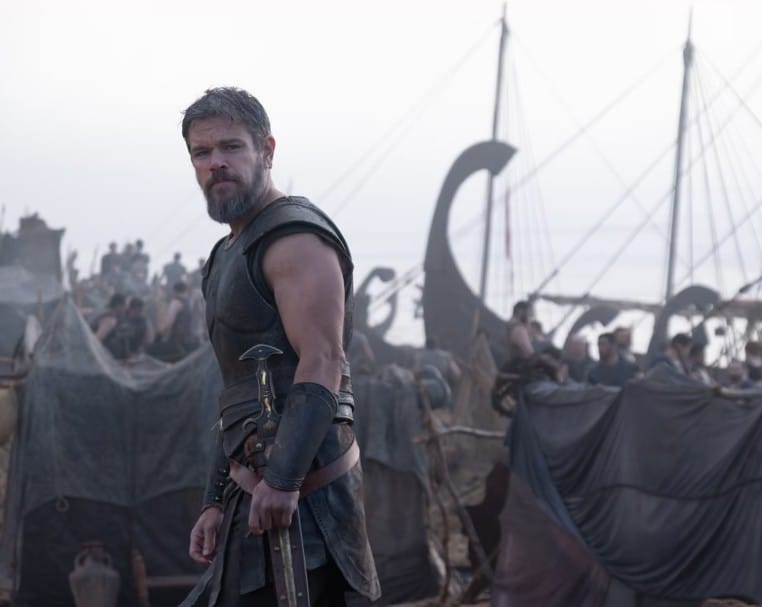
Matt Damon as Odysseus. Credit: Melinda Sue Gordon/Universal Pictures
In an insightful opinion piece published in The Guardian on June 3, 2026, titled “What the Hellenic! Why is Christopher Nolan’s new Greek epic entirely devoid of Greeks?”, author Chris Cotonou critiques the conspicuous lack of Greek actors in the director’s highly anticipated blockbuster, The Odyssey.
With an all-star ensemble featuring Matt Damon as Odysseus, alongside Zendaya, Charlize Theron, and Tom Holland, the film’s production team has repeatedly championed the cast as being meticulously chosen to “represent the world.” However, Cotonou points out a glaring irony: in the race to achieve universal global representation, the very country from which the story originates has been entirely unrepresented.
Cotonou highlights that while far-right culture warriors, including Elon Musk, have leveled bad-faith attacks against the casting of Black actor Lupita Nyong’o as Helen of Troy on the grounds of “authenticity,” they are focusing on the wrong target.
For the Greek community, both domestically and across the global diaspora, the frustration stems from a deeper cultural erasure. Cotonou notes that dinner-table debates from Patras to London have been flooded with alternative, Greek-inclusive casting ideas, with many left wondering why beloved diaspora stars like Billy Zane were bypassed entirely. To contextualize this frustration, Cotonou references Greece’s leading film critic, Thodoris Koutsogiannopoulos, who laments that Hollywood continues to perpetuate a “lazy cliché” that views Greekness through the simplistic lens of “Zorba rather than Achilles.”
Greeks secondary to their own story of Odyssey
More significantly, Cotonou argues that this complete omission carries a troubling broader implication. It suggests that Ancient Hellenic stories are viewed by Hollywood as part of a generic “shared Western inheritance,” rendering the actual Greek people incidental or secondary to their own history.
Cotonou draws a poignant parallel to the enduring geopolitical battle over the Parthenon Marbles, noting that the erasure feels as though modern Greeks are no longer viewed as worthy custodians of their ancestral mythology. While acknowledging that international audiences might dismiss the controversy under the guise that The Odyssey is merely fiction, Cotonou emphasizes how intimately interwoven these Homeric epics are with the modern Greek subconscious, identity, and sense of self.
He argues that excluding Greeks from The Odyssey is culturally equivalent to shutting out Hindus from an adaptation of the Mahabharata or stripping Polynesians from a film like Moana.
Ultimately, Cotonou connects the casting dispute back to the timeless, central theme of Homer’s poem: nostos, the deeply human yearning for homecoming after surviving grueling trials. In a Hollywood landscape that increasingly values diversity, Cotonou elegantly concludes that the Greek people are simply asking not to be written out of the journey.

 Login
Login