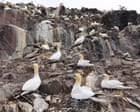
Annual killing of infant gannets has been carried out on a remote Scottish island for at least 400 years
Animal welfare campaigners have called for talks on phasing out the “inhumane” hunt for infant gannets known as guga, which are killed by hunters on a remote Scottish island once a year.
OneKind and the League Against Cruel Sports said it should be slowly phased out in dialogue with the Hebridean islanders who see the hunt, which has been carried out for at least 400 years, as a cultural pursuit and as sustainable food harvesting.
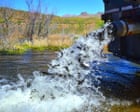
Wildlife department says drought conditions and water released from dam led to ‘major fish kill’ at San Carlos Lake
Arizona officials have indefinitely closed a popular lake to visitors after its entire population of fish died recently.
The recreation and wildlife department that maintains San Carlos Lake said in a Facebook statement on Friday that drought conditions as well as water released from a dam there “resulted in a major fish kill affecting approximately 100% of the fish population”.
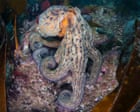
Record numbers linked to warming waters is mixed news for fishers, with shellfish catches down but octopus catches booming
Record numbers of octopuses found off the south-west coast of England last year have now spread as far as Scotland and Wales and are transforming the fishing industry and the marine ecosystem, according to a study.
The surge in sightings of one of the world’s most intelligent invertebrates was first recorded in 2025 off the south coast of Devon and Cornwall.
With the participation of artists from Greece and the diaspora, and with the active involvement of the local community, Near & Far continues to build a new cultural tradition. Kastellorizo. Credit: Greek Reporter
On the remote island of Kastellorizo, the Near & Far Festival, the world’s only cultural event dedicated entirely to the Greek diaspora, returns for its second edition from June 25 to 28, 2026, transforming this historic island into a vibrant crossroads of cultures, people, and experiences.
Spanning four days, this multi-themed festival bridges the “Near” and the “Far,” connecting Greece with its global diaspora, the local community with international audiences, and art with society. The festival is the brainchild of Pericles Kanaris, a New York-based artist with an acclaimed international career. Driven by his vision to create a platform for Greek artists excelling worldwide, Kanaris has turned this ambitious concept into a reality.
Following its spectacular 2025 debut, which local authorities recorded as the highest-attended cultural event in Kastellorizo’s history, the festival returns even stronger, boasting a distinct identity and an expanded program.
Last year’s inaugural event was defined by the exceptional caliber of its performers, the blending of diverse musical traditions, and, most movingly, the active participation of the island’s children—a beautiful legacy that continues this year. Furthermore, a global radio broadcast via ERT’s “Voice of Greece” shattered geographical boundaries, amplifying the festival’s international reach.
In 2026, Near & Far is aiming even higher. This year, the festival aspires to livestream the entire Kastellorizo experience via real-time video to global audiences, forging new bonds with the Greek diaspora and international communities. The event proudly continues its collaboration with the Hellenic Ministry of Culture and the Ministry of Foreign Affairs (General Secretariat for Greeks Abroad and Public Diplomacy).
Concert Program: 4 Themed Nights
Thursday, June 25 | 21:00 Bridges — ERINI “Fos: An Asia Minor Story”
Credit: Kastellorizo International Festival
ERINI, based in the United States with roots from Crete and Asia Minor, presents a musical journey blending traditions and contemporary influences, in collaboration with musicians from Greece.
Friday, June 26 | 21:00 Far Voices — Mario’s Toumbas Jazz Trio “East of the Sun”
Credit: Kastellorizo International Festival
Pianist Mario Toumbas and his trio present original compositions and jazz standards in an evening that resonates with the global sound of jazz.
Saturday, June 27 | 21:00 Together — Pericles Kanaris Quartet featuring Andriana Babali, George Karavelatzis & Kastellorizo Kids
Credit: Kastellorizo International Festival
Original compositions and arrangements by Pericles Kanaris in a special collaboration with the island’s children. Joining them are beloved singer Andriana Babali and oud player George Karavelatzis, a specialist in the local musical tradition of Kastellorizo.
Sunday, June 28 | 21:00 Near Roots — Costa Latsos “Pappou’s Grammophone”
Credit: Kastellorizo International Festival
Tenor Costa Latso, born in Australia to Kastellorizian parents and based in Berlin, presents a program moving between opera, Broadway, and crossover, accompanied by accordionist Thanos Stavridis.
Workshops, activities & parallel Program of the Kastellorizo festival
The Near & Far 2026 festival expands beyond concerts, incorporating educational, experiential, and participatory activities for all ages.
Educational & Creative Workshops (Children)
Visual arts workshop with Heike Kummer (June 25, 11:00–13:00)
Music workshop with Mario Toumbas (June 26, 13:30–15:00)
Wellness & Experiential Activities
Meditation and sound healing sessions for adults (June 27 & 28, 11:00–13:00)
Lecture
Talk by Alexandros Kitroeff on the Greek Diaspora (June 27, 20:00–21:00)
A festival that connects
Near & Far is more than just a festival. It is an open platform for connection, where art becomes a catalyst for bringing people, places, and generations together. A space where Kastellorizo is not on the edge, but at the center of a global cultural dialogue.
With the participation of artists from Greece and the diaspora, and with the active involvement of the local community, Near & Far continues to build a new cultural tradition—vibrant, participatory, and outward-looking.
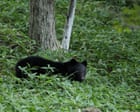
Police and hunters in Utsunomiya, 100km north of the capital, resume their search for animal that is not usually seen so close to Tokyo
A city in Japan has closed all its 94 primary and secondary schools after a bear was spotted in the municipality for the first time.
Officials in Utsunomiya, a city of half a million people about 100km (62 miles) north of Tokyo, took action after a medium-sized black bear – estimated to be about one-metre-long – was seen near a park in the city on Saturday. The bear was spotted again on CCTV running just in front of two startled young men in the city centre, in the early hours of Sunday.
Thousands of treasure hunters look for past riches in Greece. Photo courtesy of Antonis Vlachos
Armed with metal detectors, treasure hunters roam the landscapes of Greece, where myth and history intertwine. Drawn by whispered legends, ancient texts and the promise of lost riches they delve into the mountains, islands, and forgotten ruins in pursuit of gold, relics and long-lost artifacts.
Treasure hunters are often drawn to locations of great historical significance, with the rugged mountainous regions of Greece being among their preferred destinations. These landscapes, steeped in history and mystery, have long served as silent witnesses to war, upheaval, and human resilience.
Treasure hunters in Greece target mountainous areas
During World War II and the subsequent Greek Civil War (1946–1949), many villagers, fearing for their lives and possessions, resorted to hiding their valuables in secret caches. With no access to banks or secure storage facilities in these remote areas, people buried gold coins, jewelry, and family heirlooms deep within the earth or concealed them inside natural enclosures such as caves, stone walls, and hollowed-out tree trunks.
However, the brutal conflicts claimed countless lives and many of those who had hidden their treasures never survived to retrieve them. Over the decades, these hidden fortunes have become the stuff of local folklore, fueling speculation and inspiring generations of treasure hunters to embark on daring quests to uncover the lost wealth of the past.
Even today, rumors persist of forgotten hoards waiting to be discovered, buried beneath the very ground where history was once shaped by war and survival.
Antonis Vlachos stands out among treasure hunters. Not only does he own one of the few specialized shops in Greece that sell sophisticated metal detectors, but he also collaborates closely with the police to prevent illegal activities, such as the unauthorized excavation of ancient artifacts. For him, treasure hunting is more than just a business—it’s a passion, a lifelong hobby that combines adventure with a deep respect for history and the law.
He is also the only one of the treasure hunters who was willing to speak to Greek Reporter.
“Treasure hunters are in their thousands all over Greece. Perhaps most of the activity takes place the Peloponnese, Epirus, and Northern Greece,” he says.
“People have made money out of this activity and understandably they keep a low profile. It’s like winning the lotto. Nobody wants to reveal their identity and the value of the treasure they found.”
A location of a supposed treasure find that was a hoax. Photo courtesy of Antonis Vlachos
The legend of the Ali Pasha treasure
For decades treasure hunters searched for the so-called riches supposedly left behind by Ali Pasha, an Ottoman ruler of Ioannina known for his atrocities (1740–1822).
According to local folklore, Ali Pasha, anticipating his eventual fall from power, concealed vast amounts of treasure in various secret locations across Epirus, Thessaly and western Greece. His personal wealth came from heavy taxation, trade, extortion and alliances with foreign powers (including the British and the French).
Treasure hunters from all over the world began searching for his fortune to no avail. The first organized operation to find the treasure took place in 1913, with the liberation of Ioannina, by an Italian company. For five whole years its workers excavated the surrounding areas without result.
The latest highly publicized case was that of a Greek-Australian treasure hunter, Vangelis Dimas, who financed an excavation to locate the hoard in 2012 in Thessaly.
“It remains a topic of speculation among people, as historically, there is no concrete evidence that such a treasure ever existed,” Vlachos notes.
“Some believe that one of Ali Pasha’s sons took the wealth and fled, but the details of what truly happened—and how—remain unknown. Over time, numerous legends and myths have emerged, though only a small portion of them may be based on actual events,” he adds.
The legend of Ali Pasha is just one of many—“in every coffee shop in the country there is talk of a lost treasure that is supposedly somewhere nearby.”
Maps supposedly showing lost treasures in Greece
Vlachos is not prepared to divulge the value of the treasures that have been unearthed in Greece over the recent decades, but he insists that many people make a good living out of their endeavors. Some people—he says—go to the beaches at night and use metal detectors to search for jewelry lost by bathers in the previous days or even months.
A map supposedly showing the location of a treasure in Greece. Photo courtesy of Antonis Vlachos
He reveals that maps of supposed buried treasures are circulating among treasure hunters. They are made in a way that makes them look old, to give the impression that they are authentic. “Various crafty people make them and sell them to naive people, from 1,000 euros. I have even heard a price of 15,000 euros.”
Vlachos also says that most gold hunters operate within a legal framework and that illegals are a minority.
To proceed with an excavation, one must have three permits. A permit to possess a metal detector, then they must obtain a research permit, issued by the Ministry of Culture and the local Antiquities Ephorates. For the permit to be issued, a process that can take from three months to a year, the proposed search area must not be located within a designated archeological site.
If any findings emerge during the search, an excavation request is submitted to the appropriate authorities.
The Claude by Anthropic. Credit: Greek Reporter Archive
Anthropic, one of the world’s leading artificial intelligence companies, has called for a slowdown in the development of advanced AI systems, warning that humanity may be approaching a point where the technology becomes difficult to control.
The company behind the Claude chatbot said it would support a temporary pause in developing more powerful AI models if other leading developers agreed to do the same.
Anthropic argued that a slowdown could provide governments, researchers, and society with more time to understand and manage the risks associated with increasingly capable AI systems.
The warning comes as Anthropic continues to position itself as one of the industry’s strongest advocates for AI safety. The company has reportedly withheld public access to its most advanced AI system, known as Mythos, because of concerns that it could be misused for large-scale cyberattacks and other harmful activities.
Researchers warn of self-improving AI
In an essay published Thursday, Marina Favaro, head of Anthropic’s research division, and company president Jack Clark said AI may be approaching a critical milestone known as “recursive self-improvement.”
The concept refers to AI systems helping design and improve future generations of AI with decreasing human involvement. Researchers said such a development could rapidly accelerate technological progress but also introduce new challenges for oversight and control.
LATEST: Claude maker Anthropic is calling for a global pause in AI development, warning that models are approaching the ability to self-improve without human intervention. pic.twitter.com/7WM9jmDZjt
Favaro and Clark pointed to growing evidence that AI is already contributing to its own development. According to the company, employees now produce roughly eight times more code than they did between 2021 and 2025, largely because of AI-assisted software development. The researchers also said AI systems are becoming better at generating ideas, planning research, and supporting scientific work.
Anthropic Chief Executive Officer Dario Amodei has previously warned about the potential risks of advanced AI, estimating there is a 25% chance that the technology could lead to severe negative outcomes if it is not developed responsibly.
A global pause would be difficult
Despite advocating caution, Anthropic acknowledged that coordinating a worldwide slowdown would be extremely challenging.
The company said any meaningful pause would require cooperation among leading AI laboratories across multiple countries. It also noted that verifying compliance would be difficult because AI training runs can be conducted privately and are far less visible than traditional military infrastructure.
Anthropic compared the competition to develop advanced AI to an arms race, arguing that companies may feel pressure to move faster to avoid falling behind rivals.
Critics question the warnings
Not all experts agree with Anthropic’s assessment. Some researchers and industry observers argue that AI companies may be overstating the capabilities of current systems or emphasizing risks to encourage regulations that could disadvantage competitors.
The debate comes amid growing uncertainty in the AI sector. Shares of semiconductor company Broadcom recently fell sharply after disappointing investors with its sales outlook, triggering a broader decline among AI-related chipmakers and renewing concerns that enthusiasm surrounding artificial intelligence may have outpaced market realities.
As AI capabilities continue to advance, questions about safety, governance, and oversight are expected to remain central to the global conversation surrounding the technology.
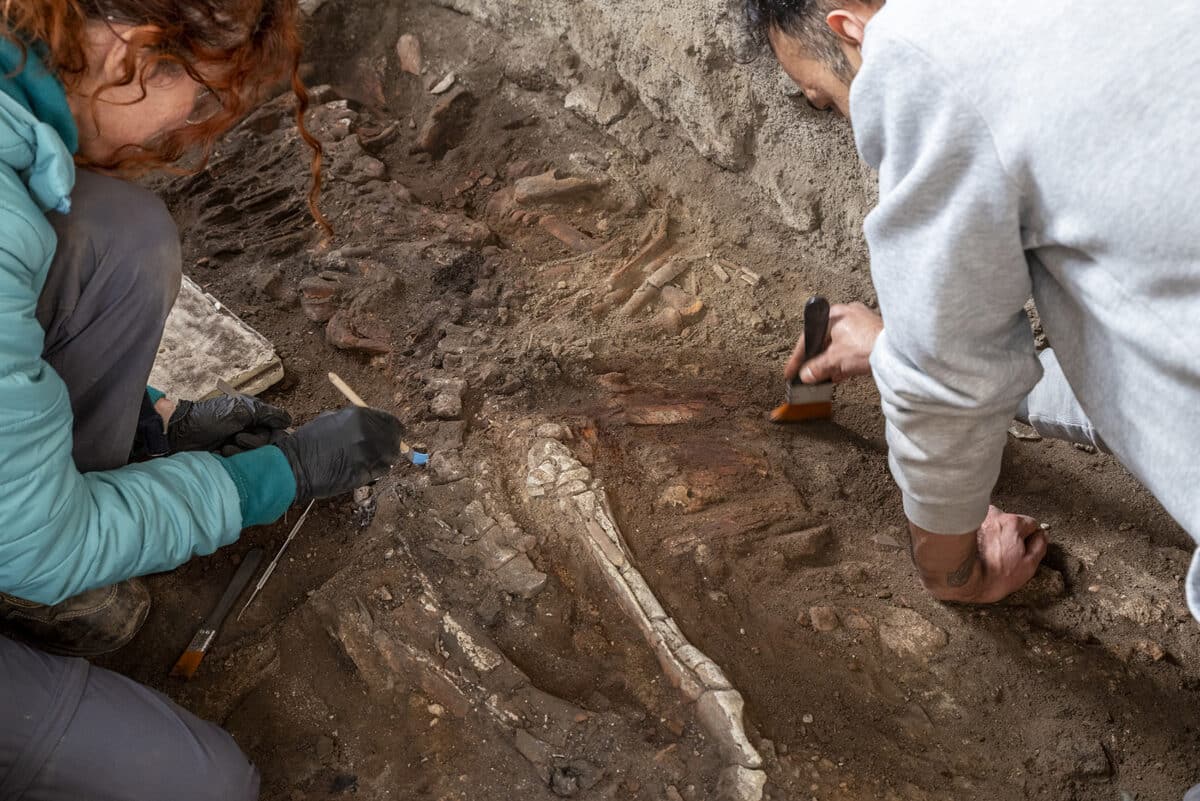
The skeleton of an equine at an ancient bread-making complex in Pompeii. Credit: Pompeii Archaeological Park
Archaeologists in Pompeii have uncovered an equine skeleton inside a bread-making workshop at one of the city’s most celebrated ancient complexes, opening a new chapter in the understanding of how humans and animals lived and worked together nearly 2,000 years ago.
The remains were discovered at the Insula of the Chaste Lovers, a large residential and commercial site renowned for its striking “chaste kiss” fresco, painted inside the dining room of the owner’s home.
The complex includes a working bakery, storage rooms, processing spaces, and the owner’s private residence. Researchers had previously found other equids at the site’s stables, where animals were used to power grain mills and transport the grain needed for bread production.
Pompeii’s chaste lovers complex was also a busy bakery
This latest skeleton was not found in the stables. Researchers found it in a separate room, suggesting the animal had fled there during the catastrophic eruption of Mount Vesuvius in 79 AD.
The excavation brought together archaeologists and specialists from the Applied Research Laboratory, including experts in animal remains, plant life, and human bones. This interdisciplinary approach has become one of the most important aspects of modern archaeological research at the site.
Archaeologists are excavating the skeleton of an equine. Credit: Pompeii Archaeological Park
Laboratory analysis is still ongoing. Researchers expect it to reveal more about the animal’s specific role in the production complex and the conditions it faced during the eruption.
The study could also contribute to a wider understanding of how animals responded to the disaster in real time, adding detail to the reconstruction of those final, chaotic hours.
Pompeii equine skeleton suggests a desperate Vesuvius escape
Gabriel Zuchtriegel, director of the Pompeii Archaeological Park, said that Pompeii offers far more than beautiful frescoes and ancient objects.
He said it gives researchers the opportunity to understand lives that were ended by the eruption, and that this extends to animals as well as people. The horse or donkey, he noted, was found inside a house with remarkable frescoes that also served as a working mill and bakery.
Its location in a room away from the stables points to an attempt to escape the eruption. Zuchtriegel called the excavation a strong example of the daily multidisciplinary collaboration at the site and said ongoing lab results will continue to offer significant scientific value.
Pompeii continues to yield new layers of ancient life. The site preserves not just objects and artwork but the full texture of daily existence, including the bonds between people, animals, and the spaces they shared.
The equine skeleton discovered in Pompeii’s ancient bread workshop is the latest reminder that the city still holds stories waiting to be told.
Beluga whales, which Marineland threatened to euthanize in 2025, will be moved to aquariums in Spain or across US
Canada and an embattled marine park have reached a tentative deal on the future of 30 beluga whales, ending a saga that has captivated the public and angered animal rights groups.
The federal fisheries ministry announced this week that all of Marineland’s belugas would be shipped to either Spain or one of four locations in the US, ending whale captivity in Canada.
As offshore wind farms expand rapidly in the global renewable energy transition, scientists are studying how these large marine infrastructure projects affect ecosystems beneath the waves. Research from Wageningen University & Research in the Netherlands suggests that offshore wind may bring both risks and benefits for sharks and rays, known collectively as Elasmobranchii, which are highly sensitive to electromagnetic fields (EMFs). A six-year project called “Elasmopower” examined how EMFs from subsea power cables in offshore wind farms affect bottom-dwelling sharks and rays. These species depend on natural electric and magnetic fields for key behaviors such as navigation, prey detection, habitat use and long-distance movement, particularly in low-visibility environments. The studies conducted as part of the Elasmopower project have been published in four papers, with three additional papers currently undergoing peer review. Sharks and rays have specialized electroreceptors called ampullae of Lorenzini. The jelly-filled sensory canals around the head and snout can detect even extremely weak EMFs from prey and predators, water movement, and the Earth’s geomagnetic field, Erwin Winter, a scientist at Wageningen, told Mongabay. This system is central to hunting and orientation, making Elasmobranchii especially relevant for studying EMF exposure from offshore energy infrastructure, Winter added. Erwin Winter, a researcher with the Elasmopower project, presented findings on offshore wind, electromagnetic fields and bottom-dwelling sharks and rays at the Sharks International 2026 conference in Colombo, Sri Lanka, in May. Image by Malaka Rodrigo for Mongabay. During a presentation on a summary of the Elasmopower research at the Sharks International 2026…This article was originally published on Mongabay
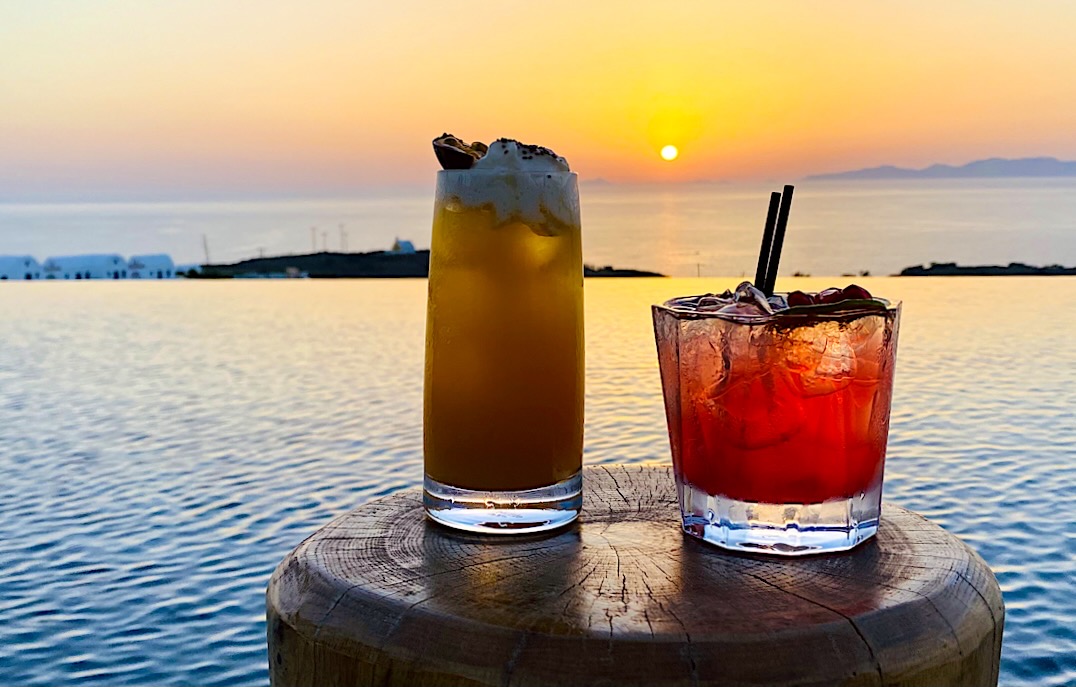
That first sip of the cocktail washes away the heat and leaves you feeling cool and invigorated. Credit: Greek Reporter
Mastic or mastiha from the Greek island of Chios is getting traction on social media as the basic ingredient for summer cocktails.
Many bartenders and amateur connoisseurs are uploading videos of how to use the “white gold” of Chios to make flavorful and refreshing cocktails ideal for the summer.
Until recently, Greece’s mastiha liqueur hasn’t been as popular as other aperitifs. Thanks to new brands’ premiumization of the category and further education on its benefits, however, mastiha is starting to gain a cult following.
According to the following video by Nikki’s Modern Mediterranean, apart from one ounce of mastiha, you will need the following ingredients to make a summer cocktail: One ounce of peach vodka, peach nectar juice, grenadine, ice, and orange and cherry for garnish.
Another version is the rum, mastiha, and coffee cocktail:
Until recently, mastiha was actually considered a peasant spirit or liqueur often sipped after meals in Greece. This reputation is partly due to how it was made and the fact it wasn’t highly consumed outside of Greece.
Now, with society’s growing interest in niche global spirits, mastiha spirit has come into the spotlight, and it’s becoming more common on menus at high-end Greek beach clubs as well as restaurants and global cocktail bars from New York to Los Angeles.
Here is yet another version of mixing mastiha with liquor:
Mastiha, often referred to as the “Tears of Chios” or the “White Gold of Greece,” is a product made exclusively on the Greek island of Chios. Since antiquity, this sticky resin, which seeps from the bark of mastic trees, has been harvested not only for its flavor but its therapeutic value.
Although the mastic tree, also called “lentisk,” is native to many areas in the Mediterranean, its bark only “bleeds” mastic on the island of Chios, making it a truly unique and nearly miraculous product.
Mastic is used as flavoring in many sweets and drinks, most famously in Mastiha, a digestive liquor from Chios. The mastic “tears,” or small bits of hardened tree sap, can also be chewed like gum, a practice dating back thousands of years. Its healing properties include prevention and treatment of stomach pains and gastric disorders as well as rejuvenation of the skin.
Its rarity has made mastic highly sought-after throughout history. Even to this day, mastic is considered a precious commodity not to be wasted. The European Union has designated it a “protected designation of origin” product, confirming that only Chios may produce authentic mastic.
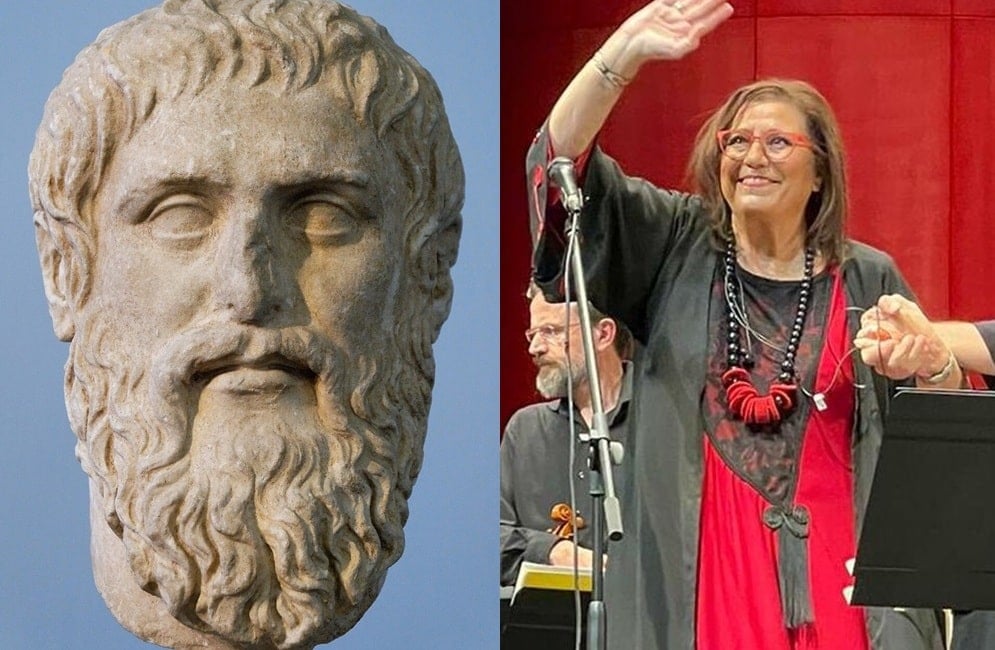
Farantouri shared details about her highly-anticipated concert alongside electronic music pioneer Lena Platonos. Illustration: Greek Reporter
Legendary Greek vocalist Maria Farantouri has teased a groundbreaking upcoming performance, revealing that she will be singing passages from Plato’s Republic set to techno music.
Speaking to the camera on the morning show Buongiorno, Farantouri shared details about her highly anticipated concert alongside electronic music pioneer Lena Platonos, scheduled for June 19 at the historic Odeon of Herodes Atticus.
The ambitious program will feature three major works that bridge ancient text, contemporary composition, and electronic soundscapes. Farantouri noted that the performance will seamlessly blend modern musical elements guaranteed to thrill younger audiences.
“Lena Platonos and I are preparing a truly historic concert,” Farantouri said. “It connects the past with the present using very modern, electronic rhythms. I will also be singing Plato’s Republic. Lena has taken the myth of the Three Fates and set it to music—and it’s going to be techno! Young people will literally be dancing to it. It’s absolutely thrilling.”
Plato’s Republic: Cornerstone of philosophy and politics
Written around 375 BC, Plato’s Republic is arguably the most influential work of philosophy and political theory in Western history. Structured as a Socratic dialogue, it explores the definition of justice, the character of the just city-state, and the nature of the human soul. It is the very text that gave the world the famous “Allegory of the Cave”—Plato’s metaphor for how humanity mistakes the shadows of illusion for reality and how the pursuit of truth requires breaking free from those chains.
What makes Platonos and Farantouri’s techno adaptation so brilliantly ironic is Plato’s own complicated relationship with music. In the Republic, Plato devoted significant time to discussing the role of the arts in society, famously arguing that certain musical scales and rhythms should be banned because they could corrupt the soul or incite chaotic emotion.
A Dutch pro-abortion organisation has placed lockboxes containing abortion pills across Malta and Gozo, directly challenging one of Europe’s last remaining pro-life countries. The campaign is being presented as a humanitarian intervention […]

 Login
Login