
Normal view

Received — 7 June 2026 GreekReporter.com

Hamas Suspect Arrested in Crete Over Alleged Israeli Cruise Ship Bomb Plot

7 June 2026 at 16:22
Anti-terrorism unit
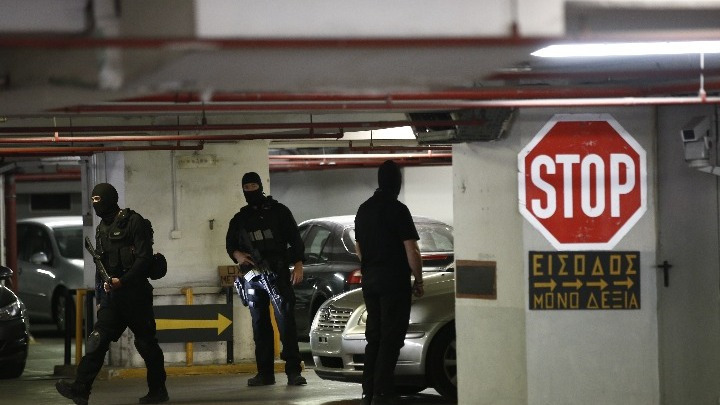
The 37-year old Palestinian was arrested in Agios Nikolaos, Crete. File photo. Credit: AMNA

Greek authorities arrested a 37-year-old Palestinian man in Agios Nikolaos, Crete, on Saturday, preventing an alleged plot to detonate explosives on a cruise ship carrying Israeli tourists. The suspect is accused of being an operative for Hamas. He was apprehended in a highly classified joint operation by Greece’s National Intelligence Service (EYP) and the Anti-Terrorist Unit.

Intelligence officials moved quickly to detain the man just days before the targeted cruise ship was scheduled to dock in Crete on Tuesday. While the suspect reportedly claimed during interrogation that he had planned an attack but ultimately backed out, Greek authorities remain unconvinced and are treating the threat as exceptionally serious.

The connection of the Hamas associate in Greece to Cyprus

The success of the Greek investigation originated from a coordinated intelligence effort with Cyprus. Approximately two weeks ago, Cypriot authorities arrested four individuals suspected of planning strikes against Israeli interests in the European Union, allegedly motivated by the ongoing conflict in Gaza.

During the investigation in Cyprus, intelligence officers analyzed mobile phones belonging to the suspects. A specific phone number surfaced as a critical link, leading Greek counter-terrorism units directly to the 37-year-old in Crete.

Security services in Greece noted that the suspects in both countries received specialized training at a camp outside the Gaza Strip. This training specifically focused on manufacturing improvised explosives using chemical substances. Officials in Nicosia consider the group found in Cyprus deeply concerning, noting that two of the arrested individuals had lived in Cyprus for years and had reportedly even managed to obtain Cypriot citizenship. One of the suspects in Cyprus has already admitted to planning attacks against Israeli targets.

The suspect in Crete

The man arrested in Crete arrived in Greece approximately one year ago and filed an active asylum application. He integrated quietly into the local workforce, taking a seasonal job at a hotel in Agios Nikolaos. Local reports indicate he had no family on the island and intentionally maintained a low profile to avoid arousing suspicion.

Following his arrest on Saturday afternoon, Greek counter-terrorism officers raided his current residence in Crete, alongside a property he previously occupied in the Patissia neighborhood of Athens. Investigators confiscated several items that could be used as evidence against his plot. Among them, Greece’s anti-terrorism unit found chemical substances and laboratory measuring equipment, a number of mobile phones, laptops, and USB data storage drives, as well as bank cards and financial documents.

Law enforcement did not find assembled explosive devices or firearms during the raids. Intelligence assessments indicate the suspect was in the final stages of preparation for the plot but was intercepted before he could formally order the final explosive components.

The 37-year-old remains in custody and is scheduled to appear before a public prosecutor. Greece’s EYP and the Anti-Terrorist Unit are actively tracing his movements, communications, and potential local contacts to verify whether he operated alone within Greece.
Greek-Swiss Christina Kitsos Becomes Mayor of Geneva for Second Term

7 June 2026 at 14:21
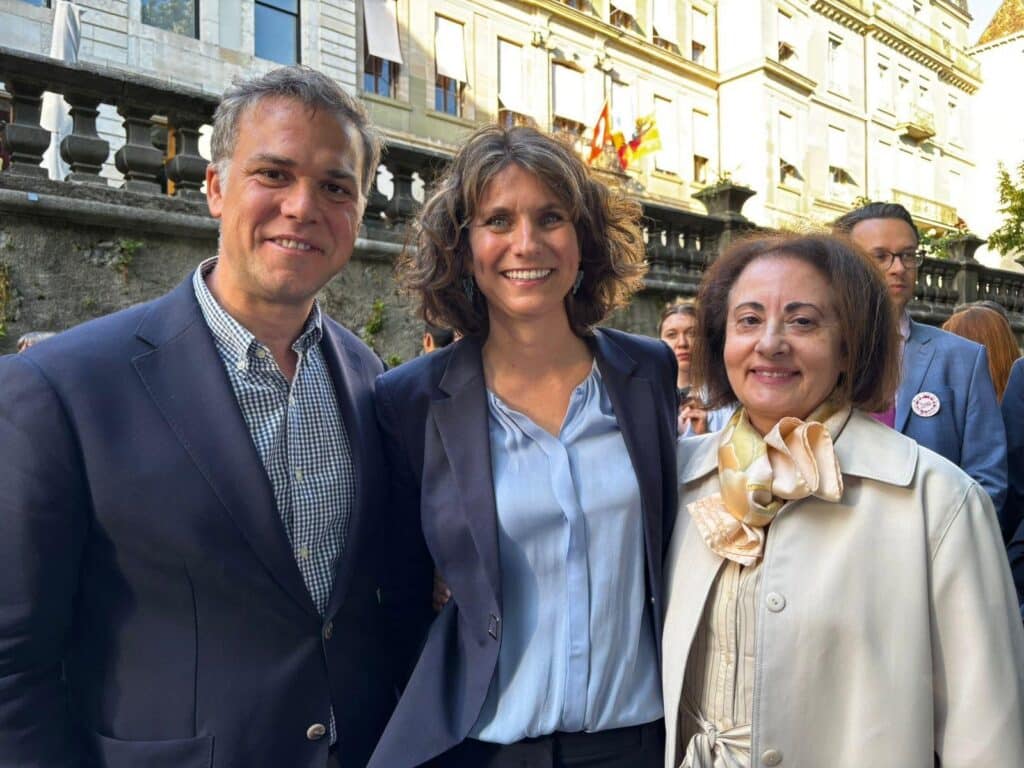
Three adults stand closely together with Christina Kitsos in the middle, smiling for a photograph outdoors against the backdrop of a historic stone building.
Attendees gathered to celebrate and show their support for Christina Kitsos (middle) during a public ceremony in Geneva. Credit: Embassy of Greece in Switzerland

Christina Kitsos, a prominent politician of Greek descent, has officially assumed office as the Mayor of Geneva for a second, separate one-year term. The Greek Embassy in Switzerland publicly congratulated the diaspora leader following a formal proclamation ceremony held in the Swiss city on June 3, 2026.

Geneva’s unique annual mayoral rotation

Local Swiss executive government operates very differently from what mayoral terms normally do elsewhere in Europe, including Greece.

The City of Geneva is not governed by a single powerful mayor elected for a standard four- or five-year mandate. Instead, the municipality is run by a five-member executive committee known as the Conseil administratif (Administrative Council).

Kitsos inauguration
Musicians entertain the crowd during the public inauguration of Kitsos. Credit: Embassy of Greece in Switzerland

The title of mayor rotates annually among these five elected council members. The individual who holds the title acts primarily as the chairperson of the executive council and the ceremonial face of the city, holding no additional unilateral governing powers. Every mayoral rotation term begins strictly on June 1 and concludes on May 31 of the following year.

The timeline of Kitsos’s re-election Kitsos’s political timeline follows this exact cycle. She was inaugurated for her first term as mayor on June 1, 2024. When that specific administrative year ended on May 31, 2025, she passed the mayoral title to another member of the five-person council and stepped back into the role of Deputy Mayor.
Shortly before her first term concluded, citywide elections were held in April 2025.

A large group of people holds hands in a circle to perform a traditional Greek dance on a paved outdoor square while spectators look on and take photos.
Kitsos joined community members and visitors in a vibrant Greek circle dance, bringing lively energy to the streets of Geneva. Credit: Greek embassy in Switzerland

The public successfully re-elected Kitsos to stay on the executive council for another multi-year mandate. Because she retained her seat on the executive committee, her turn in the annual rotation eventually came back around.

She was officially inaugurated for a completely new, distinct one-year term as mayor on June 1, 2026.

Who is the new mayor of Geneva? Born to a mother from Thessaloniki and a father from Edessa in northern Greece, Kitsos holds dual citizenship and maintains strong ties to Greece. Representing the Socialist Party, she directs the Department of Social Cohesion and Solidarity within the administrative council.

In an interview she gave in 2024 on Greek public television ERT, Kitsos highlighted the importance of her Greek heritage in shaping her worldview and approach to governance.
“Sometimes we believe that there is equality, but there are many things that are not so obvious, but which will have a meaning in everyone’s journey,” she said.

Strong 5.2 Magnitude Earthquake Shakes Greece’s Evia and Athens

7 June 2026 at 12:37
earthquake
The earthquakes rattled large parts of central and southern Greece, including Evia and Athens. Credit: AMNA

A series of strong earthquakes, culminating in a 5.2-magnitude tremor, rattled the Greek island of Evia (Euboea) and the greater Athens metropolitan area on Sunday afternoon. The seismic activity triggered extensive landslides across the northern part of the island of Evia, though local authorities report no injuries or significant structural damage to houses.
The initial shock, measuring 4.8 on the Richter scale, occurred at 12:58 p.m. local time on Sunday, June 7.

According to the automated system of the Geodynamic Institute of the National Observatory of Athens, the epicenter was located six kilometers (4 miles) southwest of the village of Prokopi in northern Evia, with a shallow focal depth of just 14.1 kilometers.

More earthquakes followed, rattling central and southern Greece

Minutes later, a stronger 5.2-magnitude earthquake struck the same localized fault line. This second, more powerful tremor originated just two kilometers east-southeast of Prokopi at a much shallower focal depth of only five kilometers. A third notable tremor followed shortly after in the exact same region, compounding the anxiety of local residents.

All three shocks were felt prominently across the Attica region, rattling windows and disrupting the Sunday afternoon routines of millions of residents and tourists in the Greek capital.

Despite the intensity of the tremors and their shallow depth, the immediate fallout appears limited. Giannis Tsapourniotis, the mayor of Mantoudi on Evia, provided an update on the situation on the ground during a statement to the state broadcaster ERT.

Earthquake Greece map
The epicenter of the tremors on the island of Evia (red star). Credit: EMSC (European Mediterranean Seismic Centre)

“We have extensive landslides, but no injuries have been recorded,” Tsapourniotis confirmed. He specified that heavy rockfalls and landslides have primarily obstructed rural roadways in the areas of Plakia and Dafnousa. Emergency crews of the local council and local civil protection units are currently working to clear the affected traffic routes and assess any isolated impacts on village infrastructure. To date, homes and commercial businesses remain intact.

Greek seismologists tried to calm public fears regarding the consecutive tremors. Kostas Papazachos, a prominent professor of seismology at the Aristotle University of Thessaloniki, described the events as a series of consecutive earthquakes that align with the area’s known geological profile. Northern Evia sits directly atop a complex network of active fault lines, making such localized clusters a known phenomenon.

“These seismic tremors are not a cause for concern,” Papazachos stated, offering a reassuring outlook despite acknowledging it is still early in the post-earthquake evaluation process.

The region surrounding Prokopi is highly trafficked, especially on weekends, as it is home to the widely venerated pilgrimage site of Saint John the Russian, drawing thousands of visitors from across Greece and the global diaspora. The lack of infrastructure collapse in such a populated sector of the island has brought significant relief to state authorities.
Greece ranks among the most seismically active countries globally, located at the geological boundary where the African tectonic plate pushes beneath the Eurasian plate.

While minor tremors are a daily occurrence across the nation, shallow earthquakes above a 5.0 magnitude near heavily populated zones like Attica consistently prompt rapid responses. Local authorities in Evia remain on standby for potential aftershocks over the coming days, actively advising residents and tourists to avoid driving through steep mountainous routes prone to further rockfalls.

The statement issued by Greece’s Civil Protection

“According to official reports from the Geodynamic Institute, consecutive seismic tremors measuring 4.8, 4.3, and 5.2 on the Richter scale were recorded in northern Evia. Concurrently, the General Secretariat for Natural Disaster Recovery and State Aid has been placed on high alert and is in continuous communication with local authorities to assess the situation.

Based on initial inspections currently underway in the area, reported damages include a collapsed wall in one home, minor cracks in a few residences, and small-scale landslides affecting sections of the road network. So far, no injuries or severe damages have been reported.

Minister of Climate Crisis and Civil Protection Evangelos Tournas Tournas, accompanied by the General Secretary for Natural Disaster Recovery and State Aid, Petros Kampouris, is heading to Prokopi and Dafnousa for an on-site briefing. The Ministry of Climate Crisis and Civil Protection continues to monitor the situation closely and will immediately take any further action if necessary.”

Greece Bans Sale of Sodas and Processed Meats in Schools

7 June 2026 at 11:30
Greece classroom Greek school
Greek schools will now sell or serve much healthier options to their students. Credit: Wikimedia Commons / Nikolaos Kotopoulis / CC BY SA 4

The Greek Ministry of Health has announced a sweeping overhaul of food guidelines for school canteens across the country. In a targeted effort to combat high rates of childhood obesity, the new regulations impose strict dietary standards, including a total ban on processed meats and soft drinks.

Set to take full effect during the 2026-2027 school and academic year, the updated framework replaces guidelines that have been in place since 2013. The policy applies to all primary, secondary, and high schools in Greece, covering canteens, dining areas, and vending machines.

Alternate Minister of Health Eirini Agapidaki introduced the initiative as a core component of the National Program for the Prevention and Treatment of Childhood Obesity. The health ministry drafted the new rules based on contemporary recommendations from Greece’s National Nutrition Committee.

Under the revised regulations, school menus will undergo structural changes. Authorities have completely prohibited the sale of cold cuts and sodas. The ministry has also mandated a reduction in portion sizes for specific food items to prevent overeating.

Greece overhauls school meals entirely

The approved product list now prioritizes fresh foods and traditional Greek cuisine staples. Students will have access to fresh fruits, vegetables, fruit salads, and unsweetened dried fruits. Dairy options include plain milk, yogurt, kefir, ariani, and rice pudding, all strictly without added sugars.

Baked snacks remain available under healthier parameters. School vendors can sell the traditional Koulouri of Thessaloniki, whole-grain rusks, cereal bars, pasteli, and halva. Nuts are permitted exclusively for middle and high school students.

Sandwiches will no longer contain processed meats. They must be made with whole-wheat bread and filled with Greek cheeses, boiled chicken or turkey, egg, or tuna. Spreads are restricted to olive oil or soft margarine. Similarly, savory pies and pizzas can only contain vegetables or cheese, prepared using an olive-oil-based dough.

Beverage options will now also be tightly regulated. Canteens will stock water and natural juices. Older students can purchase plant-based milk alternatives and tea. Coffee sales are strictly restricted to teaching staff.

“The fight against childhood obesity is not a theoretical battle, but a daily act of responsibility that starts where our children spend most of their day: at school,” Agapidaki stated following the announcement.

She emphasized that the updated framework relies on rigorous scientific data. “With the new health regulation, we are radically changing the rules of the game. We are permanently removing cold cuts and soft drinks from school canteens and reducing portions, creating an environment that actively protects students,” she said.

Agapidaki urged school administrators and suppliers to begin preparations immediately to ensure full compliance. “We make no discounts on the health of the new generation,” she added, noting that the ultimate goal is to equip Greek youth with lifelong healthy eating habits.

Can Anything Truly Stay the Same? Plutarch’s Ship of Theseus Paradox Still Baffles Minds

7 June 2026 at 07:01
Ship of Theseus
Plutarch’s Ship of Theseus paradox questions if identity remains when all parts change, challenging what it means to be the same over time. Credit: Greek Reporter archive

Have you ever wondered if your favourite old jumper, battered by time and use, is still truly the same as the one you fell in love with at the shop many years ago? That seemingly silly question is one of philosophy’s oldest and most fascinating puzzles, known as the Ship of Theseus.

The Ship of Theseus is an ancient brain-teaser

Plutarch, the ancient Greek writer and historian, presented us with a real head-scratcher with his tale of Theseus’ trireme.

Picture this: the Athenians, immensely proud of the ship that carried their hero Theseus to victory over the Minotaur, kept it docked for centuries. But as we all know, wood doesn’t last forever, as it can start to rot very quickly. So, whenever a plank rotted away or timber decayed significantly, the smart Athenians would meticulously replace it with a new one. Bit by bit, year after year, every single original piece of that ship was swapped out and replaced with brand-new wood.

Now, here’s the one-million-drachma question: was this still the Ship of Theseus? Or had it, piece by piece, become an entirely different vessel that had nothing to do with Theseus’ heroic journey? This was a profound thought experiment that kept brilliant minds confounded for millennia. It makes us wonder about identity and what makes something… something. Is it about what an object or a human is made of? Does it have to do with their materials? Their shape, maybe? What about their personal story? Or could it be something else entirely? This simple story by Plutarch prompts us to delve into what we mean when we say something is “the same.”

A digital illustration depicting the Ship of Theseus, an ancient philosophical paradox questioning whether an object that has had all its components replaced remains fundamentally the same
The Ship of Theseus, an illustration representing the famous thought experiment on identity and change. Credit: Yosemite Belbury, Wikimedia Commons, CC BY-SA 4.0.

The Ship of Theseus and the idea of change

The brilliance of the Ship of Theseus story lies in its elegant illustration of the uncomfortable truth that everyone and everything, eventually, changes. Consider yourself as an example. Most of the cells in your body are replaced every few years. Are you, reading this right now, the same person you were a decade ago, even though practically all the biological components that constitute the physical you are new?

This is why the Ship of Theseus is a perfect example of this constant flow of renewal. It shows the tension between how we perceive something as permanent and its ever-changing physical reality.

And right when you think you understood the whole story, here comes a twist, often credited to Thomas Hobbes, the English philosopher.

This twist is asking us what if, hypothetically, all those old, discarded planks from Theseus’ ship were gathered up and used to build a second ship? Which one, then, is the “true” Ship of Theseus? The one that has been continuously in the harbour, even with all new parts? Or the one made of all the original pieces, just reassembled to create a brand new ship? You can almost hear the ancient Athenians debating this topic, wondering which ship deserved the glory of their hero.

change
Does something remain the same if every part has changed? Credit: Markus Winkler, Pexels.

The modern implications

The deep implications of the Ship of Theseus go beyond the confines of ancient Greek mythology. They truly resonate in our modern world, where things are constantly being upgraded, recycled, and reinvented only to be presented as something brand new. Take your mobile phone, for example. With every software update, every component replaced, is it still the “same” phone you bought two years ago? What about a classic car that has been restored and fixed with love, often with hardly any original parts left? Is it still that iconic model, or a new creation in an old shell?

This paradox even touches on larger ideas, such as national identity. Countries evolve, populations shift, and cultures adapt. Are we, as a nation, the “same” as our ancestors from centuries past? Is the US truly a nation or just a creation of many smaller parts of people who came from distant lands to find a better future?

Is modern Greece truly the grandchild of ancient Greece? What about the Roman identity that became synonymous with the Greeks for more than a thousand years? The word ‘Romios,’ which is Greek for Roman, still defines the notion of Greekness. Thus, are Greeks a continuation of the ancient identity, or are they something new, composed of thousands of different ethnic and cultural components that migrated to their lands over time? We share history, language, and heritage, of course, but the actual people, the “material” of the nation, have changed countless times.

The Ship of Theseus tells us that identity–whether it’s ours, our nation’s, or even a beloved object’s is a fluid and ever-changing concept, rarely as straightforward as it seems.

❌