Normal view

India Completes Key Himalayan Tunnel Near China Border

10 June 2026 at 19:01
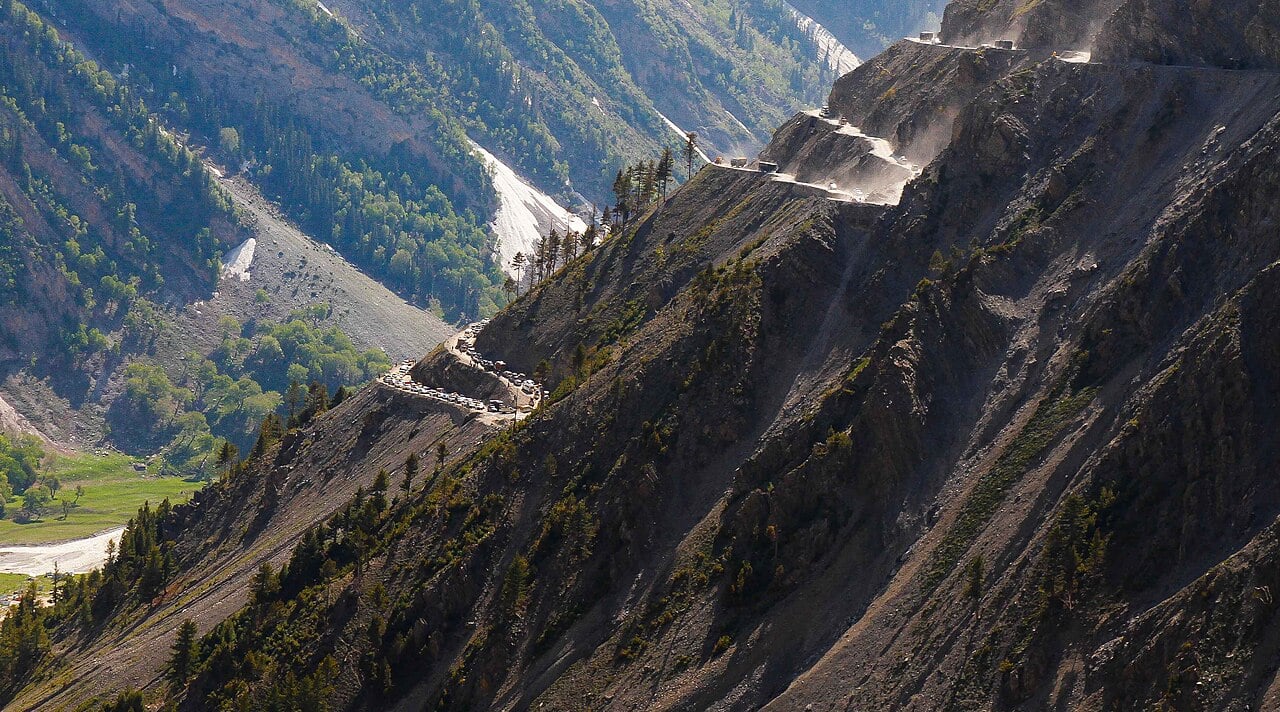
Road to Zoji La Pass from Srinagar
Road to Zoji La Pass from Srinagar. Credit: VinayakPhadatare / Wikimedia Commons / CC BY-SA 4.0

On Tuesday, engineers working inside a Himalayan mountain completed the final blast of a critical tunnel that links India’s Kashmir Valley to its Ladakh frontier with China, marking a key step in the country’s push to secure year-round access to one of its most sensitive border areas.

The Zojila Tunnel, stretching 13.14 kilometers (8.2 miles) beneath the mountains, will become India’s longest road tunnel once finishing work is done, with full operation expected by 2028.

Road Minister Nitin Gadkari remotely triggered the last detonation at the eastern portal near Minimarg in Ladakh, joining excavations driven from both ends of the mountain over more than five years.

Gadkari described the project as far more than a transport link, saying it serves as a vital lifeline for communities cut off by winter weather.

Project engineer Manmohan Singh said the team completed the job without a single accident despite working through extreme cold and difficult conditions around the clock.

Himalayan tunnel gives India year-round access near China

The Zojila Pass, which the tunnel cuts beneath at an elevation of 11,578 feet, currently shuts down every winter under heavy snowfall that can pile well above the roof of a large truck, blocking road travel between Srinagar and Leh for months. More than 3,000 workers have been involved in excavation since October 2020.

In Photos | Zojila Tunnel Poised for Historic Breakthrough

Security personnel stand guard outside the Zojila Tunnel in Minamarg ahead of the landmark breakthrough ceremony of the ₹6,500-crore project. Set to provide all-weather connectivity between Kashmir and Ladakh, the… pic.twitter.com/PkM4tqDIC3

— Kashmir Observer® (@kashmirobserver) June 9, 2026

This tunnel is one of four major passages in a $712 million road corridor that also includes the 6.5-kilometer (4 miles) Sonamarg tunnel, with all components targeted for full operation by 2028.

Beyond road access, India launched a $3.9 billion railway from its lowland plains to Kashmir in June 2025, as reported by Al Jazeera, featuring the Chenab Rail Bridge, currently the world’s tallest railway bridge.

The 272-kilometer (169 miles) line starts at Udhampur, the base of the Indian Army’s northern command.

Billions in rail and roads back India’s border push

The push behind all these projects traces to a deadly confrontation in Galwan Valley in June 2020, when Indian and Chinese soldiers fought hand-to-hand at high altitude, killing 20 Indian troops.

The clash set off an accelerated construction race on both sides of the 3,500-kilometer (2,175 miles) shared border.

The Himalayan tunnel is central to India’s effort to close the infrastructure gap with China, where both countries completed troop disengagement at contested frontier points in October 2024, as reported by The Diplomat.

Kashmir has been split between India and Pakistan since the end of British rule in August 1947, with both countries claiming it in full.

Greek Women Are Becoming Mothers Later Than Ever, Eurostat Reports

10 June 2026 at 01:01
A greek mother holding her baby
A Greek mother holding her baby. Credit: GR Archive

Greek women are having their first children later than ever. The average age of first-time mothers in Greece reached 31.2 years in 2024, according to new data from Eurostat. The figure places Greece well above the European Union average of 29.9 years and among the highest in the bloc.

That number marks a sharp climb over two decades. In 2001, the average age at which Greek women had their first child stood at 27.7 years. It crossed 30 for the first time in 2014. By 2021, it had surpassed 31. Since then, Greece’s first-time mothers have continued aging upward year by year.

The country’s standing in Europe reflects a broader pattern. Italy posted the highest first-birth age in the EU at 31.9 in 2024, followed by Luxembourg at 31.6 and Spain at 31.5.

Greece, at 31.2, sits alongside Ireland at the same level, within a cluster of countries where having a first child after 30 has become the standard.

First-time mothers in Greece having their firstborn at the age of 31

The age at all births, not just the first, has moved in the same direction. Greek women averaged 32.2 years at childbirth in 2024, up from 29.3 in 2001. Over those two decades, the average rose by nearly three years. The EU average for all births stood at 31.3 in 2024, placing Greece notably above it.

In the EU, the mean age of women at the birth of their first child was 29.9 years in 2024. 👶
⁠⁠
Learn more ➡ https://t.co/UXznIQAcaV pic.twitter.com/KZLowpImTu

— EU_Eurostat (@EU_Eurostat) June 7, 2026

These numbers in Greece sit against a wider backdrop of declining fertility across Europe. The EU’s total fertility rate dropped to a record low of 1.34 live births per woman in 2024, down from 1.46 in 2022 and from 1.57 in 2008.

Eurostat notes that a rate of 2.1 is the level required to sustain a population without migration. A rate below 1.3 carries the label “lowest-low fertility.”

Greece remains among the EU countries yet to recover above that threshold, alongside Spain, Italy, Latvia, Lithuania, Luxembourg, Malta, Poland, Finland, and Estonia.

EU fertility hits record low, Greece still below threshold

The broader birth count tells the same story. The EU recorded 3.55 million births in 2024, compared to 6.8 million at the peak in 1964. That figure has fallen by roughly half over six decades.

For Greece, the Eurostat data makes the direction clear. Women in the country are becoming mothers for the first time at a later age than at any point on record, and the gap between Greece and the EU average continues to widen.

OpenAI Takes First Step Toward Stock Market Debut

10 June 2026 at 00:31
OpenAI files for IPO
OpenAI files for IPO. Credit: Focal Foto / Wikimedia Commons / CC BY-SA 4.0

OpenAI confirmed Monday it has confidentially filed an IPO with U.S. regulators, joining rival Anthropic as the AI sector moves toward public markets. No timeline, share count, or pricing was announced.

The company said the move preserves the option for an earlier listing, while some decisions are easier to handle as a private firm.

Reuters reported OpenAI is targeting a valuation near $1 trillion for a debut possible as early as September. Anthropic filed for a U.S. IPO on June 1 after a $65 billion funding round valued it at $965 billion.

SpaceX is also pursuing a $75 billion offering at a $1.75 trillion valuation. Analysts say the simultaneous push by three major AI companies toward public markets is the most significant development of its kind for technology investors in a decade.

$2 billion monthly revenue signals rapid growth beyond ChatGPT

In March, OpenAI raised $122 billion from SoftBank, Amazon, and Nvidia at a valuation of $840 billion to $852 billion. ChatGPT had exceeded 900 million weekly active users and 50 million paying subscribers.

Monthly revenue stood at $2 billion, up from roughly $1 billion per quarter at the end of 2024, growing nearly four times faster than Alphabet and Meta at comparable stages. Internal projections put the company’s break-even point no earlier than 2030.

JUST IN: OpenAI confidentially files for IPO. pic.twitter.com/sAORVBWEy1

— Whale Insider (@WhaleInsider) June 8, 2026

Beyond ChatGPT, OpenAI launched tools for government, healthcare, and finance, a web browser, consumer hardware plans, and an AI coding agent. It added a lower-cost $8 subscription tier and advertising as new revenue sources.

The Information reported in April that OpenAI projects 122 million subscribers this year and expects advertising to lead revenue by 2030.

A renegotiated Microsoft deal, covering $13 billion in investment since 2019, enabled growth at Azure and opened new agreements with Amazon and Alphabet.

OpenAI files its IPO amid legal battles and market pressure

Gil Luria of D.A. Davidson warned that large AI listings and Google’s recent secondary share sales could reduce the capital available for smaller offerings.

Michael Ashley Schulman of Cerity Partners said OpenAI appeared to be keeping its options flexible while Anthropic moved ahead in the IPO filing process. Prediction markets had expected OpenAI to file first.

OpenAI began as a nonprofit in 2015 and later added a for-profit arm under nonprofit oversight, a structure that drew attention when CEO Sam Altman was ousted by its board and reinstated within days in late 2023.

The company announced plans to convert to a public benefit corporation in December 2024. Early backer Musk filed a lawsuit alleging Altman and others redirected the organization from its founding mission for personal benefit.

A jury ruled against Musk in May, removing what analysts described as a significant legal obstacle ahead of the OpenAI IPO filing. His attorneys plan to appeal. Separate lawsuits link ChatGPT to shootings and suicides, and public skepticism toward AI persists.

Ancient DNA Shows Iberians Maintained Genetic Continuity Despite Greek Influence

9 June 2026 at 23:01
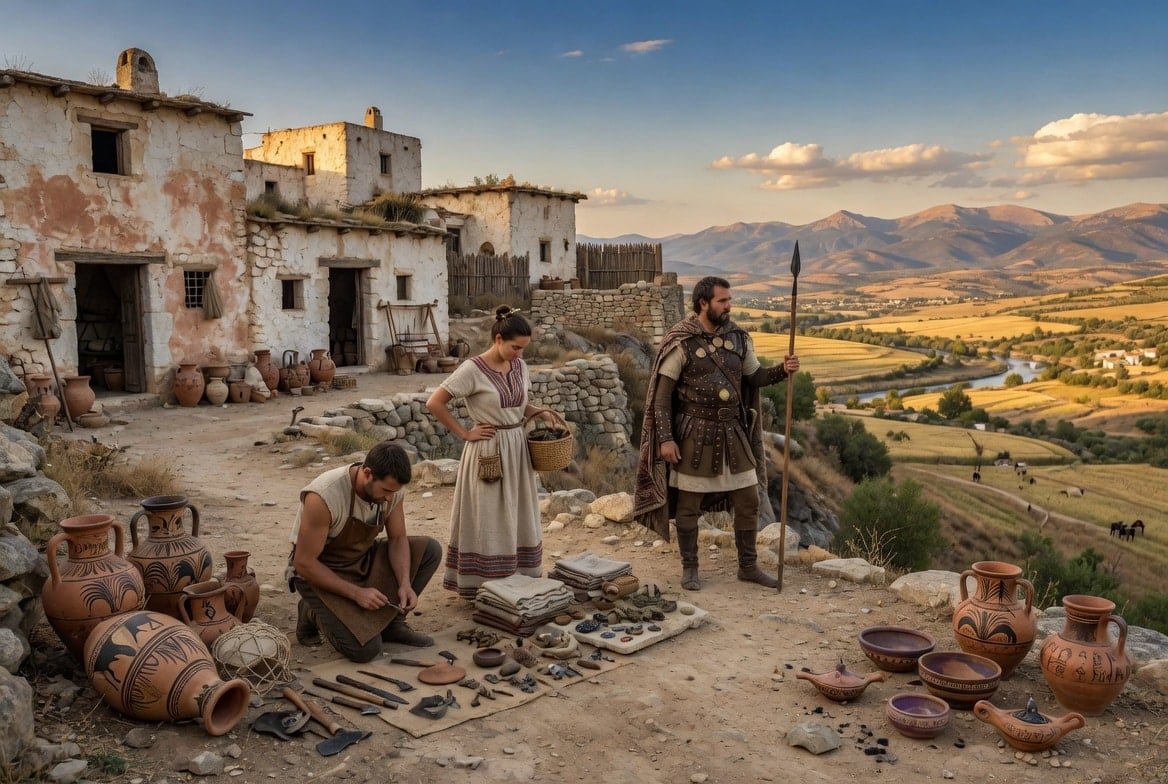
AI reconstruction of ancient Iberian people in local community
AI reconstruction of ancient Iberian people in the local community. Credit: GR Archive

Ancient DNA from the bones of Iron Age Iberians shows that these people held onto their genetic roots despite centuries of Greek, Phoenician, and Carthaginian influence along the Mediterranean coast.

A study published in iScience traced genetic changes across northeastern Spain from 775 BC to 50 CE, marking the first time researchers have systematically analyzed Iberian communities from the early Iron Age all the way through Roman conquest.

Daniel R. Cuesta-Aguirre of the Faculty of Biosciences at Universitat Autònoma de Barcelona led the research. Because Iberian adults were cremated, their remains left no usable DNA.

Researchers instead turned to newborn burials found beneath house floors and work areas at three sites: the Vilars fortress, Sant Miquel d’Olèrdola, and El Camp de les Lloses. Of 54 newborns examined, 22 yielded genome-wide data, and nine more contributed mitochondrial markers.

From fortress to Roman hub: three windows into the Iberian past

The three sites covered distinct phases of Iberian history. The Vilars fortress, home to the Ilergetae tribe, was occupied from the 8th to the 3rd century BC and captured the shift from pre-Iberian to full Iberian culture.

Sant Miquel d’Olèrdola, linked to the Cessetani tribe and active from the 4th to the 2nd century BC, reflected an established community with active trade connections.

Iberian Peninsula with the location of the Fortress of Vilars
Iberian Peninsula, with the location of the Fortress of Vilars. Credit: Joan Carbonell-Roca / CC BY 4.0

El Camp de les Lloses, tied to the Ausetani tribe and dated from the late 2nd century BC to the 1st century CE, documented the period of growing Roman presence.

Genetic analysis placed most individuals from the Vilars fortress and Sant Miquel d’Olèrdola firmly within the local Bronze Age population. Their ancestry combined Western Hunter-Gatherers, Anatolian Neolithic farmers, and Steppe-related groups.

Steppe-related ancestry was somewhat higher in Iron Age individuals than in earlier Bronze Age populations from the same region, suggesting gradual internal shifts rather than large outside migrations.

Iberian DNA and Greek and Mediterranean influence

The DNA record of Iberians showed only limited traces of Greek and other Mediterranean genetic influence before Roman arrival. A few individuals carried ancestry linked to North Africa or southwestern Asia, but these were not widespread.

One newborn at Sant Miquel d’Olèrdola had a maternal lineage associated with North Africa. Researchers interpreted this as possibly reflecting a child born to a local parent and someone with Punic or Carthaginian ancestry, consistent with the large amounts of Punic pottery recovered at the same site.

Iberian relief, showing Hittite influence
Iberian relief, showing Hittite influence. Credit: Luis García / Wikimedia Commons / CC BY-SA 3.0

The study also settled a long-standing archaeological debate. Two newborns at Sant Miquel d’Olèrdola, OLE04 and OLE06, were buried with their legs intermingled and no sediment between them, leading earlier researchers to believe they were twins.

DNA analysis proved they were completely unrelated and even carried different maternal haplogroups.

Roman military activity brought new genes to Iberian settlements

At El Camp de les Lloses, the pattern shifted noticeably. Five of the nine individuals showed clear genetic differences from earlier Iberian populations, carrying North African or Iranian Neolithic ancestry absent in previous generations.

Researchers connected this directly to Roman military and commercial activity, as the site served as a logistical hub tied to Roman infrastructure.

Taken together, the results point to a population that stayed genetically stable for centuries before Roman expansion fundamentally reshaped its makeup.

❌