The U.S. Air Force has confirmed that the VC-25B “Bridge” aircraft is now wearing its new (and controversial) red, white, and blue livery as it undergoes final preparations for its official delivery.
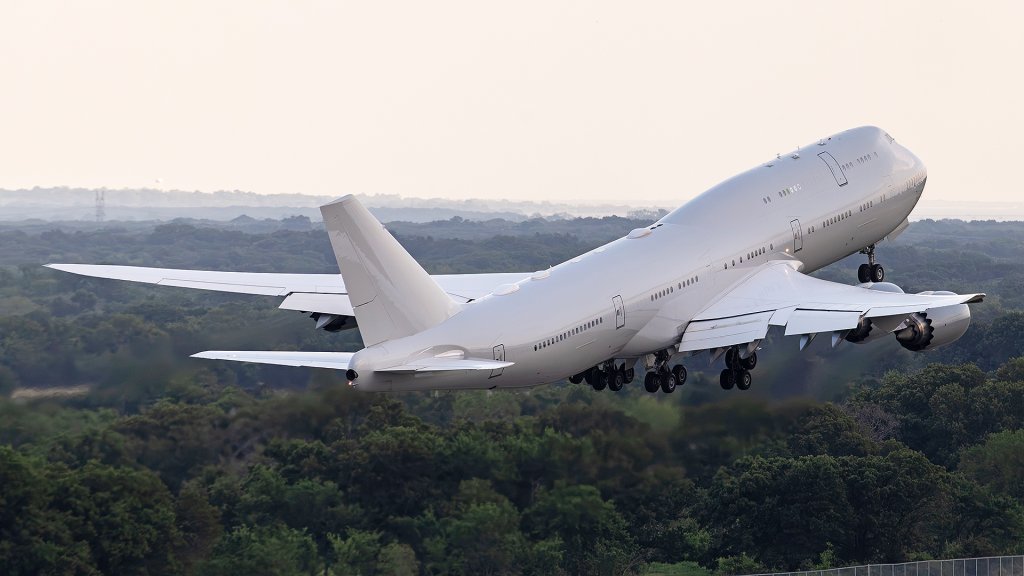
Aviation photographer Travis Ghormley shared the first picture of the modified Boeing 747-8i with its new paint scheme yesterday. It was taken the day before in Waco, Texas. The aircraft had been undergoing modification and flight testing at L3Harris’ facility in Greenville, also in Texas, as part of the conversion into its new role, since at least April, before subsequently moving to Waco to be painted. The jet, gifted to the Trump administration by the government of Qatar last year, is set to serve as an interim Air Force One aircraft ahead of the much-delayed arrival of two fully outfitted VC-25Bs from Boeing.
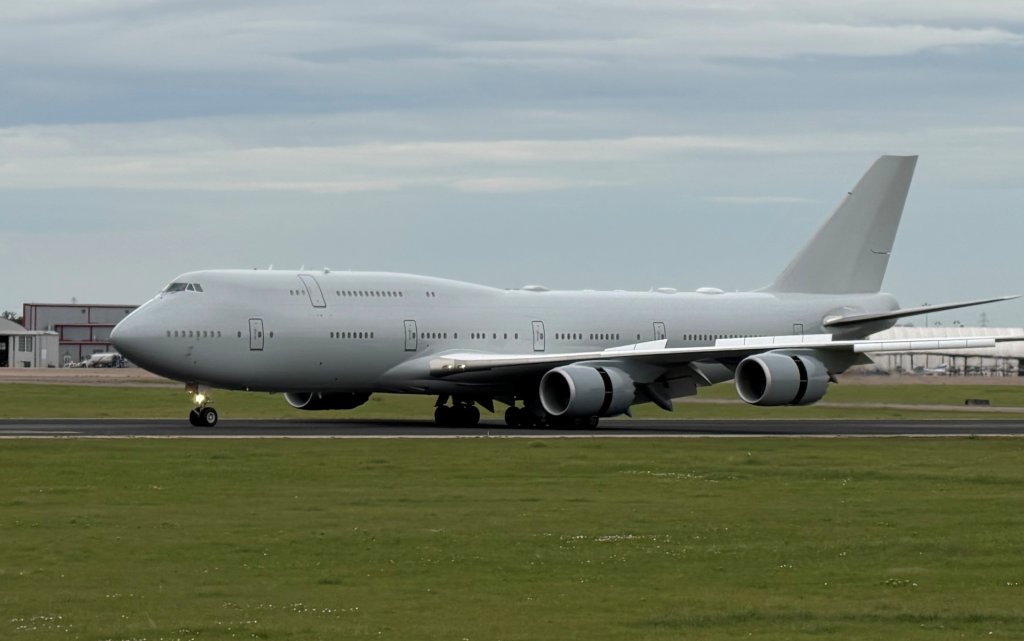
The VC-25B Bridge aircraft seen unpainted sometime circa May 1. Courtesy photo via the USAF
“The VC-25B Bridge aircraft has been painted and is going through final modifications,” an Air Force spokesperson told TWZ today when asked for more information about the aircraft’s current status. “I don’t have any additional details I can provide on delivery dates at this time.”
A press release the Air Force put out on May 1 said that the “VC-25B Bridge aircraft has officially completed modification and flight testing” and was “being painted.” We have confirmed that the completed modifications referred to here were on the contractor side, but the U.S. government still has additional modifications to make to the jet.
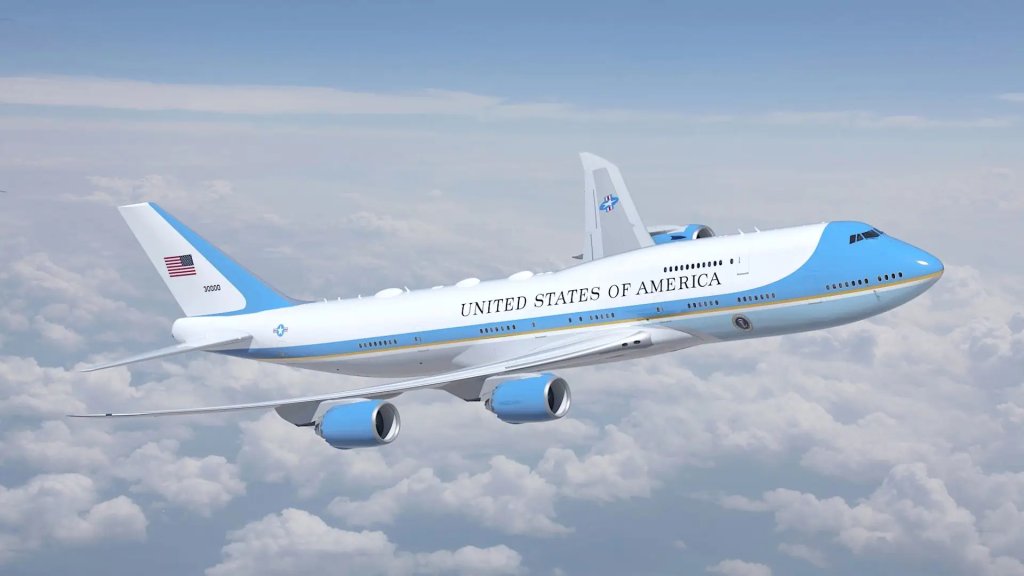
Ghormley’s picture does clearly show the jet wearing the same red, white, and blue scheme that has already been appearing on various Air Force and other U.S. government VVIP jets. The livery also includes a large American flag, depicted blowing in the wind, painted on both sides of the tail and “UNITED STATES OF AMERICA” written on both sides of the fuselage. The paint job is virtually identical to what President Donald Trump had previously chosen for the future VC-25B Air Force Ones during his first term. President Joe Biden had previously reversed that decision, bringing back plans to paint the VC-25Bs in the iconic scheme that dates back to President John F. Kennedy’s administration.
A rendering of a future VC-25B with the livery President Trump had originally selected. BoeingA rendering of a future VC-25B wearing the Kennedy-era scheme. USAF A rendering of a future VC-25B Air Force one jet. USAF
The Bridge aircraft’s current location is also unclear. Video posted on social media yesterday, seen below, purported to be of the jet departing for its new home at Andrews Air Force Base just outside of Washington, D.C. This is where the two current VC-25A Air Force One jets, as well as a host of other Air Force VVIP aircraft, are based.
Full blown operation to get this thing out without us seeing. Fueled, loaded crew, and preflighted in the hangar. Flipped CRANE01 to face me at the south end and beam me with landing lights. Entire airport blacked out, crew and grounds crew all wearing NOD’s.
Online flight tracking data does show that another U.S. military Boeing 747-8i flew from Waco, Texas, to Andrews on June 7, using the callsign Crane 01. However, this callsign has been associated with an ex-Lufthansa 747 the Air Force has also acquired for use as a trainer in support of future Air Force One operations. This aircraft, which may now carry the serial number 25-3200, has been tracked multiple times flying between facilities in Texas and Andrews in recent months. There does not appear to be tracking data for the VC-25B Bridge jet, which may also now have the serial number 25-3300, but it could have made the trip without broadcasting on ADS-B.
Past reports have indicated that the Bridge aircraft could make its public debut on July 4, which this year is also wrapped up in additional celebrations of the 250th anniversary of the founding of the United States. President Trump’s birthday (June 14) is also this weekend.
“L3Harris, known for its executive communications systems and services, was selected to undertake a complex modification of the bridge aircraft. L3Harris not only delivers secure, reliable and resilient communications for VC-25A and the executive airlift fleet but has extensive experience with self-protection and customization of VIP aircraft,” the Air Force wrote in the May 1 press release. “The accelerated timeline was further made possible by a mission-focused partnership with Boeing, who provided the necessary engineering data to support the required structural modifications.”
“Additionally, elite specialists from multiple government agencies developed advanced protocols to detect and-if necessary-neutralize potential technical hazards on previously owned aircraft,” it added. “Their rigorous approach on the Bridge aircraft has literally ‘written the book’ and set the benchmark for integrating used airframes into the secure military inventory.”
Another picture of the unpainted VC-25B Bridge aircraft, seen after arriving in Waco, Texas. Courtesy Photo via USAF
“Safety and security were at the forefront of this program. We deliberately minimized interior aesthetic modifications to focus on modifications for safety, security and mission execution. We assessed which requirements were necessary for an interim capability. We had greater flexibility in developing our mission requirements,” the Air Force also told TWZ directly at that time. “After safety and security, we focused on the mission communications systems.”
“We have made deliberate decisions such as the reduction of the number of airstairs, less chiller space, and exclusion of the Golden Eagle mission [to fly the remains of former presidents] to minimize structural modifications, while prioritizing modifications focused on safety, security and secure communications,” the service added.
Getting a new Air Force One aircraft of some kind into service on an accelerated timetable has long appeared to be a major goal for President Trump. The fully-equipped VC-25Bs from Boeing are years behind schedule. Last year, the Air Force announced that there had been some improvement on that front, but that it still did not expect to have the first of the two jets in hand until mid-2028, which would be just months before Trump is set to leave office.
What we do know for sure is that the VC-25B Bridge aircraft is now wearing Trump’s preferred red, white, and blue paint scheme ahead of its official rollout later this summer.
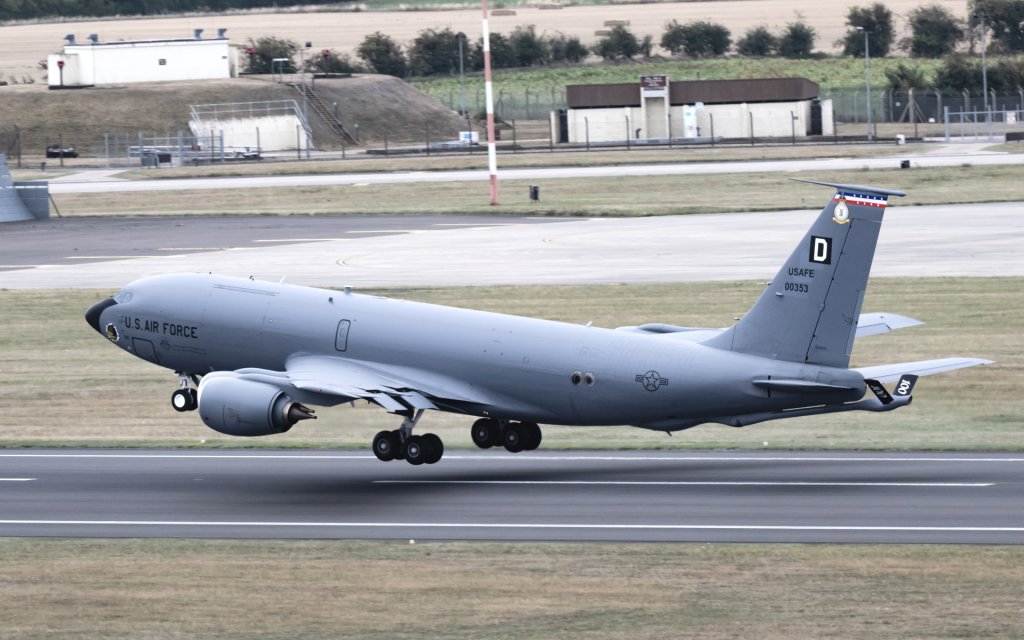
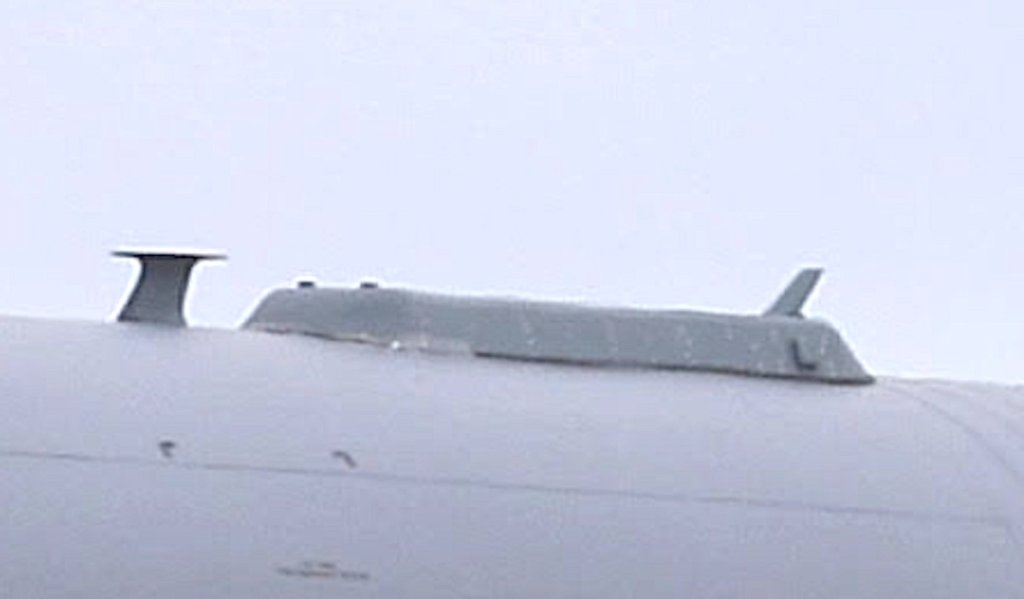
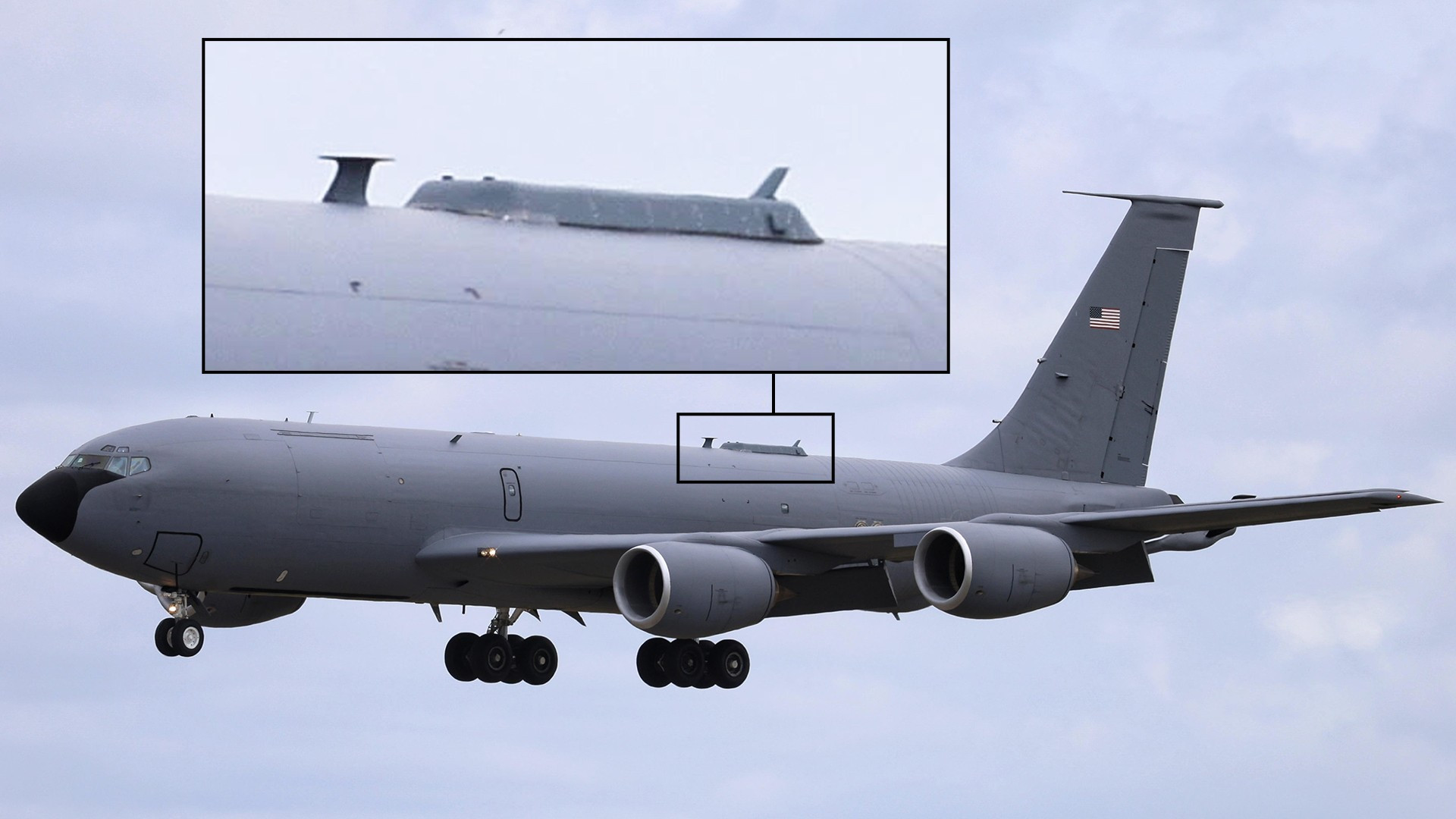
A U.S. Air Force KC-135 tanker appeared in the United Kingdom this weekend with a new antenna on top of the rear of the fuselage. The service has several efforts underway to improve the communications networking capabilities of all of its tankers and cargo planes, including ones that leverage Starshield, the government-focused cousin of SpaceX’s Starlink. This has become an especially critical priority for future survivability and effectiveness of the aging KC-135 fleet.
A stock picture of a KC-135 tanker taking off from RAF Mildenhall in 2025. USAF/Staff Sgt. Kevin Long
Ledda told TWZ that online flight tracking data says this particular KC-135 is serial number 63-7976, but that this might not be correct. The plane is largely devoid of markings, preventing easy confirmation. Two years ago, the Air Force’s Air Mobility Command (AMC) began removing serial numbers and other unique identifying markings from tankers and other aircraft as an operational security measure, as you can read more about here.
Ledda also told us that this is the first time he has seen a KC-135 with the new dorsal antenna, despite regularly photographing tankers of this type at Mildenhall. The base is home to the Air Force’s 100th Air Refueling Wing, which flies the KC-135, but is also a regular staging point for temporary deployments and a stop-over for aircraft just passing through.
A picture of the same antenna on top of a KC-135 had emerged online in April, but where and when it was taken are unclear. This may or may not be the same aircraft seen at Mildenhall this weekend. It is unknown how many Air Force KC-135s may have received this modification so far, and TWZ has reached out to the Air Force for more information. At the beginning of Fiscal Year 2026, the Air Force had 368 KC-135s in inventory, in total. At least a portion of that fleet is set to remain in service through 2050.
A close-up look at the dorsal antenna on the KC-135 seen this weekend at RAF Mildenhall. Alessandro Ledda
The antenna has a very roughly trapezoidal shape with a mostly flat top. There is a single small blade that sticks up at the rear, as well. The size and shape are broadly reflective of ‘hump’ style antennas associated with high-bandwidth satellite communications (SATCOM) suites seen on large military and commercial aircraft. In both pictures we have seen of this installation on the KC-135 so far, the new antenna is also mounted right behind a much smaller existing platter-shaped type typically used to support ultra-high-frequency SATCOM links.
Back in April, the possibility was raised that the new antenna for the KC-135 could be tied to Airlift/Tanker Open Mission Systems (ATOMS) and/or its successor, MAF NEXUS, both developed by the Sierra Nevada Corporation (SNC). MAF here stands for Mobility Air Forces, a collective term for the Air Force’s tanker and airlifter fleets, and the personnel that support them.
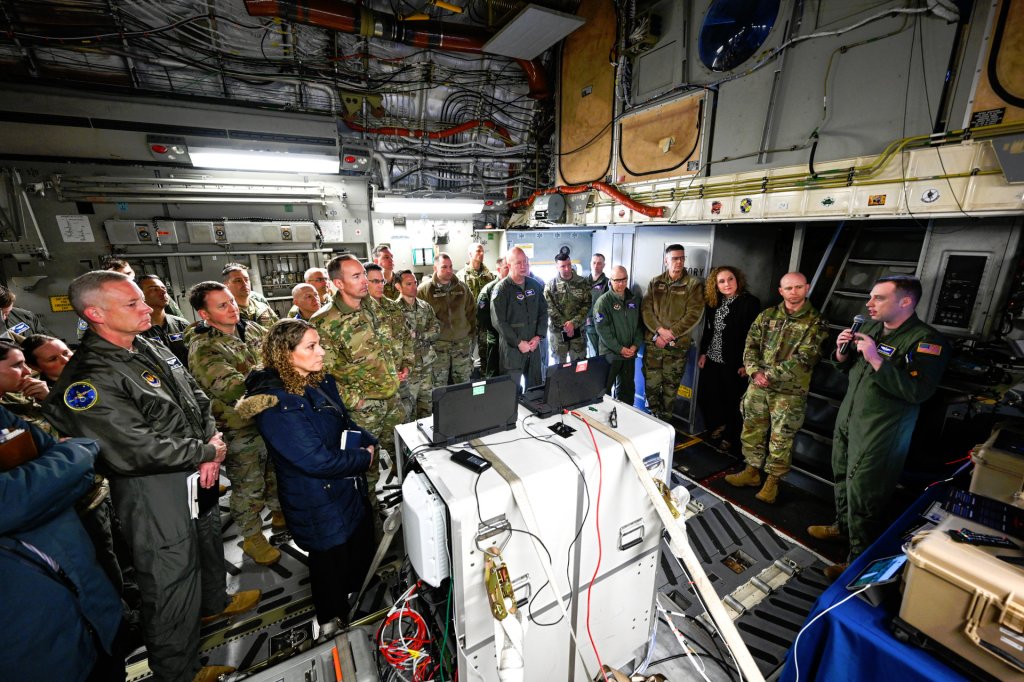
ATOMS is “a Starshield-based BLOS [beyond line of sight] satcom system SNC has been installing on a handful of [KC]-135s, [C]-17s, [KC]-46s, [C]-130s. Saw a C-17 getting it last week in Dayton,” Aviation Week‘s Brian Everstine wrote on X, speaking generally, in a thread discussing the first picture of the new antenna for the KC-135 that had emerged. ATOMS is “now transforming to Air Mobility Commands [sic] ‘MAF Nexus.'”
Elements of at least one iteration of ATOMS are seen, at center, inside a C-17 cargo plane during a briefing for senior officials in 2025. USAF/Staff Sgt. Joshua T. Crossman
As noted, Starshield is a more secure, government-centric offshoot of SpaceX’s Starlink space-based network. Starshield and Starlink have been in increasing use across the U.S. military on aircraft, as well as warships and in various contexts on the ground, for years now, as TWZ has explored on several occasions in the past.
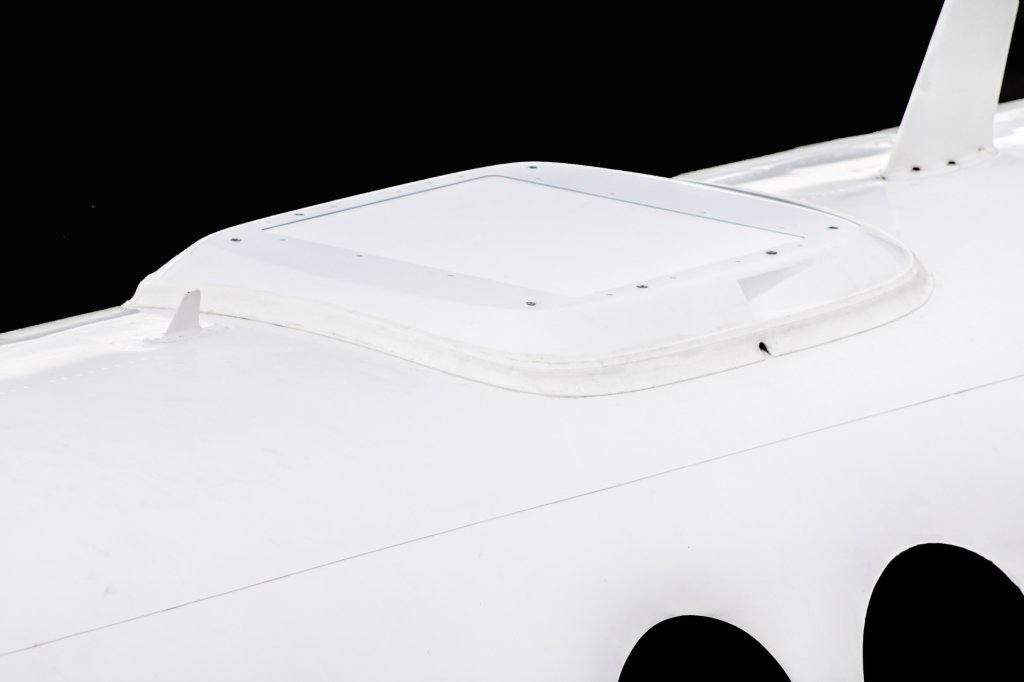
The size and shape of the antenna on the KC-135 at Mildenhall is, broadly speaking, in line with commercial Starlink antennas used on airliners and other civilian aircraft.
An example of a commercial Starlink antenna for use on aircraft, in this case integrated onto a Beechcraft King Air turboprop. AeroMech Incorporated
“The SNC solution for ATOMS, originally provided as a Quick Reaction Capability (QRC) in just six months, delivers enhanced situational awareness through multidomain networking and datalink,” SNC had explained in a press release in August 2025. “The system’s ability to provide a Common Operating Picture improves data interpretation and bolsters decision advantage, strengthening AMC’s effectiveness by leveraging multiple communications paths and sensors to seamlessly share data.”
That release followed the conclusion of the Air Force’s Mobility Guardian 2025 exercise, in which ATOMS “played a pivotal role” by “demonstrating its ability to provide seamless data management and communications solutions on multiple aircraft platforms, including the C-17, KC-135, KC-46 and C-130, as well as numerous ground nodes.”
The Air Force’s 2027 Fiscal Year budget request highlights at least two other potentially relevant communications upgrade efforts for the service’s KC-135, specifically, which could also make use of Starlink/Starshield.
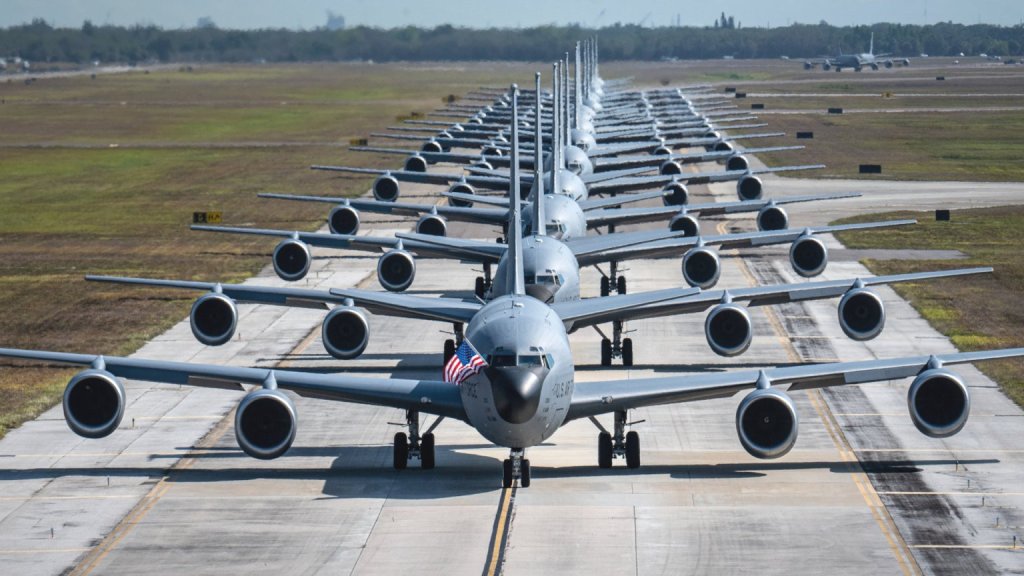
A row of US Air Force KC-135 tankers. USAF
There is the “Hybrid SATCOM capability,” which involves “the employment of Multi-Band, Multi-Orbit SATCOM terminals to switch between different government and commercial constellations,” according to official budget documents. This is tied to another project called MAF Connectivity focused on developing a “path forward as the tanker needs to be able to connect to the Joint fight to close kill chains and logistics chains.”
For MAF Connectivity, “possible capabilities include, but are not limited to, intelligent gateways, antennas, radios, software updates, crew displays, and multiple aperture array housings,” the budget documents also note. An “increment 1 first prototype installation” was also scheduled to be completed in the second quarter of Fiscal Year 2026, which began on January 1 and ended on March 31.
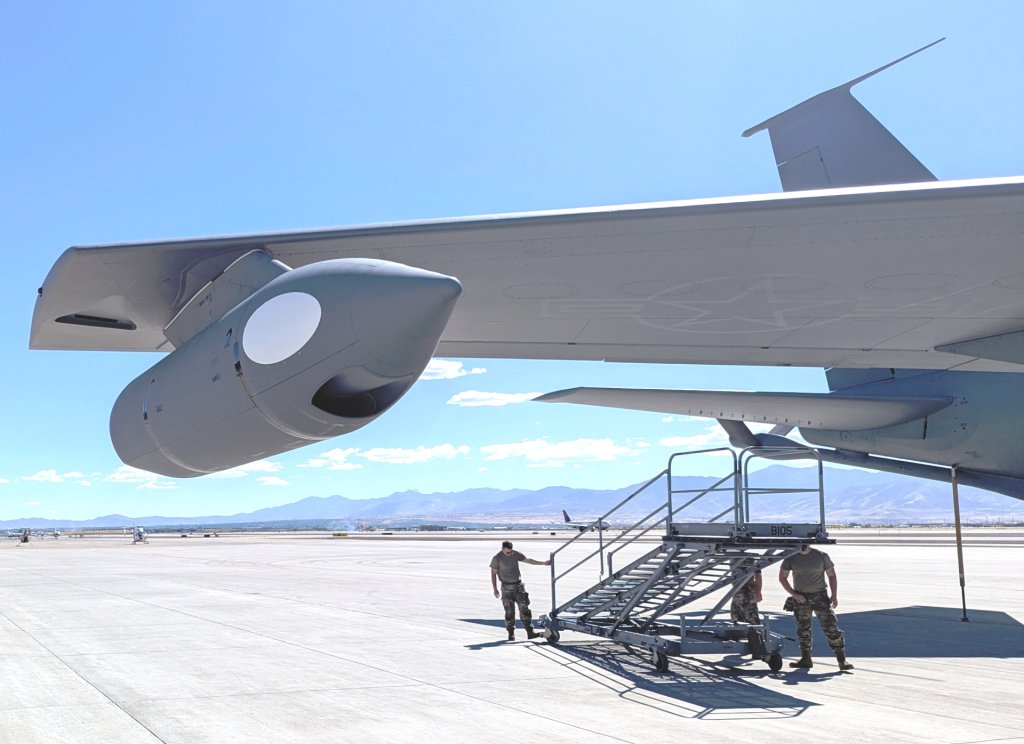
The antenna could be part of a different effort, as well. The Air Force has fielded a number of roll-on/roll-off communications and networking suites for the KC-135 over the years, but in an ad hoc manner and on a relatively limited scale. Last year, the Air National Guard also announced the demonstration of a new communications and data-sharing node packaged inside a heavily modified underwing Multipoint Refueling System (MPRS) pod, but the extent to which that capability may now be available for operational use is unclear. KC-135 and KC-46 tankers use unmodified MPRS pods to transfer fuel to receivers via the probe-and-drogue method.
A repurposed Multipoint Refueling System (MPRS) pod containing a communications and data-sharing package, seen under the wing of a Utah Air National Guard KC-135. MSgt Nicholas Perez/Utah Air National Guard
As an aside, a Boeing 757 called Trailblazer (N-number N473AP), which defense contractor L3Harris uses as a testbed, also recently emerged with a new elongated dorsal fairing. Trailblazer’s new addition is similar in some broad strokes, but also distinctly different from the antenna seen on the KC-135 at Mildenhall this weekend. One of L3Harris’ major business areas is satellite communications systems, including for the U.S. Air Force. TWZ has reached out to the company for more information about this development.
For years now, the Air Force has been trying to more deeply integrate new communications and networking capabilities onto the KC-135, as well as other tankers and aircraft across the MAF. Senior service officials have also described this as a gateway to enabling other new capabilities down the road, including ones to help better protect tankers and airlifters from future threats. TWZ has previously highlighted this as a path to airborne control for “loyal wingman” type drones and other uncrewed aerial systems, something the Air Force has already been experimenting with to differing degrees.
“I gotta keep modernizing the tanker force,” Air Force Lt. Gen. Rebecca Sonkiss told TWZ and others at a roundtable at the Air & Space Forces Association’s annual warfare symposium in February. “If I was going to parcel out the things we care about in that, though, it’s connectivity and survivability. So those are the things that we really care about in that effort.”
“There’s various ways to get after survivability,” she continued. “It starts with being connected so that you have battlespace awareness, and then it continues on to how do we protect those assets.”
Sonkiss’ official title is Deputy Commander of AMC. However, she has been serving as the interim head of the command since her predecessor, Gen. John Lamontagne, became Vice Chief of Staff of the Air Force in January.
Air Force Lt. Gen. Rebecca Sonkiss speaks at the 2026 AFA Warfare Symposium. USAF/Capt. Christian Little
“The single biggest contributor to survivability in a big airplane is connectivity. The biggest contributor is not having a 12-hour-old Intel brief that you’re relying on to get you through the mission,” retired Air Force Gen. Michael “Mini” Minihan, who led AMC from October 2021 to November 2024, told TWZ in an interview in February, as well. “So real-world updates, real-time updates, just like our fighters and our bombers enjoy. Battle management that gets after maneuver and not just kill chain. Those things matter.”
“The reality is that the car I rented right now, driving from the airport to my hotel room, has more connectivity in it than the overwhelming majority of the mobility fleet. So connectivity matters,” he also told us at that time.
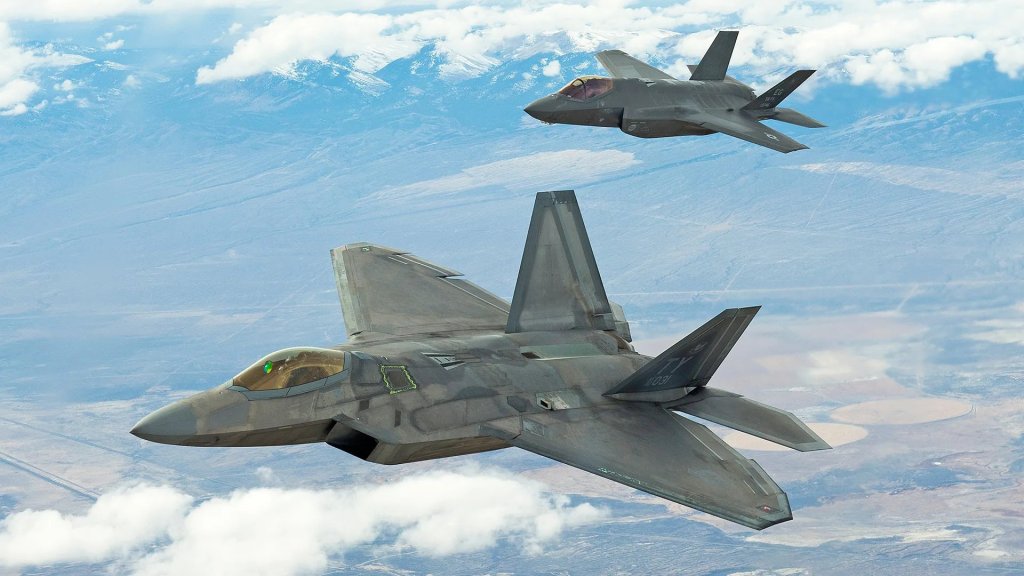
New communications and networking suites could enable AMC’s KC-135, as well as the rest of the command’s fleets, to serve as essential ‘translators’ between disparate networks and waveforms in the future. Providing a link between low probability of interception/low probability of detection (LPI/LPD) datalinks that stealthy aircraft use, such as the Multifunction Advanced Data Link (MADL) and Intra-Fighter Data Link (IFDL), and more general-purpose ones, would be especially valuable. IFDL is currently only found on the F-22 Raptor, while all variants of the F-35 fighter (and future B-21 Raider bombers) use MADL, and the two cannot ‘talk’ to each other directly, which has long created challenges. Upgraded tankers could serve as important parts of a beyond-line-of-sight mesh-like network that incorporates other kinds of line-of-sight links like Link16. In this way, they could help relay data to and from forward battle management and other command and control nodes, including ones in the air.
An F-22, in front, flies together with an F-35A, at rear. USAF
In addition, improved connectivity stands to provide additional operational and safety benefits across the MAF.
“According to the Air Force, the tankers’ ability to access tactical data links could increase mission success in contested environments by improving survivability, agility, and situational awareness for command-and-control elements and aircrews,” the Congressional Research Service (CRS) wrote in a report published in January. “The connectivity could provide aircrews with such information as potential threats, fuel availability, and safer landing sites. In addition, tanker aircraft could serve as a backup information conduit for other aircraft in a degraded communications environment.”
The points here have become a broader topic of discussion after two KC-135s collided over Iraq in March during the opening weeks of Operation Epic Fury against Iran. One of the aircraft crashed, killing all six onboard. The other tanker involved was able to land in Israel despite suffering severe damage. At the time of writing, the Air Force has not yet shared any official determinations as to the chain of events that led to that fatal incident.
“We should never put mobility crews, especially tanker crews, in a position during combat operations where they have to choose between being seen by everyone, including the enemy, or being seen by no one, including the joint force and civil aviation,” Minihan subsequently wrote in a post on LinkedIn. “Mobility force connectivity now. Write the damn check.”
“Most KC-135s [sic] communications networks are ‘not the type of battle space awareness that shows you where the red is, where the blue is, and the actions that are being taken in real time in a conflict,'”Defense One reported in March, citing an interview with retired Air Force Gen. Jacqueline Van Ovost, who previously served as head of U.S. Transportation Command (TRANSCOM). “All you have is the intelligence you took off with when you got the brief two hours prior to take off.”
All this being said, the Air Force is still years away from integrating more robust communications and networking capabilities onto the entire KC-135 fleet.
“Over the course of about the next six years, you’ll see the full fleet of KC-135s fully connected,” Lt. Gen. David Tabor, Deputy Chief of Staff for Plans and Programs, told members of Congress at a hearing last month.
The appearance of the KC-135 with the added antenna at Mildenhall does point to new progress on key connectivity upgrades for Air Force tankers and airlifters. At the same time, improved communications and networking capabilities are increasingly critical now, and it remains to be seen when they become more commonplace across the KC-135 fleet.
Special thanks again to Alessandro Ledda for sharing the picture of the KC-135 seen at Mildenhall this weekend with us.

 Login
Login