British officials accused Vice President JD Vance of trying to “stir up division” in his comments on the murder of Henry Nowak, whose killer was sentenced to life in prison last week.
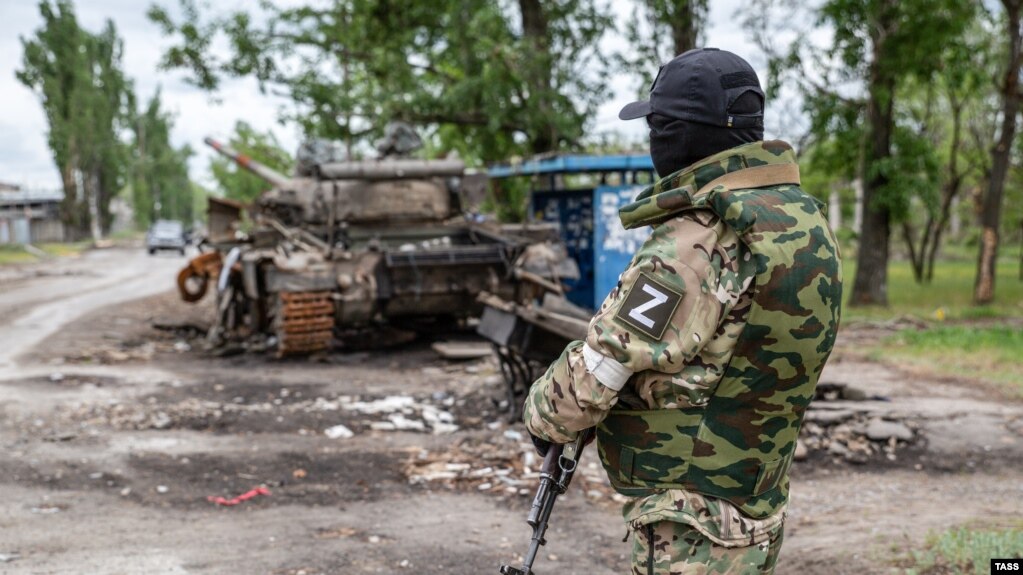
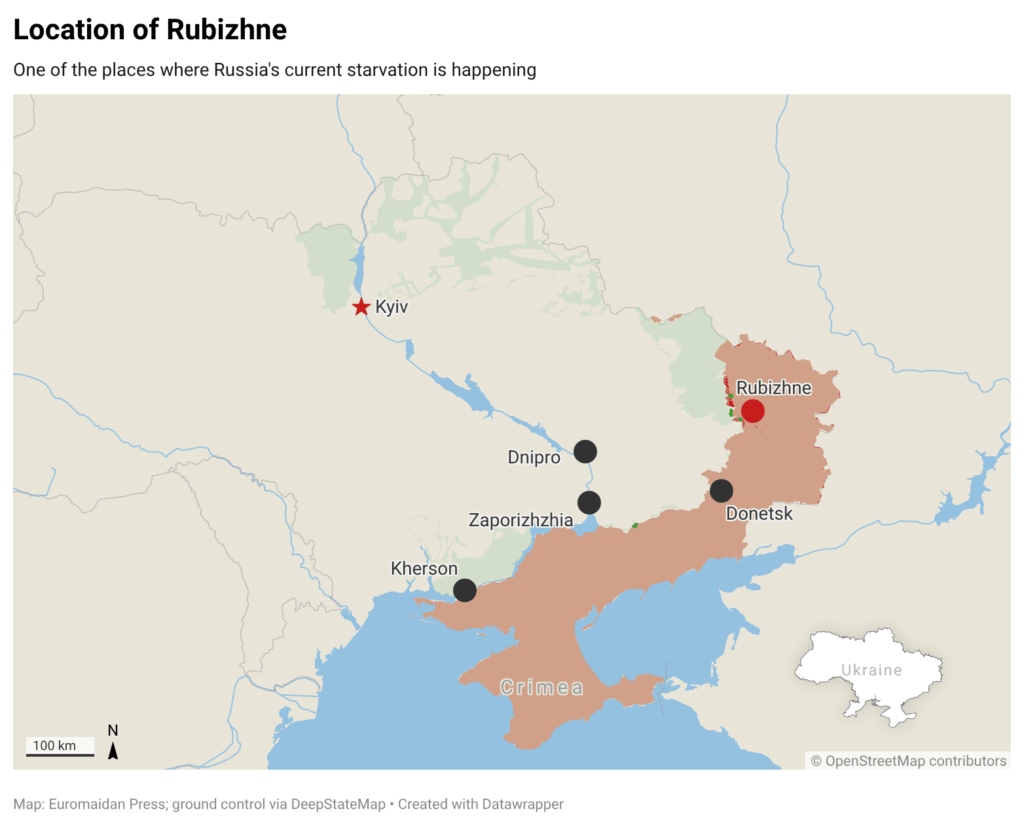
Russian occupation forces have deliberately manufactured a food shortage in occupied Rubizhne, cutting civilian food deliveries to the Luhansk Oblast city even as military supply convoys continue to flow, the head of the Luhansk Regional Military Administration reported on 8 June.
Shelves in the city's stores are emptying rapidly, Kharchenko said. Russian propaganda blames disrupted transport links, citing an alleged drone threat. Yet the occupiers have had no difficulty maintaining their own logistics routes to resupply military units stationed across the region, he noted.
"They need to make the next victim for Russian television out of local residents. They chose Rubizhne."—Luhansk governor OleksiiKharchenko
A city turned into a propaganda prop
The official accused Russia of weaponizing hunger for television cameras. He said the occupiers intend to film bare shelves and hungry residents, then broadcast the footage to Russian audiences as evidence of suffering they themselves engineered.
Before Russia's full-scale invasion, Rubizhne was home to more than 55,000 people. Russian forces seized the city in May 2022 after weeks of devastating urban combat during which they fired up to 1,500 shells per day, the BBC's Quentin Sommerville reported from the front lines. The city's current population remains unknown, but residents who stayed have endured four years of occupation without reliable utilities, communications, or public services.
In nearby Sievierodonetsk, conditions have deteriorated so far that residents now mow the grass in their own neighborhoods and clean communal areas themselves, Kharchenko added—an admission that Russia's occupation authorities provide no basic municipal services even in the cities they claim to have "liberated."
A pattern of deliberate starvation across occupied Ukraine
The manufactured food shortage in occupied Rubizhne fits a documented pattern of Russia using hunger as a weapon against Ukrainian civilians trapped behind the front lines.
In Oleshky, a frontline city in occupied Kherson Oblast, roughly 2,000 civilians have been cut off from food, medicine, and clean water for months. "If the situation doesn't improve, people will just die there from hunger. Because there's no way out, no food supplies coming in," an Oleshky resident who escaped occupation told the Kyiv Independent. Russian forces mined the access roads, destroyed the Kakhovka dam's water infrastructure, and deployed FPV drones that residents describe as conducting "human safari" attacks—hunting anyone who steps outside. People there hunt pigeons and wild ducks with fishing line, plant vegetables in shell craters, and bury their dead in wheelbarrows because no coffins or transport exist.
Ukraine's Foreign Ministry in May appealed to the United Nations and the International Committee of the Red Cross over what it called a "severe humanitarian crisis" in Russian-occupied Kherson Oblast. Russia rejected calls for a humanitarian corridor.
In Nova Kakhovka, upstream from Oleshky, most coastal areas have been abandoned. The few residents who remain live in distant high-rise microdistricts with no functioning hospital and minimal Russian administrative presence, governed remotely from Henichesk, roughly 130 kilometers away.
The Rubizhne food shortage also coincides with Russia's broader restriction of civilian movement through occupied territories. On 6 June, occupation authorities shut down bus and private car traffic on main arteries, capping two weeks of land-corridor breakdowns that have further isolated occupied communities.
Starvation as premeditated policy
International human rights investigators have gathered evidence that Russia planned to use hunger as a weapon before the 2022 invasion. A report by Global Rights Compliance found that a Russian defense contractor purchased grain-transport trucks and bulk cargo ships in December 2021—two months before the invasion began. The evidence was submitted to the International Criminal Court for what could become the first prosecution of a head of state for the war crime of starvation as a method of warfare.
Global Rights Compliance has drawn a direct parallel to the Holodomor—the Soviet-engineered famine that killed millions of Ukrainians in 1932–1933. Russia's current starvation tactics are being perpetrated, the organization noted, by "the same attacking state."
Under the Geneva Conventions, using starvation of civilians as a method of warfare is a war crime. The Rome Statute of the ICC codified the offense in 1998. Yet in occupied Rubizhne, occupied Oleshky, and across the territories Russia claims to have annexed, the pattern continues: military convoys pass, civilian supply lines close, and shelves empty.
Pro-Ukrainian partisan movement ATESH says its agents carried out a sabotage operation at a railway station in Russia’s Voronezh Oblast, destroying a rare heavy-duty rail recovery crane used by Russian Railways.
The group said the target was an EDK-300/5 rail recovery crane, a specialized system used for large-scale emergency rail restoration work. ATESH claims the equipment is no longer in production and exists in only limited numbers across Russia’s rail network.
According to the statement, the crane was designed for heavy railway accident response tasks, including lifting derailed rolling stock, clearing damaged infrastructure, and restoring traffic on key lines. It reportedly had a lifting capacity of up to 300 tons.
A heavy rail recovery crane used by Russian Railways for emergency repair and derailment response. Illustrative photo: ATESH
“Even in the deep rear, critical equipment is not safe from destruction”
ATESH said the loss of the crane would reduce Russia’s ability to rapidly repair damaged rail infrastructure, particularly at major transport junctions where recovery speed is critical for maintaining logistics flows.
The group added that the impact of the loss would be long-lasting, saying: “Replacement of the destroyed crane will require significant time and resources. While Putin’s army searches for a replacement, the railway hub and regional logistics are operating with limited recovery capacity.”
“Even in the deep rear, critical equipment is not safe from destruction,” they added.
The report has not been independently verified.
ATESH: sabotage network operating inside Russia
ATESH is a clandestine resistance network operating inside Russian-controlled territory and within Russia itself. The group says it focuses on reconnaissance and sabotage operations against military, transport, and communications infrastructure that it considers to be supporting Russia’s war effort against Ukraine.
ATESH statements are typically released via Telegram and often include claims of damage to rail assets, depots, and logistical hubs. The group also claims to have agents operating inside the Russian armed forces, which it says helps it gather intelligence and identify targets.
The operation is part of a wider campaign aimed at disrupting Russian transport infrastructure, which the group says supports both civilian logistics and military supply chains.
ATESH has increasingly focused on rail assets inside Russia, arguing that even limited damage to specialized equipment can create disproportionate delays across tightly connected transport networks.
Previous claimed strike in Saint Petersburg
In a previous claimed operation in May, ATESH said its agents set fire to a locomotive in Saint Petersburg used for oil transport, taking it out of service and disrupting rail operations in Russia’s northwestern logistics network.
The group said the locomotive had been part of fuel transport routes linked to industrial supply chains and export corridors in the northwest of the country, including areas connected to port infrastructure.
A locomotive used in oil transport was set on fire in Saint Petersburg, Russia, according to claims from the partisan network ATESH.
The group says its agents carried out the sabotage operation, taking the engine out of service and disrupting rail logistics tied to fuel and… pic.twitter.com/2c6ChkG7TR
— Euromaidan Press (@EuromaidanPress) May 21, 2026
Russia "intends to harm" the UK through economic disruption, sabotage, and "dark arts", and the evidence is clear, former UK Chief of the Defense Staff Stuart Peach told The Independent. His claims came in a joint interview with the chair of the House of Lords Select Committee on National Resilience, Baroness Coussins, who called for greater urgency from government and citizens.
The intervention is one of the most direct public warnings from senior UK figures on Russian hybrid operations against Britain. Peach is now making the case publicly that the threat has shifted from speculative to operational.
Baroness Coussins, whose committee was appointed in January 2026 and is due to report in November, framed it more bluntly: "It is not a question of 'what if?’ It's a question of 'these things are happening now.' We know we’re under cyber attack daily."
"The evidence is clear"
“The fact that Russia intends us harm – whether it's economic disruption or the ‘dark arts’, as you might call them – I think the evidence is clear," Peach said.
He warned that the UK is not prepared for the scale of scenarios that could result, including widespread power cuts and full-scale war.
Baroness Coussins added that British intelligence services regularly identify and disrupt potential violent threats inside the country and pointed to the activities of so-called proxy structures linked to Russia and Iran.
Undersea cables and European pattern
Peach said the threat to the UK posed by undersea cable disruption, which carries internet connectivity, financial transactions, and essential data, was an issue he had raised as Chief of the Defense Staff and one that has only sharpened since.
He pointed to a politically motivated arson attack in Berlin in January 2026 that caused a widespread power cut affecting 45,000 households and 2,200 businesses, including internet and heating.
The recent fire at an electrical substation that forced the closure of London's Heathrow Airport, causing mass flight cancellations and power disruption, was raised as a UK precedent showing how single-point sabotage can cascade across critical systems.
Lord Peach warned that malicious attacks “can have real damage.”
In charge for 14 years at the Home Office and 10 at Hampshire police, the Tories co-authored the Henry Nowak tragedy, says Clive Pinder. But Kemi Badenoch has shown she is determined to do something about it.
A stripped-back take on Arthur Miller’s Death of a Salesman dominated this year’s Tonys, winning six awards, while Lesley Manville and John Lithgow took home lead acting trophies.
Death of a Salesman was named best revival of a play, with the award-winning director Joe Mantello praising Miller’s story as one that “still talks to us through time”. Star Nathan Lane accepted the award on behalf of the cast, and called it a play that “continues to teach us who we are as humans and Americans”.
David Rush, who was arrested in May, stole millions from US government through ‘special access program’, officials say
A former executive intelligence agent who is accused of stealing more than $40m in gold bars from the CIA reportedly created a fake spy program to siphon money, the latest on his fraudulent activity, the Washington Post first reported.
David Rush, who was a senior-level employee of the Central Intelligence Agency (CIA) for 17 years, was arrested in May after FBI agents discovered Rush had taken 303 bullion bars, each about 2.2lbs, dozens of luxury watches, and more than $2m in foreign currency from his government office.
The letter coincides with approval of a planning application that reveals the Reform leader’s plans to transform a dilapidated Kent property into a luxury beachfront residence.

 Login
Login