
Reading view

Strong 5.2 Magnitude Earthquake Shakes Greece’s Evia and Athens

earthquake
The earthquakes rattled large parts of central and southern Greece, including Evia and Athens. Credit: AMNA

A series of strong earthquakes, culminating in a 5.2-magnitude tremor, rattled the Greek island of Evia (Euboea) and the greater Athens metropolitan area on Sunday afternoon. The seismic activity triggered extensive landslides across the northern part of the island of Evia, though local authorities report no injuries or significant structural damage to houses.
The initial shock, measuring 4.8 on the Richter scale, occurred at 12:58 p.m. local time on Sunday, June 7.

According to the automated system of the Geodynamic Institute of the National Observatory of Athens, the epicenter was located six kilometers (4 miles) southwest of the village of Prokopi in northern Evia, with a shallow focal depth of just 14.1 kilometers.

More earthquakes followed, rattling central and southern Greece

Minutes later, a stronger 5.2-magnitude earthquake struck the same localized fault line. This second, more powerful tremor originated just two kilometers east-southeast of Prokopi at a much shallower focal depth of only five kilometers. A third notable tremor followed shortly after in the exact same region, compounding the anxiety of local residents.

All three shocks were felt prominently across the Attica region, rattling windows and disrupting the Sunday afternoon routines of millions of residents and tourists in the Greek capital.

Despite the intensity of the tremors and their shallow depth, the immediate fallout appears limited. Giannis Tsapourniotis, the mayor of Mantoudi on Evia, provided an update on the situation on the ground during a statement to the state broadcaster ERT.
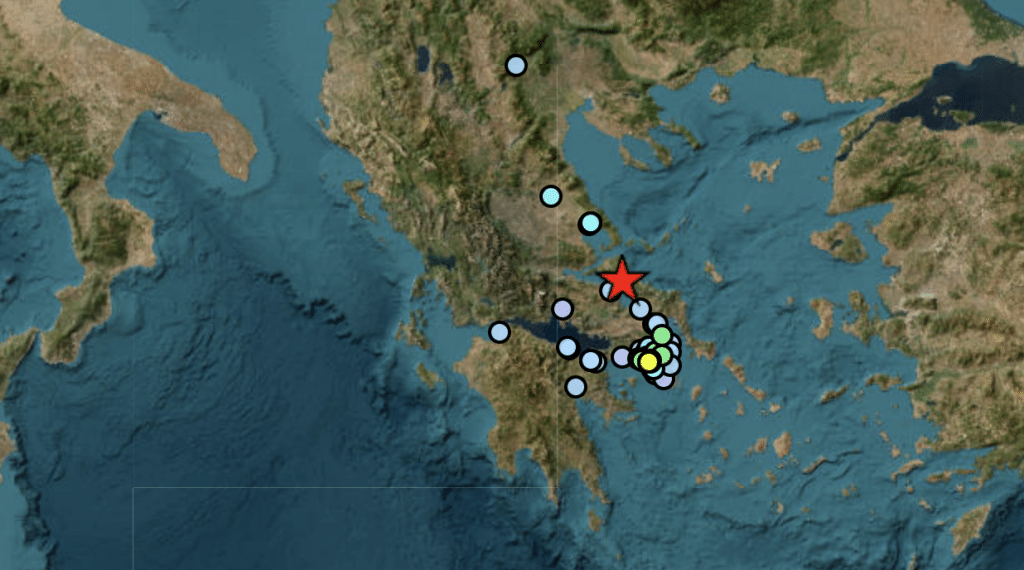
Earthquake Greece map
The epicenter of the tremors on the island of Evia (red star). Credit: EMSC (European Mediterranean Seismic Centre)

“We have extensive landslides, but no injuries have been recorded,” Tsapourniotis confirmed. He specified that heavy rockfalls and landslides have primarily obstructed rural roadways in the areas of Plakia and Dafnousa. Emergency crews of the local council and local civil protection units are currently working to clear the affected traffic routes and assess any isolated impacts on village infrastructure. To date, homes and commercial businesses remain intact.

Greek seismologists tried to calm public fears regarding the consecutive tremors. Kostas Papazachos, a prominent professor of seismology at the Aristotle University of Thessaloniki, described the events as a series of consecutive earthquakes that align with the area’s known geological profile. Northern Evia sits directly atop a complex network of active fault lines, making such localized clusters a known phenomenon.

“These seismic tremors are not a cause for concern,” Papazachos stated, offering a reassuring outlook despite acknowledging it is still early in the post-earthquake evaluation process.

The region surrounding Prokopi is highly trafficked, especially on weekends, as it is home to the widely venerated pilgrimage site of Saint John the Russian, drawing thousands of visitors from across Greece and the global diaspora. The lack of infrastructure collapse in such a populated sector of the island has brought significant relief to state authorities.
Greece ranks among the most seismically active countries globally, located at the geological boundary where the African tectonic plate pushes beneath the Eurasian plate.

While minor tremors are a daily occurrence across the nation, shallow earthquakes above a 5.0 magnitude near heavily populated zones like Attica consistently prompt rapid responses. Local authorities in Evia remain on standby for potential aftershocks over the coming days, actively advising residents and tourists to avoid driving through steep mountainous routes prone to further rockfalls.

The statement issued by Greece’s Civil Protection

“According to official reports from the Geodynamic Institute, consecutive seismic tremors measuring 4.8, 4.3, and 5.2 on the Richter scale were recorded in northern Evia. Concurrently, the General Secretariat for Natural Disaster Recovery and State Aid has been placed on high alert and is in continuous communication with local authorities to assess the situation.

Based on initial inspections currently underway in the area, reported damages include a collapsed wall in one home, minor cracks in a few residences, and small-scale landslides affecting sections of the road network. So far, no injuries or severe damages have been reported.

Minister of Climate Crisis and Civil Protection Evangelos Tournas Tournas, accompanied by the General Secretary for Natural Disaster Recovery and State Aid, Petros Kampouris, is heading to Prokopi and Dafnousa for an on-site briefing. The Ministry of Climate Crisis and Civil Protection continues to monitor the situation closely and will immediately take any further action if necessary.”

  •  

The Strange Ox Sacrifice Held at the Acropolis of Athens

Marble sculpture of a sacrificial ox from the Parthenon.
In ancient Athens, there was a custom of sacrificing an ox in the Sanctuary of Zeus Polieus. Credit: Capillon, Public Domain

In ancient Greece, the killing of an ox was prohibited by law due to its vital role in daily life. However, a peculiar and ‘unlawful’ custom saw priests performing the sacrifice of an ox at the Sanctuary of Zeus, the king of the gods, located on the hill of the Acropolis, just a few meters from the Parthenon.

The Diipoleia, also known as Buphonia, was an ancient festival of the Athenians held towards the end of every June. It was also celebrated separately in other Greek cities during antiquity.

The Buphonia ritual and its origin

According to tradition, to justify the sacrifice, a group of oxen was led to the temple. There, the priest would place a type of bread offering made of wheat and barley on the altar. The first ox to eat from this area would be considered to have committed blasphemy, as it was believed to have consumed the offering meant for the god, and therefore had to be killed.

The priest chosen to perform the killing did so in isolation, without any witnesses present, and would then flee the city.

However, since ox sacrifices were forbidden at the time, an “investigation” was launched to identify the culprit. When the rest of the priests gathered to determine who had performed the sacrifice, the guilty priest was missing. In the end, the only evidence left would be the axe used for the killing, which would eventually be thrown into the sea.

How the ritual was performed

Ancient Greek geographer and traveler, Pausanias, provides further details in his account:

“There is a statue of Zeus—one by Leochares and another called Polieus. Concerning the established practices for the sacrifice and the reason said to justify them, I will not record them here.

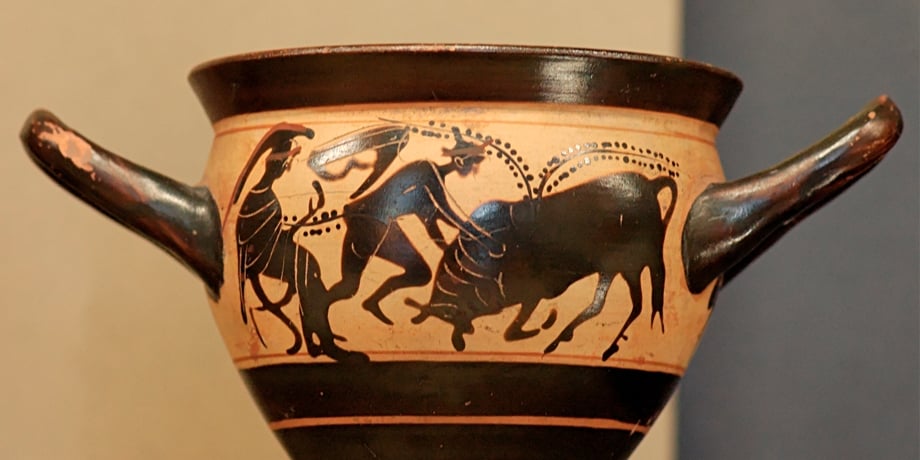
For Zeus Polieus, they would place barley mixed with wheat on the altar without any kind of guard. The ox, which they have prepared for the sacrifice and kept under watch, approaches the altar and begins eating the grain. A member of the Thalonid family sacrifices the animal that eats from the sacred offerings with a double-headed axe.

They then summon a priest, called the ‘ox-slayer’ (buphonos), who kills the ox and, in accordance with the law, throws away the axe and flees. Since the identity of the person who committed the act remains unknown, they bring the axe to trial instead. Afterwards, they enter the temple that they call the Parthenon.”

The Buphonos and the trial of the axe

It was believed that the ancestor of the Thalonids, Thalon, was the first to strike the ox. Neoplatonic philosopher Porphyry, attributes the first buphonia to a foreigner named Sopater. He also provides a shorter version of the story, in which the priest of Zeus, Diomos,  “murdered” the animal.The others then cut up the sacrificial victim and ate it.

Afterwards, they would hold a trial to determine the guilty party responsible for the killing. The buphonos (ox-slayer) did not appear, while those who participated in the sacrifice accused one another. They shifted responsibility for the killing from one man to the other.

The participants included the water carriers who brought water for the sacrificial tools, those who sharpened the knife and axe, as well as individuals responsible for carrying the tools.

Ultimately, they would accuse the knife, condemn it, and toss it into the sea. The ox’s hide was stuffed with straw and yoked to a plow. They did this to create the illusion that the animal was still alive.

The entire ritual permeated participants with intense feelings of guilt over the slaughter of the animal, and it was regarded as an act of murder.

Sacrifices in Ancient Greece
The entire ritual permeated participants with intense feelings of guilt over the slaughter of the animal. Credit: Wikimedia commons, Public Domain

Rituals, beliefs, and symbolism

It is noteworthy that, according to Porphyry, after the buphonos Sopater fled to Crete and before the establishment of the festival in Athens, a plague struck the city. The plague only ceased after Sopater’s return and the institution of the festival.

Additionally, as part of the measures to address the plague, the Oracle of Delphi deemed the establishment of the ritual involving the stuffing of the animal’s hide as necessary.

To avoid the pollution (miasma) of the murder, they made efforts to eliminate the act of murder itself. When this was not sufficient, they attempted to justify the act, for example, by claiming that the defilement resulted from impiety.

Finally, they shifted human responsibility by attributing the miasma to an inanimate tool, which became the scapegoat of the entire ritual. This object absorbed the miasma and was then removed from the city.


An animal sacrifice.
The ox, which they have prepared for the sacrifice and kept under watch, approaches the altar and begins consuming the grain. A member of the Thalonid family sacrifices the animal that is fed from the sacred offerings with a double-headed axe. Credit: Wikimedia Commons, Public Domain

Spiritual significance and agricultural connections

According to ancient Greek philosopher Theophrastus, the remains of the ox were buried. Presumably, this was so as to prevent its spirit from seeking revenge on the city. It is important to note that, in this ritual, the value attributed to the spirit of the animal is equivalent to that given to a human.

British classical scholar and linguist Jane Harrison, connects the use of offerings to attract the animal to the altar with the rites of Dionysus Zagreus and Isodaites. Furthermore, the yoking of the stuffed hide of the ox to the plow associates the festival with fertility rituals, which pertain to chthonic deities.

This ritual of purification and averting evil was initially connected to the need to ensure an abundance of game in a pre-agricultural society. Later on, an agricultural society adopted it, shifting the focus to the fertility of the land.

  •  
❌