Triumphant Achilles dragging Hector’s body around Troy, from a panoramic fresco of the Achilleion. Credit: Franz Matsch / Public Domain
He was the swift-footed Achilles, the greatest warrior of the Trojan War, a semi-divine hero whose very name was synonymous with speed and power. And yet, for centuries, the smart brilliance of an ancient Greek philosopher has left him perpetually—and quite comically—stuck behind a tortoise. Zeno’s paradox presents a philosophical conundrum that still captivates people millennia after it first questioned the intellectual doctrines of Ancient Greece.
It is a paradox that prompts us to question the nature of motion and reality itself. Specifically, it compels us to explore the infinite—a concept that still confounds quantum physicists today.
Zeno’s Paradox: The problem with Achilles and infinite steps
Picture the scene: Achilles, in all his glorious, muscular beauty, lines up against a tortoise. The tortoise, naturally, gets a head start—a gesture of fair play, one might say, that quickly devolves into philosophical torture.
Credit: Loco Steve, Wikimedia Commons, CC BY-SA 2.0 (left), Greek Reporter archive (right)
During this event, Achilles, being well, would instantly sprint past the slow tortoise. But Zeno, with a mischievous twinkle in his eye, argued otherwise. Before Achilles can even reach the position where the tortoise started, the cute little animal will have managed to go forward a little compared to its initial position.
When Achilles finally arrives at that particular spot, the tortoise has moved again. This would carry on forever. This continuous cycle, Zeno noticed, continues ad infinitum, meaning Achilles is forever playing catch-up, never truly reaching the tortoise. It sounds childish and blatantly wrong, but is it? Think about it. It makes sense. It’s enough, at least, to make you wonder about what’s real and what isn’t.
Zeno of Elea’s Achilles paradox. Credit: Aelwyn. CC BY-SA 4.0/ Wikimedia Commons/Aelwyn
This confused the ancient Greeks, whose understanding of infinity was still rudimentary. It challenged the very idea of continuous motion, suggesting that movement itself might be an illusion, a series of frozen moments rather than a fluid progression. Indeed, Zeno’s mentor, Parmenides, had famously argued that reality was static and unchanging, and our perception of movement was nothing but a trick of the senses.
Zeno, always the loyal—and brilliant—student, used his paradoxical skills skillfully as an intellectual shield for this peculiar paradox. One can almost imagine the expressions on the faces of Athenian philosophers as Zeno calmly explained why their fastest runner could never quite outrun a slow tortoise.
Of course, modern humans comprehend concepts such as calculus, therefore understanding that Zeno’s apparent deadlock is resolved. Mathematicians like Newton and Leibniz, centuries later, demonstrated that an infinite series of ever-decreasing distances can indeed sum to a finite total.
This means that in Zeno’s paradox, Achilles does overtake the tortoise; the finish line, for him, is not an illusion. Yet, to dismiss Zeno’s paradox completely as a mathematical footnote and a logical mistake would be to miss its profound impact on human thought.
It was a puzzle that had such a consequential effect that it shaped our understanding of the universe. Consider quantum mechanics, for example, where particles seem to exist in multiple states simultaneously—a concept similar to Zeno’s discomfiting fragmentation of reality.
Our digital devices work by breaking down continuous processes into tiny, distinctive steps. This is similar to how a movie creates the illusion of motion from individual frames. This approach, which traces back to Zeno’s ideas about infinitely dividing space and time, is embedded in much of our modern technology.
However, beyond academia and the complex equations of physics that ordinary people can’t even comprehend, the paradox of Achilles and the tortoise has a surprisingly relatable, almost melancholic, wisdom for our own lives that is easier to grasp.
Modern life sometimes feels like the paradox of Achilles and the tortoise: A never-ending struggle to reach our goals, only to realise it’s not possible. Credit: Greek Reporter
Achilles and the tortoise as a modern metaphor for our lives
How many times have we felt like Achilles, tirelessly chasing a goal, a dream, or even just the promise of a calmer, better tomorrow, only for it to perpetually remain just out of reach? Life, too, often feels like a series of infinite, tiny steps, each requiring immense effort, each seeming to bring us no closer to the finish line despite the progress we make daily.
Yet, Achilles and the tortoise, when illuminated by the light of calculus, can become a story of hope. It tells us that even an infinite process can have a finite, tangible result, perhaps representing the better tomorrow we all strive for. Progress is undeniably real, however gradually it arrives.
So, the next time you feel stuck, relentlessly pursuing a goal that seems to go further away with every step, remember Achilles and that remarkably slow tortoise.
Zeno, the ancient Greek mastermind, may have created this paradox to confound his contemporaries. But in doing so, he left us with a timeless truth: movement—whether through space, thought, or life itself—is never as simple as it appears. Yet, if we keep putting one foot in front of the other, even if the journey feels impossibly long, like Achilles, we will get there. Eventually.
Stoicism was one of ancient Greece’s philosophical movements founded by Zeno of Citium in Athens in the early 3rd century BC. Credit: Public domain
Stoicism, was one of ancient Greece’s philosophical movements founded by Zeno of Citium in Athens in the early 3rd century BC.
Stoicism is a philosophy of personal ethics informed by its system of logic and its views on the natural world. For the Stoic, virtue alone is sufficient for human happiness.
For Stoics, emotions like fear, envy, passionate love were merely false judgements and the sage, a person who had attained moral and intellectual perfection, would not be touched by them.
It is a philosophy of life where the individual maximizes positive emotions, reduces negative emotions, and helps him or herself hone their virtues of character.
The name derives from the porch (stoa poikile) in the Agora at Athens decorated with mural paintings, where the members of the school congregated, and their lectures were held.
Birth of Stoicism, one of ancient Greece’s philosophical movements
The philosophy of Stoicism was originally known as “Zenonism” after the founder, Zeno of Citium.
Zeno ended up in Athens after his ship wrecked near the city. He was not a philosopher, but he turned his misfortune into an opportunity by studying all the philosophical resources available in the city.
He sat in on lectures from the other schools of philosophy (e.g., Cynicism, Epicureanism) and eventually started his own.
However, the Stoics did not believe that the founders were perfectly wise. In order to avoid their philosophy becoming a cult of personality, they chose to name it Stoicism after the place they were meeting, the stoa poikile of the Agora.
Zeno’s ideas developed from those of the Cynics, whose founding father, Antisthenes, had been a disciple of Socrates. Zeno’s most influential follower was Chrysippus, who was responsible for molding what is now called Stoicism.
Other prominent Stoics included Cleanthes of Assos, Panaetius of Rhodes, Aristo of Chios, Posidonius of Apameia, Diodotus, and others.
Later, Seneca, Epictetus, and Roman emperor Marcus Aurelius ushered Stoicism to the Roman world. The philosophy flourished until the 3rd century AD.
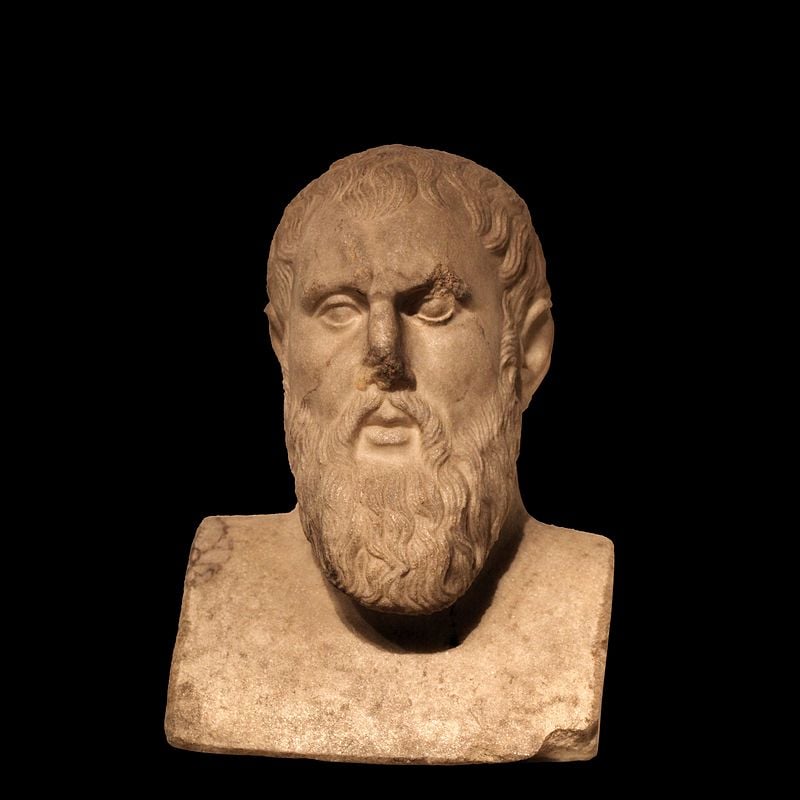
A bust of ancient Greece’s philosopher Zeno of Citium, the creator of stoicism. Credit: Rama/Wikimedia Commons/ Gallo-Roman Museum of Lyon
Stoic Philosophy
According to Stoicism, the path to eudaimonia (happiness) is embracing and accepting the moment as it presents itself by not allowing oneself to be controlled by the desire for pleasure or by the fear of pain.
The Stoic must use his or her mind to understand the world and to do one’s part in nature’s plan by working together and treating others fairly and justly.
The Stoics are especially known for the teaching “virtue is the only good” and that people must lead a virtuous life to be accomplished and complete human beings.
External things—such as health, wealth, and pleasure—are not good or bad in and of themselves but have value as “material for virtue to act upon.”
The Stoics also held that certain destructive emotions, such as fear or jealousy, resulted from errors of judgment, and they believed people should aim to maintain a prohairesis (will) that is “in accordance with nature.”
To live a good life, a person had to understand the rules of the natural order, Stoics believed, since everything was rooted in nature.
For many Stoics, virtue is sufficient for happiness. Thus, a sage would be emotionally resilient to misfortune and would therefore be considered truly free.
According to Stoics, people don’t truly have control over many things and situations in life. Therefore, they believe that worrying about things outside of their control is unproductive, or even irrational for a person who wants to attain tranquility and happiness.
Stoics differentiate between what is and what is not under human control and do not waste energy and thoughts over uncontrollable adverse events.
Where many people worry endlessly about things out of their control, the Stoics believe they should expend their energy in thinking of creative solutions to problems, rather than the issues themselves.
Stoicism is not about having a set of beliefs or ethical claims. It is not a school of philosophy that is separate from everyday life.
The stoic must continuously practice and train (“askesis”). Stoic philosophical and spiritual practices include logic, Socratic dialogue and self-dialogue.
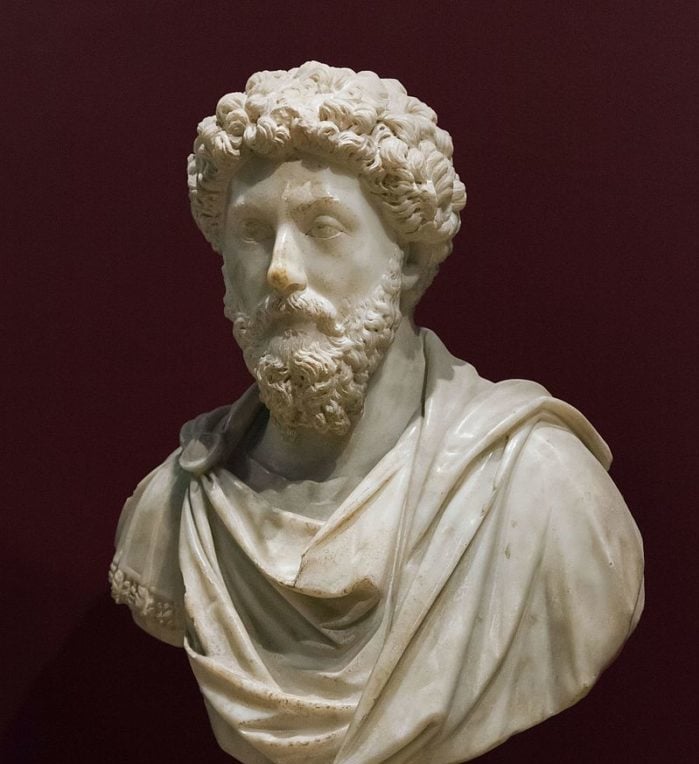
Roman emperor and philosopher Marcus Aurelius. Credit: Eric Gaba/Wikipedia
The Greek term for word is logos. The Greek philosopher Heraclitus used logos (the word) to explain what he saw as the universal force of reason that governed everything.
In the 5th century BC, Heraclitus said that all things happen according to the Logos. The Stoics also believed in the Logos, along with the notions of conscience and virtue.
A few centuries later, Greek-speaking Jews came to view the Logos as a force sent by God. In the Gospel of John, Jesus is referred to as the Word — “and the Word of God was made flesh and dwelt among men.”
The apostle Paul is known to have met with Stoics during his stay in Athens. In his letters, Paul reflected on his knowledge of Stoic philosophy, using Stoic terms and metaphors to assist new converts in their understanding of Christianity.
Both Stoicism and Christianity teach a person the importance of training their mind and body to be disciplined.
Both encourage the elimination of passions and inferior emotions, such as lust and envy, from one’s life, so that the higher possibilities of one’s humanity can be awakened and developed.
“If you want to be perfect, go, sell your possessions and give to the poor, and you will have treasure in heaven,” Jesus preached.
Similarly, as Seneca wrote, “We must give up many things to which we are addicted, considering them to be good.”
The Eastern Orthodox Church and Oriental Orthodox Church accept the Stoic ideal of dispassion to this day, as do ascetics all over the world.
Stoicism today
Daily Stoic, How to be a Stoic, The Modern Times Stoic, Modern Stoicism, Traditional Stoicism: these are only a handful of the websites that hail the importance of—even the need for—Stoicism in the 21st century.
Is it possible, though, for today’s man to embrace a philosophy that teaches indifference to material things and possessions in a ruthlessly material world?
An intellectual and popular movement called Modern Stoicism began at the end of the 20th century which is aimed at reviving the practice of Stoicism.
However, before that, Stoic philosophy served as the original philosophical inspiration for modern cognitive psychotherapy, particularly as mediated by Dr. Albert Ellis’ Rational-Emotive Behavior Therapy (REBT), the major precursor of Cognitive Behavioral Therapy (CBT).
In the original cognitive therapy treatment manual for depression by Aaron T. Beck et al., it is stated, “The philosophical origins of cognitive therapy can be traced back to the Stoic philosophers.”
A well-known quotation from the “Enchiridion” of Epictetus was taught to most clients during the initial session by Ellis and his followers: “It’s not the events that upset us, but our judgments about the events.”
This subsequently became a common element in the socialization phase of many other approaches to CBT.
Ryan Holiday’s The Obstacle is the Way; Stoicism—A Stoic Approach to Modern Life, by Tom Miles; Modern Stoicism, by Steve Brooks; and Modern Stoicism—How to Be a Stoic in the 21st Century, by Stephen Ryan are some of the books on Stoicism that have been published recently.
Famous Stoic quotes
“The happiness of your life depends upon the quality of your thoughts.”
“Luck is what happens when preparation meets opportunity.”
“You have power over your mind—not outside events. Realize this, and you will find strength.”
“It is not death that a man should fear, but he should fear never beginning to live.”
“Think of yourself as dead. You have lived your life. Now take what’s left and live it properly.”
“To live a good life; we all have the potential for it, if we learn to be indifferent to what makes no difference.”
“Death smiles at us all, but all a man can do is smile back.”
“Accept whatever comes to you woven in the pattern of your destiny, for what could more aptly fit your needs?”
“The object of life is not to be on the side of the majority, but to escape finding oneself in the ranks of the insane.”
“The best revenge is not to be like your enemy.”
“Very little is needed to make a happy life; it is all within yourself, in your way of thinking.”
“Loss is nothing else but change, and change is nature’s delight.”
“It is not because things are difficult that we don’t dare; it is because we do not dare that things are difficult.”
“A gem cannot be polished without friction, nor a man perfected without trials.”
“The bravest sight in the world is to see a man struggling against adversity.”
“Throw me to the wolves and I will return leading the pack.”
“Life is never incomplete if it is an honorable one. At whatever point you leave life, if you leave it in the right way, it is whole.”
“Man is affected not by events, but by the view he takes of them.”
“Sometimes even to live is an act of courage.”
“If you really want to escape the things that harass you, what you’re needing is not to be in a different place but to be a different person.”
“He suffers more than necessary, who suffers before it is necessary.”
“It is not the man who has too little, but the man who craves more, that is poor.”
“If a man knows not to which port he sails, no wind is favorable.”
“If you want to improve, be content to be foolish and stupid.”
“The world turns aside to let any man pass who knows where he is going.”
“Seek not the good in eternal things, seek it in yourselves.”
“It is the nature of the wise to resist pleasures, but the foolish to be a slave to them.”
“No man is free who is not a master of himself.”
“It is impossible to begin to learn that which one thinks one already knows.”
“Never depend on the admiration of others. There is no strength in it. Personal merit cannot be derived from an external source.”

 Login
Login