
Reading view

Ctesibius: The Ancient Greek Tech Genius You’ve Never Heard Of

Ctesibius
A digital representation of Ctesibius. Credit: Greek Reporter archive

Ever found yourself scratching your head, wondering if aside from legendary philosophers and epic poets there were also any “tech gurus” in ancient Greece? When the conversation turns to Greek scientific minds, one might think of figures like Archimedes and Euclid and rightly so. However, there’s a name that truly deserves a much brighter spotlight—that of Ctesibius.

Ctesibius was a true genius of Hellenistic Alexandria, who, quite literally, set the wheels (and yes, the water organ, or hydraulis!) in motion. Due to his brilliant mind, he laid down fundamental principles for technologies that, believe it or not, continue to shape our everyday world to this very day.

Ctesibius was one of ancient Greece’s greatest innovators

Born into the vibrant, intellectual epicenter of Alexandria during the Ptolemaic era, Ctesibius became a hands-on inventor, driven by an almost insatiable curiosity to truly understand and harness the raw power of the natural world.

Imagine at a time when entire civilizations relied on human muscle and simple machines, seeing someone create music from water or build a clock accurate for two thousand years. The sheer innovative audacity of Ctesibius was difficult to fathom.

Of course, at a time of wizards, this wasn’t a magic trick but the real, unadulterated brilliance of the mind of this Greek man. His groundbreaking contributions to pneumatics, the study of compressed air, and hydraulics, the science of liquids in motion, were utterly revolutionary for their time, making Ctesibius the “father of pneumatics.”

Just think about the fact that long before your car tires ever saw a pump or your pneumatic drill came to life, Ctesibius meticulously explored the very principles that made these tools possible. It’s a bit humbling, isn’t it, how many unsung heroes from antiquity have genuinely shaped the modern world we so often take for granted?

Reconstruction of the ancient Greek hydraulis, the first keyboard instrument, displayed at the Kotsanas Museum of Ancient Greek Technology in Athens, displaying its pipes, water basin, and control mechanisms.
Reconstruction of the ancient hydraulis on display at the Kotsanas Museum in Athens. Credit: Aga39memnon, Wikimedia Commons, CC BY 4.0.

From melodic water organs to clocks

Among Ctesibius’ most well-known creations was the hydraulis, a genuinely revolutionary water organ. This was, quite simply, the world’s very first keyboard instrument. What an astonishing feat of engineering from over two millennia ago! It ingeniously utilized water pressure to guarantee a completely constant supply of air to its pipes, producing a sound that was remarkably stable and resonant. Imagine the awe of ancient audiences in hearing such a complex, melodic instrument for the absolute first time. It must have felt like nothing short of a miracle.

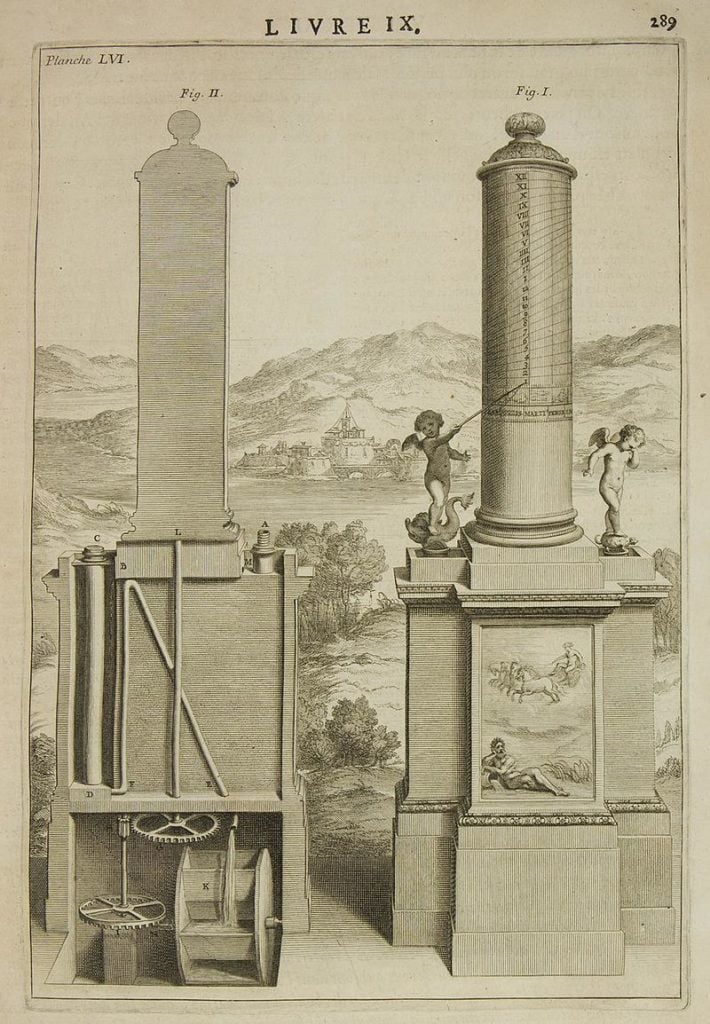
Beyond the enchanting music, Ctesibius’ improvements to the clepsydra, or water clock, were equally impressive. Prior to this tech guru, water clocks were notoriously imprecise. He revolutionized them through innovative mechanisms for regulating water flow and added an indicator system that provided unprecedented accuracy.

For over 1,800 years, his water clocks were the absolute gold standard in timekeeping. In other words, the pinpoint accuracy of your smartphone’s clock owes an indirect yet profoundly deep debt to a man who lived centuries before the mere concept of electricity was even a thing.
ancient greek inventions
Ctesibius’ water clock, the first alarm clock ever, as depicted by an architect in the 17th century. Credit: Wikimedia Commons, Public domain

Ctesibius’ impact on our world

While Ctesibius himself may not have managed to become one of ancient Greece’s top names, his principles and inventions survived the test of time. They influenced later Roman and Arab engineers and eventually powered the European Renaissance. The very force pump he designed, for instance, is a direct progenitor of modern pumping systems, absolutely essential for everything from our city water supplies to the fire engines we rely on to keep us safe on a daily basis.

His profound understanding of the properties of air-laid processes set the foundation for all future pneumatic applications which today power everything from colossal industrial machinery to delicate medical devices. Hence, next time you hear the satisfying whoosh of a bus door, the gentle hiss of an automated machine, or simply admire the quiet precision of a modern watch, take a moment to think back to Ctesibius, the ancient Greek tech genius.


  •  

Os Millennials: das disquetes à Cloud | Por Anna Kosmider Leal

A geração dos millennials, aqueles que nasceram entre o principio dos anos 80 e a chegada aos anos 2000, encontra-se numa posição única e, muitas vezes, desafiadora. Eles são os intermediários entre dois mundos: o tradicional, marcado por valores e realidades pré-digitais, e o digital, onde a informação flui a uma velocidade vertiginosa. Este fenómeno, acrescido ao facto de ser a “geração sandwich” atual, carrega consigo uma série de responsabilidades e pressões que podem impactar profundamente o seu bem-estar psicológico.

Dupla Exposição: O Conflito de Gerações

Na Antropologia, o conceito de “transição cultural” é fundamental para entender como as sociedades evoluem e se adaptam. Os millennials são, de certa forma, os arautos desta transição, vivendo num espaço onde as expectativas dos pais em relação ao sucesso e à estabilidade financeira se confrontam com a realidade incerta do mundo digital. Enquanto os seus pais, maioritariamente da geração X ou Baby Boomers, valorizam a segurança no emprego e a vida familiar convencional, os millennials são frequentemente empurrados para o empreendedorismo, a flexibilidade e a inovação. Esta discrepância gera um dilema: como equilibrar as expectativas familiares com as novas oportunidades e desafios que a era digital proporciona?

ANNA KOSMIDER LEAL
Antropóloga

A sobrecarga de informações é outra pressão significativa. Com acesso a um mundo de dados e opiniões a um clique de distância, os millennials enfrentam uma avalanche de perspectivas que podem ser confusas e contraditórias. Isso gera um estado de paralisia decisional, onde a dificuldade em escolher um caminho se torna um fardo emocional. A constante comparação com os outros, amplificada pelas redes sociais, pode levar a sentimentos de inadequação e ansiedade, criando um ciclo vicioso que afeta a saúde mental.

Sabedoria de Duas Realidades

Apesar dos desafios, a geração millennials também possui um rico capital cultural. Crescendo em dois mundos, eles desenvolvem uma perspetiva única que combina a sabedoria das tradições com a inovação da era digital. Esta habilidade de transitar entre diferentes realidades permite que os millennials sejam mais adaptáveis e resilientes, características valiosas num mundo em constante mudança. Eles aprendem a navegar em ambientes complexos, conciliando o que aprenderam com os seus pais, com as novas práticas e tecnologias que emergem.

Além disso, a experiência de ser a “geração sanduíche” pode também fortalecer laços familiares. Os millennials encontram-se, frequentemente, a cuidar não apenas dos seus filhos, mas também dos seus pais, criando uma dinâmica de apoio mútuo que pode ser enriquecedora. Este papel de mediador entre gerações pode fomentar um diálogo intergeracional que enriquece ambos os lados, promovendo uma compreensão mais profunda das necessidades e desafios de cada grupo.

Consequências Psicológicas e a Necessidade de Apoio

Entretanto, a pressão persistente pode levar a consequências psicológicas significativas. O burnout, a ansiedade e a depressão são problemas que afetam muitos millennials, resultantes da tensão constante entre as expectativas familiares e as realidades do mundo moderno. É crucial que haja uma maior compreensão e apoio, tanto a nível familiar como comunitário, para que esta geração possa encontrar um equilíbrio saudável.

Os millennials têm uma oportunidade única de moldar o futuro, aproveitando a riqueza das suas experiências. Ao aprenderem a integrar as lições do passado com as inovações do presente, podem construir um caminho que não só honra as tradições, mas também acolhe a mudança. A chave está em reconhecer que, mesmo sob pressão, a sabedoria de duas realidades pode ser uma força poderosa para a criação de um futuro mais inclusivo e sustentável.

Em última análise, os millennials devem ser vistos não apenas como a “geração sanduíche” e intermediaria do analógico para o digital, mas também como os arquitetos de uma nova era, onde a convergência de mundos pode gerar um inimaginável potencial.

Nota: A propósito, esta imagem foi gerada por IA.

Leia também: A justiça do polegar levantado | Por Anna Kosmider Leal

  •  
❌