Reading view

Tunisie: une migrante menacée de viol collectif sur les réseaux sur les réseaux

En Tunisie, la diffusion sur les réseaux sociaux d'une femme migrante tunisienne subsaharienne, dénudée de force devant sa famille et menacée de viol collectif par des Tunisiens a suscité l'indignation sur les réseaux sociaux. La vidéo n'a pas été encore authentifiée ou commentée par les autorités mais un journaliste tunisien a réussi à localiser l'un des agresseurs.

  •  

Google compra la potenza dell’IA: maxi accordo da oltre 30 miliardi con SpaceX

La corsa globale alla potenza di calcolo per l’intelligenza artificiale aggiunge un nuovo capitolo miliardario. A pochi giorni dalla sua quotazione in Borsa, SpaceX ha annunciato un accordo di dimensioni eccezionali con Google per la fornitura di capacità computazionale destinata ai sistemi di intelligenza artificiale e ai servizi cloud.

Secondo quanto emerge da documenti finanziari resi pubblici oggi, la società di Elon Musk metterà a disposizione del colosso di Mountain View una infrastruttura composta da circa 110.000 Gpu prodotte da NVIDIA, oltre a Cpu, memoria e altri componenti necessari all’elaborazione avanzata dei dati.

L’intesa prevede che Google versi a SpaceX circa 920 milioni di dollari al mese a partire da ottobre 2026 fino a giugno 2029. Nell’arco dell’intero contratto, il valore complessivo dell’accordo supera i 30 miliardi di dollari, confermandosi tra i più rilevanti mai siglati nel settore delle infrastrutture per l’intelligenza artificiale.

L’operazione testimonia come il vero collo di bottiglia della rivoluzione dell’IA non sia più soltanto lo sviluppo di modelli sempre più sofisticati, ma la disponibilità di enormi quantità di potenza di calcolo. Le Gpu Nvidia, considerate lo standard di riferimento per l’addestramento e l’esecuzione dei modelli di intelligenza artificiale generativa, sono diventate una risorsa strategica per le grandi aziende tecnologiche.

La domanda di capacità computazionale è infatti cresciuta a ritmi senza precedenti. Le principali società statunitensi stanno investendo centinaia di miliardi di dollari nella costruzione o nell’affitto di data center specializzati, indispensabili per sostenere chatbot, assistenti virtuali, sistemi di ricerca avanzata e applicazioni aziendali basate sull’intelligenza artificiale.

L’accordo tra SpaceX e Google si inserisce proprio in questa competizione. Il mese scorso anche Anthropic, una delle principali aziende americane attive nell’IA generativa, aveva annunciato un maxi contratto con SpaceX per l’utilizzo di uno dei suoi principali data center.

Per SpaceX, tradizionalmente associata alle attività spaziali, ai lanci orbitali e alla rete satellitare Starlink, il contratto rappresenta anche la conferma della crescente diversificazione del business verso il mercato delle infrastrutture digitali. Per Google, invece, l’intesa garantisce accesso a una riserva di capacità computazionale fondamentale per sostenere la competizione con rivali come Microsoft, Amazon e Meta nella corsa all’intelligenza artificiale.

La battaglia tecnologica si gioca ormai sempre meno sugli algoritmi e sempre più sulla disponibilità di energia, chip e data center. E il maxi accordo tra Google e SpaceX ne è una delle dimostrazioni più evidenti.

L'articolo Google compra la potenza dell’IA: maxi accordo da oltre 30 miliardi con SpaceX proviene da Il Fatto Quotidiano.

  •  

How Roman Emperor Julian Fought Christianity to Save the Ancient Greek Gods

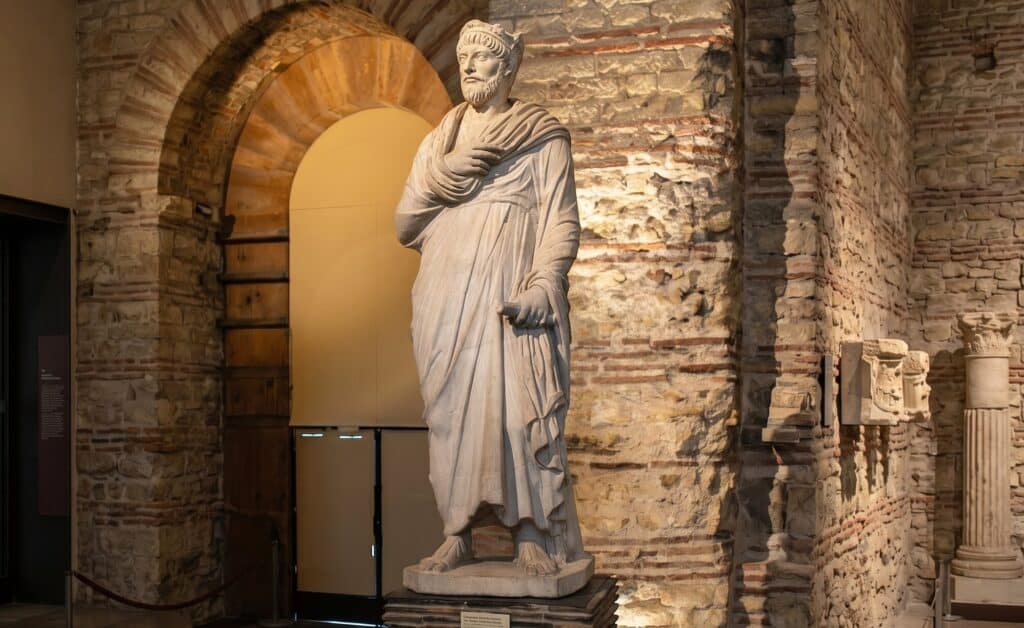
A full-length marble statue of a bearded man draped in a traditional Roman cloak and holding a scroll stands within a stone gallery.
The depiction of Julian in this classical guise shows his commitment to Neoplatonism and Greek culture over the rapidly spreading Christian faith. Credit: Ash Crow, Wikimedia Commons, CC BY-SA 4.0

Few figures in late antiquity present as compelling a historical debate as Julian the Apostate’s attempt to restore the Greek gods in opposition to Christianity in the Roman Empire.

During his brief but highly consequential reign in the fourth century AD, the Roman Empire stood at a profound religious crossroads. For a short period, Julian attempted to slow the empire’s accelerating Christianization, launching a sweeping effort to revive the ancient Olympian pantheon and return Rome to its traditional pagan practices. His sudden death on the battlefield has led historians to debate how dramatically the cultural trajectory of Western civilization might have shifted had his reforms endured.

Julian was born into the heart of the Constantinian dynasty, a family that had only recently converted to Christianity. Nonetheless, he became the last Roman emperor to openly support and worship the traditional Greek gods. He ruled for only about two years from 361 to 363 AD, but he acted with urgency and purpose. Julian the Apostate initiated an extensive program of philosophical and religious reform, aiming to reverse the Christian expansion advanced by his predecessors. To the growing Christian population, he was seen as a traitor to the new religious order, but to those who still admired the intellectual and cultural legacy of the classical world, he appeared as a philosopher-king attempting to restore an older vision of Rome.

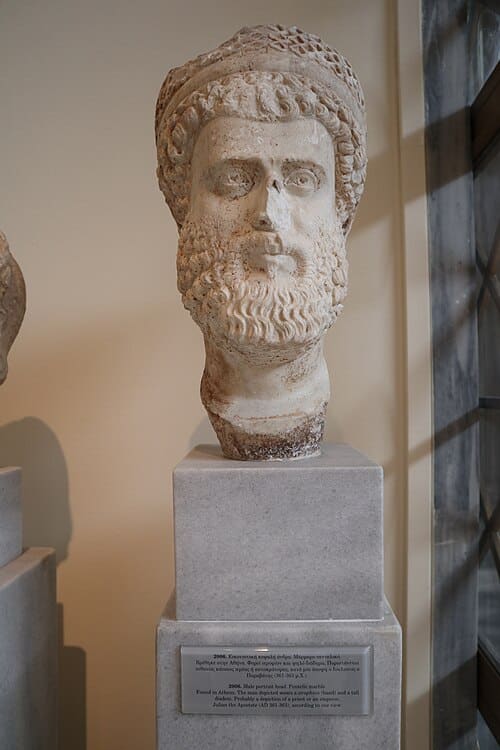
A sculpted marble portrait head of a bearded man wearing a diadem rests upon a stone pedestal inside a museum.
This marble head from Athens is widely believed to be a rare surviving portrait of the Roman Emperor Julian the Apostate. Credit: George Koronaios, Wikimedia Commons, CC BY-SA 4.0

Julian the Apostate’s early life

Julian did not experience the typical sheltered upbringing of an imperial heir. He grew up constantly looking over his shoulder, surviving political purges that eliminated many members of his own family. Although he was raised in a strict Christian environment under the supervision of powerful bishops, he is often understood to have developed a private intellectual attraction to classical texts and traditions associated with the ancient world.

His life took a decisive turn when he went to study in Athens. There, he was secretly initiated into the Eleusinian Mysteries, an experience that deeply shaped his philosophical outlook and strengthened his commitment to rejecting Christianity in favor of Neoplatonism. This forced dual existence helped form a uniquely strategic mindset. He became familiar with the inner workings of the Church, knowledge he later leveraged in support of his own religious and philosophical aims. By the time his troops in Gaul unexpectedly proclaimed him emperor, Julian was convinced that the gods themselves had chosen him to restore the ancient order.

Julian the Apostate as Emperor and the worship of the Ancient Greek gods in the Roman Empire

When he finally took power, Julian did not launch the kind of widespread, violent persecutions often associated with earlier periods of religious conflict. Instead, he pursued a more calculated cultural strategy. His approach focused on weakening Christian influence within imperial institutions while strengthening traditional religious structures. Julian the Apostate reduced the privileges and state support enjoyed by Christian clergy and redirected resources and prestige toward the priesthood of the traditional Greco-Roman religion centered on the Greek gods.

In a particularly controversial move, he restricted Christians from teaching classical literature. His reasoning was that those who rejected the traditional religious framework of Homer and Hesiod should not profit from instructing it. At the same time, Julian sought to make traditional religion more socially competitive by encouraging pagan priests to adopt public charitable functions, including aid for the poor and the establishment of hospitals—areas in which Christianity had been especially successful in gaining support. He appears to have believed that traditional worship had declined not because of its inherent weakness but because its institutions had failed to match the organizational and charitable presence of Christianity.

In practice, many historians argue that this cultural and intellectual strategy posed a different kind of challenge to early Christianity than outright violence. While persecution could strengthen Christian identity through martyr narratives, Julian the Apostate’s policies instead aimed to limit the social structures that supported its continued expansion while restoring the worship of the Ancient Greek gods within the broader Greco-Roman religious tradition.

A weathered page from an illuminated manuscript features three stacked, colorful panels showing medieval figures in royal and religious garments amidst dramatic interactions.
This illuminated manuscript page depicts vivid scenes of Emperor Julian ordering the arrest of a Christian bishop and overseeing acts of persecution. Credit: Wikimedia Commons, Public Domain

Unfortunately for his beliefs, that grand vision of such a revived Greco-Roman empire came to an abrupt end in the arid regions of Persia. During a military campaign, Julian was struck in the side by a spear, cutting his reign tragically short. Ancient sources and later traditions continue to debate the circumstances of his death, with some attributing the blow to a Persian soldier and others speculating—without evidence—that it may have come from within his own ranks. The true origin remains uncertain.

A well-known tradition holds that, as he lay dying, Julian the Apostate is said to have declared, “Thou hast conquered, O Galilean,” acknowledging the perceived triumph of Christianity. Whether or not he actually spoke these words, his brief reign left a lasting imprint on Roman and Western history. His efforts to restore the Ancient Greek gods within the Roman world continue to be discussed by historians as a striking moment in the empire’s religious transformation. Even in modern Greek cultural memory, echoes of this tension can still be felt in the broader contrast between the rational legacy of ancient philosophy and the spiritual tradition of Orthodox Christianity.

  •  

Loulé | Este sábado, a Câmara Municipal deixa o convite: “Bora Lá ao Parque”

Amanhã, sábado, dia 6 de junho, entre as 10h00 e as 17h00, o Parque Municipal de Loulé recebe mais uma edição do “Bora Lá ao Parque”. Numa iniciativa do Município de Loulé, e com a forte participação de parceiros locais, o evento, de entrada livre, oferece dezenas de atividades gratuitas, incluindo cultura, desporto, oficinas e […]

  •  

Esta praia secreta do Algarve está escondida entre arribas e “parece saída de um filme”

Há praias no Algarve que dispensam grandes apresentações. Outras, pelo contrário, parecem existir quase em segredo, escondidas entre arribas, acessíveis apenas a quem aceita caminhar, procurar e respeitar os limites impostos pela natureza.

É o caso da Praia do Ninho de Andorinha, uma pequena enseada situada na zona de Albufeira, entre a Praia de São Rafael e a Praia da Coelha. De acordo com o Algarve Marafado, o local impressiona pelo enquadramento natural, pelo areal reduzido e pela forma como o mar entra através de um arco e de um túnel natural escavado na rocha.

Uma caminhada entre arribas

O acesso pode ser feito a partir da Praia de São Rafael, seguindo um trilho pelas arribas em direção a poente. Pelo caminho, a paisagem oferece vistas amplas sobre o litoral, com o azul do mar a contrastar com os tons dourados e ocres das formações rochosas. Outra possibilidade é começar a caminhada na Praia da Coelha. Em ambos os casos, o percurso exige atenção, sobretudo em zonas mais irregulares ou próximas das arribas.

Segundo o Algarve Marafado, há partes do trilho que apresentam alguma dificuldade. Por isso, a visita deve ser feita com calçado adequado, tempo disponível e cuidado redobrado, evitando aproximações perigosas à beira das falésias.

Uma praia pequena e bem escondida

A Praia do Ninho de Andorinha não é uma praia ampla nem preparada para grandes multidões. Pelo contrário, é precisamente a sua dimensão reduzida e o acesso menos evidente que ajudam a manter o carácter mais reservado do local. O pequeno areal dourado fica praticamente cercado por arribas imponentes. Na maré cheia, a faixa de areia pode quase desaparecer, o que torna essencial consultar previamente a maré antes de tentar descer ou permanecer no local.

A singularidade da praia está também no túnel natural que permite a entrada da água do mar. O enquadramento cria um cenário visualmente marcante, muito procurado por quem gosta de fotografia, vídeos de viagem ou simplesmente de descobrir recantos menos óbvios do Algarve.

Acesso pode estar condicionado

Apesar da beleza do lugar, a visita exige prudência. Existe um trilho com degraus esculpidos que permite a descida até à praia, mas o acesso pode ser condicionado ou interditado pelas autoridades por razões de segurança. O risco de derrocada nas arribas é uma realidade em várias zonas do litoral algarvio. Por isso, qualquer sinalização existente no local deve ser respeitada, mesmo que a praia pareça acessível.

A recomendação é simples: antes de descer, confirme se o acesso está permitido e evite permanecer junto às arribas. Em zonas deste tipo, a beleza natural não elimina o risco associado à instabilidade das falésias.

Pelo mar, uma entrada alternativa

Muitos visitantes chegam à Praia do Ninho de Andorinha pelo mar, sobretudo em caiaque ou em pequenas embarcações. Esta opção permite atravessar o túnel natural quando as condições marítimas e a maré o permitem.

Ainda assim, também este acesso depende do estado do mar, da altura da maré e da experiência de quem se desloca. Em dias de ondulação mais forte, vento ou maré desfavorável, a aproximação pode tornar-se perigosa. Para quem não conhece a zona, o ideal é recorrer a operadores locais ou a visitas organizadas, que conheçam os horários, as condições do mar e as limitações do local.

Um recanto para ver com responsabilidade

A Praia do Ninho de Andorinha é um daqueles lugares que explicam por que razão o litoral algarvio continua a surpreender mesmo quem já o conhece bem. Não é uma praia para longas jornadas de toalha estendida, mas sim um recanto para observar, fotografar e visitar com cautela. O seu encanto está na combinação entre isolamento, rocha, mar e luz. Mas essa mesma fragilidade obriga a uma utilização responsável, sem lixo, sem ruído excessivo e sem desrespeito pela sinalização.

No fundo, esta praia escondida do Algarve “parece saída de um filme”, como refere o Algarve Marafado, precisamente porque não se entrega de imediato. Exige caminho, atenção e alguma paciência. Em troca, oferece um dos cenários mais inesperados da costa de Albufeira.

Leia também: Sul de Portugal vai ficar ‘à pinha’ no verão? Turismo do Algarve admite não ter subido preços

  •  

Escola Profissional de Cândido Guerreiro lança Formações Modulares em Regime Pós-Laboral

A Escola Profissional de Cândido Guerreiro anuncia a realização de um conjunto de formações modulares, com a duração de 25 horas cada, em regime pós-laboral, dirigidas à comunidade em geral. As ações formativas visam proporcionar oportunidades de aprendizagem flexíveis e acessíveis, conciliáveis com os horários profissionais e pessoais dos participantes. Com uma oferta diversificada e […]

  •  

Dia Mundial do Ambiente | Edifício-sede do Turismo do Algarve classificado com sistema AQUA+ da Adene

A ADENE entrega esta sexta-feira, Dia Mundial do Ambiente, a classificação AQUA+ ao edifício-sede do Turismo do Algarve, em Faro. Este referencial, desenvolvido pela ADENE para avaliar e classificar a eficiência hídrica de edifícios, identificou na sede do Turismo do Algarve um potencial de redução de consumo de 518 mil litros de água por ano, […]

  •  

New Pompeii Discovery Reveals Equine Skeleton in Ancient Bread-Making Workshop

The skeleton of an equine at ancient bread making complex in Pompeii
The skeleton of an equine at an ancient bread-making complex in Pompeii. Credit: Pompeii Archaeological Park

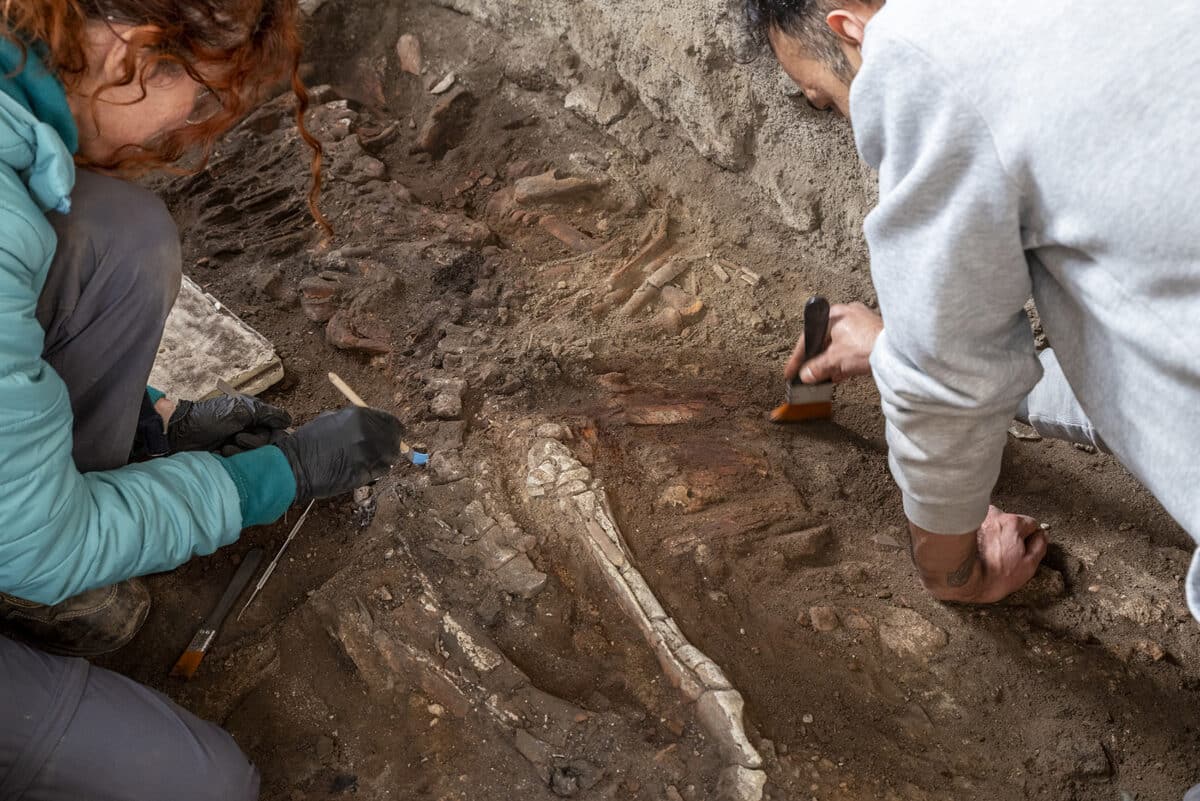
Archaeologists in Pompeii have uncovered an equine skeleton inside a bread-making workshop at one of the city’s most celebrated ancient complexes, opening a new chapter in the understanding of how humans and animals lived and worked together nearly 2,000 years ago.

The remains were discovered at the Insula of the Chaste Lovers, a large residential and commercial site renowned for its striking “chaste kiss” fresco, painted inside the dining room of the owner’s home.

The complex includes a working bakery, storage rooms, processing spaces, and the owner’s private residence. Researchers had previously found other equids at the site’s stables, where animals were used to power grain mills and transport the grain needed for bread production.

Pompeii’s chaste lovers complex was also a busy bakery

This latest skeleton was not found in the stables. Researchers found it in a separate room, suggesting the animal had fled there during the catastrophic eruption of Mount Vesuvius in 79 AD.

The excavation brought together archaeologists and specialists from the Applied Research Laboratory, including experts in animal remains, plant life, and human bones. This interdisciplinary approach has become one of the most important aspects of modern archaeological research at the site.

Archaeologists excavating the skeleton of an equine
Archaeologists are excavating the skeleton of an equine. Credit: Pompeii Archaeological Park

Laboratory analysis is still ongoing. Researchers expect it to reveal more about the animal’s specific role in the production complex and the conditions it faced during the eruption.

The study could also contribute to a wider understanding of how animals responded to the disaster in real time, adding detail to the reconstruction of those final, chaotic hours.

Pompeii equine skeleton suggests a desperate Vesuvius escape

Gabriel Zuchtriegel, director of the Pompeii Archaeological Park, said that Pompeii offers far more than beautiful frescoes and ancient objects.

He said it gives researchers the opportunity to understand lives that were ended by the eruption, and that this extends to animals as well as people. The horse or donkey, he noted, was found inside a house with remarkable frescoes that also served as a working mill and bakery.

Its location in a room away from the stables points to an attempt to escape the eruption. Zuchtriegel called the excavation a strong example of the daily multidisciplinary collaboration at the site and said ongoing lab results will continue to offer significant scientific value.

Pompeii continues to yield new layers of ancient life. The site preserves not just objects and artwork but the full texture of daily existence, including the bonds between people, animals, and the spaces they shared.

The equine skeleton discovered in Pompeii’s ancient bread workshop is the latest reminder that the city still holds stories waiting to be told.

  •  

10.ª edição da Revista Águas do Algarve!

É com satisfação que partilhamos convosco a 10ª edição da Revista Águas do Algarve. Nesta edição, refletimos sobre a nova relação do Algarve com a água num contexto de crescente imprevisibilidade climática. Ao longo de mais de 70 páginas, reunimos entrevistas, reportagens e artigos que abordam alguns dos temas mais relevantes para o futuro da região: a […]

  •  

Apresentação de livro “O cavaleiro Rui Valente” de Fernando Pessanha – em Castro Marim

A Comendadoria do Algarve do Grão‑Priorado de Portugal da Ordem Militar e Hospitalária de São Lázaro de Jerusalém anuncia a realização de uma sessão pública dedicada à apresentação da obra O Cavaleiro Rui Valente: um pirata e corsário de Faro, no Algarve do século XV, da autoria do historiador, Doutor Fernando Pessanha. O evento terá […]

  •  

Bombshell Broadcast: CIA Insiders Confirm Iran Has Nuclear Weapons! Head of Anthropic Calls For Global Pause On AI

Bombshell Broadcast: CIA Insiders Confirm Iran Has Nuclear Weapons! Head of Anthropic Calls For Global Pause On AI, Warns Humans Have Already LOST CONTROL! Plus, Netanyahu Brags He Wrote Section 224 of 2027 NDAA That Hands Control of Pentagon To Israel! https://t.co/TDZsqQx9IX — Alex Jones (@RealAlexJones) June 5, 2026
  •  

FDA Allows Public Comments on Moderna’s New mRNA Influenza ‘Pandemic’ Vaccine MFLUSIVA (mRNA-1010)

by Jon Fleetwood, Jon Fleetwood: MFLUSIVA triggers six times more severe reactions for less than 1% absolute benefit, Moderna scientists admitted last month in the New England Journal of Medicine. The U.S. Food and Drug Administration (FDA) has scheduled a June 18, 2026 advisory committee meeting to publicly review the “safety and effectiveness” of Moderna’s […]
  •  
❌