By 2030, water consumption linked to the use of artificial intelligence will be equivalent to that of 1.3 billion people in sub-Saharan Africa, while it will require nearly three times the annual energy consumption of Pakistan, Bangladesh and Nigeria — countries with a combined population of 650 million. In terms of carbon emissions, these could reach 400 million tonnes of CO₂ equivalent, comparable to the United Kingdom’s total emissions. The operation of AI will require 14,500 square kilometres of land, including infrastructure and supply chains — twice the size of the Jakarta metropolitan area, a megacity with more than 32 million inhabitants, or 10 times that of Mexico City (21 million).
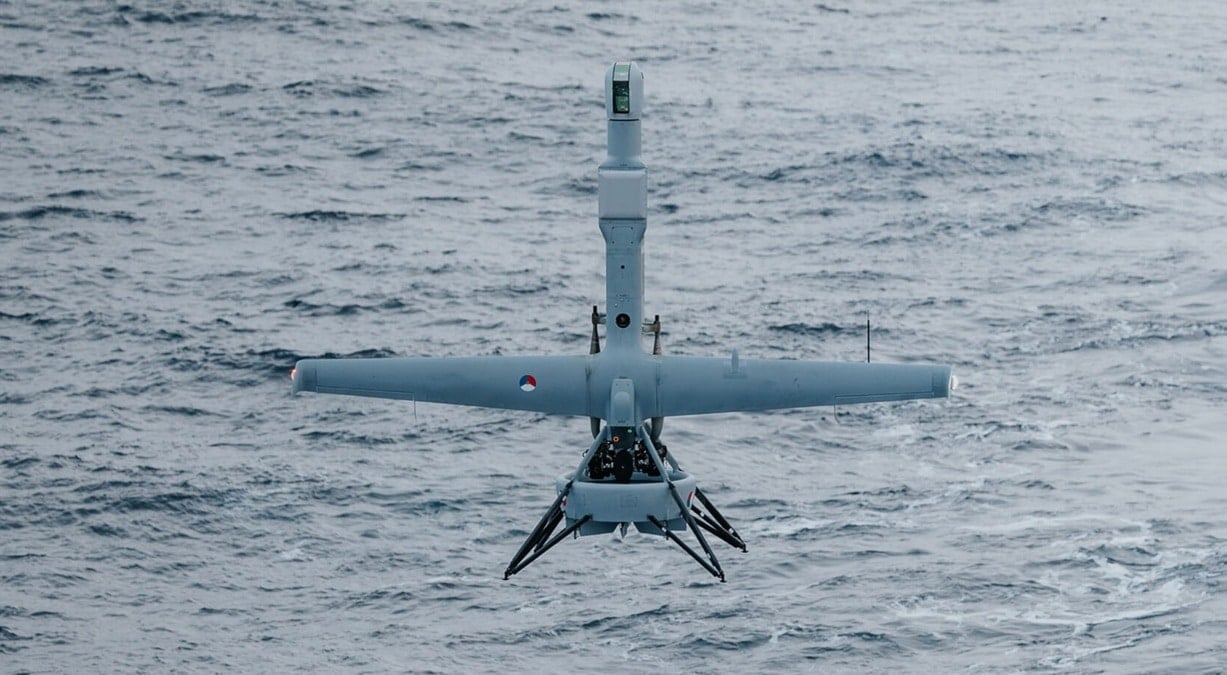
The V-BAT can launch from ship decks or small island clearings without a runway. Credit: Shield AI
Greece has signed an agreement to expand its fleet of Shield AI V-BAT unmanned aerial systems for maritime surveillance operations across the Aegean Sea, the American company announced June 2.
The deal deepens an existing partnership that has already seen the Hellenic Army deploy these advanced drones for intelligence and reconnaissance missions.
Concluded between Shield AI and the Hellenic Army, the agreement bolsters Greece’s existing V-BAT fleet. The company says that the agreement will enhance the nation’s capacity to maintain persistent situational awareness over hundreds of islands, remote coastlines, and contested maritime approaches.
Company says drone is ideal for Greece’s needs
The V-BAT can launch from ship decks or small island clearings without a runway, fly for over 12 hours on a single sortie, and operate seamlessly despite aggressive electronic warfare attempts to disrupt its navigation and communications.
“V-BAT is exceptionally well-suited for operations in Greece, where forces operate across dispersed islands, remote coastlines, deep valleys, mountain ranges, and complex maritime environments,” said James Lythgoe, Shield AI’s regional director for Eastern and Southeast Europe. “V-BAT has proven itself in combat operations in Ukraine, including in GPS- and communications-denied environments, and was built for exactly these kinds of operational realities.”
Combat-proven resilience
In Ukraine, the V-BAT has successfully operated amid intense Russian electronic warfare, where GPS signals are actively jammed and drone communications are disrupted. This proven resilience against satellite spoofing and signal jamming ensures the system remains operational against sophisticated adversaries, rather than falling out of the sky.
Classified as a NATO Class I unmanned aircraft (weighing under 330 pounds), the V-BAT acts as a highly tactical asset deployable by ground units and small naval vessels without requiring massive support infrastructure. Its twelve-hour flight endurance allows a single aircraft launched at dawn to maintain continuous coverage through the entire day. This enables crucial “pattern-of-life” analysis to reveal suspicious maritime activity.
By expanding its V-BAT fleet, the Hellenic military strengthens its layered early-warning architecture across the Aegean, giving commanders the vital reaction time needed to respond to maritime intrusions before situations escalate.

 Login
Login