Reading view

Molon Lave: The Ancient Greek Phrase of Defiance Turned Global Marketing Tool
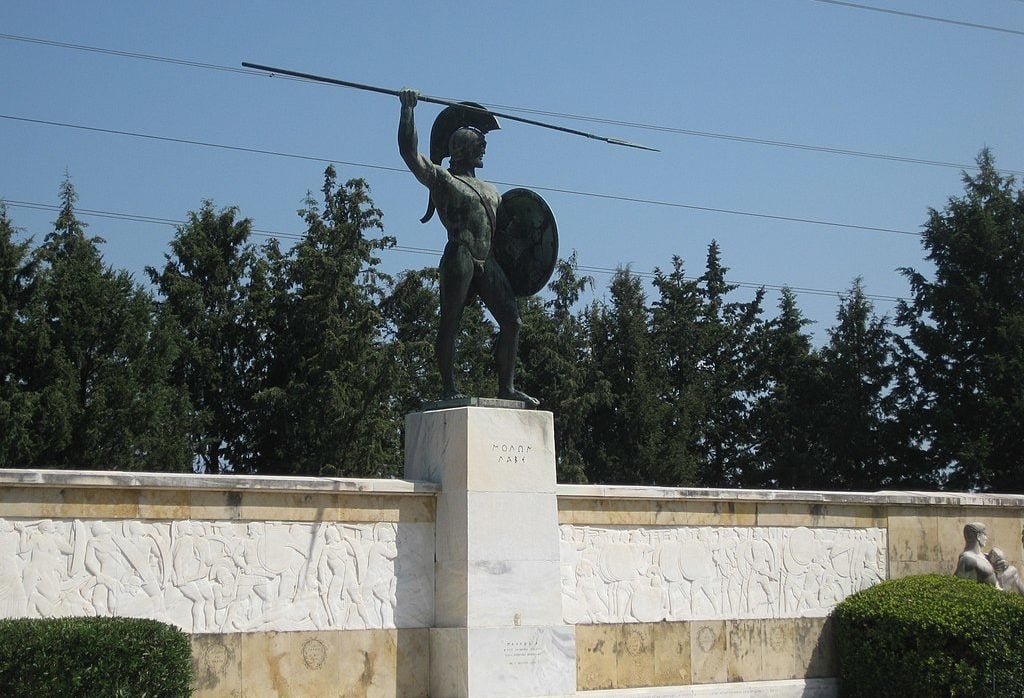
staue of Leonidas king of sparta
Statue of Leonidas of Sparta, Greece. Credit: Dmpexr/Wikimedia Commons/CC BY-SA 4.0

It was in 480 BC during the second Persian invasion of Greece, when King Leonidas of Sparta ahead of the legendary Battle of Thermopylae responded by the phrase “Molon Lave” (‘Come and Take Them’ in ancient Greek) to Persian King Xerxes’ demand that the Spartan army lay down their weapons and surrender to his army. The outnumbered Greeks were eventually annihilated, though they held Thermopylae for three days and inflicted serious damage to the Persians, while delaying them from reaching Athens.

That’s how the story ended back then. But little did King Leonidas know that over 2,500 years later, his “Molon Lave” phrase (also spelled “Molon Labe” by many) would not only become immortalized through the centuries but moreover, it would thrive as a global marketing tool -linked to the sale of weapons, wine, olive oil, expensive watches and even cigars.

King Leonidas I reigned the ancient city-state of Sparta, a warrior society, from 489 to 480 BC. Subjected to military drills since early manhood, the Spartans had become one of the most feared and formidable military forces in the ancient Greek world, attaining legendary status in their wars against Persia. At the height of Sparta’s power, between the 6th and 4th centuries BC, according to Peter Connolly, a British historian and the scholar of the ancient world, other Greeks commonly accepted that “one Spartan was worth several men of any other state.”

“The appeal of Molon Lave comes from its Spartan origins,” Effie Delimarkos-Fletcher, a Greek-American communications expert and marketing strategist tells Greek Reporter. “Spartans themselves have come to symbolize power, strength, resolve, and defiance, which was catapulted into the mainstream with the debut movie of ‘300.’ As a result, aligning with the phrase “Molon Lave” is a distinct way for a brand to signal strength and prowess in an area worth defending.”

Moreover, there are few other phrases like “Molon Lave,” where two single, short words are able to convey all that, perhaps the most famous military last stand of all time, embodies -defiance, strength and resolve. Spartans were expected to be men of few words, famous for using “laconic phrases,” named after Laconia, the region of Greece, including the city of Sparta, whose ancient inhabitants had a reputation for verbal austerity. A laconic phrase was used for efficiency (as during military training and operations), for emphasis or to deflate a pompous speaker.

Molon Lave marketing knife
The company has applied for and successfully registered the ‘Molon Lave’ brand in Greek, as seen on the handle of the knife. Credit: Panther Wholesale
Molon Lave marketing cigars
Another Florida-based company named “Molon Labe” is selling high-quality cigars, spirits and coffee, and as with most other businesses, is also using a Spartan helmet on its logo. Credit: Molon Labe Official Instagram Account

Military, the industry where Molon Lave has the largest appeal as a brand

From tactical patches and other military paraphernalia sold online, to assault rifles sold in stores across the United States, the phrase “Molon Lave” graces thousands of military-related products.

According to Delimarkos-Fletcher, Molon Lave and its English translation “Come and Take Them” has been present in the country’s early DNA as it is said to have been used as far back as the Revolutionary War. Even so, it is better known for its connection to the Texas Revolutionary War, when the phrase was stitched onto a flag that has come to be associated with the defiant spirit of the state. In more recent times, many U.S.-based militia groups and paramilitary organizations have taken the phrase “Molon Lave,” and often the depiction of a Spartan helmet, signaling defiance for gun regulations.

“Because Molon Lave has been adopted by militia-type groups in the United States, securing the Molon Lave trademark is done by companies looking to appeal to that target,” Delimarkos-Fletcher says.

And that’s exactly what at least one US.-based company had done. A short Greek Reporter investigation revealed that, while there are hundreds of knives and weapons with the phrase “Molon Lave” appearing on them in different variations, in 2015 this one company has gone as far as to apply for and successfully register a year later a trademark for the original Molon Lave phrase in Greek (ΜΟΛΩΝ ΛΑΒΕ) for one of its knives selection. The company, advertises the knives on its website by stating “It takes a bold individual to make a statement of defiance like ‘Come and Take Them (Molon Labe),’ we provide the knives that re-enforce the bravado.”

But can a company apply and secure a trademark for the use of a common, ancient phrase like Molon Lave, that seems almost free for anyone to use?

According to Pamela Koslyn, a Los Angeles-based attorney specializing in intellectual property law, U.S. legislation allows a company to successfully apply for a trademark for a brand new phrase, or an “ancient” phrase or an invented word/phrase, with the age and origin of the phrase being irrelevant.

“A trademark isn’t a monopoly on a phrase, it’s a source identifier of some phrase associated with some goods or services. Like knives. Or olive oil. Or wine. These are all actual “live or pending marks of Molon Lave…There’s also a Chinese textile seller called Molon Lave,” Koslyn tells Greek Reporter. “If a user has a registered trademark on a phrase in a particular class, e.g. knives, that means the user own the exclusive right to use their mark in association with their goods or services and can theoretically successfully sue and enjoin any competitor who infringes those rights by using the same or confusingly similar mark for the same or confusingly similar goods or services.”

Still, Koslyn notes, that one in two trademark applications to the United States Patent and Trademark Office (USPTO) fail not only because they’re not viable or available but moreover because of the complexity of the law and the time needed to find out if an application has been approved by USPTO -a process that could take months if not years.

Molon Lave marketing taverna
On its website, the restaurant says that it’s “based on the Spartan epic saying Molon Lave, which means ‘Come and Get Them,'” and has a mission “to celebrate and share Greek cuisine and culture.”Credit: Molon Lave Taverna Official Instagram Account

The famous ancient Greek phrase many want to own

But few actually register the phrase in order to enhance their branding or make their products stand out more. Given the enormous competition among companies to win the hearts of consumers, proper branding and marketing could mean the difference between life and death for a company. And given its global fame, that’s exactly what “Molon Lave” does.

Nowhere is this more obvious than in the United States, the beating heart of global consumerism. A family-owned farm winery in Virginia was established in 2009 under the name “Molon Lave.” Aside from informing its customers that it also produces “kokkineli,” a traditional Greek style rose, the winery fully explains on its website the origins of its name, noting that “‘Molon Lave’ is a phrase that has inspired throughout the centuries a sense of dignity and pride, and a unique perception of life.”

Another Florida-based company named “Molon Labe” is selling high-quality cigars, spirits and coffee, as with most other businesses, also using a Spartan helmet on its logo. Moreover, the cigars are wrapped in paper bearing the phrase in Greek. The company on its website gives no explanation as to why it chose the specific name.

Molon Lave marketing watches
A consumer browsing the handmade watches of the UK-based company. Credit: Greek Reporter

Greek Reporter’s investigation also found a watch company with the name “Molon Labe” based in the UK, selling handmade, military watches inspired by the phrase, with some having a price tag of over $1,500. There’s also a global security company named “Molon Lave,” an information technology service activity company in the UK and a gym in Cyprus, featuring on its premises the bust of a muscular Spartan soldier alongside the “Molon Lave” phrase, which is showcased in ancient Greek type. The list goes on.

With a fortitude reminiscent of the very people it once represented, the phrase “Molon Lave” survived to this day as one of the few expressions that so efficiently evoke an immediate connection not only to power but also to Greece.

It is no wonder the phrase has also been adopted as the name of a “small, Greek authentic restaurant” in Ontario, Canada, which on its website says that it’s “based on the Spartan epic saying Molon Lave, which means ‘Come and Get Them,'” and has a mission “to celebrate and share Greek cuisine and culture.”

At the same time, a thriving Greek olive oil brand named “Molon Lave” based in Sparta, the place where King Leonidas and his Spartan warriors once lived, is probably one of the more successful examples using the phrase as a marketing tool.

Delimarkos-Fletcher says many using the phrase may not even know its true origins so it is refreshing to see Greek-related businesses reclaiming Molon Lave as they “seek to evoke a connection to the best known story of Greek strength and prowess.”

“Other brands are just using ‘Molon Lave’ as shorthand for having something powerful enough that others want for their own,” Delimarkos-Fletcher tells Greek Reporter.


Molon Lave marketing wine
The winery explains on its website the origins of its name, noting that “‘Molon Lave’ is a phrase that has inspired throughout the centuries a sense of dignity and pride, and a unique perception of life.”Credit: Molon Lave Vineyards Official Instagram Account


  •  

Fincantieri premiata agli Italian Hydrogen Technology Awards 2026 per il progetto IPCEI Wave 2 The Future

Fincantieri protagonista agli Italian Hydrogen Technology Awards 2026 con il progetto IPCEI Wave 2 The Future

Fincantieri è stata premiata nell’ambito degli Italian Hydrogen Technology Awards 2026, assegnati in occasione di Hydrogen Expo, la manifestazione dedicata alle tecnologie per lo sviluppo della filiera dell’idrogeno tenutasi a Piacenza. Il riconoscimento è stato attribuito al Gruppo per il progetto IPCEI Wave 2 The Future, iniziativa considerata dalla giuria di carattere pionieristico per l’evoluzione della decarbonizzazione nel settore marittimo. Il premio conferma il ruolo di Fincantieri come protagonista dell’innovazione tecnologica e della sostenibilità nella cantieristica navale. Il progetto si inserisce infatti nel percorso strategico del Gruppo guidato dall’amministratore delegato Pierroberto Folgiero, orientato al raggiungimento dell’obiettivo net-zero entro il 2035.

IPCEI Wave 2 The Future punta allo sviluppo di sistemi di propulsione avanzati basati sull’idrogeno e su soluzioni ibride, con l’obiettivo di accelerare la transizione energetica del comparto navale. Tra le tecnologie previste figurano motori a combustione interna alimentati a idrogeno, fuel cell PEM abbinate a batterie al litio e sistemi di controllo energetico di nuova generazione. Il progetto comprende inoltre lo sviluppo di un ciclo combinato gas-vapore a idrogeno ad alta efficienza per la produzione elettrica. A queste soluzioni si affiancano sistemi innovativi di stoccaggio dell’idrogeno a bordo e l’integrazione di fuel cell PEM e SOFC, Solid Oxide Fuel Cell, ampliando ulteriormente la portata tecnologica dell’iniziativa.

Alcune delle tecnologie sviluppate nell’ambito del progetto trovano applicazione su Viking Libra, la prima nave da crociera a integrare un sistema containerizzato alimentato a idrogeno, la cui consegna è prevista alla fine di quest’anno. Su questa unità, l’idrogeno alimenta fuel cell PEM da 6 MW sviluppate da Isotta Fraschini Motori, società parte del Gruppo Fincantieri, e ottimizzate per il settore crocieristico. Il riconoscimento ottenuto agli Italian Hydrogen Technology Awards sottolinea dunque la capacità di Fincantieri di guidare l’innovazione della cantieristica navale verso una nuova generazione di navi a emissioni ridotte. Una strategia che unisce ricerca, sviluppo industriale e sostenibilità, confermando la visione del Gruppo nella costruzione del futuro del trasporto marittimo.

L'articolo Fincantieri premiata agli Italian Hydrogen Technology Awards 2026 per il progetto IPCEI Wave 2 The Future proviene da Affaritaliani.it.

  •  

400,000-Year-Old Cave in Israel Reveals Clues to Early Human Life

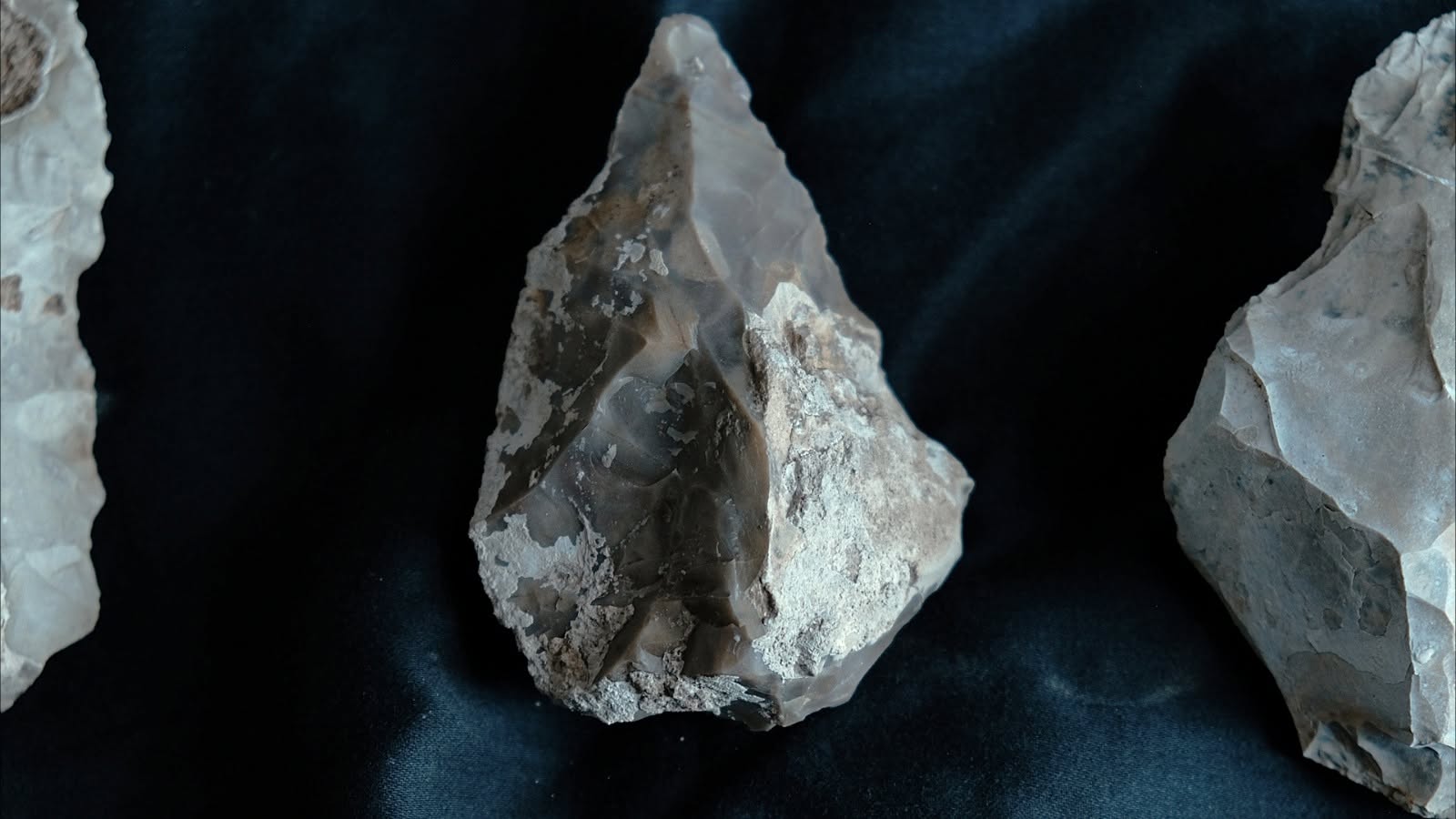
A stone handaxe from the Acheulo-Yabrudian period
A stone handaxe from the Acheulo-Yabrudian period. Credit: Israel Antiquities Authority

Archaeologists are excavating a prehistoric cave in northern Israel that could provide rare insights into early human life, how they adapted, and developed new technologies hundreds of thousands of years ago.

The cave was discovered on the outskirts of Fureidis, south of Haifa, near the Zichron Ya’acov interchange. The excavation is being led by the Israel Antiquities Authority (IAA) in partnership with researchers from the University of Haifa. Funding for the project is being provided by Ayalon Highways Company.

Researchers date the cave to between 250,000 and 400,000 years ago, placing it within the Acheulo-Yabrudian cultural complex, a group of prehistoric cultures that existed in the Levant during the final stages of the Lower Paleolithic period.

Exceptionally preserved prehistoric site

The site has drawn attention because of its exceptional state of preservation. “It is very rare to find a site in such a state of preservation,” said Dr. Kobi Vardi, head of the IAA’s Prehistory Branch and one of the excavation directors. “Every prehistorian who visits the site is absolutely thrilled.”

Vardi said the cave is comparable in importance to the famous Nahal Me’arot caves in northern Israel, which date to the same period. “The site, which is no less important than the well-known Nahal Me’arot site, and dates to the same period, will allow us to study in high resolution how humans lived at that time,” he said.

Excavations have already uncovered animal bones belonging to fallow deer, gazelles, and ancient horses. Researchers have also found evidence of a nearby water source, suggesting the area may have attracted prehistoric hunter-gatherer groups.

Clues to ancient technology and daily life

The Acheulo-Yabrudian culture is known for advanced stone-tool production. Archaeologists say people living during this period produced carefully crafted flint tools, including handaxes, scrapers, and blades. These technologies reflect an important stage in human development.

Researchers believe the cave may help answer key questions about a period that preceded the rise and spread of both Neanderthals and modern humans.

“We have been fortunate to excavate a unique site of global importance that has been protected from the ravages of time thanks to the exceptional conditions that existed here,” said Prof. Ron Shimelmitz of the University of Haifa.

“This time capsule belongs to a unique period at the end of the Lower Paleolithic era, just before Neanderthals and modern humans became dominant and spread across many regions,” he said.

Evidence of growing social complexity

According to Shimelmitz, the Acheulo-Yabrudian period marked a turning point in human evolution. Gradual changes in technology, social organization, and behavior began to emerge during this era, laying the foundations for more complex societies.

Researchers believe people started living in larger groups and spending longer periods at the same locations. Evidence from similar caves points to repeated use of fire and extended occupation, suggesting increasingly organized camp life and stronger social cooperation.

“These are findings that many researchers associate with the development of social cooperation and the transmission of knowledge, as part of the processes of human evolution,” Shimelmitz said.

Plans for future research

The IAA and the University of Haifa plan to launch a broader research program at the site. Researchers also hope the cave will eventually be opened to the public, allowing residents, students, and visitors to explore one of the region’s most important prehistoric discoveries.

  •  

22,000-Year-Old Jewelry Reveals Ice Age Social Networks in Spain

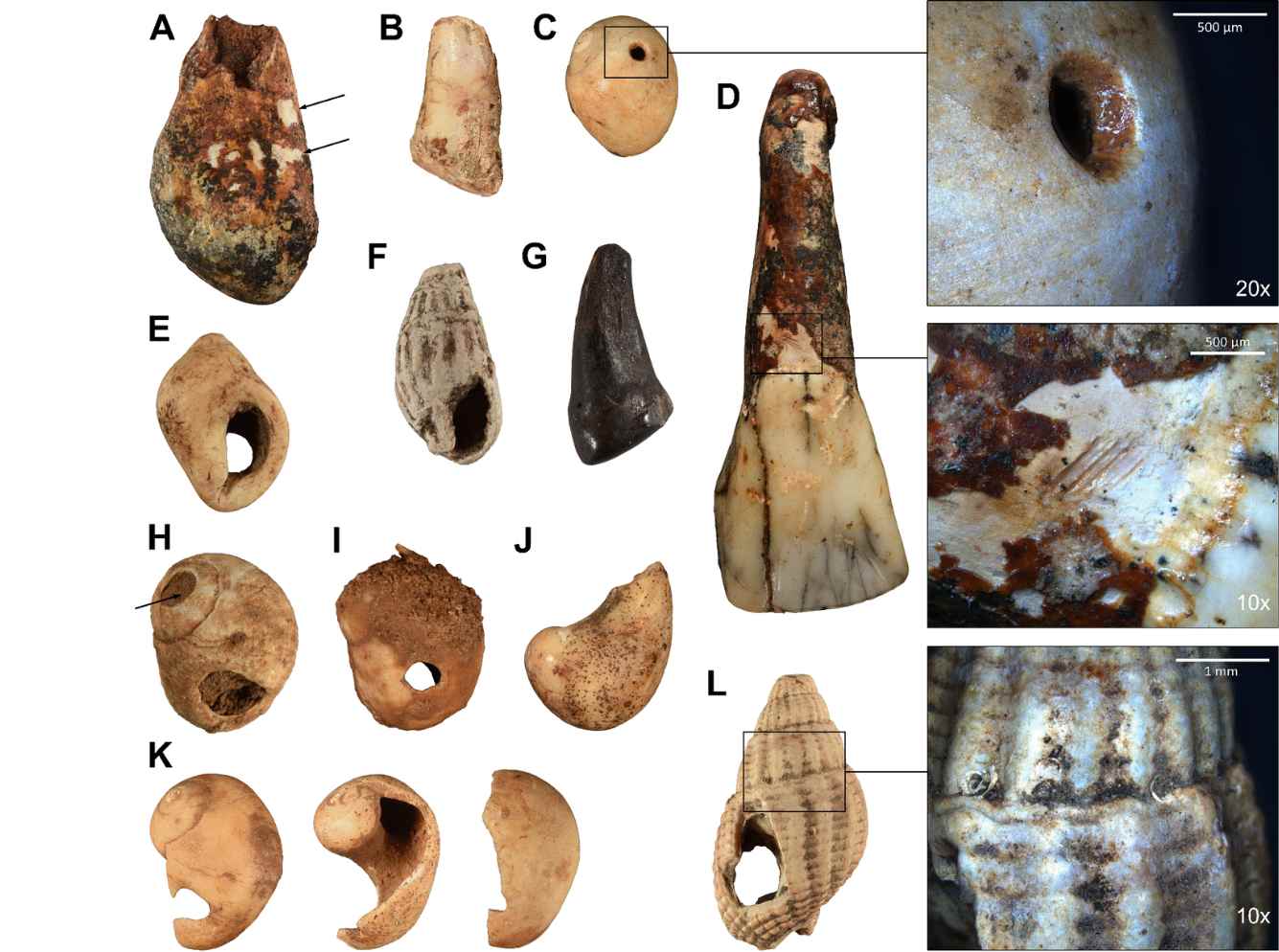
Selected personal ornaments from Llonín Cave in northern Spain
Selected personal ornaments from Llonín Cave in northern Spain. Credit: Daniel Pérez-García de los Salmones et al. / CC BY 4.0

A collection of 22,000-year-old jewelry discovered in northern Spain is offering new insights into how Ice Age hunter-gatherers expressed identity, exchanged ideas, and maintained social networks across vast distances.

Researchers found that people living in and around Llonín Cave used shells, animal teeth, bones, and even fossils to create personal ornaments over thousands of years, revealing changing patterns of social life during the Upper Paleolithic.

The study, led by Daniel Pérez-García de los Salmones and published in PLOS One, analyzed 271 ornaments recovered from Llonín Cave in northern Spain. The cave preserves a long archaeological sequence dating from roughly 23,500 to 11,000 years ago, covering several major cultural periods of the Late Ice Age.

A cave filled with symbolic objects

The ornaments included marine shells, red deer teeth, fish vertebrae, bone fragments, and a fossilized tube worm. Most were intentionally modified and worn as pendants or beads. Researchers identified at least 17 genera and 15 species used in their production. Marine shells made up the largest share of the collection, while red deer canine teeth were the most common animal-derived ornaments.

Microscopic analysis showed that many pieces had been worn for long periods. Friction from cords, clothing, or skin leaves polish marks, grooves, and rounded edges around perforations. More than 90% of the analyzed ornaments displayed signs of use.

A new study from Llonín Cave in northern Spain suggests Ice Age hunter-gatherers used shells, animal teeth, bones, and fossils to create ornaments that expressed identity, marked social ties, and connected communities across long distances.#Archaeology #IceAge #Jewelry #Spain pic.twitter.com/DXcBNuubUJ

— Tom Marvolo Riddle (@tom_riddle2025) June 9, 2026

Researchers also found evidence that some ornaments were made inside the cave. Unfinished deer tooth pendants and partially worked animal teeth suggest that people crafted jewelry on site rather than simply acquiring finished pieces from elsewhere.

Long-distance connections across Ice Age Iberia

One of the most striking discoveries involved shells that likely originated from the Mediterranean coast. The species Tritia mutabilis does not naturally occur along the Cantabrian coast of northern Spain, where Llonín Cave is located.

Its presence suggests that people exchanged objects or maintained contact networks stretching hundreds of kilometers across the Iberian Peninsula.

The cave occupied a strategic position between the Atlantic coast, the Ebro Valley, and routes leading toward the Pyrenees. Researchers argue that these pathways helped facilitate the movement of materials, ornaments, and cultural traditions between distant groups.

From individual identity to group identity

The study found that ornament styles changed over time. During the Upper Solutrean period, around 23,500 to 22,000 years ago, jewelry showed great diversity in materials, manufacturing methods, and designs. Researchers believe these ornaments likely served as markers of individual identity and personal expression.

Later, during the Middle Magdalenian period, ornament production became more standardized. Shell beads were more uniform in size and style, and many appear to have arrived at the cave already finished.

Researchers suggest that this shift reflects larger social gatherings where ornaments may have been used to signal group membership or strengthen alliances among different communities.

A window into Ice Age society

The findings suggest that personal ornaments were far more than decorative objects. They helped communicate identity, social relationships, and cultural connections during a time when hunter-gatherer groups were spread across changing Ice Age landscapes.

According to the researchers, Llonín Cave stands out as an important site for understanding how prehistoric people used jewelry to navigate both everyday life and wider social networks. The collection shows that even 22,000 years ago, people were connected through systems of exchange, shared traditions, and symbolic communication that stretched far beyond their local communities.

  •  

Flat steppe: Ukraine is strangling Crimea’s supply lines from air. Melitopol-Chonhar road is latest target

The Russian vehicles are burning on the route to Crimea. Source: The 3rd Separate Special Purpose Regiment

Ukrainian Special Operations Forces drone operators have established aerial control over part of the Russian land supply route from occupied Melitopol to Chonhar. The path is the entry point to Crimea, and they are destroying Russian equipment and disrupting Russian military logistics on the road, the 3rd Separate Special Purpose Regiment announces.

Russian forces on the peninsula already depend on a constrained set of supply lines: the Kerch Bridge (under sustained Ukrainian threat since 2022), the rail and road corridor through occupied Donetsk Oblast, and the Melitopol-Chonhar bottleneck. Ukrainian aerial denial of any one of these links compounds pressure on the others. 

Squeezing land corridor from both ends

The new operation puts pressure on the land corridor's western end. On 31 May, Mariupol residents reported in local group chats that Russia shut down part of its land corridor from Crimea to occupied Donetsk because of Ukrainian drones.

The Melitopol-Chonhar segment crosses flat steppe with limited cover and funnels Russian convoys through narrow bridge crossings over the Syvash to reach the peninsula, the terrain optimal for drone operators to deny the air with persistent surveillance and strike capability. 

SSO drones as the strangulation instrument

The 3rd Separate Special Purpose Regiment is one of Ukraine's veteran Special Operations Forces units, named after the tenth-century Kyivan Rus prince.

The regiment's deployment of drone operators against Russian logistics on the Melitopol-Chonhar route fits within Ukraine's broader "logistics lockdown" approach to occupied territory. Ukraine's Defense Ministry has recently committed $113 million to medium-strike drones designed to target Russian rear logistics.

"Drones of the Special Operations Forces unit are destroying equipment and breaking the enemy's logistics routes on the Melitopol-Chonhar route," the 3rd Regiment said.

What does this change for Russia on peninsula? 

Russia's military presence in Crimea depends on a continuous supply of fuel, ammunition, and food, as well as on personnel rotation. 

"As a result, the already-difficult logistics for supplying the Russian army and fuel to the peninsula have grown harder," the SSO said.

  •  

Alpi Apuane, stop alla riapertura della cava Cresta degli Amari: “Le aree rinaturalizzate non si toccano”

“Le cave rinaturalizzate non possono essere interessate da attività estrattive né a cielo aperto né in sotterraneo”. Con queste parole nette, scritte il 12 febbraio 2026, ma rese pubbliche solo nei giorni scorsi, la Conferenza dei Servizi indetta per verificare la conformità alla normativa regionale dei Piani Attuativi dei Bacini Estrattivi (PABE) presentati dal Comune di Massa chiude il capitolo della riapertura della cava Cresta degli Amari, nel Parco delle Alpi Apuane. Anche se l’ufficialità arriverà solo al termine del procedimento di approvazione dei PABE, gioiscono gli ambientalisti che si erano schierati a difesa di questo clivo verde nell’area di Pian della Fioba del Parco delle Alpi Apuane, a pochi passi dalla falesia “Campaccio”, attrazione per gli appassionati di arrampicata che vi arrivano da ogni parte d’Italia. “È una vittoria della società civile contro la malapolitica che amministra il territorio, che vede nelle Apuane solo marmo da estrarre e non sa immaginare un futuro diverso per le nostre montagne” commenta a ilFattoquotidiano.it Andrea Ribolini, dell’Associazione Aquilegia, tra i promotori della mobilitazione a difesa della Cresta degli Amari e gestore del limitrofo Orto Botanico delle Alpi Apuane “Pellegrini-Ansaldi”.

L’amministrazione guidata da Francesco Persiani (Lega) ha provato a consentire l’escavazione sotterranea della cava che insisteva nel luogo, chiusa dal 1980, tramite il suo strumento urbanistico (i PABE), nonostante proteste pubbliche e osservazioni formalizzate da ambientalisti e operatori di quell’economia della valorizzazione e tutela della montagna che in quelle zone trovano continui ostacoli per l’inconciliabile convivenza con i siti estrattivi. Con il verbale del 12 febbraio 2026, la Conferenza dei Servizi ha messo la parola fine a queste ambizioni, benché il sindaco Persiani, in un comunicato ufficiale, cerchi di ridimensionare la questione sostenendo che “parlare oggi di bocciatura risulta improprio e fuorviante. Le osservazioni formulate dagli enti (nella Conferenza dei Servizi ndr) vengono analizzate dall’amministrazione proponente (ovvero il Comune di Massa ndr), che può recepirle integralmente, recepirle parzialmente apportando modifiche e approfondimenti al piano, oppure motivatamente non accoglierle”.

Eppure la Conferenza dei Servizi a guida Regione Toscana ha indicato chiaramente che la partita è chiusa e anzi doveva essere già chiusa il 18 dicembre 2023, quando “gli esiti del sopralluogo hanno portato a riconoscere tale cava (Cresta degli Amari ndr), non servita da alcuna viabilità di accesso, come una cava rinaturalizzata”, con la specificità ulteriore di essere “vicina al crinale” e con “sostanziale integrità del versante (…) motivi in più per inserirla tra le cave rinaturalizzate”.

Una bocciatura senza appello quindi, evidenziata anche dal Polo Progressista e di Sinistra di Massa (M5S, RC) guidato dalla consigliera Daniela Bennati, che ha reso pubblica la notizia del verbale. “La posizione della Conferenza dei Servizi ricalca esattamente quanto osservato in sede di approvazione da diverse associazioni e movimenti politici tra cui M5S, CAI e Associazione Aquilegia, bocciato dal Consiglio Comunale – chiarisce il Polo Progressista in un comunicato -. Le valenze paesaggistiche e ambientali delle nostre montagne non possono essere sottomesse al modello estrattivista. Le Apuane sono un bene comune che non può essere sottratto alla collettività per il beneficio di pochi”.

Il Comune di Massa, quindi, ha approvato in Consiglio Comunale a fine 2025 la riapertura della cava rinaturalizzata Cresta degli Amari, seppur per via sotterranea, nonostante la Conferenza dei Servizi ne avesse indicato l’impossibilità giuridica due anni prima. Il riconoscimento amministrativo della rinaturalizzazione delle cave, così come la necessità di evitare escamotage semantici per autorizzare l’attività estrattiva laddove è vietata, sono diventati ormai dirimenti negli iter di approvazione dei Piani Attuativi dei Bacini Estrattivi (PABE) proposti dai comuni apuani.

La stessa Conferenza dei Servizi del 12 febbraio 2026 ha indicato, ad esempio, la necessità di esplicitare come “naturalizzata” e non semplice “cava dismessa” anche un’altra area – cava Campo Fiorito – perché quest’ultima definizione avrebbe aperto spazi interpretativi impropri. Persino il simbolo della devastazione delle Apuane, il Monte Carchio, con la sua non cima, squadrata dall’attività estrattiva fino alla sua sommità e le frane di scarti lapidei sui crinali, ha trovato posto nella Conferenza dei Servizi, con una prescrizione: in tutti i documenti dev’essere indicato “non sono ammesse autorizzazioni all’escavazione sui suoi versanti”. Basterà?

L'articolo Alpi Apuane, stop alla riapertura della cava Cresta degli Amari: “Le aree rinaturalizzate non si toccano” proviene da Il Fatto Quotidiano.

  •  

Águas Públicas do Alentejo reabilita reservatórios em Almograve e Santiago do Cacém

A empresa Águas Públicas do Alentejo (AgdA) vai reabilitar os reservatórios de Almograve e São Francisco da Serra, no litoral alentejano, num investimento de 720 mil euros, para melhorar a operacionalidade e segurança destes equipamentos, foi hoje revelado.

Em comunicado, a AgdA indicou que já foi adjudicada, no mês passado, a empreitada de execução da reabilitação dos reservatórios de Almograve, no concelho de Odemira, distrito de Beja, e de São Francisco da Serra, no concelho de Santiago do Cacém, no distrito de Setúbal.

A obra, no valor de cerca de 720 mil euros e com um prazo de execução de 210 dias, visa “a reabilitação estrutural e funcional das infraestruturas, assegurando a melhoria das condições de operação e segurança”, explicou.

Segundo a empresa, os trabalhos incluem o “tratamento de fissuras, impermeabilização, substituição de tubagens e a modernização de equipamentos hidráulicos e elétricos” dos dois reservatórios de água. 

Esta reabilitação irá contribuir para “a renovação e valorização destas infraestruturas essenciais ao sistema de abastecimento de água”, acrescentou. 

Durante a execução da empreitada serão implementados “sistemas provisórios de ‘bypass’”, com o objetivo de garantir “a continuidade do abastecimento de água, em quantidade e qualidade, às populações servidas” por aquelas infraestruturas.

No mesmo comunicado, a empresa salientou que, com esta obra, procura “reforçar a durabilidade, funcionalidade e fiabilidade dos reservatórios, garantindo melhores condições de segurança no abastecimento de água às populações servidas”.

“Esta intervenção insere-se na estratégia da AgdA de reabilitação e modernização contínua das infraestruturas, contribuindo para um serviço cada vez mais eficiente, resiliente e sustentável”, reforçou.

Constituída em 25 de setembro de 2009, a AgdA tem como acionistas a Águas de Portugal (AdP) e a AMGAP – Associação de Municípios para a Gestão da Água Pública do Alentejo.

A empresa tem sede em Beja e gere o Sistema Público de Parceria Integrado de Águas do Alentejo (SPPIAA), criado em 2009, numa parceria entre o Estado e as autarquias, para a gestão integrada do ciclo urbano da água.

Gostou do que leu? Ajude-nos a continuar!
 
O nosso compromisso é levar até si notícias rigorosas, relevantes e próximas da sua comunidade. Para continuarmos a fazer o que fazemos, precisamos do seu apoio. Qualquer donativo, por mais pequeno que seja, faz a diferença e ajuda a garantir a continuidade deste projeto. Juntos, mantemos a informação viva no Algarve e no Alentejo.
Obrigado por fazer parte desta missão!
Contribua aqui!

O conteúdo Águas Públicas do Alentejo reabilita reservatórios em Almograve e Santiago do Cacém aparece primeiro em Sul Informação.

  •  
❌