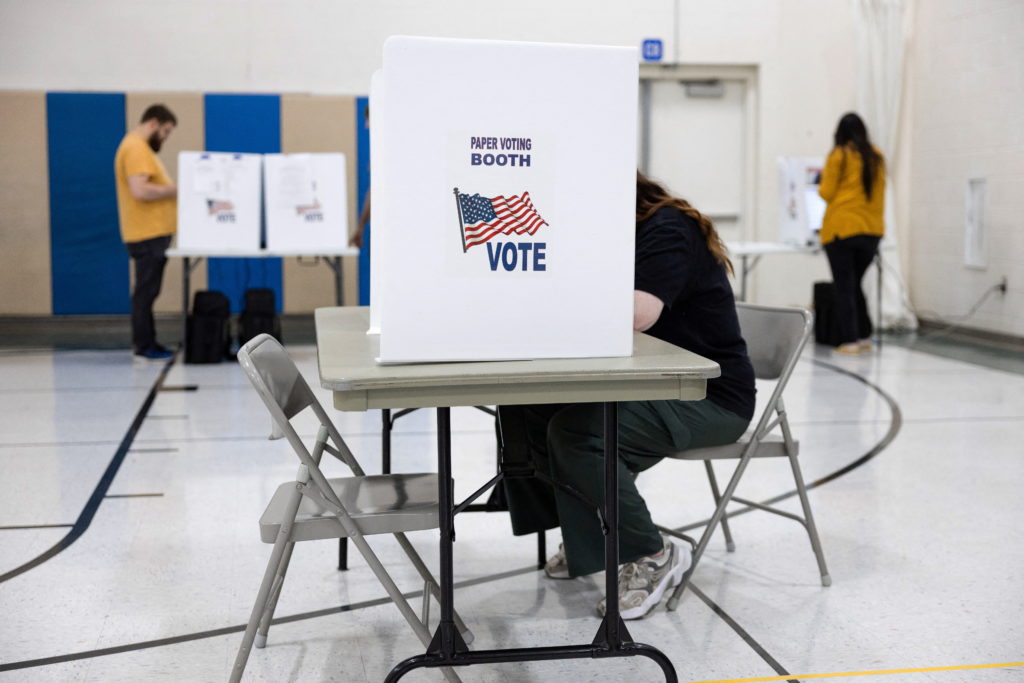
Federal agents showed up at the Cleveland office of the Ohio Organizing Collaborative on Thursday and spent hours questioning staff, said Prentiss Haney, a board member of the grassroots organization.
But as such federal efforts continue, there’s apparently a new twist on the broader gambit related to state voter rolls. The New York Times reported:
The U.S. Postal Service has proposed a new rule that would allow it to refuse to deliver mail ballots in states that don’t turn over voter rolls to the federal government.
The rule, proposed last week, is vaguely written but appears to establish broad authority for the agency to intervene in the mail voting process. It calls on states to compile lists of mail voters that Postal Service employees would use to screen ballots for eligibility. If states refuse to comply, the agency could refuse to send their mail ballots.
Pointing to the proposed rule, published in the Federal Register last week, the Times added, “Screening mail ballots for voter eligibility … would amount to an unprecedented, and potentially unconstitutional, involvement of the federal government in the administration of elections.”
For Donald Trump, that might very well be the point.
In March 2025, just two months into the president’s second term, the Republican signed a radical executive order intended to impose sweeping changes on the nation’s system of elections. Trump, however, lacked the legal authority for such a power-grab, and his policy was rejected throughout the judiciary.
One year later, in March 2026, the president nevertheless did it again, signing another order in which he purportedly gave himself sweeping authority over the country’s elections systems. As part of the radical scheme, hatched to address a problem that does not exist, the Republican administration set out to create a citizens database, which the U.S. Postal Service would then use to limit mail-in voting.
It was widely assumed that this, too, would fail in the courts, but two weeks ago, U.S. District Judge Carl Nichols, a Trump appointee, allowed the executive order to restrict mail-in voting to stand (at least for now), ruling that the plaintiffs, the NAACP and the League of United Latin American Citizens cannot claim to have been harmed by the policy because the president’s policy had not yet been implemented.
One day after the Trump-appointed judge allowed the president’s policy to remain in place, the U.S. Postal Service proposed its new rule to require states to provide voter-level data on mail-in ballots in federal elections.
There’s still a great deal of uncertainty about how, exactly, this policy would be applied, and the legal fight is ongoing.
Indeed, the Times’ report noted recent oral arguments before a federal judge in Boston in which a coalition of Democratic state attorneys general and voting rights advocates said the administration’s rule isn’t merely an unconstitutional federal intrusion into the voting process, but would also “be expensive, cumbersome and chaotic to comply with the demand to create new lists of voters and, in some cases, to change mail ballot designs, with fewer than 150 days until the 2026 general election.”
Time will tell what becomes of the fight, but that it’s even a possibility the USPS might refuse to deliver ballots unless states comply with Trump’s unnecessary demands is breathtaking. Watch this space.
Our chief political analyst, Nate Cohn, who writes The Tilt newsletter, looks at the Republicans’ advantage in the House of Representatives after partisan redistricting. To win the House, how much of the popular vote would Democrats need to win?
It’s been 10 days since California held its closely watched statewide primaries, and nearly every day since, Donald Trump has shared baseless conspiracy theories about the contests, with varying degrees of hysteria about Democratic mischief that hasn’t happened in reality.
The list of problems surrounding the president’s claims is not short. Even putting aside the obvious and inconvenient details — there’s literally no evidence of the system being “rigged,” Trump doesn’t seem to understand how election administration works, etc. — the fatal flaw in the Republican’s groundless claims is that the election outcomes haven’t quite turned out as Democrats would have preferred.
In Los Angeles’ mayoral race, for example, the Democratic incumbent would have welcomed the opportunity to run in the fall against a conservative television personality with an embarrassingly thin professional resume, but instead she’ll face a Harvard- and MIT-educated City Council member who’s already demonstrated an ability to win local elections.
In the state’s gubernatorial race, Democrats would have been delighted if Republicans had been locked out of the general election altogether, but instead, Republican Steve Hilton, a Trump-backed former Fox News personality, finished second in the multiparty “jungle” primary.
Yet despite the obvious flaws that have already made these theories flimsy, the president added a new twist on Thursday.
During a phone interview that aired live on “Fox and Friends,” Fox News’ Brian Kilmeade asked about the war in Iran. Trump responded by immediately focusing on his 2020 election conspiracy theories, which naturally led to his California election conspiracy theories.
“It was happening to Steve Hilton, and I went on a tear,” the president said. “And they said it was going to be two weeks and they’d know about Hilton, whether or not he’s going to make it. I went on such a tear, then they approved it immediately. They approved Steve. It’s such a rigged deal, it’s so crazy. They approved him so fast because everybody was watching.”
Hours later, at a White House event ostensibly about commercial fishing, Trump echoed his absurdities.
Trump again tells his delusional story about how Steve Hilton was "approved" to advance in the California election only because California officials were feeling "heat" after he started yelling about the "rigged election"
“They said it’s going to take two more weeks,” the president said. “It was a week and it was heading south, and I started saying, ‘It’s a rigged election.’ And then they said it was going to take two weeks, one week, two weeks, and all of a sudden, [Hilton] was approved. You know why? Because the heat was on. They couldn’t get away with it. If I didn’t do it, I guarantee he wouldn’t be the nominee. It’s a rigged election.”
To the extent that reality impinges in any way on these presidential conspiracy theories, none of Trump’s claims was true, but of particular interest was his vision of how election administration works in the nation’s most populous state.
Hilton was already well positioned to advance to the general election when Trump started peddling baseless assertions. Earlier in the week, it became clear based on the remaining outstanding ballots that it simply wasn’t possible for any other candidate to surpass him.
But to hear the president tell it, election administration officials in California effectively told one another, “Sure, we planned to secretly arrange for Hilton’s defeat, but Trump is onto our nefarious scheme! It looks like we now have no choice but to let Hilton advance to the general election.”
In other words, from Trump’s perspective, when a Republican falls short, it’s proof that his conspiracy theories are true, and when a Republican doesn’t fall short, it’s still proof that his conspiracy theories are true.
This is madness, but a Trump-appointed federal prosecutor in the Golden State nevertheless appeared on Glenn Beck’s program this week to ask Californians to help him uncover evidence (which he apparently lacks) that could lead to the kind of prosecutions the president wants to see.
Texas Attorney General Ken Paxton (R), a candidate for Senate, is warning schools across the Big 12 Conference that the state would consider suing any institution that sanctions Texas Tech over a decision to play a quarterback who sued the NCAA to regain his eligibility. In a letter to Big 12 Commissioner Brett Yormark and Kansas Chancellor…
Texas Attorney General Ken Paxton (R), a candidate for Senate, is warning schools across the Big 12 Conference that the state would consider suing any institution that sanctions Texas Tech over a decision to play a quarterback who sued the NCAA to regain his eligibility. In a letter to Big 12 Commissioner Brett Yormark and Kansas Chancellor…
After nights of violence across Belfast this week, politicians continue to call for calm, but what else can be done to stop the violence spreading? Plus, Jessica Elgot has been to Makerfield and spoken to undecided voters on the doorstep
The full list of candidates for the Makerfield byelection:
As midterms são um barómetro ao Presidente, cuja taxa de rejeição é hoje cerca de 60%. Somando isto à recente subida dos juros dos títulos do Tesouro a 10 anos, de 3,95% para 4,44%, são más notícias para o POTUS pois sinalizam uma provável subida da inflação e um aumento do custo da dívida quando os juros já são o segundo item do orçamento americano.
Como responde Trump a isto? Manipulando as eleições – isto é, fazendo aquilo que acusa falsamente os outros de lhe terem feito. A panóplia de truques é vasta: primeiro ameaçou enviar o ICE (polícia de fronteiras) às assembleias de voto, para intimidar os imigrantes, sendo que será inconstitucional ter lá pessoas armadas.
De seguida temos o Save America Act, que obriga os votantes a estarem documentados; pretensamente visa impedir o voto dos imigrantes ilegais, mas na verdade é mais uma manobra de intimidação – o Brennan Center determinou em 2017 que para uma dúzia de estados tal representaria 0,0001%, o que significa, projetado aos eleitores de 2024, 150 votos.
Terceiro, Pam Bondi e companhia exigiram o acesso à informação dos estados sobre os votantes; aos estados que recusaram (mais de vinte) foram instaurados processos e os dez que tinham acedido tiveram que assinar MOUs (outra moda de Trump) confidenciais que tratavam da análise da informação tendo em vista ordenar a remoção das listas dos votantes classificados como “presumptive noncitizens” – o que constituiria uma violação do National Voter Registration Act.
Quarto, quer proibir o voto por correspondência, que considera lhe ser prejudicial.
Quinto, cereja no topo do bolo, tornou-se o campeão no Gerrymandering (redefinição dos limites dos círculos eleitorais; vem de Gerry, o governador do Massachusetts que para ganhar deputados desenhou um círculo eleitoral de Boston com o feitio de uma salamandra). Só no Texas está a tentar ganhar cinco.
Finalmente, para atuar em roda livre, a voting section do Departamento (ministério) da justiça, responsável por garantir o direito a votar, foi reduzido a dois juristas.
Isto não é tudo. Se parece mau, relembre-se que Trump consegue sempre surpreender-nos.
Democrats and voting-rights groups have challenged the proposed rule as a harmful federal intrusion that could affect millions of voters who cast their ballots by mail.
Hundreds of Labour activists and MPs have ‘made the pilgrimage’ to the seat, where they are pounding the streets
For a few short weeks, the centre of political gravity in Britain has shifted from the Palace of Westminster to the bar of a former Labour club in Wigan.
In London, even as Keir Starmer insists he will fight to stay in No 10, the walls seem to be crumbling around him, especially with Thursday’s resignation of the defence secretary, John Healey.
In his first extensive interview since his defeat by a Trump-backed challenger, the Texas Republican said the Senate was in for a “bumpy ride” as he and others flex new political freedom.
“There’s never going to be good enough for him, other than 100 percent, you know, slavish adherence to whatever he wants,” Senator John Cornyn said of President Trump. “But obviously that’s not what the senator’s role is supposed to be.”
As this week got underway, the public saw Donald Trump abruptly end his latest “Meet the Press” interview when NBC News’ Kristen Welker asked the president whether he had evidence to support his election conspiracy theories. “You’re either crooked or you’re stupid,” the Republican told the host instead of answering the question like an adult who wasn’t making stuff up.
Unprompted, Trump returned to the subject Wednesday at an unrelated White House event, telling reporters:
They rigged the election, the second election, as you probably heard and probably know, most of you know, that happened and now it’s been proven, and it will be proven as time goes by, even more so. We have things that you won’t believe. When we release the full files, you’re not going to believe how crooked the second, the 2020 election was.
He made the comments while surrounded by congressional Republican leaders, who simply nodded along.
Trump: "They rigged the election. Now it's been proven, and it will be proven even more as time goes by even more so. We have things that you won't believe. When we release the full files, you won't believe how crooked the 2020 election was."
There’s probably no point in rehashing what reality-based observers already know: The election wasn’t rigged; it isn’t “proven”; Trump and his team haven’t found “things”; there is no “they”; etc.
What I found notable about this, however, was the idea that there might still be people out there who are willing to believe that the president may yet uncover and release some evidence of a conspiracy that did not and does not exist.
Six months ago, for example, Trump sat down with Politico’s Dasha Burns, and when she brought up the president’s views on Russia’s war in Ukraine, his brain quickly shifted to what he described as the “rigged election.” Trump declared at the time, “It’s going to come out over the next couple of months too, loud and clear, because we have all the information.”
A couple of months came and went. The “information” never surfaced, because there is no such information.
For nearly six years, Trump and his team, like Lucy holding the football for Charlie Brown, have said the evidence to support the election conspiracy theories really is on the way. Any day now. Just you wait. It’ll be awesome.
My advice for those waiting for the president to follow through on his vow: Stop. He can’t produce that which does not exist.
A new poll shows Democrats have maintained a 10-point advantage over GOP congressional candidates. Emerson College released survey results on Thursday that found Democrats have 50.3 percent support from likely voters while Republicans have 39.5 percent support. A total of 10.2 percent of survey participants were undecided about which party they’d support. An April poll found…
A new poll shows Democrats have maintained a 10-point advantage over GOP congressional candidates. Emerson College released survey results on Thursday that found Democrats have 50.3 percent support from likely voters while Republicans have 39.5 percent support. A total of 10.2 percent of survey participants were undecided about which party they’d support. An April poll found…
On June 7, parliamentary elections were held in Armenia, as a result of which the ruling party can form a new government. What distinguished the 2026 elections, and is a parliamentary crisis looming? Crisis and frustration after military defeats After the defeat in the 44-day war in 2020 and the complete loss of control over […]

 Login
Login