President Trump on Tuesday blamed Iran for shooting down an American Apache helicopter overnight and said a response was necessary. “I have just been informed by our Great Military that last night the Iranians shot down one of our highly sophisticated Apache Helicopters while patrolling over the Strait of Hormuz,” Trump posted on his social…
President Trump on Tuesday blamed Iran for shooting down an American Apache helicopter overnight and said a response was necessary. “I have just been informed by our Great Military that last night the Iranians shot down one of our highly sophisticated Apache Helicopters while patrolling over the Strait of Hormuz,” Trump posted on his social…
Two senior Republican senators on Tuesday agreed Congress is unlikely to pass a third reconciliation bill, cautioning against relying on the possibility for defense funding. During a hearing Tuesday morning about next year’s budget for the Air Force, Senate Appropriations Committee Chair Susan Collins (R-Maine) questioned Air Force Secretary Troy E. Meink about a low…
Two senior Republican senators on Tuesday agreed Congress is unlikely to pass a third reconciliation bill, cautioning against relying on the possibility for defense funding. During a hearing Tuesday morning about next year’s budget for the Air Force, Senate Appropriations Committee Chair Susan Collins (R-Maine) questioned Air Force Secretary Troy E. Meink about a low…
An unmanned U.S. Navy surface vessel rescued the U.S. Army AH-64 Apache crew late Monday that went down near the Strait of Hormuz. The two crew members, who were in the waters close to the coast of Oman, were located and picked up by a Saronic Corsair, which is part of the Navy’s artificial intelligence and drone…
An unmanned U.S. Navy surface vessel rescued the U.S. Army AH-64 Apache crew late Monday that went down near the Strait of Hormuz. The two crew members, who were in the waters close to the coast of Oman, were located and picked up by a Saronic Corsair, which is part of the Navy’s artificial intelligence and drone…
The Pentagon has barred Chinese tech giant Alibaba, electric car maker BYD and search engine Baidu from getting U.S. defense contracts by adding them to its list of Chinese military companies operating in America. The Defense Department on Monday published an updated list of non-state-owned Chinese companies that, while not in traditional defense or security sectors, are…
The Pentagon has barred Chinese tech giant Alibaba, electric car maker BYD and search engine Baidu from getting U.S. defense contracts by adding them to its list of Chinese military companies operating in America. The Defense Department on Monday published an updated list of non-state-owned Chinese companies that, while not in traditional defense or security sectors, are…
Former Defense Secretary Lloyd Austin on Monday said the U.S. could reopen the Strait of Hormuz but should only undertake the effort with the support of international allies. “Certainly, the United States Navy could open the Strait of Hormuz,” Austin, who served under former President Biden, told Bloomberg during remarks at the HSBC Gulf Cooperation…
Former Defense Secretary Lloyd Austin on Monday said the U.S. could reopen the Strait of Hormuz but should only undertake the effort with the support of international allies. “Certainly, the United States Navy could open the Strait of Hormuz,” Austin, who served under former President Biden, told Bloomberg during remarks at the HSBC Gulf Cooperation…
Nearly 6 in 10 adults in the U.S. expect gas prices to worsen over the next year, as the ongoing Iran war continues to roil energy markets, according to a new poll. The survey, released Monday by Reuters/Ipsos, found that 59 percent of 4,531 respondents said that gas prices will go up in the next…
Nearly 6 in 10 adults in the U.S. expect gas prices to worsen over the next year, as the ongoing Iran war continues to roil energy markets, according to a new poll. The survey, released Monday by Reuters/Ipsos, found that 59 percent of 4,531 respondents said that gas prices will go up in the next…
Vice President Vance on Monday acknowledged divergent U.S. and Israeli interests on the way forward in the Middle East, amid public disputes between President Trump and Israeli Prime Minister Benjamin Netanyahu and rising concern about Israel spying in America. “The Israelis and I, excuse me, the Israelis and the United States, we have a lot…
Vice President Vance on Monday acknowledged divergent U.S. and Israeli interests on the way forward in the Middle East, amid public disputes between President Trump and Israeli Prime Minister Benjamin Netanyahu and rising concern about Israel spying in America. “The Israelis and I, excuse me, the Israelis and the United States, we have a lot…
Iranian state television on Tuesday reported that at least two members of its air defense units were killed in Israeli strikes. It comes amid renewed conflict between the two countries for the first time since April as the U.S. strives to enter a firm ceasefire agreement with Tehran. President Trump has repeatedly expressed concern with…
Iranian state television on Tuesday reported that at least two members of its air defense units were killed in Israeli strikes. It comes amid renewed conflict between the two countries for the first time since April as the U.S. strives to enter a firm ceasefire agreement with Tehran. President Trump has repeatedly expressed concern with…
President Trump on Monday said two crew members who were aboard a U.S. attack helicopter when they crashed near the Strait of Hormuz are “fine.” The two crew members, whose AH-64 Apache helicopter was patrolling regional waters, were rescued within two hours after they crashed near Oman’s coast, according to U.S. Central Command (Centcom). The…
President Trump on Monday said two crew members who were aboard a U.S. attack helicopter when they crashed near the Strait of Hormuz are “fine.” The two crew members, whose AH-64 Apache helicopter was patrolling regional waters, were rescued within two hours after they crashed near Oman’s coast, according to U.S. Central Command (Centcom). The…
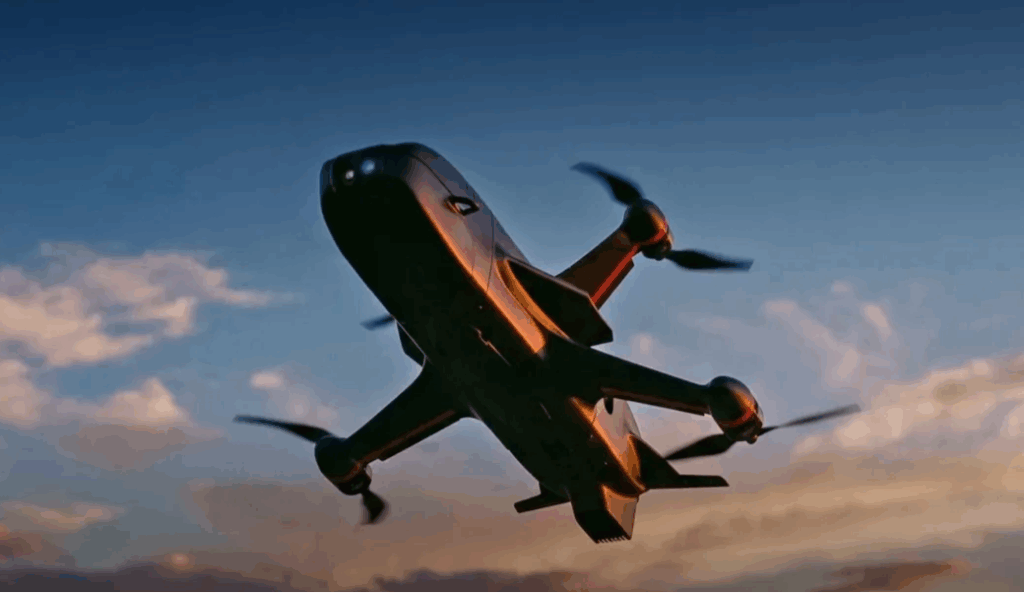
If you want to understand how Ukraine’s interceptor drones are evolving and improving but don’t have a lot of time, you can just take a look at the Litavr interceptor announced by the Ministry of Defense on 8 June.
F-Drones’ Litavr has been in serial production since the fall but its specs have been classified until now. While its capabilities do not appear to be brand new or exclusive to itself, the features list reads like a map of all the ways Ukrainian engineering and battle testing of the past few years made their various interceptors so highly sought-after.
That includes autonomous last-mile guidance, non-GPS navigation, radar integration, and the ability to control the drone from thousands of kilometers away. The company reportedly manufactures most of its own components, reducing dependence on China.
All these things are instrumental to Ukraine’s goal of “closing the sky” to Russian weapons. The Defense Ministry set a goal of shooting down no less than 95% of Russian drones and missiles and has been steadily climbing towards that goal: from just over 80% shot down late last year, to 92% shot down in May.
Last-mile autonomy
According to the MoD, the Litavr's key ability is the automatic pixel lock last mile guidance, in which a pilot controls the speed, while the drone does the rest.
Semi-autonomous weapons are one of the major achievements of Ukraine’s military-industrial ecosystem. Defense Minister Mykhailo Fedorov emphasized autonomy as a key technology.
“Autonomy is one of the key areas of development of modern air defence,” he said in a 8 June statement.
“Technologies like this enable faster responses to large-scale attacks and more effective protection of Ukrainian cities. We are scaling solutions that have already proved their effectiveness in combat conditions.”
Fedorov claimed that a Brave1 company has already created tech that automates 95% of the "entire interception process, from launching a drone to destroying a Shahed," which has been battle-tested in Kharkiv Oblast.
AI-assisted navigational and target lock tools are present in a plethora of Ukrainian drones: from deep and middle strike UAVs, to FPVs, to interceptors, which were reportedly getting anti-Shahed modules in December.
Across Ukraine and around the world, companies and volunteer cooperatives are using the country’s archive of battlefield footage to train models to become progressively more accurate and deadlier in combat.
Navigation and controls
Besides its daytime and thermal cameras, the Litavr has its own non-GPS navigation tools and integrates into existing radar systems through a proprietary software package.
The announcement was light on details, but this is another demonstration of Ukraine creating solutions to the realities of Russia’s war. The skies and battlefields are full of jamming and spoofing, which makes GPS a highly-unreliable solution.
Adaptations have included visual-inertial odometry, like the kind NASA's Mars drones use, beacon-based systems, AI that image matches preloaded terrain data, and tapping into nearby radar systems, like the Litavr does.
The drone also incorporates a system that allows operators to steer them from hundreds or thousands of kilometers away.
This system has been in development for over a year and announced in April, with more than 10 manufacturers integrating it into their systems. Wild Hornets made a splash online with their announcement that an operator took down a target from outside Ukraine's borders.
Speed and range
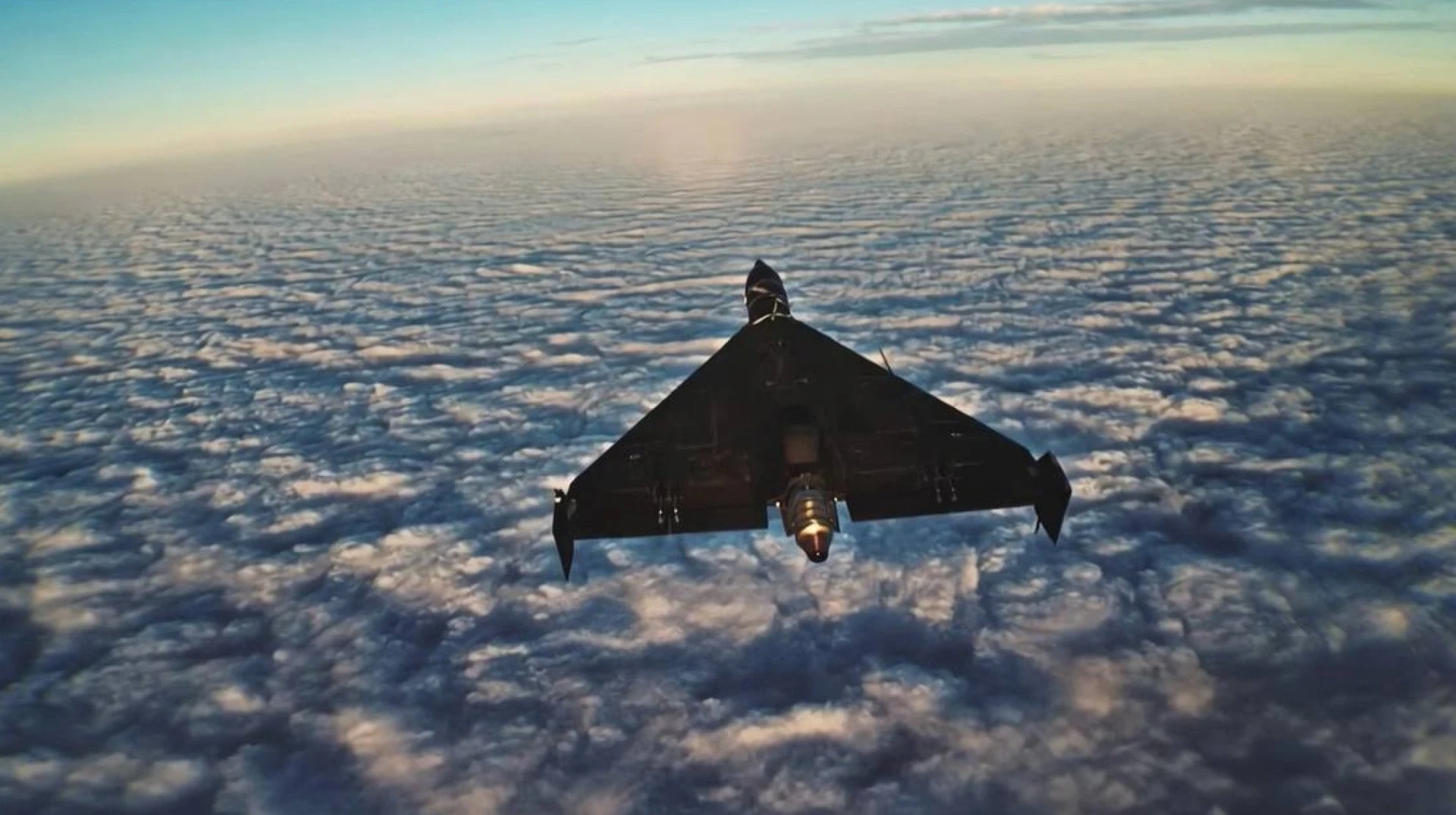
The Litavr has a reported top speed of 350 kilometers per hour. This isn’t the first drone with such a claim—the MoD said the same thing of the JEDI Shahed Hunter presented in March—and other drones before it had similar claims made about them, like the Furia.
However, 350 km/h is on the upper end of most interceptors in use these days. The more famous drones of this class like SkyFall’s P1-SUN has a reported top speed of 310 km/h and Wild Hornets’ Stinger reportedly hit 315 km/h in tests, though the website says it tops out at 280 km/h. This was a massive upgrade from earlier Sting, which could reportedly go up to 160 km/h.
Ukraine is pushing that ceiling higher. As early as December, the Brave1 Defense Cluster announced that Ukraine can now mass-produce a motor that can accelerate an interceptor to 400 kilometers per hour. The manufacturer, Motor G, makes more than 100,000 motors per month, according to the announcement.
The growing speed is needed to combat jet-powered Shaheds, whose speeds can climb up to 600 kilometers per hour, which is a drum MoD adviser Serhiy “Flash” Beskrestnov has been beating constantly. Ukrainian devs are working on the problem: for example, General Cherry and STRIX are reportedly integrating chemical boosters into their Bullet interceptors.
Litavr’s operational range of 40 kilometers appears to be comparable to the Sting, though the MoD claimed a record flight of 80 km for the former. The flight ceiling of 9 kilometers appears to be higher than many interceptors of Litavr’s type, which range from 3 to 7 km.
Reducing reliance on China
The manufacturing is also indicative of what Ukraine is trying to accomplish. F-Drones reportedly builds most of its own electronics, engines and flight controllers.
Ukraine's government has a stated goal to reduce its dependence on Chinese parts, which, while cheaper, also pose a security risk. If China stops the flow of parts for whatever reason, Ukraine's entire weapons industry can be in trouble. China also supplies many of the parts for the very Shaheds these interceptors are meant to stop.
According to a December report by Zmiinyi (Snake) Island Institute, Ukraine's domestic manufacturers covered 70% of the need for communication systems for controlling drones, and 55% for analog video transmitters. The institute believes that Ukraine has the potential to cover 100% of the market in these three categories.
At the time of the report, Ukrainian manufacturers produced just 25% of flight controllers for domestic FPV drones, 14% of the thermal cameras and 12% of the electric motors. However, the Institute projected that Ukraine can produce as much as 75% of flight controllers, 90% of thermal cameras and 50% of electric motors over 2026.
Russia's overnight drone and missile barrage on 9 June killed and wounded civilians in the Kharkiv Oblast cities of Chuhuiv and Kharkiv, regional officials reported. More strikes over the past 24 hours left several people dead and dozens wounded elsewhere in Ukraine. Ukraine's Air Force said air defense stopped most of the drones, though missiles and others still reached homes.
Russia has pounded Ukrainian cities with nightly aerial barrages since 2022, sending waves of drones and missiles that air defenses can thin but not fully stop. Such daily attacks mainly target residential areas and civilian infrastructure.
Chuhuiv and Kharkiv bear the brunt
A series of Russian missile strikes on Chuhuiv overnight on 9 June killed at least three people and wounded six, the city's mayor, Halyna Minaieva, reported. Fire crews stayed at the impact sites as emergency services worked, she wrote, and the strikes damaged about eight apartment buildings and more than ten detached houses.
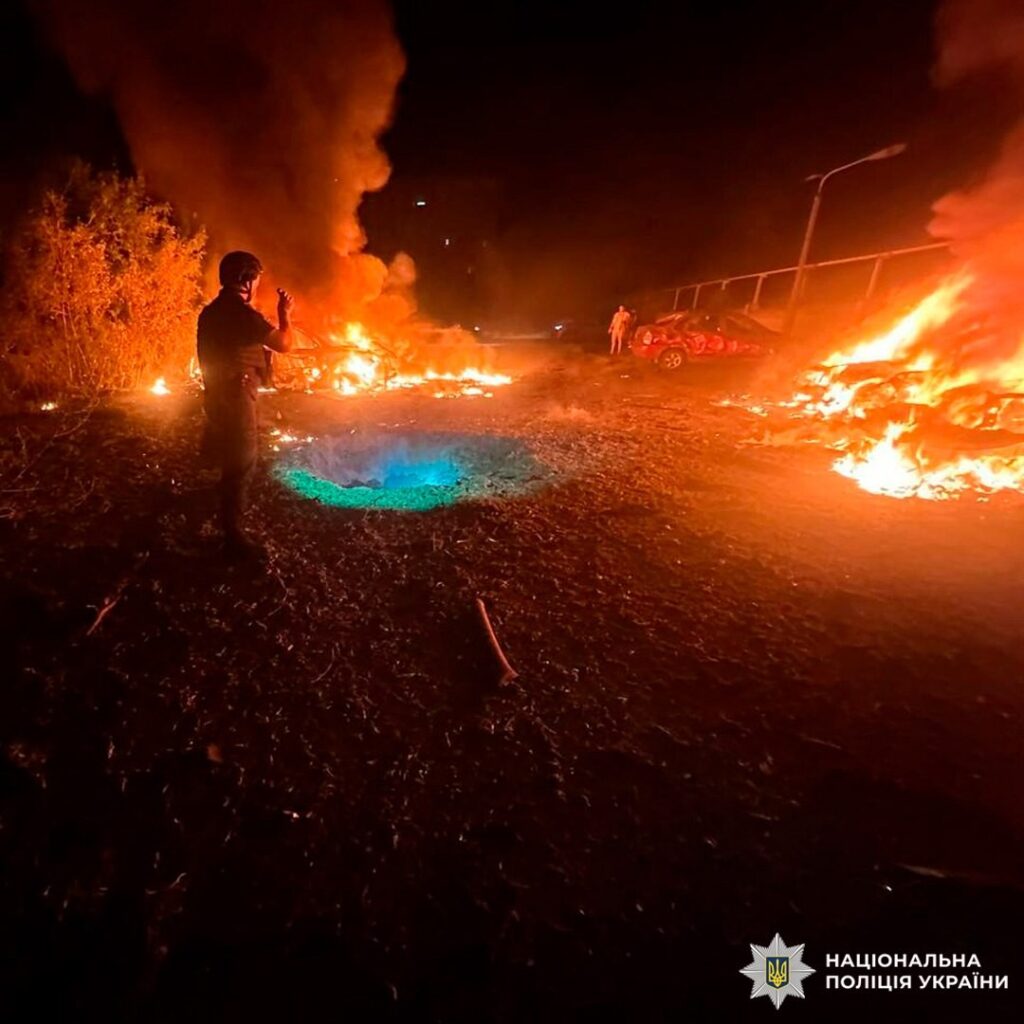
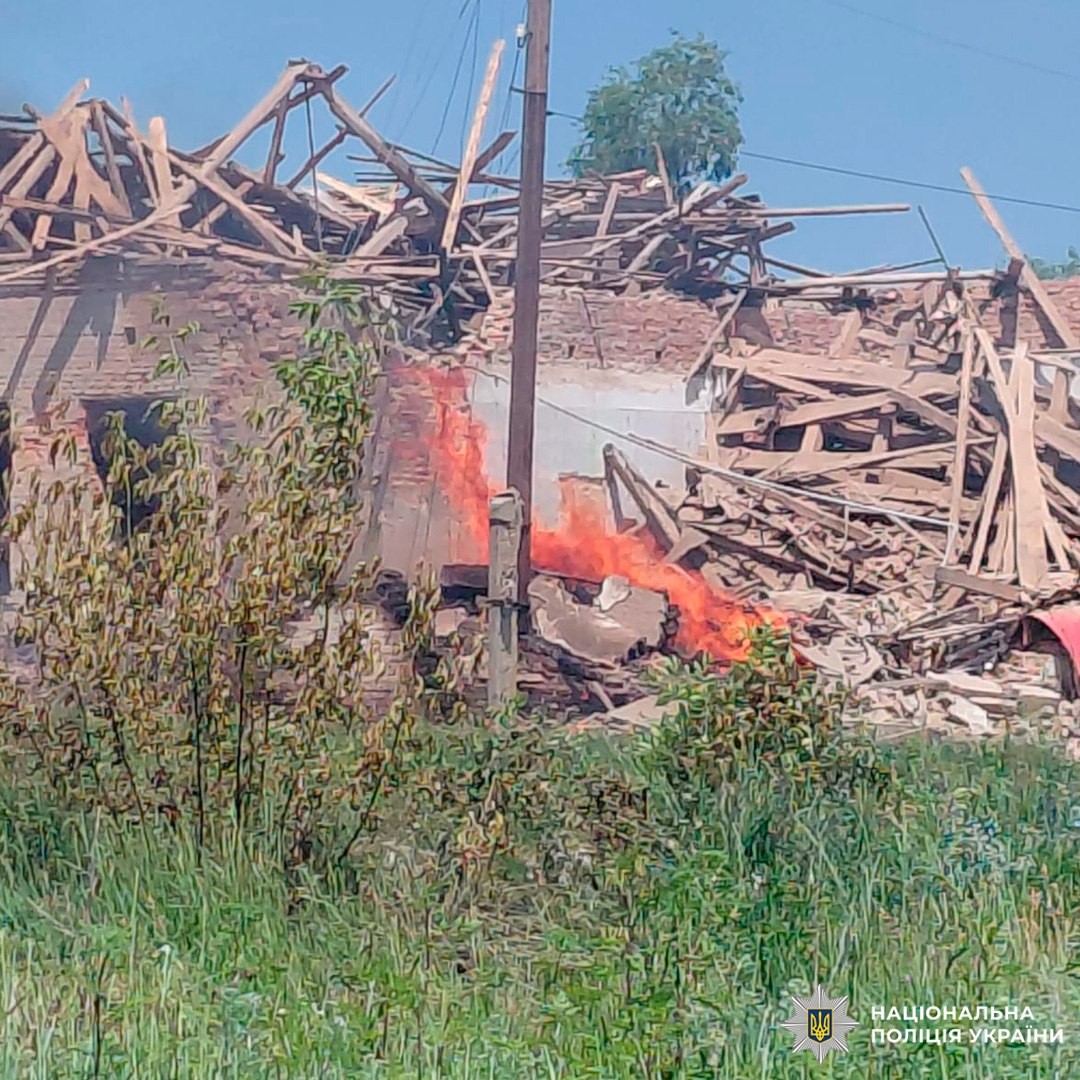
Police officers film the aftermath of a Russian strike in Kharkiv Oblast, 9 June 2026. Photo: National Police of Ukraine
In Kharkiv—the regional capital—Russian drone strikes set off fires, damaged at least 18 cars, and blew out windows and facades in residential high-rises, Kharkiv Oblast head Oleh Syniehubov reported.
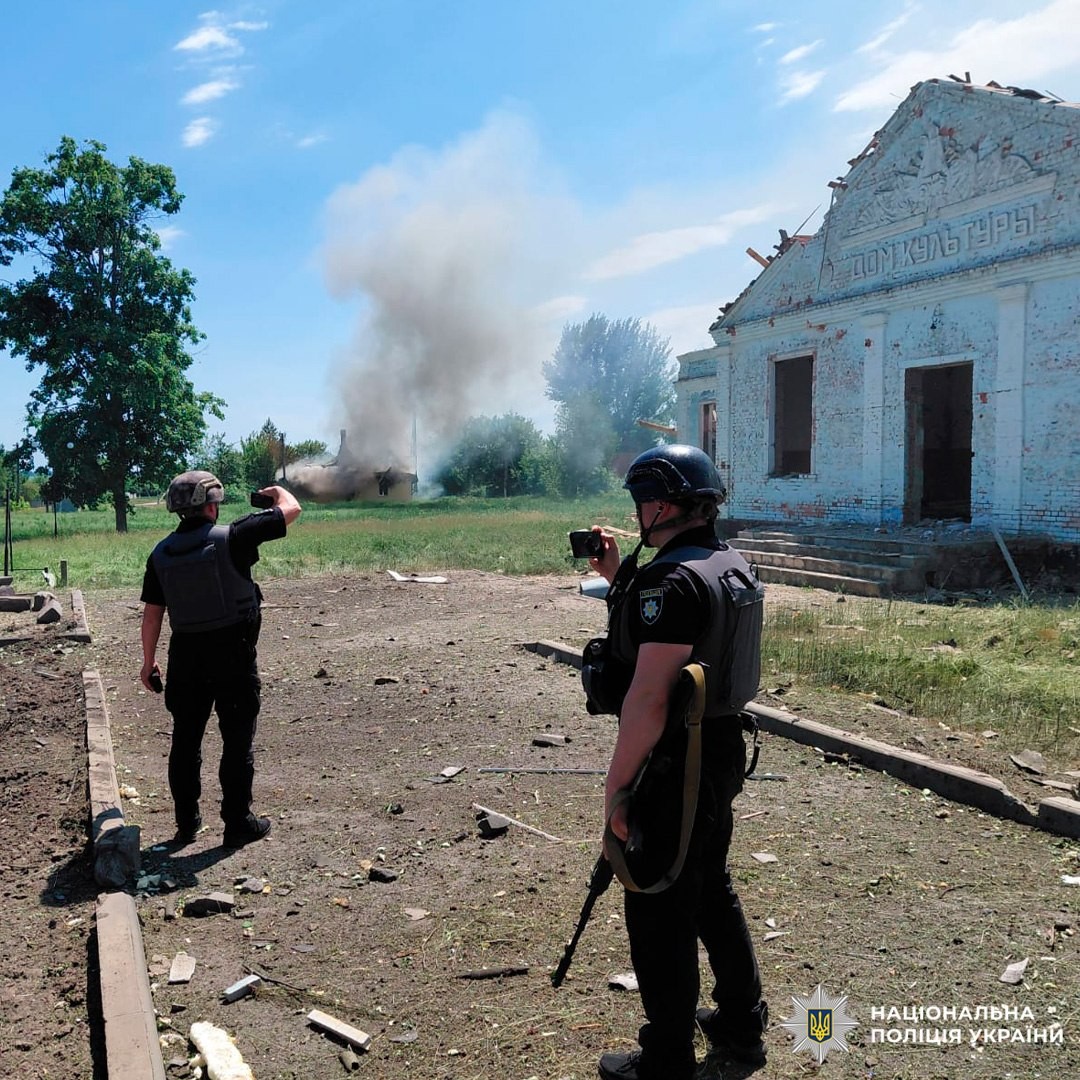
Police officers film the aftermath of a Russian strike in Kharkiv Oblast, 9 June 2026. Photo: National Police of Ukraine
He said 15 people were hurt, among them three children, including a one-year-old boy, and three women were hospitalized.
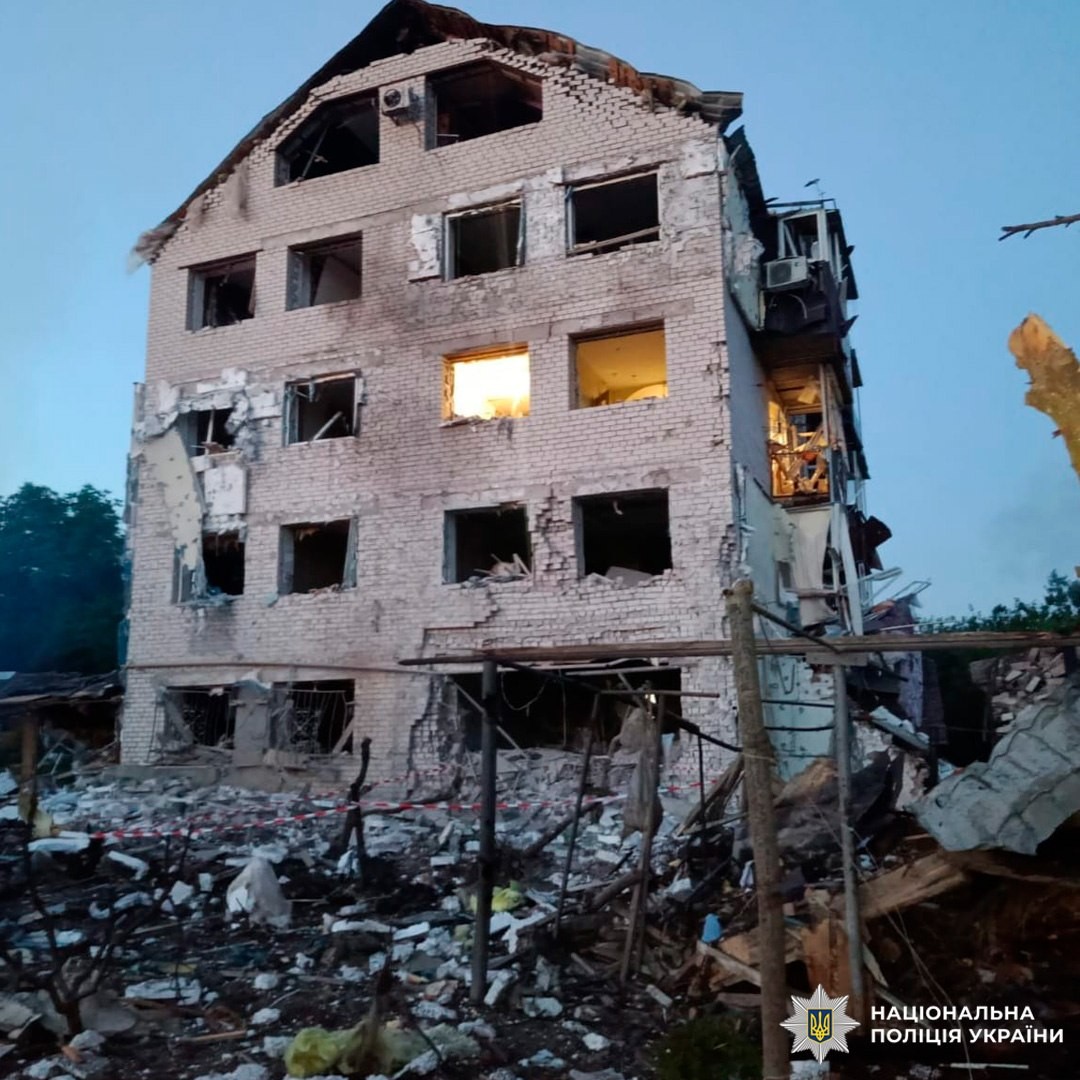
A multi-story residential building wrecked by a Russian strike in Kharkiv Oblast, 9 June 2026. Photo: National Police of Ukraine
Both cities sit dozens of kilometers from the Russian border and have been struck repeatedly through the war.
A barrage of two missiles and 166 drones
Russia launched two Kh-59/69 guided air missiles from Voronezh Oblast and 166 strike drones overnight, Ukraine's Air Force reported. The drones included Shahed types, some jet-powered, along with Gerbera, Italmas, "Banderol" loitering munitions, and "Parodiya" decoys, launched from Oryol, Kursk, Bryansk, Primorsko-Akhtarsk, and Millerovo in Russia, occupied Donetsk, and Hvardiiske in occupied Crimea.
By 08:00, air defense had downed or suppressed 146 of the drones. Two missiles and 17 drones struck 18 locations, and debris from intercepted drones fell at eight more.
Explore further
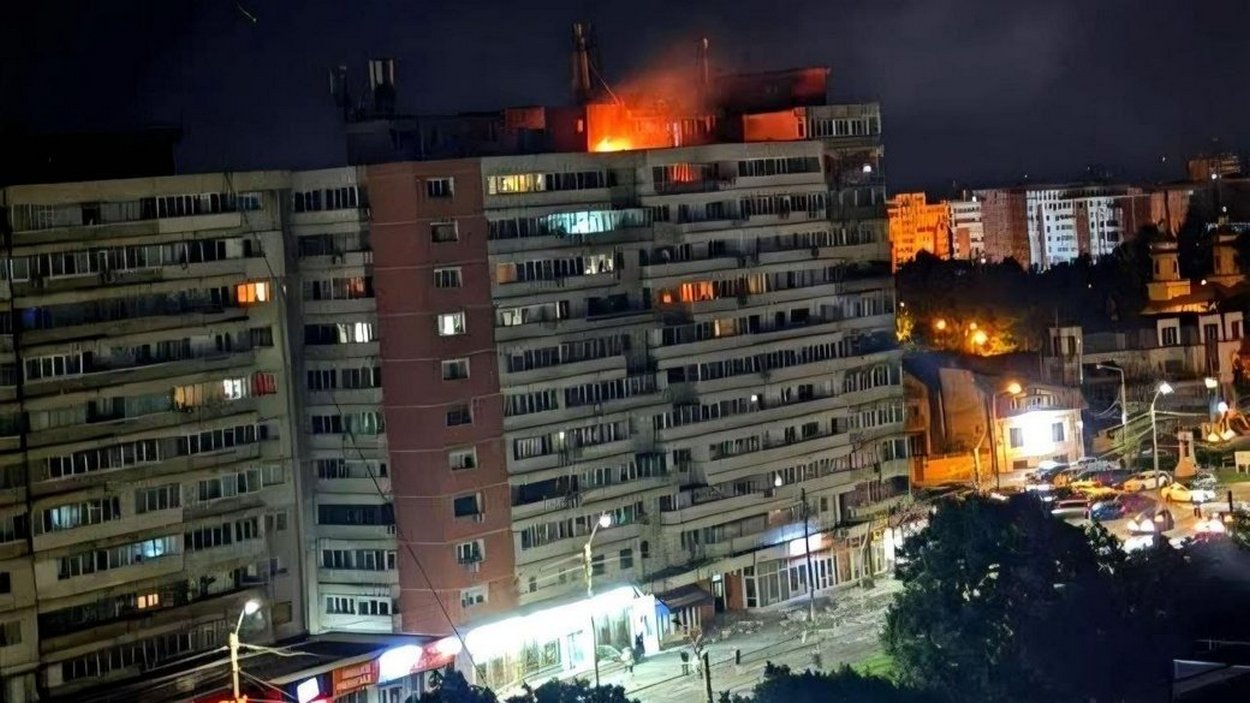
Moscow’s drone hits 10-story apartment block in Romania, injuring two as Russia fires 232 UAVs at Ukraine
Zaporizhzhia counts the damage from the day before
A Russian drone attack the previous day damaged 11 residential buildings across three districts of Zaporizhzhia, the city council reported. Six apartment blocks and five detached houses in the Khortytskyi, Zavodskyi, and Kosmichnyi districts lost windows, balconies, doors, and roofs to blast waves and debris. No one was hurt, and priority repairs were finished.
A nationwide wave
Russian attacks over 8 June killed two people in Sumy Oblast and wounded 13 across 21 hromadas, the regional police reported. A 78-year-old woman died in the Konotop hromada and a 71-year-old man in Seredyna-Buda, with a two-year-old boy and an eight-year-old boy among the injured.
In Donetsk Oblast, Russian forces killed two residents, in Bilozerske and Druzhkivka, and wounded 11 more, nine of them in Sloviansk, Oblast head Vadym Filashkin reported. Police recorded 1,309 attacks on the oblast's front line and residential areas, damaging 53 civilian sites. Hours later, Russia dropped three FAB-250 glide bombs on Sloviansk's outskirts, destroying one home and damaging more than 20.
In Kherson Oblast, drone and artillery attacks killed one person and wounded 13, including a child, Oblast head Oleksandr Prokudin reported.
Drone strikes in Dnipropetrovsk Oblast wounded three people.
Russian forces also hit 12 villages in four border hromadas of Chernihiv Oblast, the local border detachment told Suspilne.
The Russians also attacked communities in Mykolaiv Oblast with drones, where the administration reported no casualties.

 Login
Login