
Reading view

Ancient Greece’s Fascination With India’s “Naked Philosophers”

Gymnosophists India Greek philosophers
Medieval miniature reproducing the meeting of India’s gymnosophists with Greece’s commander Alexander the Great, c. 1420. The ancient Greeks were fascinated by India’s gymnosophists. Credit: Unknown Author, Wikimedia Commons, Public Domain.

Throughout history, and since the first exchanges between India and ancient Greece, Greeks have been captivated by the intriguing stories of the mysterious gymnosophists of India or the “naked philosophers.”

These philosophers became infamous for their austere and ascetic lifestyle along with their enigmatic wisdom. There are numerous Greek accounts of these wise people, offering a fascinating picture of the important cultural exchanges between two of the greatest civilizations on Earth.

Encounters with Alexander the Great

One could argue that perhaps the most famous interactions between Greeks and the gymnosophists took place during the campaign of Alexander the Great in India in 326 BC.
Ancient historians such as Onesicritus and Nearchus described (in their works) the dialogues that the great Macedonian Greek commander had with these naked wise men.

During these dialogues, we can see their distinctive disregard for any material possessions and their truly spectacular willingness to embrace death as a part of life. The philosopher Calanus famously demonstrated this by actually setting himself on fire in front of Alexander in an extreme attempt to showcase his fearless nature.

Gymnosophists Alexander the Great
Miniature of Alexander encountering the gymnosophists. Image taken from f. 17v of Poems and Romances (the ‘Talbot Shrewsbury book’). Written in French. Credit: British Library, Europeana, Public Domain.

These examples are only a part of the entire collection of accounts that have managed to paint a vivid picture of the unconventional way of life of the gymnosophists. Porphyry, for instance, noted in his works that these Indian philosophers were strictly vegetarians, much like the Brahmins. Their absolute rejection of garments and clothing, in general, along with their distaste for worldly goods in pursuit of spiritual enlightenment made a deep impression on the Greeks, who were genuinely amazed by the dedication of these men.

Ancient Greece’s views on philosophy of India

For the Greeks and their worldview, the gymnosophists represented a very different and acutely unique philosophical tradition with both many similarities to but also divergences from their own. From the accounts of ancient writers we learn that Greeks saw similarities between the ideas from gymnosophists of India and their own Greek philosophical concepts.

The belief of the gymnosophists for example in reincarnation, or metempsychosis, was of particular interest to many. Some scholars even speculated that Greek thinkers such as Pythagoras may have been influenced by Indian thought in the way he shaped his own worldview.

However, it is obvious that the Greeks also noted differences. This is something that probably led to a greater curiosity about and fascination with the Indian gymnosophists. Unlike the gymnosophists, mainstream Greek philosophers tended to engage more with society and politics, becoming much more active in the everyday life of their cities. The radical asceticism of the gymnosophists, on the other hand, as well as their rejection of material life, was more extreme than most Greeks had ever witnessed.

Asceticism and self-denial—from India’s gymnosophists to ancient Greece

What seems to have impressed the Greeks the most about the gymnosophists and their life was their incredible commitment to self-denial and extreme austerity. These naked wise men renounced almost all possessions and lived in the wilderness away from urban centers of the time.

Their sole goal was to pursue spiritual wisdom through material deprivation. To Greek eyes, their extremely ascetic lifestyle represented the ultimate mastery over physical desires and earthly attachments. For the Greeks, this was almost inherently difficult to comprehend, as the Greeks had a fundamentally different view, which was much closer to today’s Western attitude towards material possessions.

This is the reason why the example of living adopted by the gymnosophists inspired some Greek philosophical movements, particularly the Cynics. The Cynics were the ones who emulated the Indian rejection of social norms and material goods in favor of the benefits of asceticism. Christian ascetics also later looked to the Indian philosophers as true role models of self-discipline and pure piety.

India’s gymnosophists and influences on ancient Greece

As is understandable, the gymnosophists played a fundamental role in shaping and affecting the Greek imagination. They appeared as archetypal wise men in works by authors like Plutarch, Lucian, and Clement of Alexandria. Their fascinating way of life continued to amaze later Greek and Roman writers. These writers saw them as exotic embodiments of the philosophical ideal.

More broadly speaking, the Greek encounters with the gymnosophists show us the importance and richness of the cultural exchanges and the discourse of ideas between ancient cultures and civilizations. These Indian wise men expanded many of the Greek notions of philosophy and the possibilities of the ascetic path, even shaping Christian thought, although they lived centuries before the birth of Jesus. At the same time, the Greek accounts give us valuable information about the fundamentals of Indian thought and practice.
  •  

World’s Oldest Toothpaste Recipe Found in Egypt Reveals Ancient Greek Dental Secrets

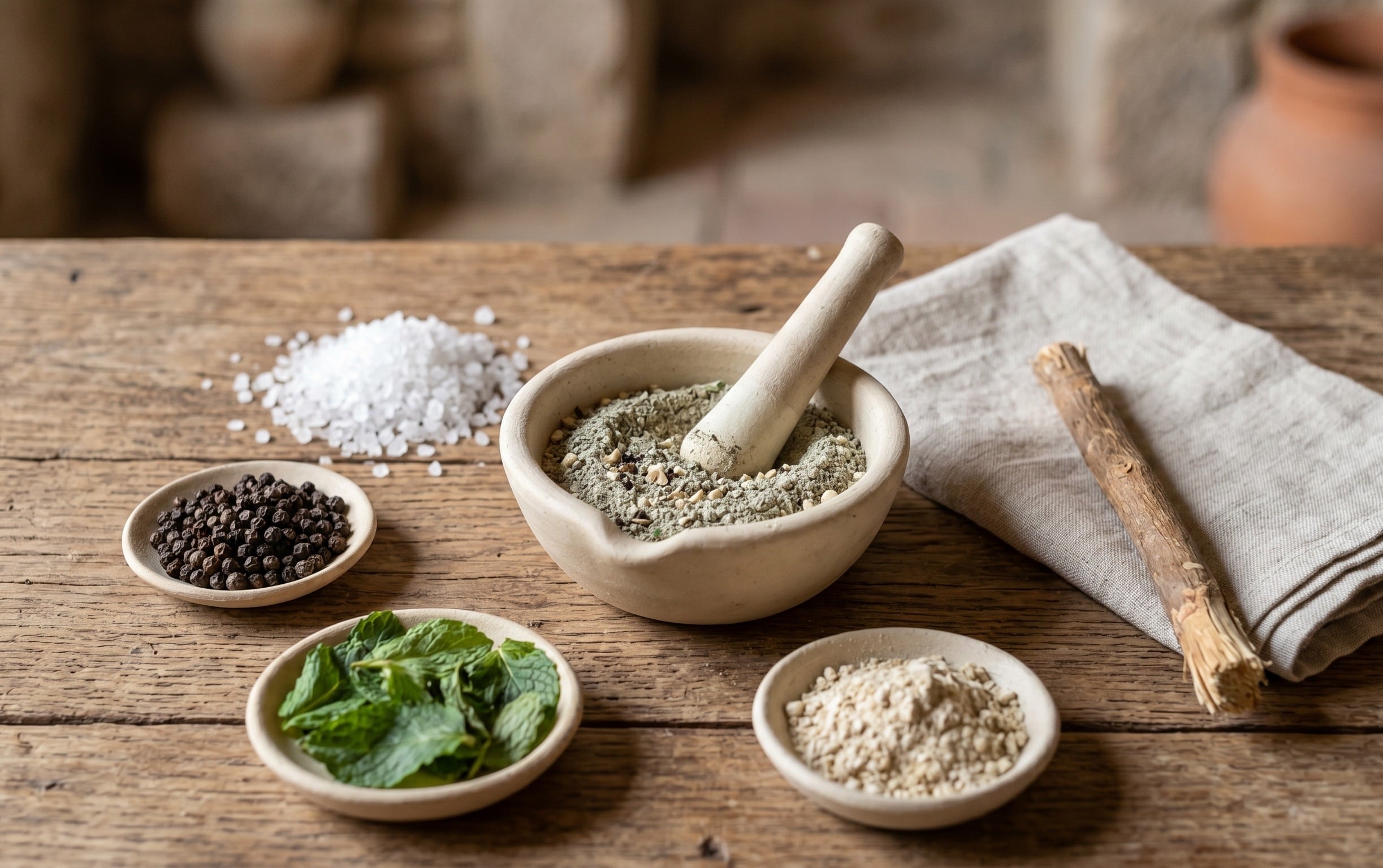
A variety of ingredients, including herbs, coarse salt, and peppercorns, are arranged on a rustic wooden table alongside a mortar and pestle for making ancient-style toothpaste.
The natural, abrasive components used by Ancient Greeks to maintain oral hygiene, such as crushed oyster shells, charcoal, and mint. Credit: Greek Reporter archive

Most of us assume that looking after our teeth is a modern habit shaped by supermarket shelves, mint-flavored ads, and childhood dentist scares, but a surviving Ancient Greek toothpaste recipe suggests otherwise.

Sitting quietly in the Austrian National Library in Vienna is one of the most remarkable documents in the history of medicine: a small, faded papyrus from the fourth century AD containing what is widely considered the world’s oldest surviving, precise toothpaste formula.

The existence of this Ancient Greek toothpaste recipe points to something larger at work. By the time it was copied onto papyrus, Greek had long since become the language of science, medicine, and intellectual life across the Mediterranean. This linguistic dominance was a legacy of the conquests of Alexander the Great and, above all, of Alexandria, the city his successors transformed into the ancient world’s foremost hub of knowledge. Even in Roman Egypt, centuries after the Ptolemies had given way to the Caesars, Greek remained the language a physician used when he wanted to be taken seriously.

When was the toothpaste recipe written in Ancient Greek discovered?

The papyrus first came to the attention of modern researchers in 2003, when curators at the Austrian National Library in Vienna identified it while preparing for an international dental congress. It had likely been sitting in the collection for years, its significance unnoticed and largely forgotten. Once translated, however, scholars quickly realized what they were looking at—a toothpaste formula that predates the first commercially marketed toothpaste, Colgate, launched in 1873, by well over fifteen hundred years.

The formula itself is strikingly systematic. The scribe prescribes “a powder for white and perfect teeth” composed of four ingredients: one drachma of rock salt, two drachmas of mint, one drachma of dried iris flower, and twenty grains of pepper. The drachma in this context was a standard unit of Greek medical weight, roughly equivalent to one-eighth of an ounce (about 3–4 grams), part of the same measurement system used throughout the major pharmacological texts of the ancient world. Taken together, the recipe reads less like folklore and more like a physician’s deliberate prescription, carefully calibrated for a patient.

But one might wonder if it actually worked. In 2003, Austrian dentist Dr. Heinz Neuman decided to test it for himself by recreating the formula. His conclusion was cautious but intriguing: the mixture was mildly abrasive and caused slight gum bleeding, yet it also produced a noticeable sensation of cleanliness and freshness. Modern dental science helps explain why. Dried iris flower, or orris root, is now known to contain antibacterial compounds that target the pathogens responsible for gum disease. What might once have looked like ancient guesswork increasingly appears to be empirical knowledge derived through observation and practice. In this sense, modern pharmaceutical science is only now arriving at conclusions the Greeks and Egyptians had already explored more than a thousand years earlier.

Ancient Greek father of pharmacology
Dioscorides is considered the father of pharmacology. Painting of unknown artist depicting Heuresis (the personification of discovery) presenting Dioscorides with a mandrake root. Credit: Unknown artist. Wikipedia Public Domain

None of this should entirely surprise us when we consider the world from which this recipe emerged. Ancient Greece had produced Pedanius Dioscorides, whose monumental work on medicinal plants shaped medical practice for more than a millennium. It had also produced physicians, botanists, and scholars who approached the human body with a level of rigor and curiosity that few ancient traditions matched. The anonymous scribe who recorded this formula was working squarely within that intellectual lineage, effectively encoding practical medical knowledge in Greek because it was the language in which serious medicine was conducted at the time.

The paste itself would have been applied without anything resembling a modern toothbrush. A folded linen cloth or a frayed chew stick—a fibrous twig worn soft at the tip through repeated use—would have served the purpose well enough. The tools were simple, but the intention was essentially the same as ours.

There is a quiet continuity in that detail. The next time you reach for mint toothpaste in the morning, you are participating in a ritual that a Greek-speaking scribe in Roman Egypt thought important enough to preserve on papyrus seventeen centuries ago. The ingredients have been refined, the packaging has changed beyond recognition, and no one is applying the mixture with linen anymore. Still, the impulse behind it—the very human desire for clean, white teeth—remains as old as the ancient world itself, and in many ways, the Ancient Greek world had already put the first working version of the answer into writing.

  •  
❌