Reading view

Ancient Yeasts Found on Ötzi the Iceman May Still Be Alive, Study Finds

Reconstruction of Ötzi the Iceman.
Reconstruction of Ötzi the Iceman. Credit: South Tyrol Museum of Archaeology / Flickr / CC BY-NC-ND 2.0

More than 5,300 years after his death, Ötzi the Iceman is helping scientists uncover a hidden world of cold-adapted yeasts. Researchers have discovered that the famous mummy’s skin and stomach contain yeasts that likely colonized his body shortly after his death. Some of these microorganisms may still be active today, according to a study published June 3 in the journal Microbiome.

Ötzi, one of the world’s best-preserved natural mummies, was discovered by hikers in the Ötztal Alps in 1991. Scientists believe he died around 3300 B.C. after a violent attack.

Microorganisms survived alongside the mummy

Researchers analyzed swab samples, thawed water from inside the mummy, soil from the discovery site, and material from Ötzi’s storage environment. Using genetic analysis, they identified microbial communities living on and around the remains.

The study found that many of the yeasts are closely linked to cold Alpine environments. Scientists believe they originated from the glacier where Ötzi’s body remained frozen for thousands of years.

The findings suggest the microorganisms survived after the mummy was recovered and transferred to a refrigeration chamber maintained at about 21 degrees Fahrenheit (minus 6 degrees Celsius).

More than 5,300 years after his death, Ötzi the Iceman is still surprising scientists.

Researchers discovered cold-adapted yeasts living on and inside the famous mummy. Some may have survived since the Copper Age, while others appear to have continued growing in cold storage. pic.twitter.com/mpIT8neT24

— Tom Marvolo Riddle (@tom_riddle2025) June 4, 2026

Researchers found that the yeasts are highly adapted to cold conditions, allowing them to persist in both glacial environments and modern storage facilities.

Ancient yeasts may still be active

The team successfully cultivated four cold-adapted yeast species from samples collected from Ötzi’s skin and from water taken from inside the mummy.

Genetic evidence showed signs of ancient DNA damage, suggesting the yeasts either remained dormant for more than five millennia or descended directly from the original microorganisms that colonized the body after death.

Researchers also compared skin samples collected in 2019 with samples gathered in 2010. The analysis showed that a cold-loving yeast known as Glaciozyma had become the dominant strain over time.

The finding indicates that the glacier-associated yeast has continued to slowly grow while the mummy has remained in cold storage.

Study co-author Frank Maixner of the Eurac Research Institute for Mummy Studies said the discovery shows that Ötzi is not simply a preserved archaeological artifact but part of an evolving biological system.

Potential uses beyond archaeology

The researchers also explored whether the ancient yeasts could have practical applications. Preliminary tests showed some strains performed well in sourdough fermentation. Lead author Mohamed Sarhan said the results suggest the yeasts could potentially be used in industries that rely on fermentation, including bread and beer production.

Scientists also identified modern microorganisms that were likely introduced during decades of conservation and study. It remains unclear whether these microbes affect the long-term preservation of the mummy.

Researchers said Ötzi offers a rare glimpse into ancient microbial life. However, they cautioned that the mummy represents only one individual and cannot fully reflect the broader population of the Copper Age.

  •  

The Truth Behind Flying Saucers: How Project Blue Book Shaped the UFO Debate

Interest in unidentified objects in the sky often emerges during periods of uncertainty, when people seek explanations for phenomena that appear mysterious or difficult to understand. The human mind tends to interpret unusual sights as warnings, threats, or messages from beyond the familiar world, especially during times of social tension. Efforts to understand such phenomena have often evolved into large-scale government programs where scientific investigation served purposes that extended beyond pure research. How the Flying Saucer Phenomenon Began The story gained momentum when experienced pilot Kenneth Arnold reported seeing a group of unusual objects flying over mountain peaks. Instruments estimated their speed at approximately 1,900 kilometers per hour — an extraordinary figure for the technology of that era.

  •  

Video Shows Rare ‘Black Explosion’ on the Sun as Massive Blast Tears Apart Hydrogen Cloud

A rare solar phenomenon known as a "black explosion” occurred on the Sun after a powerful flare tore apart and scattered a cloud of neutral hydrogen, according to the Solar Astronomy Laboratory of the Space Research Institute of the Russian Academy of Sciences. "If you wanted to know what a wow effect looks like, this is it,” the laboratory's press service said. Rare Solar Event Creates Black Blanket Effect The laboratory explained that hydrogen in this state is almost opaque to the radiation emitted by the Sun's hot atmosphere.

  •  

Did Paleolithic People Eat Bread?  

Assorted bread rolls with different seed toppings in a wicker basket.
New archaeological evidence suggests that Paleolithic humans may have baked simple types of bread as early as 30,000 years ago. Credit: 2368zauber, Wikimedia Commons, CC-BY-SA-3.0

For decades, conventional wisdom held that bread didn’t exist among Paleolithic people and was a relatively recent human innovation, an agricultural byproduct that emerged with the rise of farming in the Neolithic era, roughly 10,000 years ago. Recent archaeological discoveries have radically challenged this view, however, pushing the timeline of breadmaking back by at least 20,000 years.

In what can only be described as a groundbreaking study, a team of Italian researchers has revealed that Paleolithic hunter-gatherers in Europe not only consumed wild plants but also processed them into flour and baked a primitive flatbread. These findings were published in the prestigious journal Proceedings of the National Academy of Sciences (PNAS). They suggest that the roots of culinary innovation run far deeper than previously imagined.

Grinding stones and starch residue

At the heart of this discovery are ancient grinding stones. The archaeologists unearthed these flat stone slabs and pestle-like tools at sites across Italy, Russia, and the Czech Republic. The tools, dated to around 30,000 years ago, were originally assumed to have been used for processing pigments or crushing seeds. Nevertheless, when researchers Anna Revedin and Laura Longo of the Italian Institute of Prehistory and Early History in Florence conducted a detailed microscopic analysis, they uncovered traces of starch granules embedded in the stone surfaces.

The starches were identified as those of cattails, ferns, and other starchy wild plants, which would have required careful preparation to be rendered digestible. Revedin’s team concluded that these Paleolithic humans had not only harvested the plants but had dried, ground, and mixed them with water to form a kind of dough. Additionally, they likely cooked the resulting paste on hot stones near the fire, producing an early version of unleavened bread.

Rethinking the Paleolithic diet

The ancient Greeks themselves had a clear grasp of the evolution of human diet. Hippocrates, the father of medicine, wrote in his work On Ancient Medicine:

“It is for this reason, I believe, that people sought out food more suited to human nature, and eventually discovered the kind we now use. From wheat, after soaking, grinding, kneading, sifting, and baking, they made bread; from barley, they made flatcakes. After many efforts, they cooked, baked, mixed, and blended foods, diluting the strong and raw with milder ingredients, shaping everything according to human nature and capacity.”

The implications are profound. Until now, the standard narrative of Paleolithic diets emphasized a reliance on animal protein. This included meat and fish, with foraged fruits and plants playing only a minor role. The recent discovery challenges that model, however. Moreover, the implication is that these early humans were actually greatly skilled in the complex processing of wild plant foods. In other words, they also possessed the sophisticated ability to cook.

Furthermore, the evidence of flour production long before the advent of agriculture hints at a continuity of knowledge. The leap from gathering and grinding wild plants to cultivating domesticated grains may not have been as abrupt or revolutionary as once believed. Paleolithic peoples were far from passive consumers of raw resources, and the rise of farming could in fact have been the result of millennia of experimentation, habit, and accumulated expertise.

Ancient Greek bread
Ancient Greek woman taking bread out of the oven. Terracotta figure found in Tanagra, Greece. Credit: Marie-Lan Nguyen CC BY 2.5

A quiet revolution

Perhaps most striking is what this discovery on bread reveals about Paleolithic ingenuity. The production of flour and bread is not simply a dietary choice. It reflects planning, patience, and an understanding of food chemistry. Drying plant roots, grinding them into powder, and then baking them requires more than survival instinct. It also requires culture.

As more research sheds light on the lives of our Paleolithic ancestors, it becomes increasingly clear that they were not the brutish cave-dwellers of outdated caricatures. They were observant, resourceful, and remarkably sophisticated in their interaction with the natural world.

Bread, it turns out, is not just the food of civilization. It may have been the food of pre-civilization, as well.

  •  

4,000-Year-Old Child’s Skull Reveals Oldest Known Surgery in Central Asia

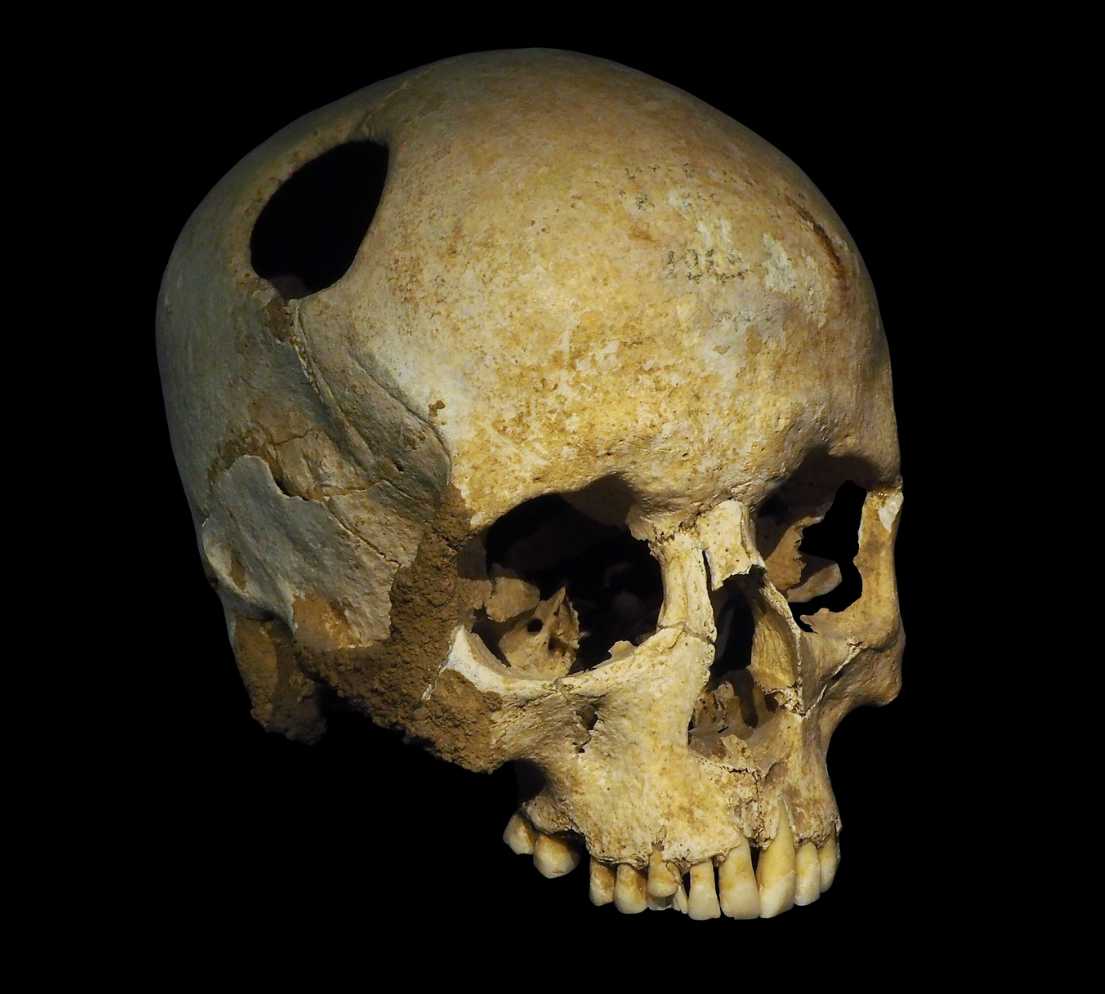
The perimeter of the hole in this trepanated skull
The perimeter of the hole in this trepanated skull. Credit: Rama / Wikimedia Commons / CC BY-SA 3.0

A 4,000-year-old child’s skull discovered in Uzbekistan is offering rare evidence of one of the oldest known surgery in Asia, shedding new light on medical knowledge in the Bronze Age.

The remains belonged to a child who died at about 5 years old. Researchers found clear signs of cranial trepanation, a procedure that involved cutting or drilling into the skull. The discovery represents the oldest documented evidence of surgery in Central Asia and one of the oldest known examples anywhere in Asia.

A joint team of Italian and Uzbek researchers uncovered the skeleton during excavations in the Northern Bactria region of southern Uzbekistan, near the border with Afghanistan.

Evidence of a complex procedure

Archaeologists found the child buried in a single grave alongside another child who died at about 3 years old. Examination of the older child’s skull revealed distinct traces of trepanation that researchers believe were made using stone or bone tools.

Trepanation is among the oldest surgical procedures known to humanity. Archaeologists have documented similar operations in ancient societies across Europe, Africa and Asia. The practice may have been used to treat head injuries, epilepsy, severe headaches or other medical conditions. In some cultures, it may also have served ritual or spiritual purposes.

A 4,000-year-old child’s skull discovered in Uzbekistan contains evidence of cranial trepanation, making it the oldest documented surgery in Central Asia and one of the earliest known in Asia. pic.twitter.com/w1NDyBNpEV

— Tom Marvolo Riddle (@tom_riddle2025) June 3, 2026

Researchers noted that medicine and religion were often closely connected in ancient societies, making it difficult to determine the exact reason for the operation.

The findings also raise questions about the level of medical expertise that existed in Central Asia thousands of years ago. Performing such a procedure would have required specialized knowledge of the human body and considerable technical skill.

A window into the Oxus civilization

The burial was discovered at the prehistoric settlement of Djarkutan, one of the most important urban centers of the Oxus civilization. Researchers dated the grave to the late third millennium B.C.

Also known as the Bactria-Margiana Archaeological Complex, or BMAC, the Oxus civilization flourished across parts of modern-day Uzbekistan, Turkmenistan and Afghanistan between about 2500 and 1500 B.C. The culture is known for its advanced agriculture, urban development and rich material traditions.

Researchers began a broader project to investigate Djarkutan and other aspects of the Oxus civilization in 2024. “Djarkutan continues to surprise us,” excavation director Enrico Ascalone said in a statement. “A cranial trepanation on a child, four thousand years ago, in Central Asia: until yesterday it was unthinkable. Today it is in our data.”

Questions remain unanswered

The discovery has also created new mysteries. Researchers are now investigating who may have performed the operation, what medical knowledge was available at the time and why such a procedure was carried out on a young child.

Evidence of ancient trepanation is relatively common in some parts of the world, but cases involving children of this age remain rare. Further analysis may help researchers understand whether the operation was intended to treat an illness, respond to an injury or fulfill a ritual purpose.

For now, the skull offers a remarkable glimpse into the medical practices, beliefs and capabilities of a Bronze Age civilization that thrived in Central Asia four millennia ago.

  •  

Global Smartphone Market Faces Sharpest Decline Since 2013, Analysts Warn

The global smartphone market is on track to record its most significant annual contraction since 2013, according to a new report from research firm Counterpoint Research. Following a reassessment of market conditions, analysts revised their forecast for 2026. In February, the firm projected a decline of 12.4 percent for the year. The latest estimate now points to a steeper drop of 13.9 percent. Counterpoint Research described the projected downturn as the largest annual decline since it began tracking the smartphone market in 2013.

  •  
❌