Reading view

As UGV adoption soars, Ukraine must write the playbook for saving soldiers’ lives
Ukraine war soldiers ground drone

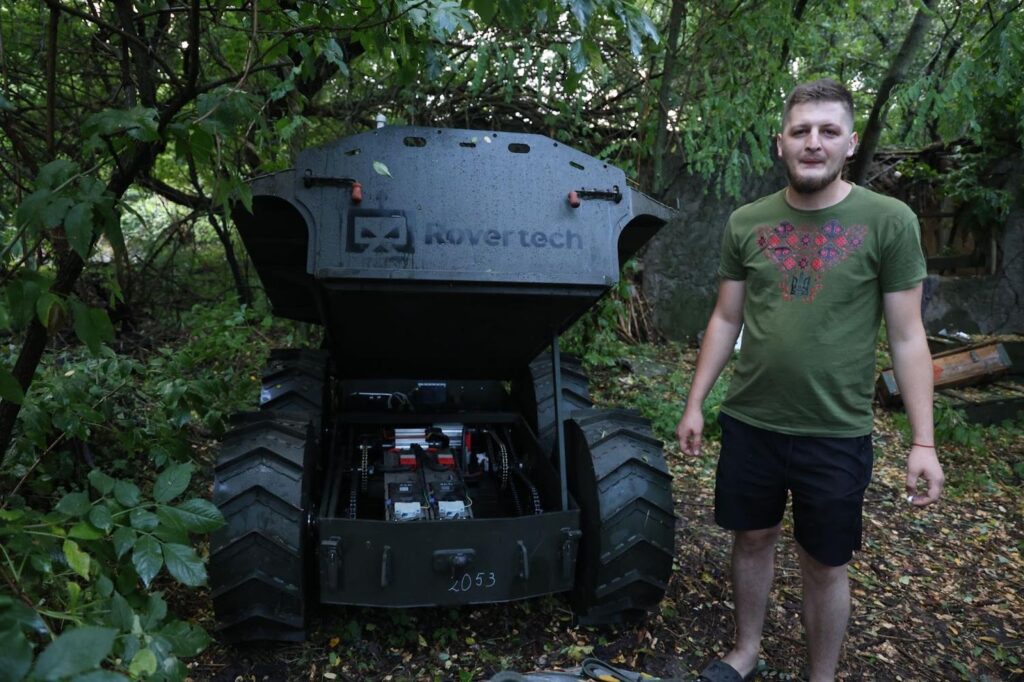
Ukrainian forces conducted 50,000 missions with unmanned ground vehicles as of January, the Ministry of Defense announced. The number is constantly growing: from 7,500 missions in January to 14,000 in May, and the number of units employing UGVs grew from 117 to 230.

"The UGV is a very, very promising thing," callsign Electric of the 93rd Brigade told Euromaidan Press—his brigade was an early adopter, having used UGVs for three years running.

"It has already proven its effectiveness, developing and scaling quickly, and becoming one of those tools of war that is already contributing to victory."

UGVs are meant to solve Ukraine’s chronic personnel shortages and battlefield casualties and have been rather effective, according to testimonials such as these. The General Staff has credited ground robotic platforms with cutting personnel casualties by up to 30%. In the Azov Corps, a single battalion moves over 40 tons of equipment per month with UGVs.

However, just having more machines is not nearly enough. Ukrainian forces are working to solve a myriad challenges before these machines can live up to their fullest potential, including:

  • Creating a military doctrine for their use
  • Establishing sufficient training for their operation
  • Building the infrastructure to deliver, modify, and repair them
  • Ironing out spare parts shortages, intercompatibility, and delivery challenges
  • Figuring out how to employ the menagerie of the dozens of systems in service 

“The development of UGVs is one of our priorities: the more tasks robots perform, the more lives of military personnel can be saved,” Defense Minister Mykhailo Fedorov said in a statement. 

More doctrine, more training

While remote-controlled ground crawlers existed before the full-scale invasion, mass adoption only exploded in 2026. The number of units using UGVs doubled between January and June. “The majority of brigades don’t have a (specialized) working UGV unit inside,” said Andrei Kushniarou, Commander of the 108 Battalion “Da Vinci Wolves.”

As a result, many units are getting UGVs for the first time without much of an idea of what to do with them, soldiers said in interviews. This applies not just to driving them but planning missions, figuring out what models work best for specific tasks, and which ones to commit to purchasing. 

“They began rapidly scaling up UGVs in just over six months,” Electric said. “Before that, there was no systematic use of this in the army. There were only isolated units that were doing something, trying things out.” 

“Systematic implementation began in just over six months and it scaled up from a dozen units, to hundreds of units. That is, this is an incredibly rapid leap, so there is no doctrine, nothing. There is only the experience of certain successful units, which share it and finally scale it up.”

This is natural: any new way of war requires figuring out. Ukrainian air defenders and UAV operators have had a long and difficult learning process over the past four years before Ukraine began to tip the drone war in its favor. UGVs must tread a similar path.

For the time being, for every story of a UGV rescuing a wounded soldier or capturing a Russian position, there are lesser-known stories of troops flailing about and learning on the job. Kushniarou said he has seen logistics UGV operators using the same route to deliver supplies to front line troops for half a year, as though inviting Russian FPV drones to come and destroy them. 

“We have some classes for FPV drones, for the bombers, where they use simulators before taking the real drones. But we don't have this kind of thing for UGV's,” said Olexiy Severin, the financial director of Ukrainian Unmanned Systems, which produces the heavy-duty Ravlyk ground drone for units including the military intelligence (GUR).

Ground drone UGV medical evacuations
Lyuba Shipovich stands near a Ukrainian TERMIT unmanned ground vehicle (UGV). (Photo David Kirichenko)

The solution is more training. There are some military training centers, such as the one operated by the 3rd Corps, as well as others scattered among different units. The military is working on creating more—for example, the South Operation Command, which plans to not only train soldiers how to use drones but to better integrate them with infantry. Volunteer-led initiatives like Dignitas are launching their own programs.

One bottleneck is the lack of experienced instructors, soldiers said. Experienced operators are at a premium, both on the front line and in the classroom. Meanwhile, current best practices become outdated in roughly six months. Another bottleneck is cash.

"We need money. A lot," Electric said. "First and foremost, money for scaling up production facilities, training centers and infrastructure development workshops. Everything is ready for it, it's just a matter of stating the facts and writing a doctrine."

Managing the menagerie of systems

Around 33 different models are available through the DOT-Chain marketplace. The actual number of different models of UGV floating around the country is closer to 200, soldiers said. 

This can be an overwhelming number of systems to get used to. Every system comes with its own nuances, use cases, and teething troubles. And “basically every one” has to be modified by the unit before it can be used, said Mykyta Puz, a technology liaison with the Azov Corps. Other soldiers agreed with him. 

“That's why we were the first to create our own universal control board, which we're installing throughout this entire zoo, standardizing the electronic components at a minimum,” Electric said. They must also add their own cameras and Starlink terminals. 

The 93rd isn’t alone in this. Starlink is the standard army-wide control method for driving UGVs at a distance, yet Starlink doesn’t come standard with UGVs. Many robots come without night vision and thermal cameras integrated into the basic package.

Other parts require tinkering as well, especially when UGVs come from outside Ukraine. Multiple soldiers were quite negative with their reviews of foreign-made machines, with reviews like "highly expensive, utterly useless" and "the quality of work is really bad.”

Specific complaints ranged from the act of driving toggling a safety cutoff switch, antennas jostling loose, or radio controls dying when a friendly UAV was flying nearby. 

The 93rd is trying to solve the “zoo” issue by limiting themselves to no more than 10 systems they trust, of which two are the mainstay and several more sit in backup. 

Spare parts and infrastructure

The challenge there is access to spare parts, with Electric calling it “critical… We only supply them through our own resources and methods.” 

Kushniarou said that units have a choice to make. They can decide to rely on just one or two developers, to buy UGVs from them. But if these developers get hit by a Russian missile or some parts fail to arrive from China, they can be screwed. 

Or they can embrace the “zoo,” work with many developers at the same time, which spreads out the risk, but turns into a “logistical hell” where parts are concerned. This also calls for really good specialists who know how to work with a dozen different systems. 
Ukraine drone war NATO
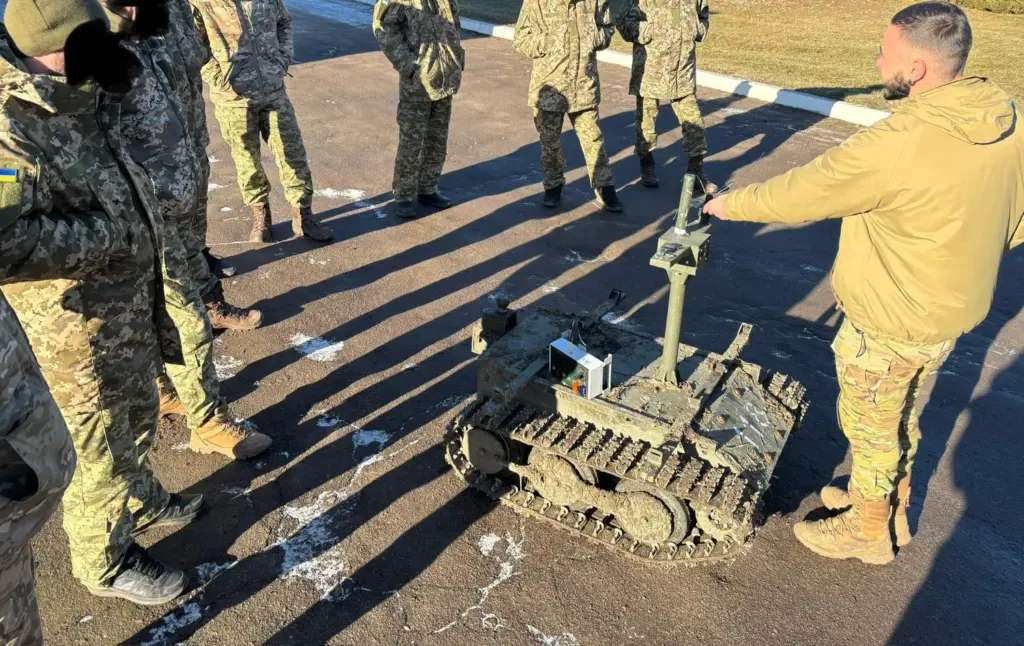
A small tracked unmanned ground vehicle of the kind multiplying across the Ukrainian front in dozens of locally-built variants. The vertical mast carries an elevated camera or communications antenna; the exposed controller board on the chassis is the workshop signature — the visible mark of a platform iterated in the dugout R&D labs Yabchanka describes, not on a factory production line. These small UGVs handle resupply, reconnaissance, and serve as radio relays extending the range of other robots and FPV drones operating deeper into the kill zone. Photo: Oleksandr Yabchanka / Facebook.

Getting parts can be a doozy, even when they are available. Severin said that units are begging his company to include a second battery for the Ravlyk UGV into the standard purchase package because "to buy additional batteries is all the circles of hell, harder than to buy a new UGV, because they have to go through multiple layers of military permission." 

He said that the company replaces wheels free of charge at its own expense, just so Ravlyk users can get them repaired in a week instead of a month. 

The solution is to build a more robust military-wide infrastructure for UGVs, soldiers said. That includes a spare parts pipeline, repair and servicing centers, and analytical centers for what can be improved. 

"You can’t just have a UGV, you need to create infrastructure around it,” like workshops, R&D and analytical centers, and logistics systems for parts, Kushniarou said. “Without infrastructure, any UGV is just a tool without a master.”

Scaling up adoption

Ukraine has set a goal to offload 100% of logistics tasks to UGVs. If all of the doctrinal and military-industrial teething troubles can be resolved, many more frontline warfighters’ lives can be saved. 

The Defense Ministry previously mentioned several things it’s doing to accelerate adoption. 

One is the development of “a separate UGV competence center” that will liaise between the General Staff and the military and become a “single point of contact” for manufacturers. 

The ministry also said it’s working on “comprehensively resolving” a VAT issue that led to contract delays. Severin told Euromaidan Press that a VAT that applies to electric vehicles has hit the Ravlyk, making it cost 30% more when purchased directly by units, discouraging them from using it. 

Procurement contracts are now being signed for the following year to ensure the lots can be delivered. 

As for 2026, Ukraine has plans to contract for 50,000 UGVs. But as of mid-May, the Ministry of Defense wrote that over 3,000 orders have been filed through the DOT-Chain marketplace and over 1,000 of them were delivered. Even though this number doesn’t include direct unit purchases, getting to 25,000 units by the end of June seems unlikely. 

It would be in the military’s best interest to prioritize getting good systems rather than fulfilling the number at any cost, developers said.

  •  

“We have guidance at home”—Kalibrs back to foreign parts after import substitution failed, MOD says

Kalibr missile

Russia went back to using imported electronics for their Kalibr cruise missiles’ guidance system after failing to replace them with homemade alternatives, according to Ukraine’s Ministry of Defense. 

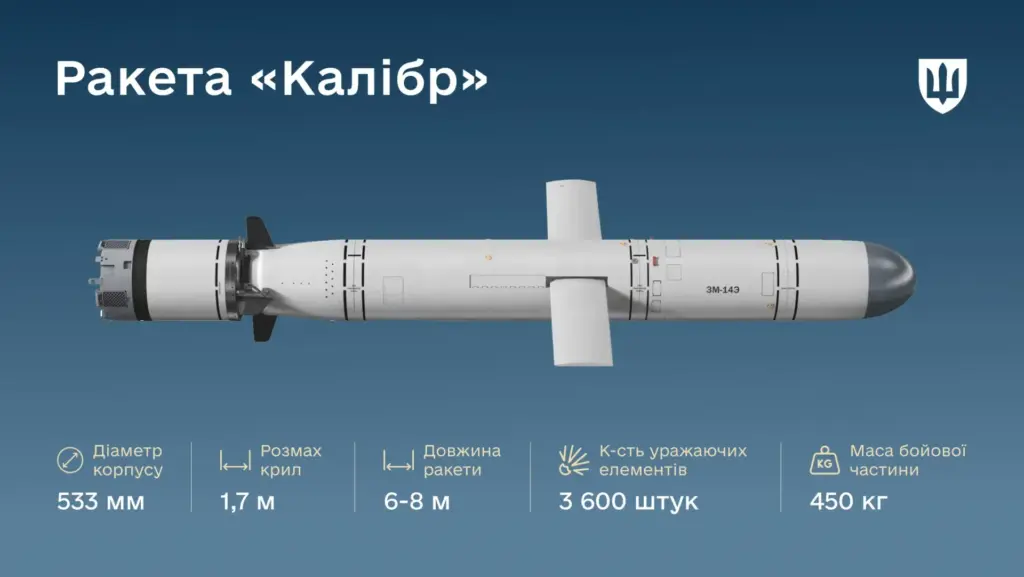
The ship-launched missile’s homing boards “are made up of more than 80–90% foreign-made components,” the MoD wrote. “This is a confirmed fact, not an estimate: each part is marked and has been checked by military representatives.”

Starting in 2023, Moscow began to transition to domestic components in manufacturing their Kalibr missiles, which may have worsened their performance. As a result, the Russians went back to what works, the MoD wrote, citing an analysis of Kalibrs that were shot down.

The announcement did not disclose the manufacturers of these systems. However, according to the General Intelligence Directorate’s website that tracks foreign parts in Russian’s weapons, most chips that went into Kalibrs prior to 2024 came from the US. 

Diagram of a Kalibr missile. (Ukraine's Ministry of Defense)

Russia has routinely used foreign electronics in the missiles it fires against Ukraine throughout the course of the war. 

A Russian Kh-101 cruise missile that killed 12 people in Kyiv in May was built in the second quarter of 2026, which points to components continuing to reach Russia despite 21 sanctions packages from the EU and years of Western export controls, President Volodymyr Zelenskyy said last month.

Cluster munitions added

Russia has also started using cluster munitions for the Kalibrs' payloads—the first such use was recorded in the Spring of 2026, according to the announcement. Previously, Kalibrs tended to be armed with high explosive fragmentation loads.  

Cluster payloads can widen the destructive radius and allow the missiles to more effectively hit spread-out targets. The MoD described them as analogous to the cluster munitions found on Kh-101 missiles. 

The use of weapons that cover an area with bomblets is controversial around the world because of the lingering danger they pose to civilians. A total of 124 countries have ratified the Convention on Cluster Munitions, outright banning the use of such weapons, though Ukraine and Russia are not signatories. 

Moscow’s army has repeatedly used cluster munitions, including against cities, since the opening days of the full-scale invasion.

  •  

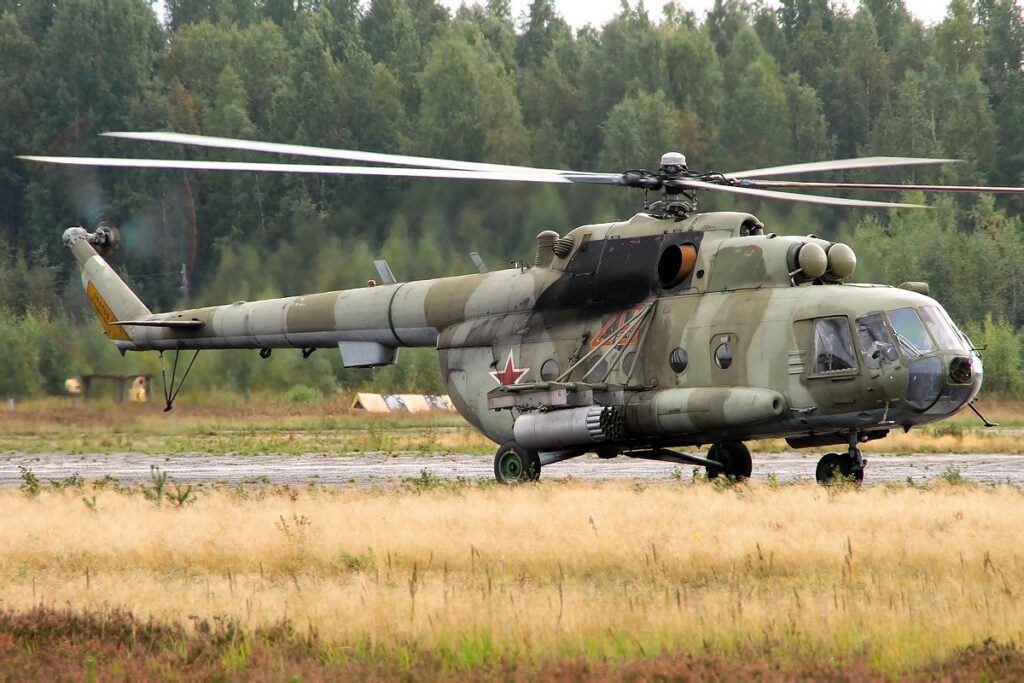
Russia plans to double Mi-8 helicopter production to offset war losses in 2 years

Mi-8 helicopter

Russia plans to make 72 Mi-8 helicopters at their Kazan plant over the next two years, more than offsetting their total full-scale invasion losses of 56 units as of March, Dallas Analytics reported, citing leaked Russian documents. It is also double the production rate from earlier estimates.

Russia also has another Mi-8 factory at Ulan-Ude. In 2024, both plants jointly delivered 40 helicopters, according to Moscow’s defense conglomerate Rostec. A December analysis by Frontelligence Insight, also based on leaked documents, estimated that Russia can make 20 Mi-8s at each plant per year.

The number of helicopters the Ulan-Ude plant can produce is unknown. However, if it has similar capacity to the Kazan plant, Russia’s production rate could be substantially higher. 

Mi-8s are versatile workhorses, able to transport troops and cargo, conduct reconnaissance, electronic warfare, and attack missions. Due to heavy losses, their role moved away from frontline missions during the battle of Kyiv, towards evacuation, and subsequently indirect fire roles and hunting Ukrainian UAVs and USVs on the Black Sea.

War has changed significantly since before the full-scale invasion, largely due to the invasion. The ubiquity of drones means that Russia could hardly risk attempting large-scale airborne assault operations.

However, if Russia plans to escalate its hybrid war against NATO into more direct aggression, as some Alliance military officials predict, the Mi-8s would come in handy for ground incursions.  

The production plan also hints at Russia’s priorities. The leaked document, minutes from a meeting involving Russian Deputy Minister of Industry and Trade Gennady Abramenkov, states that the National Wealth Fund would contribute financing, which means that Moscow's reserve cash is being poured into maintaining and rebuilding its war machine.

On the other hand, the documents revealed some potential hiccups in Russia's plan to rebuild the Mi-8 fleet. Many details seem to hang on contractors securing advance payments and contracts that have yet to be signed. The United Engine Corporation is expected to only start delivering engines for the Mi-8s beginning in September.

One clause calls for an estimate of how many helicopters can "actually" be built in 2026, suggesting that there's a gap between expectation and reality. 

  •  

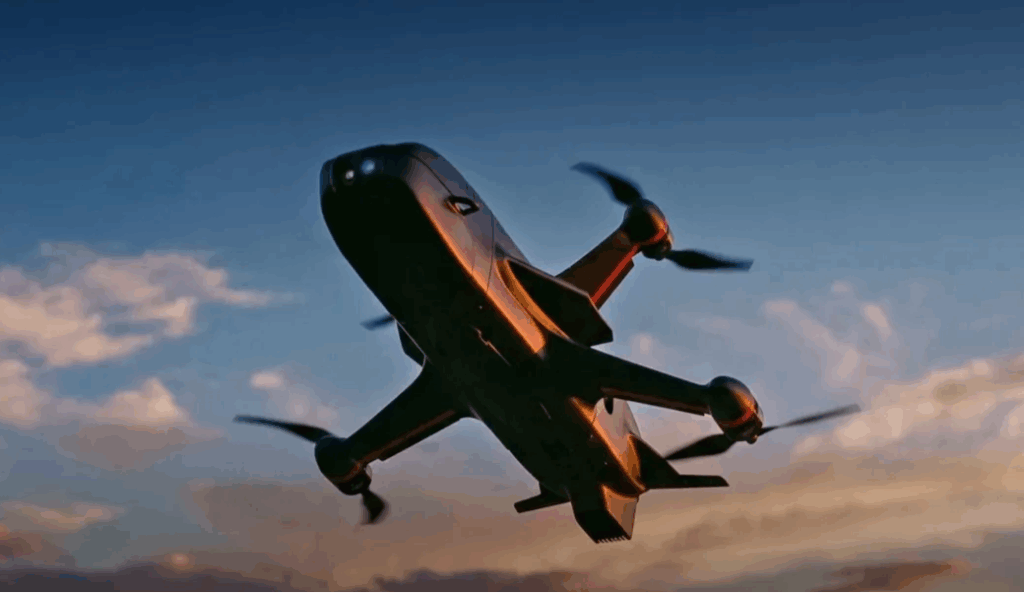
Newly-announced Litavr interceptor is a model microcosm of Ukraine’s drone innovation programs

Litavr interceptor drone F-drones

If you want to understand how Ukraine’s interceptor drones are evolving and improving but don’t have a lot of time, you can just take a look at the Litavr interceptor announced by the Ministry of Defense on 8 June. 

F-Drones’ Litavr has been in serial production since the fall but its specs have been classified until now. While its capabilities do not appear to be brand new or exclusive to itself, the features list reads like a map of all the ways Ukrainian engineering and battle testing of the past few years made their various interceptors so highly sought-after.  

That includes autonomous last-mile guidance, non-GPS navigation, radar integration, and the ability to control the drone from thousands of kilometers away. The company reportedly manufactures most of its own components, reducing dependence on China. 

All these things are instrumental to Ukraine’s goal of “closing the sky” to Russian weapons. The Defense Ministry set a goal of shooting down no less than 95% of Russian drones and missiles and has been steadily climbing towards that goal: from just over 80% shot down late last year, to 92% shot down in May. 

Last-mile autonomy

According to the MoD, the Litavr's key ability is the automatic pixel lock last mile guidance, in which a pilot controls the speed, while the drone does the rest. 

Semi-autonomous weapons are one of the major achievements of Ukraine’s military-industrial ecosystem. Defense Minister Mykhailo Fedorov emphasized autonomy as a key technology. 

“Autonomy is one of the key areas of development of modern air defence,” he said in a 8 June statement.

“Technologies like this enable faster responses to large-scale attacks and more effective protection of Ukrainian cities. We are scaling solutions that have already proved their effectiveness in combat conditions.” 

Fedorov claimed that a Brave1 company has already created tech that automates 95% of the "entire interception process, from launching a drone to destroying a Shahed," which has been battle-tested in Kharkiv Oblast. 

AI-assisted navigational and target lock tools are present in a plethora of Ukrainian drones: from deep and middle strike UAVs, to FPVs, to interceptors, which were reportedly getting anti-Shahed modules in December.

Across Ukraine and around the world, companies and volunteer cooperatives are using the country’s archive of battlefield footage to train models to become progressively more accurate and deadlier in combat. 

Navigation and controls

Besides its daytime and thermal cameras, the Litavr has its own non-GPS navigation tools and integrates into existing radar systems through a proprietary software package. 

The announcement was light on details, but this is another demonstration of Ukraine creating solutions to the realities of Russia’s war. The skies and battlefields are full of jamming and spoofing, which makes GPS a highly-unreliable solution. 

Adaptations have included visual-inertial odometry, like the kind NASA's Mars drones use, beacon-based systems, AI that image matches preloaded terrain data, and tapping into nearby radar systems, like the Litavr does. 

The drone also incorporates a system that allows operators to steer them from hundreds or thousands of kilometers away. 

This system has been in development for over a year and announced in April, with more than 10 manufacturers integrating it into their systems. Wild Hornets made a splash online with their announcement that an operator took down a target from outside Ukraine's borders.

Speed and range

The Litavr has a reported top speed of 350 kilometers per hour. This isn’t the first drone with such a claim—the MoD said the same thing of the JEDI Shahed Hunter presented in March—and other drones before it had similar claims made about them, like the Furia.  

However, 350 km/h is on the upper end of most interceptors in use these days. The more famous drones of this class like SkyFall’s P1-SUN has a reported top speed of 310 km/h and Wild Hornets’ Stinger reportedly hit 315 km/h in tests, though the website says it tops out at 280 km/h. This was a massive upgrade from earlier Sting, which could reportedly go up to 160 km/h.

Ukraine is pushing that ceiling higher. As early as December, the Brave1 Defense Cluster announced that Ukraine can now mass-produce a motor that can accelerate an interceptor to 400 kilometers per hour. The manufacturer, Motor G, makes more than 100,000 motors per month, according to the announcement.

Geran-3 jet-powered Russian attack drone. (Photo: Wild Hornets)

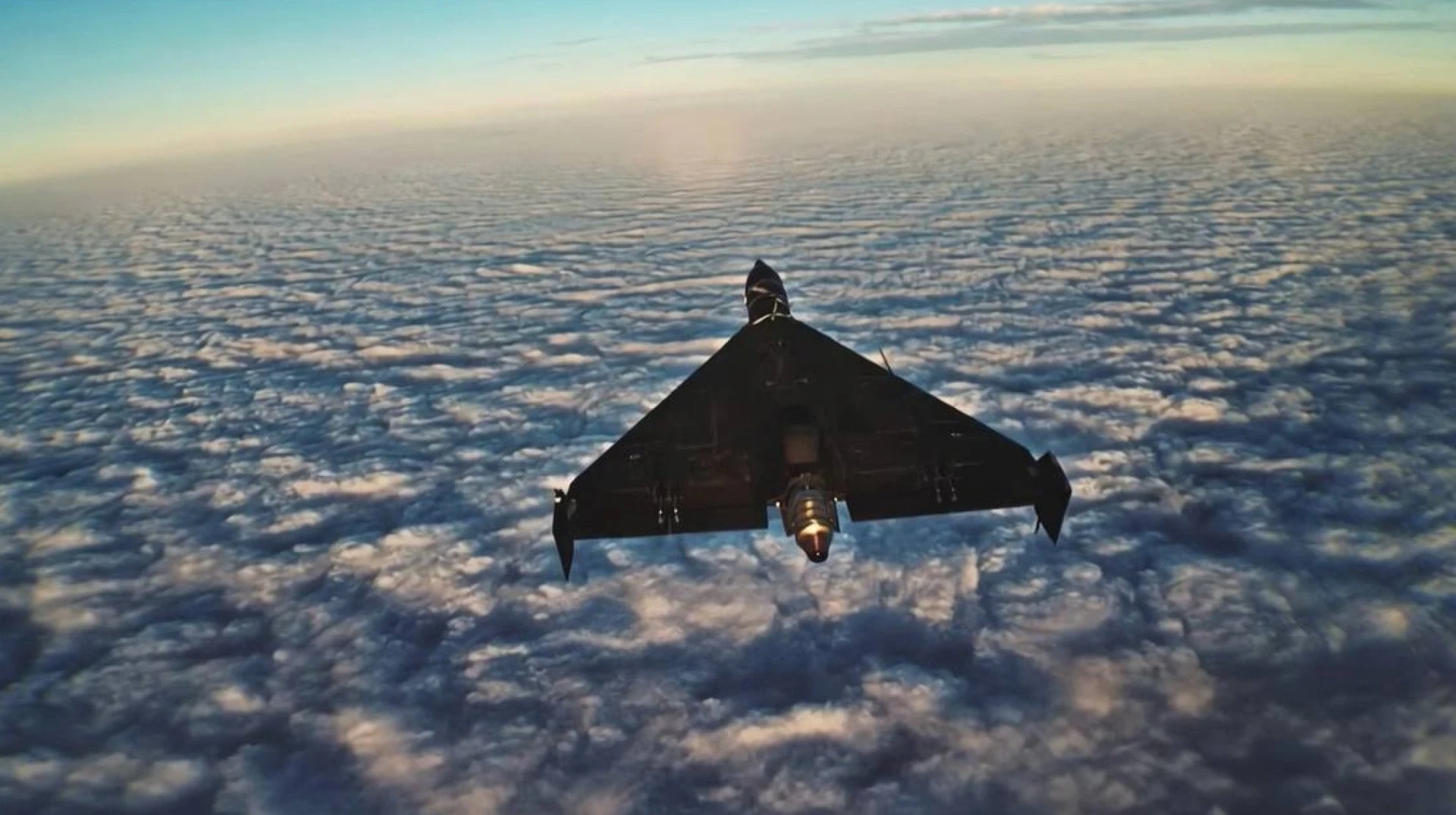
The growing speed is needed to combat jet-powered Shaheds, whose speeds can climb up to 600 kilometers per hour, which is a drum MoD adviser Serhiy “Flash” Beskrestnov has been beating constantly. Ukrainian devs are working on the problem: for example, General Cherry and STRIX are reportedly integrating chemical boosters into their Bullet interceptors.

Litavr’s operational range of 40 kilometers appears to be comparable to the Sting, though the MoD claimed a record flight of 80 km for the former. The flight ceiling of 9 kilometers appears to be higher than many interceptors of Litavr’s type, which range from 3 to 7 km.

Reducing reliance on China

The manufacturing is also indicative of what Ukraine is trying to accomplish. F-Drones reportedly builds most of its own electronics, engines and flight controllers.

Ukraine's government has a stated goal to reduce its dependence on Chinese parts, which, while cheaper, also pose a security risk. If China stops the flow of parts for whatever reason, Ukraine's entire weapons industry can be in trouble. China also supplies many of the parts for the very Shaheds these interceptors are meant to stop. 

According to a December report by Zmiinyi (Snake) Island Institute, Ukraine's domestic manufacturers covered 70% of the need for communication systems for controlling drones, and 55% for analog video transmitters. The institute believes that Ukraine has the potential to cover 100% of the market in these three categories. 

At the time of the report, Ukrainian manufacturers produced just 25% of flight controllers for domestic FPV drones, 14% of the thermal cameras and 12% of the electric motors. However, the Institute projected that Ukraine can produce as much as 75% of flight controllers, 90% of thermal cameras and 50% of electric motors over 2026.

  •  
❌