Login
Login
Ukraine just showed world its first homegrown glide bomb in Paris
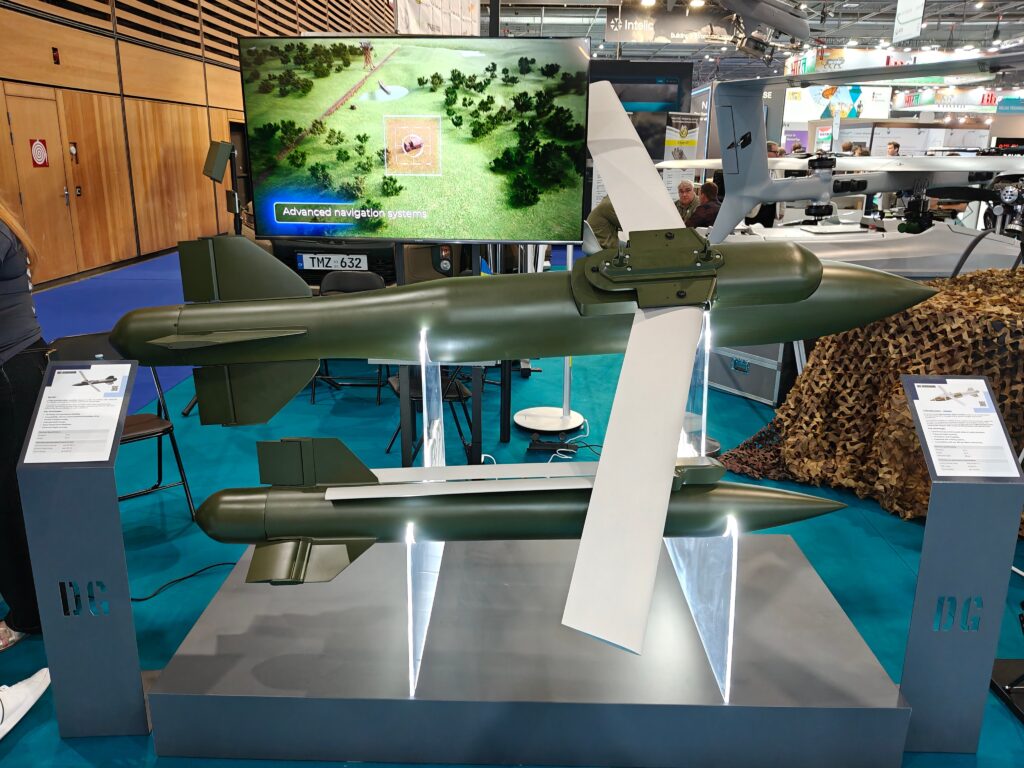
Ukraine's first domestic guided glide bomb, Vyrivniuvach, made its public debut at the Eurosatory-2026 defense exhibition in Paris. Images from the OSINT source Jeff2146 on X have revealed the design of the 250-kilogram weapon developed by DG Industry through the Brave1 platform.
The Vyrivniuvach matters because it represents Ukraine's first domestically produced response to Russia's intensive use of KAB glide bombs, which Russia dropped at a rate exceeding 5,700 per month in January 2026. Ukraine announced the Vyrivniuvach's combat readiness on 18 May 2026. The bomb costs approximately one-third as much as the US JDAM-ER kits Ukraine has used since early 2023.
Defense Express analysis indicates the bomb's declared maximum range of 130+ kilometers is achievable only from high altitude, with a realistic combat range likely closer to 40 kilometers when launched via low-altitude toss-bombing.
Defense Express analysis identifies design differences from US JDAM-ER
The Vyrivniuvach consists of two main modules: a wing block with deployment and locking mechanisms that mounts to the bomb body via clamps, and a tail section that replaces standard fin assemblies and contains the navigation and guidance module.
Defense Express analysts examined the Vyrivniuvach photographs released from Eurosatory-2026 and identified key design differences from the US JDAM-ER kit Ukraine has used since 2023.
The American JDAM-ER uses three of four fully rotating control surfaces, while the Vyrivniuvach uses stabilizers combined with smaller-area control surfaces. The Ukrainian design represents what Brave1 described in May as a unique Ukrainian construction rather than a copy of Western or Soviet systems, per Business Insider.
Russian air superiority forces low-altitude toss-bombing tactics
Defense Express analysts assessed that the only realistic application of the Vyrivniuvach is low-altitude release via a toss-bombing maneuver, when the carrier aircraft approaches the target at low altitude and executes a sharp climb (Ukrainian "hirka" or "hill").
In this tactical profile, the bomb's range is limited to approximately 40 kilometers rather than the declared 130+ kilometers. The tactical constraint results from Russia's deployment of long-range surface-to-air missiles and fighter aircraft that threaten Ukrainian carrier aircraft attempting high-altitude releases.
The 40-kilometer effective range nonetheless exceeds the engagement range of most Russian frontline air defenses while keeping carrier aircraft below the Russian fighter radar envelope.
The same 40-kilometer figure approximates the operational range of standard Russian UMPK kits before Russia introduced the extended-range UMPK-PD variant in 2025.
Brave1 platform enables Ukrainian domestic precision weapons production
The Vyrivniuvach development was supported by Brave1, Ukraine's defense technology accelerator, established on 26 April 2023 by the Ministry of Digital Transformation, jointly with the Ministry of Defense, the General Staff, the Ministry for Strategic Industries, the Ministry of Economy, and the National Security and Defense Council.
Brave1 has registered more than 3,500 defense developments, codified over 260 items to NATO standards, and distributed more than 470 grants totaling approximately $29.3 million, according to Army Recognition.
The Vyrivniuvach represents one of Brave1's highest-profile precision-weapon outputs, joining a portfolio that includes missiles, anti-Shahed systems, sea drones, swarm drones, anti-KAB systems, and other guided munitions, per the War Zone. Ukraine's Defense Ministry confirmed the procurement of an initial experimental batch in May 2026 for further operational evaluation under combat conditions.