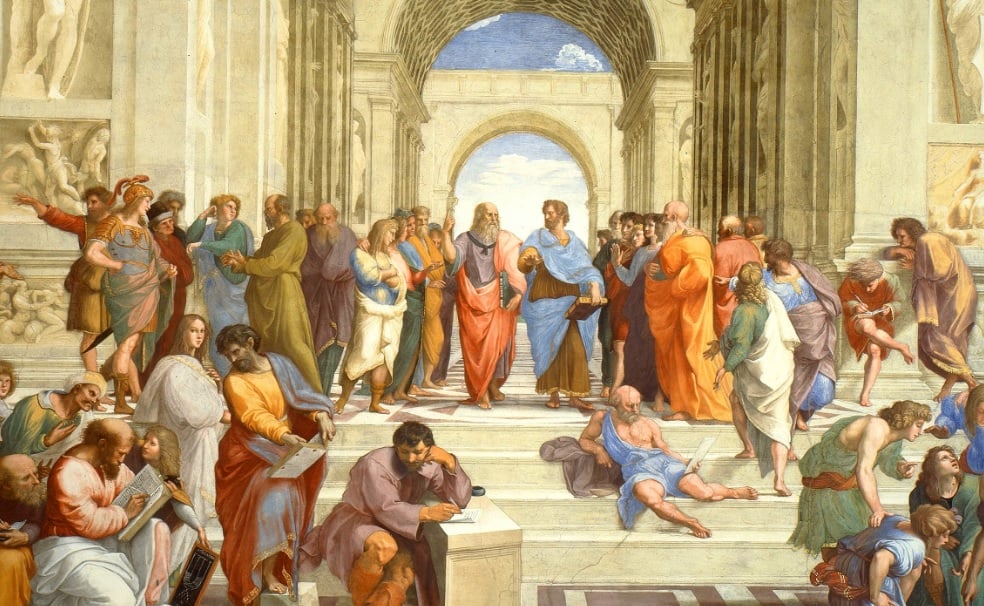
“The School of Athens,” depicting some of the Ancient Greek philosophers, by Raphael. Vatican Museums. Credit: Public domain
Several of the most influential Greek philosophers and thinkers are portrayed in Raphael’s masterpiece the School of Athens, which adorns the Apostolic Palace in the Vatican.
Painted between 1509 and 1511, it portrays a congregation of philosophers, mathematicians, and scientists from Ancient Greece, including Plato and Aristotle. But did you know that, in addition to the two philosophers in the center of the painting, there are six more “hiding”?
In his work, Raphael desired to pay his deepest tribute to the greatest philosophers in history, several of whom had tried throughout their lives to discover the prime mover, or cause, in the universe, a branch of thought known as the “knowledge of the first causes.”
It also shows sculptures of the Greek gods Athena, portrayed as the Roman goddess Minerva, representing Wisdom, and Apollo, representing Light and Music, in a direct nod to the greatness of Greek mythology and its contributions to the Western world. In short, Raphael’s painting is the Who’s Who of ancient Greek culture.
Who are the ancient Greek philosophers in Raphael’s painting?
Plato and Aristotle
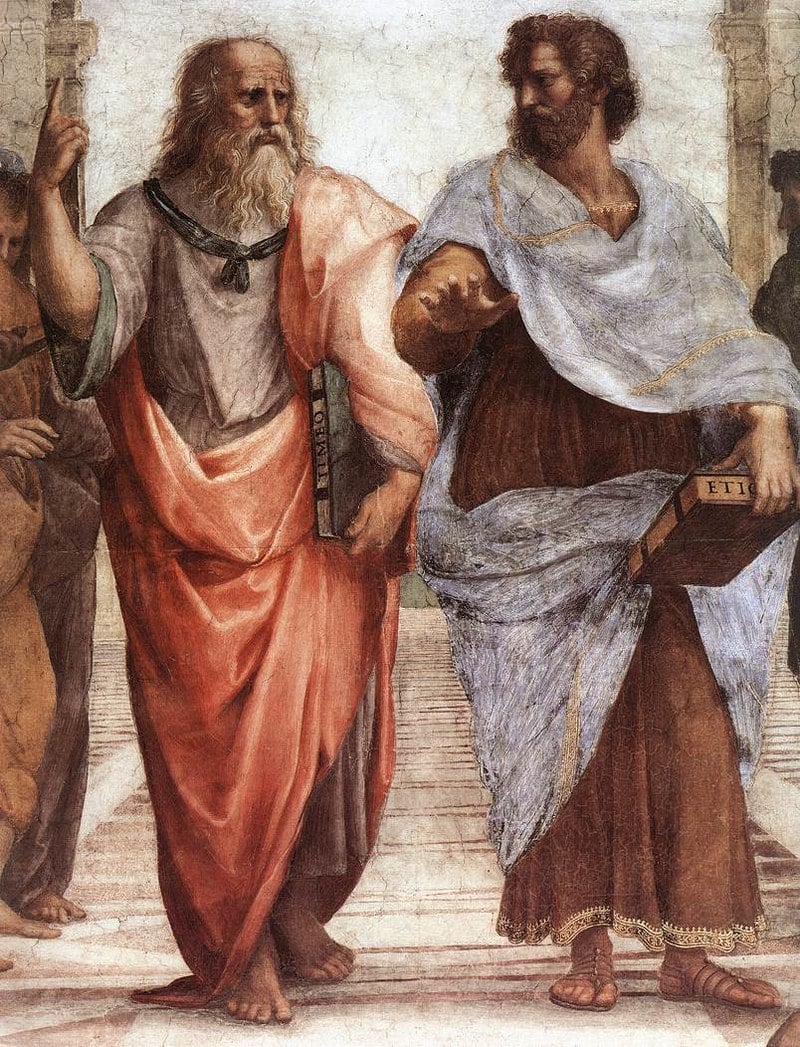
Plato and Aristotle, The School of Athens. Credit: Public Domain
The two main figures in the work are placed directly under the archway and in the fresco’s vanishing point, a compositional trick meant to draw the viewer’s eye to the most important part of the painting. Here, we see two men who effectively represent the different schools of philosophy—Plato and Aristotle.
An elderly Plato stands on the left, pointing his finger to the sky. Beside him is his student, Aristotle. In a display of superb foreshortening, Aristotle reaches his right arm directly out toward the viewer. Each man holds a copy of their books in their left hand—Timaeus for Plato and Nicomachean Ethics for Aristotle.
Socrates, the founder of Western philosophy
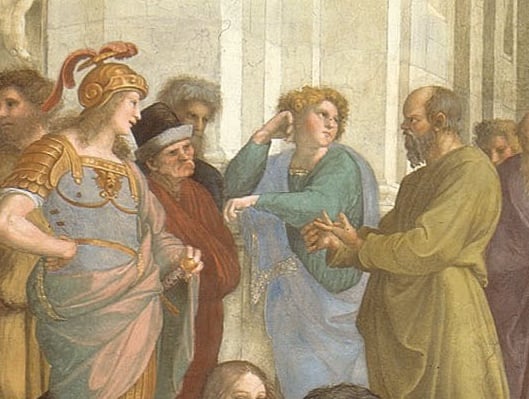
Socrates depicted lecturing his students. Credit: Public Domain
To the left of Plato, Socrates is recognizable thanks to his distinct features. It is said that Raphael was able to use an ancient portrait bust of the philosopher as his guide.
Among the crowd surrounding Socrates are his students, including the general Alcibiades and Aeschines of Sphettus.
Socrates is credited as the founder of Western philosophy and was among the first moral philosophers of the ethical tradition of thought.
Pythagoras, the theorist of metempsychosis
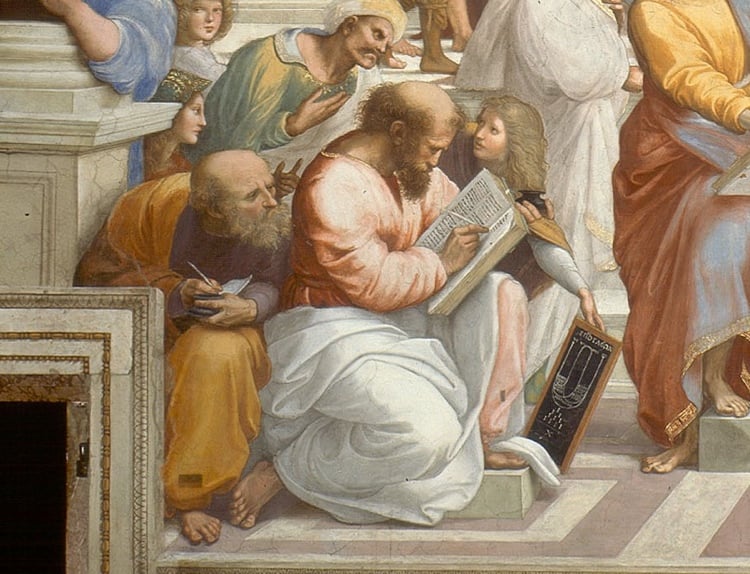
Pythagoras’ philosophy influenced Plato and Aristotle. Public Domain
In the foreground, Pythagoras sits with a book and an inkwell, also surrounded by students.
The influence of Pythagoras in mathematics and philosophy remains indisputable to this day. His philosophy influenced both Plato and Aristotle, and through them, his ideas became fundamental to Western philosophy.
The teaching most securely identified with Pythagoras is metempsychosis, or the “transmigration of souls,” which holds that every soul is immortal and, upon death, enters into a new body.
Euclid, the father of geometry
Euclid established the foundations of geometry. Credit: Public Domain
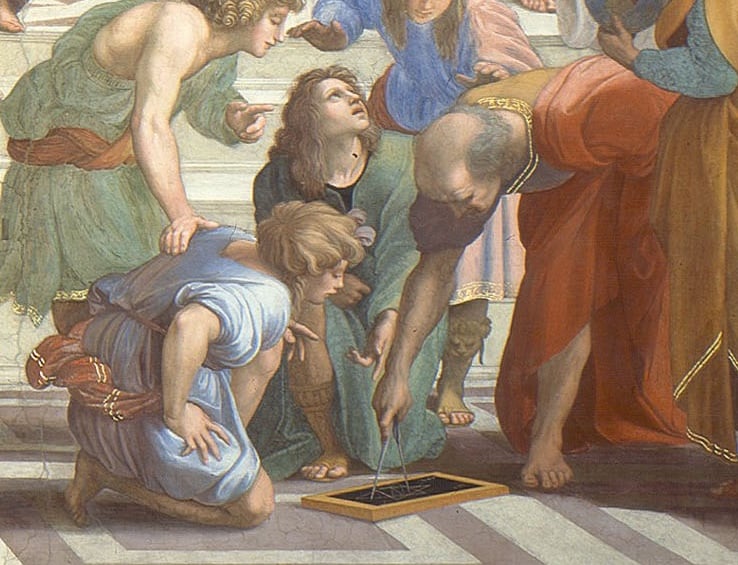
Mirroring Pythagoras’ position on the other side, Euclid, considered the “father of geometry,” is bent over demonstrating something with a compass. His young students eagerly try to grasp the lessons he’s teaching them.
Euclid is chiefly known for the Elements treatise, which established the foundations of geometry that largely dominated the field until the early 19th century.
Ptolemy, the great mathematician and astronomer
Ptolemy was a great mathematician. Credit: Public Domain
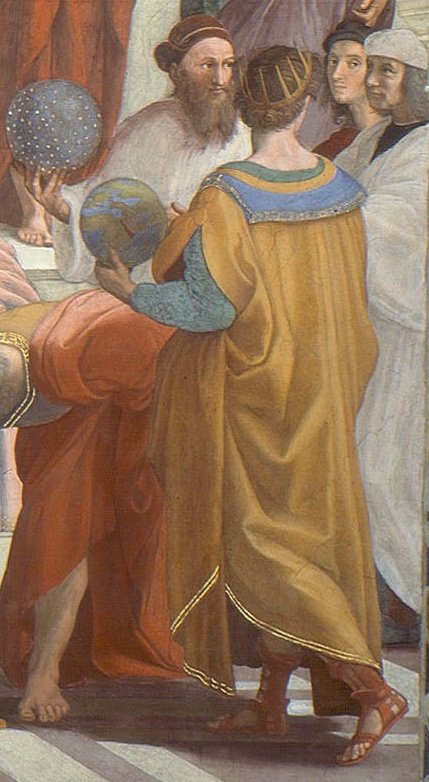
The great mathematician and astronomer Ptolemy is right next to Euclid, with his back to the viewer. Wearing a yellow robe, he holds a terrestrial globe in his hand. It is believed that the bearded man standing in front of him holding a celestial globe is the astronomer Zoroaster.
Ptolemy wrote about a dozen scientific treatises, some of which were of importance to later Byzantine, Islamic, and Western European science.
Diogenes: The ancient Greek philosopher of cynicism
Diogenes was a homeless man by choice whose life goal was the search for wisdom. Credit: Public Domain
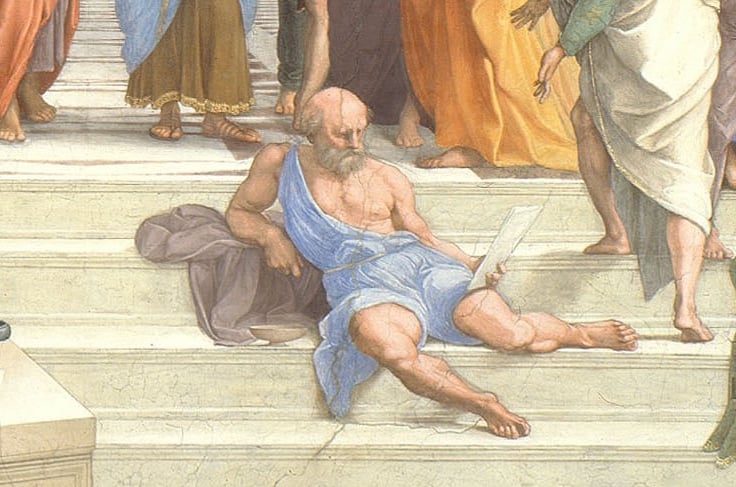
Diogenes the Cynic (also known as Diogenes of Sinope) could have been the first anarchist, absurdist, satirist, or naturalist—depending on the reader’s point of view. By today’s standards, Diogenes was a homeless man by choice, and his life goal was the search for wisdom.
Heraclitus: The Greek philosopher of wisdom
“No man ever steps in the same river twice,” Heraclitus famously said. Credit: Public Domain
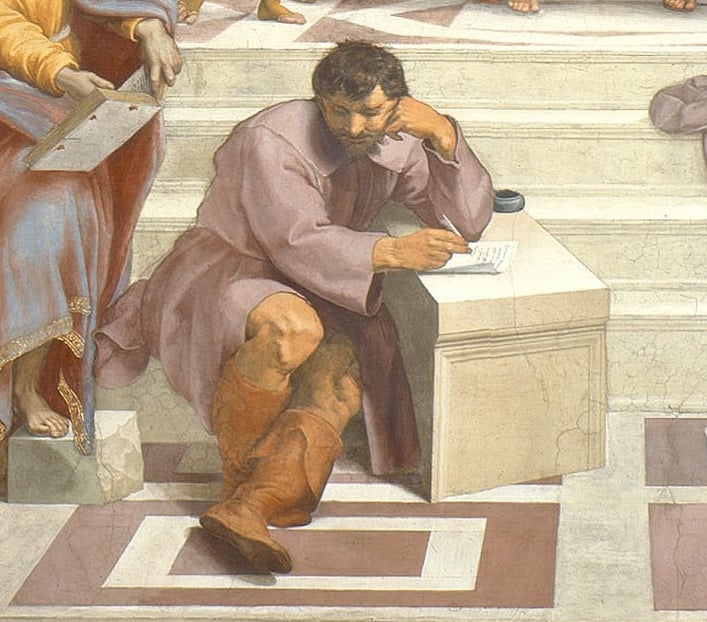
Heraclitus was an ancient Greek pre-Socratic philosopher from the city of Ephesus, then part of the Persian Empire. He saw the world as constantly in flux, changing as it remained the same, and expressed this in saying, “No man ever steps in the same river twice.”
He was a self-taught pioneer of wisdom and a melancholy character who did not enjoy the company of others, making him one of the few isolated characters in the fresco.
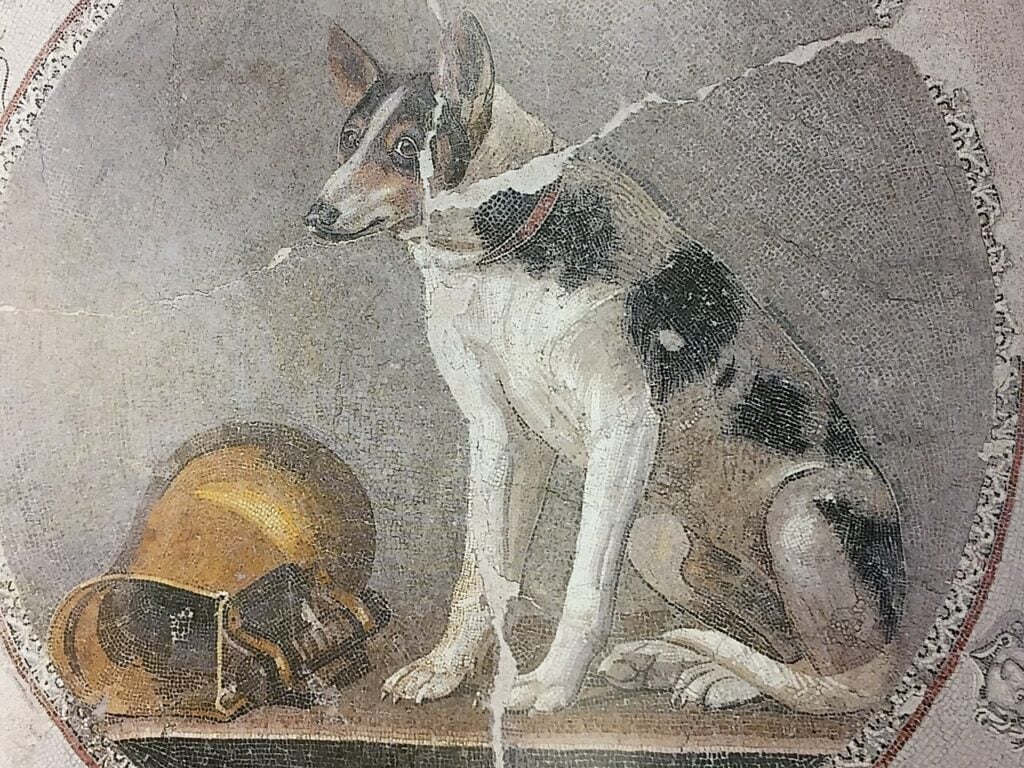
Ancient Greeks believed that animals had intelligence, reason, and emotion. Ptolemaic mosaic from Hellenistic Egypt, dated between 200 – 150 BC, located in the Greco-Roman Museum of Alexandria, Egypt. Credit: Public Domain
Ancient Greeks held deep respect and affection for animals, believing they possessed reason, intelligence, and emotion, even as they hunted and sacrificed them to the gods. Greek literature and philosophy reveal a culture that viewed animals not merely as property but as living beings connected to humanity through thought, feeling, and shared experience.
Among the ancient thinkers who reflected most passionately on the treatment of animals was the historian Plutarch, whose writings remain among the strongest defenses of animals in the ancient world. Long before modern debates over animal welfare emerged, Plutarch argued that animals possessed intelligence and emotion and that cruelty toward them degraded the human soul itself. His ideas did not exist in isolation. Rather, they grew out of a broader Greek tradition in which animals occupied an honored place in religion, philosophy, daily life, and even familial affection.
The Ancient Greeks lived closely alongside animals in nearly every aspect of life. Dogs guarded homes and accompanied hunters, while horses symbolized nobility and courage. Birds were kept for pleasure, and cats, although less common than in Egypt, were sometimes used to control pests. Greek children played with pets, and wealthy households often treated favored animals as cherished members of the family.
Pet tombstones reveal Ancient Greeks loved their animals
Archaeological discoveries confirm the deep emotional attachment Ancient Greeks felt toward their pets. Tombstones dedicated to dogs, horses, and birds have been uncovered throughout the Greek world, and some inscriptions mourn animals with the same tenderness reserved for human relatives. One epitaph for a dog named Parthenope expresses grief in deeply personal language, demonstrating that the death of a beloved pet could inspire genuine sorrow. Greeks occasionally buried pets beside their owners or placed them in carefully prepared graves filled with offerings and decorations. These burials suggest that companionship with animals was not merely practical but also emotional and spiritual.
This affection appears vividly in Greek literature. In the Odyssey, the old dog Argos waits faithfully for Odysseus for twenty years. When Odysseus finally returns home in disguise, Argos recognizes him immediately before dying. The scene is brief yet unforgettable because Homer portrays the dog as capable of loyalty, memory, and emotional recognition. The moment suggests that Ancient Greeks understood animals as creatures capable of deep attachment.
Greek mythology likewise reflected admiration for animals. The owl symbolized wisdom through its association with Athena, while dolphins were regarded as intelligent and sacred creatures connected to Apollo and Poseidon. Horses were honored in myths surrounding heroic figures such as Achilles. Even the gods themselves frequently appeared in animal form, suggesting a sacred bond between humanity, divine power, and the natural world. One of the most famous examples is Zeus transforming himself into a magnificent white bull to carry away Europa.
Greek philosophers on animals
The philosophical discussion of animals became especially significant among thinkers associated with Pythagoras. Pythagoras himself believed souls could migrate between humans and animals through reincarnation. Because of this belief, he discouraged the eating of meat and taught respect for all living creatures. According to ancient tradition, he once intervened to stop a man from beating a dog, claiming he recognized the voice of a deceased friend within the animal.
Pythagoras was firmly opposed to killing “living creatures,” abstaining from what ancient sources describe as “harsh-sounding bloodshed,” including animal sacrifice, and reportedly “never eating meat.” In this sense, he is often regarded as the first Greek vegetarian. None of his original writings survive today, but his ideas are known through later authors such as Philolaus, Iamblichus, Ovid, and Plutarch.
Across these accounts, it becomes clear that Pythagoras was believed to hold that animals possessed a soul. As attributed in Ovid’s writings, “Animals share with us the privilege of having a soul,” a sentiment associated with Pythagorean teaching and vegetarian practice.
The Greek philosopher Empedocles, himself influenced by Pythagorean thought, later expanded these ideas by arguing that all living beings share kinship. He condemned the killing of animals and viewed both violence toward them and their consumption as morally corrupting. He even described animal sacrifice as a form of injustice, regardless of its religious purpose. Tradition holds that he once crafted an ox out of barley meal and perfumes as an offering to the gods in place of a real animal. Such ideas were radical in a society where animal sacrifice remained central to religious life, yet they demonstrate that compassion toward animals already held a respected place in Greek philosophical thought.
Plutarch: the first animal rights advocate
No ancient writer expressed these ideas more forcefully than the biographer Plutarch. Living during the 1st and early 2nd centuries AD, Plutarch wrote essays that challenged widely held assumptions about human superiority. In works such as “On the Eating of Flesh and Whether Land Animals Are Cleverer Than Sea Animals,” he argued that animals possessed intelligence, emotion, and reasoning ability.
Plutarch was troubled not only by cruelty toward animals itself but also by the indifference people showed toward suffering. One of his most cited passages asks readers to confront the moral shock of eating flesh: “I for my part do much admire in what humor, with what soul or reason, the first man with his mouth touched slaughter.”
This was not merely a dietary critique. Plutarch believed that violence toward animals corroded human morality. In his view, cruelty was a habit that extended outward. Societies accustomed to bloodshed against animals risked becoming desensitized to violence more broadly.He also rejected the idea that animals lacked intelligence. Plutarch insisted that animals possessed perception, memory, emotion, and understanding. In one striking passage, he describes them as beings capable of thought and awareness: “Each animal hath received from Nature…imagination, and intellection.”
For Plutarch, this recognition carried clear ethical implications. He criticized those who treated living creatures as mere objects of pleasure or luxury. In another memorable line, he writes: “But for the sake of some little mouthful of flesh, we deprive a soul of the sun and light.” Such language is striking because it attributes something close to personhood to animals. Plutarch ultimately presents them not as mindless beings but as fellow participants in the shared experience of life itself.
Ancient Greek philosopher Aristotle finds similarities between behavior of humans and animals
Other Ancient Greek thinkers also recognized forms of intelligence in animals. Aristotle, though less compassionate than Plutarch, studied animals extensively and acknowledged notable similarities between animal and human behavior. In his biological works, he observed memory, communication, and social organization across a wide range of species. Theophrastus, Aristotle’s successor, went even further, arguing that animals could reason and experience pain in ways comparable to humans. He opposed unnecessary slaughter, maintaining that humans and animals share a natural kinship.
Respect for animals in the Ancient Greek world also appeared in religious practice. Certain animals were considered sacred to specific gods, and in some sanctuaries, their killing was forbidden. Festivals at times honored animals alongside deities, while myths frequently portrayed them as wise guides, loyal companions, or messengers of divine will.
Yet the Greek attitude toward animals was never entirely uniform. The same society that mourned pets and admired dolphins also engaged in hunting and animal sacrifice. Oxen plowed fields, horses served in warfare, and livestock provided food. Ancient Greek culture therefore contained an ongoing tension between the practical use of animals and a genuine admiration for them.
This contradiction is what makes Plutarch particularly significant. Rather than accepting cruelty as inevitable, he challenged prevailing norms directly. He questioned whether intelligence, emotion, and the capacity to suffer should carry moral weight. In many ways, his writings anticipate modern discussions of animal consciousness and ethical responsibility.
Plutarch’s insistence that animals possess intelligence and feeling ultimately challenged assumptions of human superiority. He argued that kindness toward animals was inseparable from human virtue itself. To harm innocent creatures unnecessarily was, in his view, to diminish one’s own humanity.
Hermogenes of Tarsus developed the seven ancient Greek styles of speech to explain how rhetoric shapes clarity, emotion, persuasion, character, and intellectual power. Credit: GreekReporter archive.
Among the greatest rhetorical theorists stood Hermogenes of Tarsus, an Ancient Greek sophist and rhetorician who lived during the second century AD and developed a sophisticated theory of style that categorized speech according to seven major rhetorical qualities or styles of speech. These included Clarity (saphēneia), Grandeur (megethos), Beauty (kallos or omorphia), Rapidity (gorgotēs), Ethos, Sincerity, and Force (deinotēs).
Although many people mistakenly associate these rhetorical categories with the rhetorician Demosthenes, the systematic classification belongs to Hermogenes himself. Together, these categories formed a complete philosophy of expression. Hermogenes did not view rhetoric as ornamental alone. Instead, he treated speech as a living art capable of shaping thought, emotion, and public action.
The Ancient Greek Hermogenes and the art of rhetoric qualities or styles of speech
Ancient Greek rhetoric shaped political life, education, philosophy, and literature for centuries. Public speech held enormous importance in the Greek world because success in courts, assemblies, and intellectual debates depended upon persuasive expression. As rhetoric evolved, Greek thinkers attempted to classify the qualities that made speech effective, elegant, and emotionally powerful.
Hermogenes of Tarsus gained fame at a very young age. He was a rhetorical prodigy whose abilities astonished teachers and audiences alike, and he later composed several influential rhetorical treatises, especially On Types of Style. This work became one of the most significant manuals of rhetoric in late antiquity and Byzantium. Byzantine scholars such as George of Trebizond studied Hermogenes extensively, and introduced his theories in the West during the Renaissance.
Unlike simpler rhetorical systems, Hermogenes established a highly nuanced approach. He understood that persuasive speech requires flexibility rather than rigid formulas. Differing situations demand different styles, tones, and emotional effects. For this reason, his seven categories of styles of speech function less as isolated techniques and more as interconnected dimensions of expression.
“Clarity,” or Saphēneia, as a critical style of speech according to the Ancient Greek Hermogenes
Hermogenes considered clarity the foundation of all effective speech. Without clarity, audiences are unable to follow arguments or comprehend meaning. A speaker may possess intelligence and passion, yet confusion eradicates persuasion. Clarity therefore requires precise vocabulary, logical structure, and direct expression. Sentences should communicate ideas without unnecessary obscurity.
Nevertheless, Hermogenes did not reduce clarity to simplicity alone. Clear speech can still remain elegant and intellectually sophisticated. The goal involves illumination rather than oversimplification.
Greek philosophers also highly valued clarity. The philosopher Plato often criticized sophists who concealed weak arguments beneath decorative language. Similarly, Aristotle emphasized intelligibility as an essential feature of rhetoric. Hermogenes continued this tradition while developing a more refined stylistic analysis.
Plato criticized the sophists in his work “Gorgias.” Credit: Sebastian Bertrand. flickr
“Grandeur” as one of the most significant rhetorical qualities
Grandeur introduces elevation, dignity, and majesty into speech. This style suits heroic themes, political crises, moral exhortation, and public ceremonies. A grand style expands language through emotional intensity, powerful imagery, and elevated rhythm. Speakers using grandeur aim to inspire awe and admiration. Demosthenes often exemplified this quality in his speeches against Philip of Macedon. His rhetoric combined patriotic urgency with emotional force.
However, Hermogenes warned against excess. Grandeur must remain controlled. Otherwise, speech becomes inflated and artificial. True grandeur emerges from harmony between content and expression. Noble themes require compatible, equally noble language, yet authentic emotion must guide rhetorical elevation.
Statue of Greek God Zeus. Credit: flickr / Richard Mortel CC BY 2.0
The speech style of “Beauty,” or Omorphia
Beauty in rhetoric concerns elegance, harmony, and aesthetic pleasure. Hermogenes believed that beautiful speech delights audiences through rhythm, imagery, and balanced structure. This quality resembles artistic composition in poetry, sculpture, or music. Beautiful speech flows smoothly and creates emotional resonance through sound and proportion.
Greek culture deeply associated beauty with order and harmony. Philosophers often linked external beauty with inner balance. Hermogenes applies this principle directly to language. A beautiful style does not merely persuade intellectually. It also captivates emotionally and aesthetically.
Writers achieve beauty through careful word choice, graceful transitions, and balanced phrasing. Metaphors, cadence, and musicality all contribute to this effect. Nonetheless, Hermogenes again emphasizes moderation. Excessive ornament weakens rhetorical effectiveness. Beauty must support meaning rather than overwhelm it.
Doryphoros statue. Roman copy of the late 1st century BC — early 1st century AD, replica of a Greek bronze original by Polykleitos of the 5th century. Credit: flickr / Sergey Sosnovskiy cc by 2.0
The speech style of “Rapidity,” or Gorgotēs
Rapidity injects speech with energy, movement, and urgency. Hermogenes used the term gorgotēs to describe swift and dynamic expression that propels audiences forward. This style relies upon shorter clauses, quick transitions, and vigorous pacing. Rapid speech creates excitement and emotional momentum.
Orators often utilized this technique during moments of tension or conflict. Fast-moving rhetoric can produce feelings of urgency, danger, or passionate conviction. At the same time, rapidity demands careful control. If speech moves too quickly, audiences lose comprehension. Therefore, speakers must balance speed with clarity.
Hermogenes admired speakers who could accelerate rhythm without sacrificing coherence. Rapidity also reflects psychological intensity. Passionate conviction naturally produces energetic language and movement.
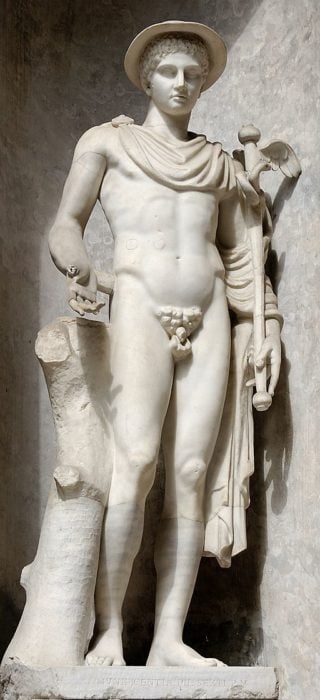
Hermes Logios was the god that protected rhetoricians. Courtesy of Vatican Museums. Credit: Public domain, via Wikimedia Commons
Styles of speech, “Ethos,” and “Sincerity”
Ethos concerns character and moral presence within speech. Aristotle had already emphasized ethos as one of the three pillars of persuasion. Hermogenes expanded this concept stylistically. A speaker’s language reveals personality, values, and emotional disposition. Audiences trust speakers who appear honorable, wise, and sincere.
Ethos therefore demands moral credibility and emotional authenticity. Differing rhetorical situations also require varying forms of ethos. A judge, philosopher, general, or grieving citizen each projects distinct moral qualities through speech.
Hermogenes understood that persuasion depends heavily upon the audience’s perception of character. Even brilliant arguments fail when listeners distrust the speaker. Thus, rhetorical success involves ethical presence as much as intellectual ability.
Sincerity is another trait that creates emotional truthfulness and human immediacy. Hermogenes recognized that audiences respond deeply to speech that feels genuine. A sincere speaker avoids excessive theatricality or artificial ornament. Instead, sincerity emerges through direct emotional connection and honest expression. This style often appears in personal appeals, lamentations, or moral reflections. Sincere rhetoric results in intimacy between the speaker and audience.
Greek tragedy frequently employed this quality during scenes of grief or confession. Philosophers also valued sincerity because truth required alignment between speech and inner conviction. Hermogenes therefore treated sincerity as a rhetorical strength rather than weakness. Genuine emotion can persuade more powerfully than technical brilliance alone. Nonetheless, sincerity still requires artistic control. Raw emotion without structure can become chaotic or ineffective.
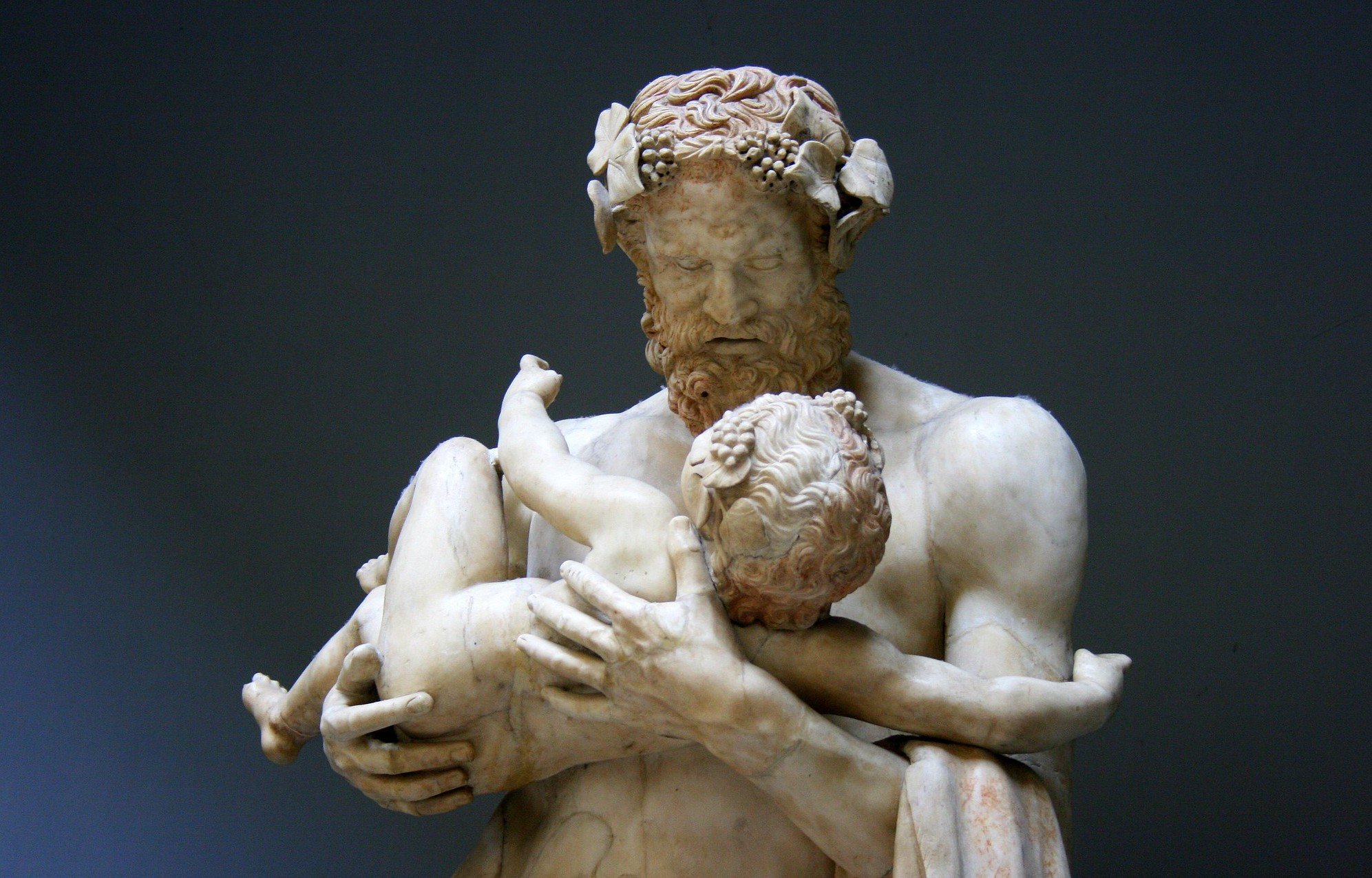
According to the philosopher Plutarch, Dionysus was also the god of sincerity. Credit: just.Luc / Flickr CC BY 2.0
“Force,” or Deinotēs, as the seventh of the major Ancient Greek styles of speech
Force represents the culmination of rhetorical power. Hermogenes viewed deinotēs as the ability to overwhelm audiences through intensity, authority, and commanding presence. This style combines emotional energy, intellectual precision, and persuasive momentum. Forceful rhetoric strikes listeners with irresistible impact. Demosthenes often embodied this quality during political speeches. His words carried urgency, moral conviction, and strategic precision simultaneously.
Force differs from mere aggression. True rhetorical force arises from mastery over every dimension of speech. Clarity, grandeur, rhythm, sincerity, and ethos all contribute to it. Hermogenes considered this quality extremely challenging to achieve, and only highly skilled speakers could combine all rhetorical elements harmoniously. Force therefore represented the highest form of rhetorical excellence.
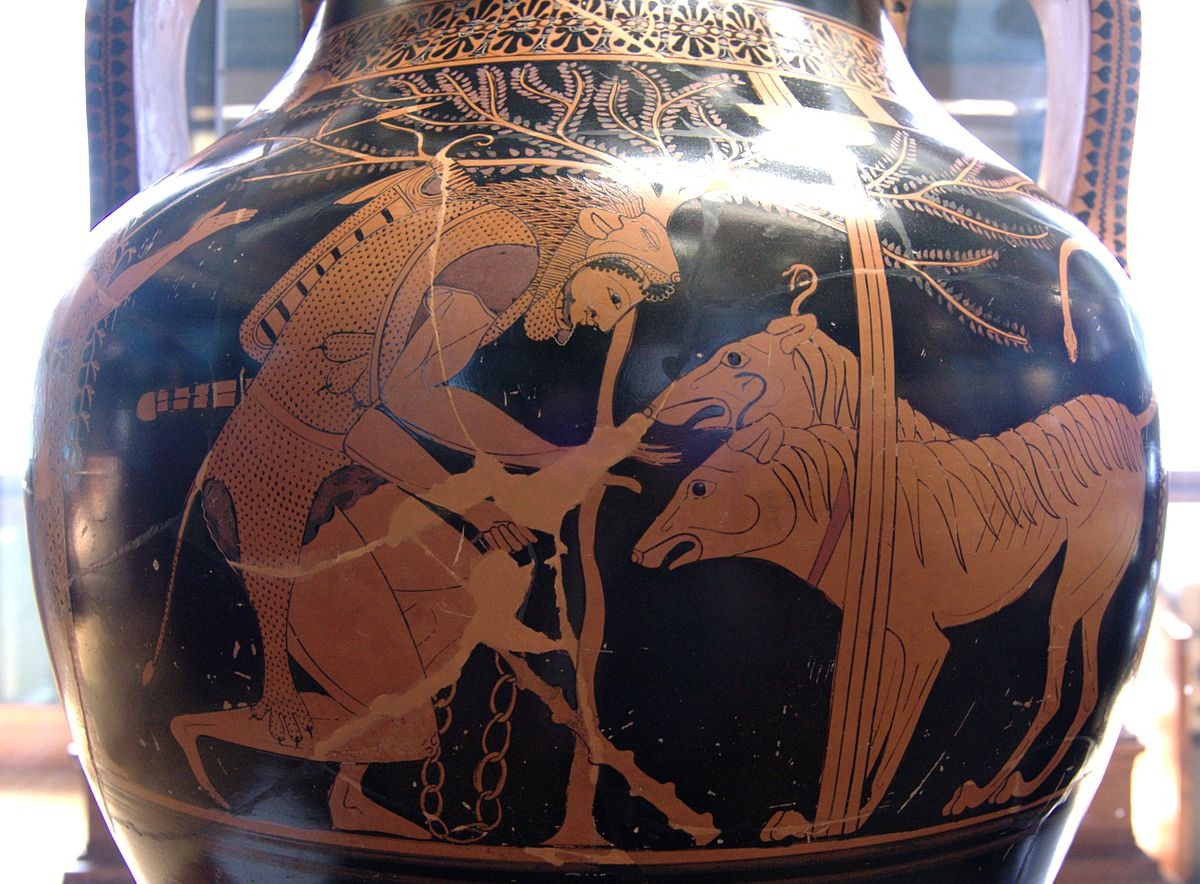
Heracles, the strongest hero depicted on red-figure style Ancient Greek pottery. Credit: Louvre Museum / Public domain / Wikimedia Commons
The unity of the seven styles of speech
Hermogenes never intended these categories to function separately. Great rhetoric combines multiple styles according to circumstance. A political speech may require grandeur during patriotic appeals, clarity during argumentation, sincerity during emotional moments, and force during conclusions. This flexibility explains the lasting influence of Hermogenes. His system recognized the complexity of human communication.
Hermogenes of Tarsus shaped rhetorical education for more than a thousand years. Byzantine scholarship practically treated his works as sacred manuals of eloquence. Renaissance humanists later read his theories and incorporated them into European education. His influence extended beyond rhetoric into theology, literature, and philosophy. Christian preachers especially valued his understanding of emotional and ethical persuasion.
Even today, modern communication still reflects principles Hermogenes identified centuries ago in his seven styles of speeches. Political speeches, courtroom arguments, literature, and public debates all rely upon clarity, emotional force, sincerity, and character.
Marx and Aristotle, though centuries apart, both recognized that value is rooted in social relations rather than in objects themselves. Credit: GreekReporter Archive
When the philosopher Karl Marx set out to unravel the mysteries of value, exchange, and labor in capitalist society, he found a surprising intellectual ally in Aristotle, the ancient Greek philosopher who lived two millennia earlier. Despite their different historical contexts, both thinkers examined how value arises not inherently from things but from their social relations—especially through the lens of use and exchange.
Marx, in Capital, openly acknowledged Aristotle’s importance. Not only did Aristotle lay the groundwork for distinguishing use-value from exchange-value but his reflections on early human society, property, and the role of labor and technology revealed a conceptual framework that Marx would radicalize for modern critique.
Use-value and exchange-value: Aristotle’s anticipation
Aristotle’s analysis of value in Politics distinguishes between two uses of a commodity. One is proper and natural while the other is improper or derivative. He writes:
“Every commodity has two uses: both belong to the thing itself, but not in the same manner—one is the proper use, the other is not. For example, a shoe serves either to be worn or to be exchanged; both are uses of the shoe, for he who gives a shoe in exchange to someone who needs it, receiving in return money or food, uses the shoe as a shoe, but not according to its proper use, for it was not made to be exchanged.”
This distinction—between use-value and exchange-value—is a cornerstone of Marx’s analysis. For Marx, this Aristotelian formulation prefigures what he calls the “value-form” of the commodity. Commodities are useful in particular ways (use-value), but also enter into a social system of equivalence when exchanged (exchange-value).
Marx directly builds on this by showing that exchange-value does not exist inherently in an object but arises through the abstraction of labor—because human labor makes different useful things commensurable. Aristotle notes that a shoe does not exist for exchange. Marx took this insight and asked: What kind of society inverts this logic and makes objects valuable only in proportion to their exchangeability rather than their utility?
From the household to the marketplace: society before exchange
Aristotle’s theory of the household (oikos) as the first form of society was essential for Marx’s historical materialism. In Politics, Aristotle describes early society as beginning with families. In these families, property was communal and exchange unnecessary. It was only as the population grew and self-sufficiency gave way to interdependence that markets and money emerged.
Marx adopts this trajectory in Capital and his Grundrisse notebooks, writing that commodity exchange is not a timeless activity. Instead, it is a historically specific development that reflects changes in social relations and property forms. The transition from common property to private ownership and from useful production to production for exchange is the material foundation of class society.
In Aristotle, we already see the seeds of this analysis. He distinguishes between natural wealth-getting (production for use) and unnatural chrematistics (the accumulation of wealth for its own sake). Marx seizes upon this distinction to critique capitalism as a system in which the unnatural pursuit of profit replaces human need as the goal of production.
A statue of Aristotle. Credit: Public Domain, via Wikimedia Commons
The machine and slavery
One of the most striking moments in Capital (Vol. I) occurs when Marx discusses machinery and automation. Here, he ironically invokes Aristotle’s dream that if tools could operate themselves, no slaves would be needed:
“If—dreamed Aristotle, the greatest thinker of antiquity—if every tool could perform its task at command or even by anticipation, like the statues of Daedalus that moved of their own accord, or the tripods of Hephaestus that spontaneously began their sacred work, if the shuttles of the loom wove by themselves, then master craftsmen would not need assistants, nor masters slaves.”
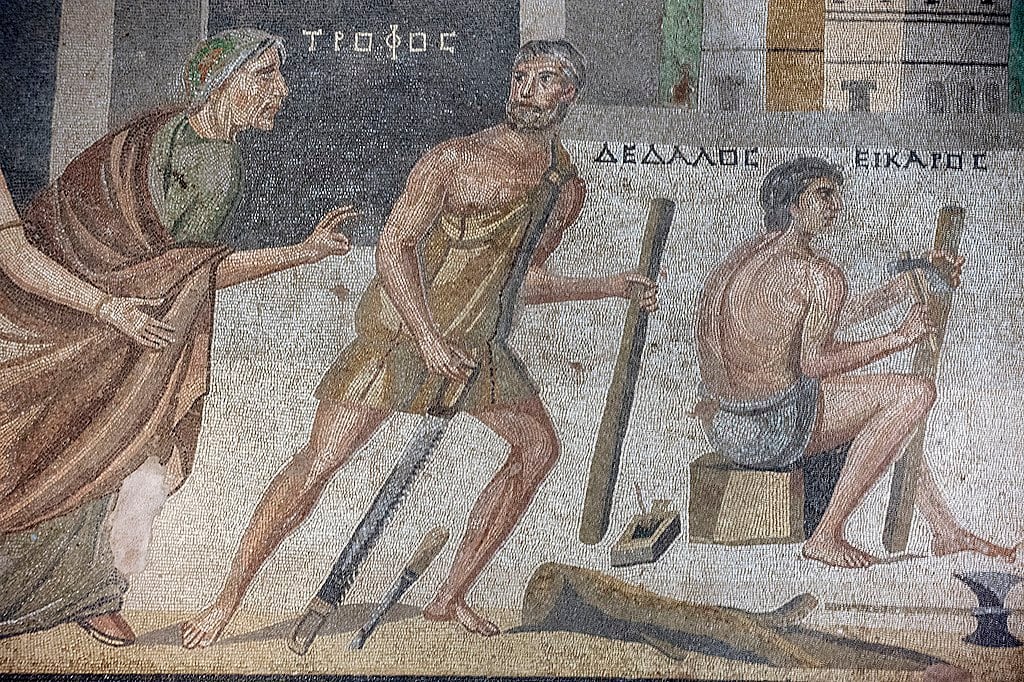
This vision did not remain uniquely Aristotelian. Antipatros, a Greek poet from the era of Cicero, hailed the invention of the watermill—the earliest rudimentary form of productive machinery—not simply as a technical advancement but as a social revolution. He praised it as the liberator of enslaved women who had been condemned to grind grain by hand. He envisioned it as the usher of a new golden age of human dignity and freedom.
In these ancient myths and poetic praises, technology is seen not merely as efficiency but as emancipation. The ancients, despite their slave-based economies, understood that the highest purpose of tools was to free people from servitude.
Gaziantep Zeugma Museum Daedalus mosaic. Credits: Dosseman / Wikimedia Commons CC BY-SA 4.0
Marx’s irony and the betrayal of the promise of automation
Marx, however, saw this ancient hope turned upside down in modern capitalist society. In his words, what was supposed to free labor had become its jailer:
“Ah, those idolaters! They knew nothing of political economy or Christianity, as discovered by clever Bastiat and even cleverer McCulloch. They failed to understand, among other things, that the machine is the most reliable means for lengthening the working day.”
Here, Marx mocks the liberal economists of his time. Frédéric Bastiat and John Ramsay McCulloch, champions of laissez-faire capitalism, celebrated mechanization without recognizing its role in intensifying exploitation. Unlike the “idol-worshiping pagans,” who at least had the imagination to conceive of automation as a force for liberation, these modern theorists lacked even that mythical foresight.
Marx continues with biting irony:
“They failed to understand, among other things, that the machine is the most reliable means for lengthening the working day.
Thus the strange phenomenon arises in the history of modern industry. That the machine, the most powerful instrument for reducing labor time, becomes the most unfailing means of converting the whole life of the worker and his family into labor-time for capital’s valorization.”
The true paradox for Marx is that mechanization offers a means to liberate humanity but capital instead weaponizes it to intensify exploitation. The ancients envisioned automation as a means of human emancipation. Capitalism uses it to deepen alienation and dependency.
The irony is profound: the ancients dreamed of freedom through the machine, and capitalism delivered machines that reinforce dependency. In this way, Marx reclaims the ancient vision but also shows how the promise of automation has been betrayed.
Antipatros celebrated the invention of the watermill as a liberating force, heralding it as a symbol of a new golden age of human dignity. Credit: Pietro da Cortona, Wikimedia Commons, Public Domain
Aristotle and Marx: From ancient slavery to modern compulsion
Marx’s dialogue with Aristotle was not just academic—it was dialectical. He admired Aristotle’s clarity in distinguishing between types of value and his historical insight into the development of exchange. However, Marx also showed how the slave economy of antiquity historically constrained Aristotle’s ideas.
Ironically, in an age in which full automatism is increasingly possible, the prevailing economic model continues to reproduce the conditions that Aristotle associated with slavery—not through direct ownership of people but through economic compulsion and structural inequality. In that sense, Marx saw in Aristotle both the seed of critical insight and the limit of pre-modern social theory.
Hence, while Aristotle could not imagine that labor determines value in commodities, he sensed something essential: that value is not a thing but a relation and that social forms of labor determine the shape of society itself.
Ancient Greek philosophers emphasized the importance of virtue in life. Photo of bronze door detail at the National Academy of Sciences building in Washington, DC. Credit: Carol M. Highsmith. Public Domain
For the Ancient Greeks, virtue was regarded as the highest quality a person could possess, and living virtuously was considered the ultimate goal of life.
Virtue was not merely a philosophical concept but a moral guide to be followed. Living a virtuous life was the greatest achievement for an Ancient Greek, but beyond moral virtue, the word itself also conveyed meanings of excellence, purpose in life, goodness, and happiness (eudaimonia, ευδαιμονία)—the fulfillment of human nature itself.
Reference to virtue (aretē, αρετή) first appeared in Homer’s epics, the Iliad and the Odyssey, and later evolved into a central ideal for Greek philosophers such as Socrates and Aristotle. In the Iliad, Homer exalted the virtue of bravery, placing Achilles at the forefront as the model of an excellent warrior. Achilles fought and triumphed for the sake of honor but accepted the fate destined for him.
In the Odyssey, Homer praised the virtues of intelligence (or cunning) and the endurance of Odysseus. His loyalty to Penelope is also celebrated, reflecting the virtue of loyalty to family and home. Upon returning to Ithaca, Odysseus declared that “there is nothing nobler than a man and wife who share their minds and hearts in harmony.”
The Ancient Greeks, Socrates, and virtue
Socrates, the Ancient Greek philosopher regarded by most as the father of philosophy, believed that knowledge and virtue were inseparable. The pursuit of virtue was of great importance, as Socrates viewed it as synonymous with knowledge of the good: to know what is good is to do what is good. “Virtue does not come from wealth, but wealth and every other good thing which men have comes from virtue, both to the individual and to the state” Socrates said.
By the time of the classical philosophers, the Ancient Greek world had evolved. The city-state (polis) had replaced the heroic household as the center of life, and the question was no longer how to be a great warrior but how to be a good citizen and a good person. Socrates emerged as the first great moral philosopher. “No one errs willingly,” he insisted in Plato’s Protagoras—meaning that moral failure arises from ignorance, not malice. He believed that virtue could be taught.
Socrates’ famous elenchus was a dialectical method of questioning, testing, and refining ideas. Through a series of probing questions, the method sought to expose contradictions in a person’s beliefs and systematically guide them toward a clearer, more consistent understanding of truth. By revealing these contradictions, Socrates led people toward self-knowledge.
When he was arrested and tried for disrespecting the gods and corrupting Athenian youth with his teachings, he famously declared, “The unexamined life is not worth living” (Apology 38a). For Socrates, the pursuit of virtue was the same as the pursuit of wisdom. Courage, justice, temperance, and piety were not separate traits but expressions of a unified understanding of the good. Thus, Socrates transformed virtue from heroic excellence into a philosophical and ethical ideal grounded in reason and self-knowledge.
Plato and the soul
Plato, Socrates’ most famous pupil and the philosopher who became his master’s voice, once remarked: “Consider your origins: you were not made to live as brutes, but to follow virtue and knowledge.” He developed this vision of virtue further, seeking to define its nature and role in human life. In his dialogues, especially The Republic, he explored the essence of virtue in both the individual and the state.
For Plato, the human soul was composed of three parts: the rational, spirited, and appetitive. Virtue, he taught, consisted of harmony among these elements, with reason guiding spirit and desire. Justice was this inner balance made visible in action. As he wrote, “Justice is doing one’s own work and not meddling with what is not one’s own” (Republic IV.433a). The just person, therefore, is one whose reason governs, whose spirit supports, and whose desires obey.
Plato identified four cardinal virtues that reflected this harmony: wisdom, courage, temperance, and justice. Wisdom was the virtue of reason; courage, that of the spirited part; temperance, the balance among all desires; and justice, the overarching order of the soul. These four virtues became the foundations of Western moral philosophy and profoundly influenced Christian ethical thought.
For Plato, virtue also had a transcendent dimension. True virtue was likeness to God, aimed at the Form of the Good—the ultimate reality that gives meaning and value to all things. As he wrote, “The Good is the cause of all that is right and beautiful” (Republic VI.517b). The virtuous person, through philosophical contemplation, seeks to align the soul with this divine Good, just as the sun illuminates the visible world. Thus, virtue is not only inner harmony within the self but also participation in a higher cosmic order.
Aristotle and practical virtue
For Aristotle, the concept of virtue was practical wisdom (phronēsis). He believed that ethical virtue, rather than mere self-control, is required for practical wisdom. In the Nicomachean Ethics, Aristotle defined virtue as a disposition to act correctly, formed through habit and guided by reason. Virtue was not innate, nor purely intellectual; it was something cultivated through action. “We become just by doing just acts, temperate by doing temperate acts, brave by doing brave acts” (Ethics II.1), he explained. In other words, virtue is learned by living it. As he also said, “We are what we repeatedly do. Excellence, then, is not an act but a habit.”
Aristotle’s famous doctrine of the mean illustrates the balanced nature of virtue. Every virtue lies between two extremes of excess and deficiency. Courage, for example, lies between cowardice (too little fear) and recklessness (too much). Generosity lies between stinginess and extravagance. “Virtue, then, is a state of character concerned with choice, lying in a mean,” he writes, “this being determined by reason and as the prudent person would determine it” (Ethics II.6).
For Aristotle, the goal of life was eudaimonia, often translated as “happiness” but more accurately “flourishing.” This state is achieved not through pleasure or wealth but through the full realization of one’s potential as a rational and social being. “The good for man is an activity of the soul in accordance with virtue,” he said (Ethics I.7). Virtue, then, is not a single act or rule but the lifelong practice of living wisely, courageously, and justly within a community. It requires both intellectual virtues (like wisdom and understanding) and moral virtues (like courage and moderation), harmonized under the guidance of practical wisdom.
Aristotle’s conception of virtue was purpose-driven. He believed that everything in nature has an end (telos). The eye’s purpose is to see, the seed’s to grow into a tree, and the human’s to live rationally and ethically. Virtue is the perfection of this natural purpose. Hence, for Aristotle, ethics was not about obeying rules but about fulfilling one’s nature as a rational being in society.
Quotes on virtue from Aristotle
Aristotle’s work on virtue and knowledge is unparalleled. A student of Plato and tutor to Alexander the Great, he established his own school, the Lyceum, where he explored topics ranging from biology to metaphysics. His reflections on virtue and the cultivation of character remain influential. Below are some of his most notable insights:
Aristotle emphasized the importance of educating both mind and character, stating that “educating the mind without educating the heart is no education at all.” He highlighted self-knowledge as the foundation of wisdom: “Knowing yourself is the beginning of all wisdom,” and courage and freedom were intertwined in his thought as is evident in his statement, “He who has overcome his fears will truly be free.”
Aristotle also emphasized the role of habit in shaping virtue: “Good habits formed at youth make all the difference.” For Aristotle, wisdom involved understanding life beyond immediate pleasure: “The aim of the wise is not to secure pleasure, but to avoid pain.” Cultivation of the mind and spirit was central to a flourishing life: “The energy of the mind is the essence of life,” and “The ideal man bears the accidents of life with dignity and grace.”
Aristotle also reflected on honor, leadership, and moral excellence: “Dignity does not consist in possessing honors, but in deserving them,” and “He who cannot be a good follower cannot be a good leader.” Finally, he distinguished the cultivated from the uncultivated, stating that “the educated differ from the uneducated as much as the living from the dead.”
Through these statements, Aristotle encapsulated his enduring vision of virtue as a combination of wisdom, moral character, and practical living.
The Stoics, moral worth, and virtue in Ancient Greece
The Stoics believed that the goal of all philosophical inquiry was to provide a mode of conduct characterized by tranquility of mind and certainty of moral worth. Flourishing during the Hellenistic period after Aristotle’s death, Zeno of Citium founded Stoicism around 300 BC, building on and radicalizing the moral insights of earlier philosophers. For the Stoics, virtue was not merely the highest good—it was the only good.
All external things—wealth, pleasure, health, even life itself—were morally indifferent. What mattered was the state of one’s soul: one’s rational and moral integrity. As the Stoic philosopher Epictetus later observed, “It is not things themselves that disturb men, but their opinions about things” (Enchiridion 5).
The Stoics saw virtue as living in accordance with nature, which meant acting in accordance to reason and accepting fate. Since the universe was governed by divine reason (logos), the wise individual aligns with it, remaining tranquil amid the changes of fortune. Courage, justice, temperance, and wisdom remained the core virtues, but now they were expressions of a single rational attitude toward life. As Seneca, the Roman Stoic, wrote, “Virtue is the only good, and vice the only evil; everything else is indifferent” (Letters 76). Even suffering or poverty could not harm the virtuous person because virtue itself was self-sufficient.
In this way, Stoicism universalized the Greek idea of virtue. It was no longer the privilege of citizens or philosophers but the potential of every human being. The Stoic sage, like Socrates before him, embodied moral freedom through inner mastery and reason. Marcus Aurelius, emperor and Stoic, summarized this ideal succinctly: “A man’s worth is measured by the things he pursues” (Meditations VII.3). To pursue virtue was, therefore, to live fully in harmony with the divine order of the world.
Influence of the Ancient Greek conception of virtue
The ancient Greek concept of virtue has had a profound influence on Western civilization. Ideas of moral inquiry, a virtuous life, practical wisdom, and moral worth were later adopted by Christian theology and continue to resonate today. Thomas Aquinas, for example, integrated Aristotle’s virtues with Christian faith in his writings.
In their exploration of virtue, the Ancient Greek philosophers offered no simple answers to questions such as, “How can I become virtuous?” Yet they left behind a framework for thinking, questioning, and appreciating the importance of a moral life for Western civilization.
For the Ancient Greeks, to live a virtuous life was to live well, to become the best version of oneself, and to align human nature with the rational order of the cosmos. They believed that this path led not only to moral goodness but also to true happiness.

 Login
Login