Reading view

AI is not the answer to AI-enabled fraud

A top banker has got in trouble by referring to employees whose jobs will be replaced by AI as “lower-value human capital.” But he’s just saying the quiet part out loud: compliance officers have been expected to work like inefficient computers for years already anyway. Standard Chartered CEO Bill Withers used the unfortunate phrase when describing how the bank plans to keep hitting its profitability targets by cutting 15% of back office staff, and has tried to backtrack a little after a predictable storm of criticism, including from the former president of Singapore. 

It would be nice to think of bank employees deployed to fight financial crime as super-effective old-school gumshoes, with a bottle of bourbon in the bottom drawer and an inexhaustible stock of one-liners, but in reality their jobs are more like something from ‘The Office’ than ‘The Big Sleep’.

Thousands of people sit in cubicles in Warsaw or Bengaluru, checking through transactions flagged as possibly abnormal by banks’ automated systems, and confirming that 99% of them are, in fact, normal. Anything that might conceivably be abnormal gets sent up the chain, where someone more senior will almost certainly decide it wasn’t. 

It is a ruinously expensive process and, as far as we can tell, completely ineffective. The best estimates we have for the size of the criminal economy suggest it has grown, untroubled, along with everything else for decades despite all the laws, fines, and prosecutions that we’ve thrown at the problem. 

But banks’ financial crime compliance isn’t about stopping financial crime at all: it’s about stopping banks from being fined, as Standard Chartered has previously been, enormous sums in both the U.S. and the UK. As long as banks can be sure that AI checks boxes in ways that satisfy regulators, then they’ll be happy.

This is a little bit worrying because AI is already getting very good at fraud. I am very alert to attempts to trick me but was sufficiently fooled by an AI email yesterday to forward it on to someone. Fortunately, a very similar one arrived (purportedly from someone else) a few minutes later, alerting me to my mistake. Money laundering is a laborious activity and criminal gangs will be as keen as banks to cut their back office expenditure, and AI could help automate the processing of the many small transactions that add up to a large amount of money. Phishing and smurfing are just a couple of its use cases, however.

“Scammers can leverage AI to scrape data from social media and dating platforms to identify vulnerable targets (e.g. lonely individuals, recent retirees, or people interested in finance) for pig butchering scams,” notes TRM Labs. “Bots can sustain long-term, emotionally persuasive conversations without tiring or making mistakes, making the scam more scalable.”

And that’s before you get onto AI’s ability to exploit cryptocurrencies and smart contracts to really start rampaging through the crypto world. “TRM observed a roughly 500% increase in AI-enabled scam activity over the past year. The convergence of generative AI, programmable financial infrastructure, and global crypto liquidity has altered the economics, velocity, and scalability of fraud,” the blockchain analytics firm said in a follow-up report. This is very bad indeed.

So, although I can see why people are annoyed that Withers referred to his bank’s employees in such a disparaging way, I am more troubled that he’s planning to replace them with AI, rather than to retain them and train them in how to counter it.

It was remarkable, however, to see Warren Davidson, chair of the illicit finance subcommittee at the House of Representatives Financial Services Committee, draw precisely the wrong conclusion from all this. Although he was correct in condemning the defensive nature of compliance, and its focus on generating paperwork over results, he then got lost in praising the White House’s decisions to attack corporate transparency legislation.

"As we focus on risk, we must also ensure that tools like artificial intelligence are fully deployed to counter the AI-enabled crimes of today,” he said, without realising that, without reliable information to train the AI models on, this is as useless an approach as the one he says has failed. If you don’t know who owns what, neither will a computer, no matter how cleverly it can pretend to be human.

I sincerely hope he listened to the testimony of Carole House of the Atlantic Council who forcefully pointed out the harm to national security and to ordinary Americans caused by the United States’ failure to create even an approximation of a decent corporate registry, as well as the historic idiocy of its current crypto policy. “Without a secure identity foundation, AI agents will simply scale up fraud at a speed and volume that human investigators can't possibly track, destroying trust in the whole system,” she said in testimony that I highly recommend you take a look at.

I very much doubt Davidson was listening, however, because that is not the direction the Republican Party is going in right now. I would write more about that, but frankly it’s all too depressing, and I’d rather move on.

So let me point you towards this excellent paper on how online scam marketplaces work, with criminals using the messaging app Telegram and the stablecoin Tether to launder hundreds of billions of dollars. It argues that our current approach of sanctioning exchanges is futile since their owners just shut them down and switch to a new platform that works in the same way but hasn’t yet been sanctioned.

“As long as the underlying digital infrastructure remains permissive, criminal syndicates will simply migrate to new channels. To move from reactive disruption to systemic prevention, the international community must shift its focus toward the structural enablers of these marketplaces,” Elliptic’s Tom Robinson argues. Elliptic is unusual among blockchain analytics companies in being willing to name Tether as a major vector for money launderers. Its rivals tend to just say “stablecoins,” I have no idea why.

Meanwhile, there is something grimly depressing about the fact that — against the backdrop of, well, everything — the UK has postponed June’s illicit finance summit due to “scheduling issues in the international calendar.” Everyone is so busy dealing with the consequences of illicit finance, that no one has time to talk about illicit finance.

A version of this story was published in this week’s Oligarchy newsletter. Sign up here.

The post AI is not the answer to AI-enabled fraud appeared first on Coda Story.
  •  

Crypto’s corrupt American dream

The United States is inching closer to passing a gigantic piece of legislation to put cryptocurrencies on a secure footing, with the bill emerging unscathed from the Senate’s banking committee. Opinions differ as to what this means: crypto people are thrilled, while anyone who knows about money laundering is terrified. Passage of the so-called CLARITY bill has been a key goal of crypto enthusiasts since Donald Trump came to power, since it would give them the legal certainty to engage in “financial innovation” without worrying about a return to the Biden-era policy of trying to regulate them as if they were normal people.

Committee chairman Tim Scott is delighted: “For me, this is personal. My mother raised my brother and me with faith, grit, and determination, and she taught me that the American Dream should be within reach for every family, including single mothers working hard to build a better life for their children.”

I quote Scott partly because it’s such a weird justification for passing crypto regulation (or perhaps he just says that sort of thing about literally everything he ever does?), but mainly because it’s pretty clear that the bill as it stands will be a disaster for the kind of vulnerable people he claims to be fighting for.

In a sign of experts’ concerns, Transparency International’s U.S. office put out a statement quoting nearly all the most respected voices on money laundering in America arguing that the bill needs better safeguards against dirty money. “At a time when we know that hostile actors like (Iran’s Revolutionary Guards) are looking to circumvent U.S. sanctions to rearm and threaten Americans and U.S. interests around the world, it is inconceivable to me that we would open new, effective channels for sanctions evasion,” said Richard Nephew, former U.S. Coordinator on Global Anti-Corruption and Deputy Special Envoy for Iran.

“Terrorists, violent drug traffickers, and organized criminals who prey upon the elderly and unlearned in increasingly sophisticated financial and AI generated schemes are, quite literally, getting away with murder, funded by untraceable cryptocurrency transactions hidden behind an anonymous block chain,” said former FBI agent Karen Greenaway.

There is an awful lot of money in crypto, and Tether alone now has three people among the richest 100 in the world. Tether’s largest single shareholder Giancarlo Devasini’s wealth has grown from $9.2 billion in 2024 to $89.3 billion now, while chief executive Paolo Ardoino and former CEO Jean-Louis van der Velde have done pretty well too. Though none of them have done quite as well as Changpeng “Binance” Zhao, crypto’s only centibillionaire (so far).

In the UK, there’s a lot of concern about the millions of pounds going from crypto investors to Reform’s Nigel Farage, who has become a crypto champion, no doubt coincidentally. But, wow, look at what’s happening in Alabama for a sign of what the future looks like if crypto people really get their hands on the purse strings and try to buy their way into the Senate. 

That much money doesn’t just help supporters win, it also terrifies opponents: standing up to the crypto lobby guarantees you’ll be swamped in hostile advertising. How do you want to be paid, as Pablo Escobar used to say, in silver or lead

But why should the rest of the world care that this is happening? I’m sure I’m not the only foreigner who’s been staring in bewilderment at the growth of U.S. prediction markets, and how efficiently they allow insiders to monetise their privileged access to inside information. A lot of those markets are barred in other countries, but the U.S. soldier who was arrested for betting on the Maduro capture was trading on polymarket, a crypto-denominated market which is blocked in the United States too, despite Donald Trump Jr. being an investor.

Such restrictions can be easily bypassed by using a Virtual Private Network, so U.S. regulators are using artificial intelligence to track down insider trading on polymarket. After that soldier’s arrest, I suspect Americans will be much more careful about what they do.

Prediction markets claim they don’t want insiders trading on privileged information. But if the markets are to function in a way that supports their founders’ justification for them, as a price signal for future events, they rely on people with knowledge to be using them to make bets and thus to move prices in a useful direction. So clearly the temptation will always be there for anyone with inside information to use it to make some easy money.

And does anyone think U.S. regulators will care about Indians, Brits, South Africans Ukrainians, or other foreigners using crypto to trade on information from their own countries? They after all have a track record of treating foreigners and U.S. citizens differently. That’s why it was Francesca Albanese, with her American husband and daughter, who managed to have sanctions cancelled for daring to investigate Israel’s behaviour in Gaza, whereas non-U.S. connected people have failed to do so.

The new U.S. crypto bill coupled with U.S.-based crypto-denominated prediction markets points towards the United States becoming a gigantic offshore enabler of corruption for the rest of the world; a digital version of what Switzerland was in the analogue years, with everyone else reduced to begging its regulators for assistance. 

“Crypto prediction markets are accessible to anyone with an internet connection and a wallet, pooling liquidity from a global user base rather than a regional one,” says Chainalysis. I think they mean that to be a good thing, because the blockchain is transparent and malefactors can be spotted easily yada yada, but it sounds beyond dystopian to me. I’m genuinely a bit terrified of what this will mean for corruption in the next few years, and I haven’t heard of any politicians who are alert to it yet.

A version of this story was published in this week’s Oligarchy newsletter. Sign up here.

The post Crypto’s corrupt American dream appeared first on Coda Story.

  •  

Wealth is health, Insider betting & Trump will see himself in court

Inequality is bad for you, and new figures in the UK show that the number of years when people can live healthy lives have fallen everywhere and furthest in the country’s poorest areas. This is partly a lingering after-effect of COVID, but is mostly a result of cuts imposed on health services by the last government. The results are dramatic, with the average person in a wealthy area expected to enjoy almost 20 years more good health than someone in a more deprived area. The situation in the United States is similar, and declines in health have also been observed in Germany, Canada and the Netherlands.

“Reducing smoking and improving diet and physical activity can delay the onset of illness and improve day-to-day wellbeing,” notes this extremely commonsensical analysis from the UK healthcare think tank The Health Foundation. “Secure work, good-quality housing and supportive local environments all influence physical and mental health.”

Being unhealthy is just terrible in all ways, and the problem is clearly getting worse, so you would expect the disrupters of our new economy to be finding ways to respond to this challenge. And at first glance, the Sam Altman-backed Retro Biosciences — with its focus on targeting “aging mechanisms to increase healthy lifespan” — looks promising. So does Altos Labs, with its mission to reverse “disease, injury, and the disabilities that can occur throughout life.” And there’s Saudi Arabia’s Hevolution, which is catalysing “the shift from lifespan to healthspan.”

And that’s before we get to the start-ups operating in a “free city” off the coast of Honduras, which has the brave approach of basically letting people do whatever medical research they like (“Prospera is a unique place where we can do such things,” says one businessman) to help drive progress towards an illness-free future.

But don’t get your hopes up. They’re not looking at ways to help people to get vaccinated, eat healthily, stop smoking or do more exercise. Instead, they’re working on gene therapy, stem cells, and other extremely expensive treatments that will only benefit people who can afford them, and who are thus already likely to be doing well. In the UK meanwhile, Genflow is also aiming to slow the ageing process in dogs, to make sure the super-rich aren’t left without their pets in this artificially prolonged future.

It’s tempting to see this as a metaphor for late-stage capitalism in the West, with its focus on the needs of the few (and their pets) rather than of society as a whole, except that we’re seeing a similar pattern in other places too. In Russia, Moscovites live longer than people from the provinces (although the picture is complicated by the relatively good health of the non-drinkers from Muslim regions), so you would have expected Vladimir Putin to be concerned about how to close that gap. But when he was chatting with Xi Jinping last year in China (where inequality has also harmed health), they were instead more focused on how to live forever. 

“Human organs can be continuously transplanted, and people can live younger and younger, and even achieve immortality,” Putin said. (Three important questions: firstly, does this mean he will be president of Russia literally forever, the world’s first un-dead head of state? Secondly, are they farming people as a source of organs for him? Thirdly, does he really believe this?)

“This century, there's a chance of also living to 150,” replied Xi, who could — under that scenario — rule China for another 77 years, which is longer than he’s been alive, by which time his nation’s population could well, according to UN estimates, have halved.

I, for one, wouldn’t mind having a vote on whether this is a future I want to be a part of.

An insider betting scam

Here’s a fascinating piece of research from the Anti-Corruption Data Collective about prediction markets, looking at how often “long shot” bets on military and security matters pay off compared to what you would expect: fully 52% succeed, compared to only 14% across Polymarket as a whole.

“Government officials and members of our military being able to turn a profit on insider information incentivises corrosive corruption in public office and undermines national security,” notes David Szakonyi, Co-Founder of the Anti-Corruption Data Collective.

The analysis follows the indictment of a U.S. serviceman who made $400,000 betting on the bid to capture Nicolas Maduro in Venezuela, with 13 “yes” wagers on various aspects of the operation in December and January. And that was only a comparatively small military campaign. Just imagine how much money privileged insiders could have made in the past, if only they’d had access to prediction markets before D-Day, before the first nuclear bomb test, or before the assassination of Archduke Ferdinand in Sarajevo.

I really enjoyed this recent episode of Planet Money about prediction markets, particularly with its clear explanation that — like so much “financial innovation” of the past — they’ve not invented anything new at all; they’ve just found a clever way around regulations that previously stopped people making bets in this way.

There is fierce competition between the two leading players — Kalshi and Polymarket — although they have common ground in one area: they both employ Donald Trump Jr.

Trump sues his own government

There are so many things happening in the United States at the moment that it’s hard to keep track, but I did like this analysis from David Allen Green of a particularly strange lawsuit, in which President Trump is suing the federal government for $10 billion. The judge is, unsurprisingly, concerned about a situation where the president is basically suing himself, and wants more information about how that’s going to work.

This could, however, be a whole new money-making front for the first family, and why should the Trumps stop at just $10 billion? They could presumably take the government for every penny it’s got. I’m amazed no one has done this before.

A version of this story was published in this week’s Oligarchy newsletter. Sign up here.

The post Wealth is health, Insider betting & Trump will see himself in court appeared first on Coda Story.
  •  

The Alibi Machine: The Pattern

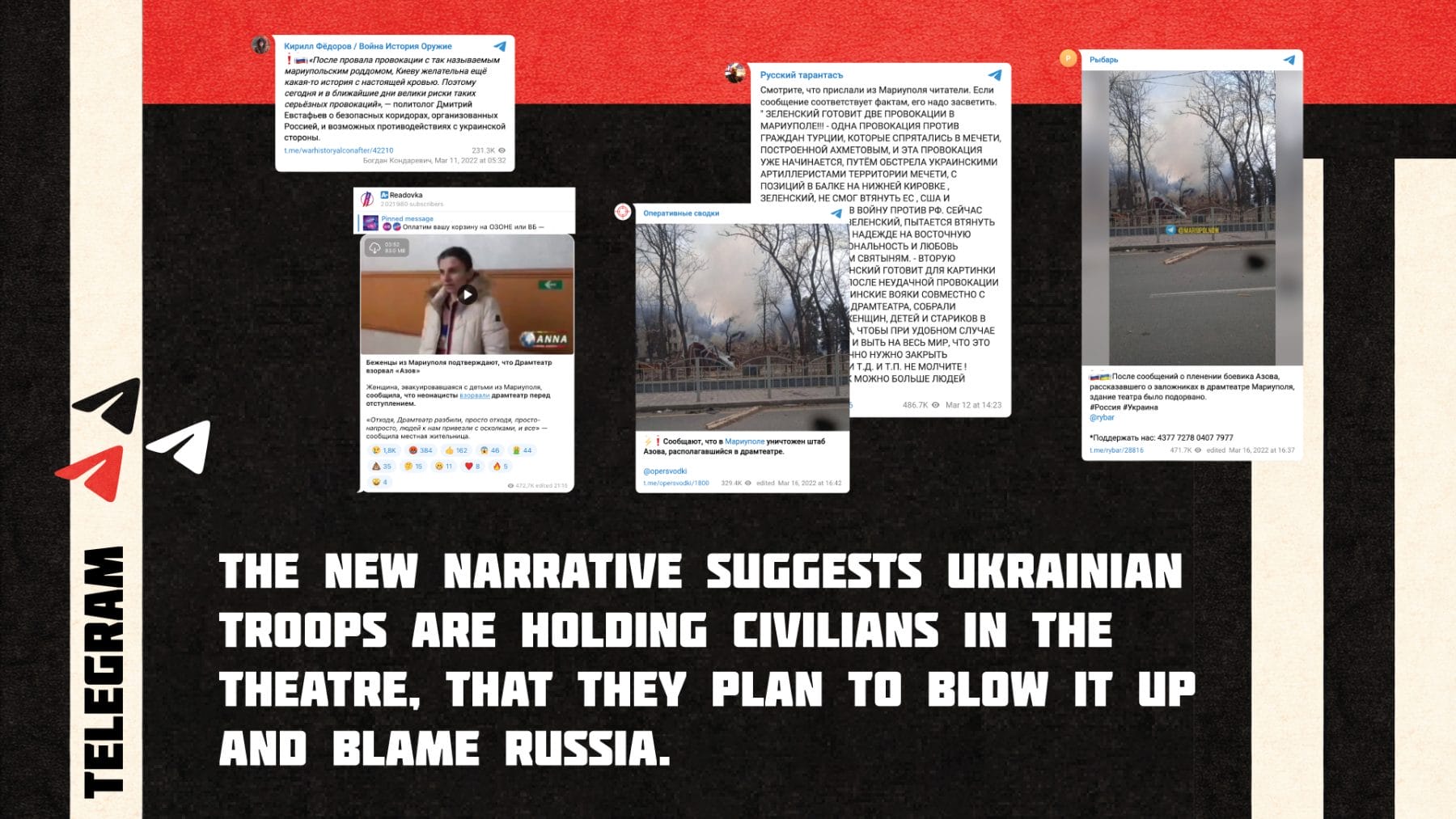
Two days after the attack on the maternity ward, new warnings appear on Russian social media channels.

The focus this time: Mariupol’s Drama Theatre.
Hundreds of Ukrainians are sheltering there from Russian airstrikes.
At 10 a.m. on March 16, 2022, the theatre is hit by Russian airstrikes. 

Initial estimates suggest hundreds of people are killed.
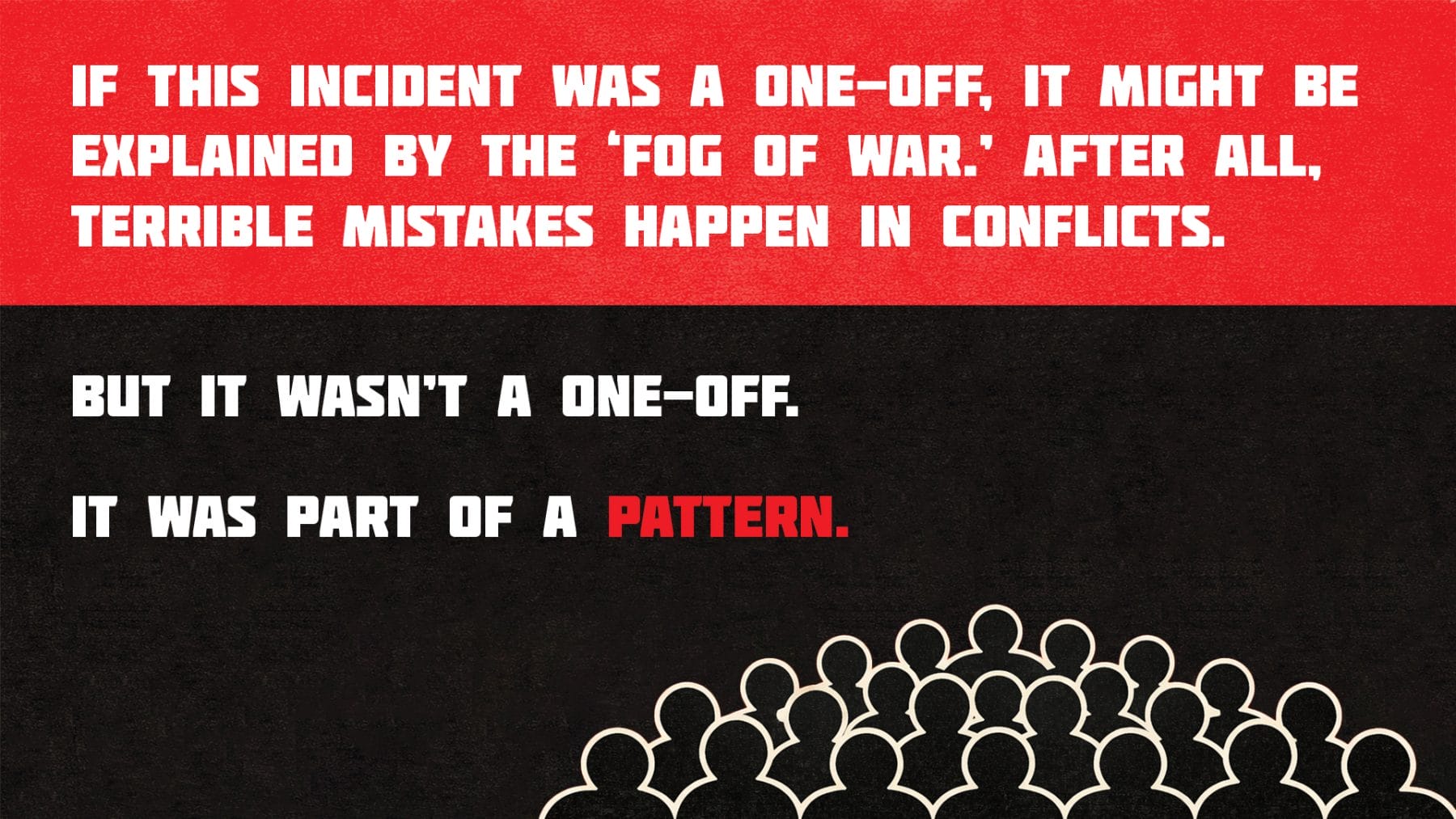
It’s the same pattern as the airstrike on Mariupol’s Maternity Ward:

Russian media outlets and officials lay the groundwork for a potential attack.

The attack happens. 

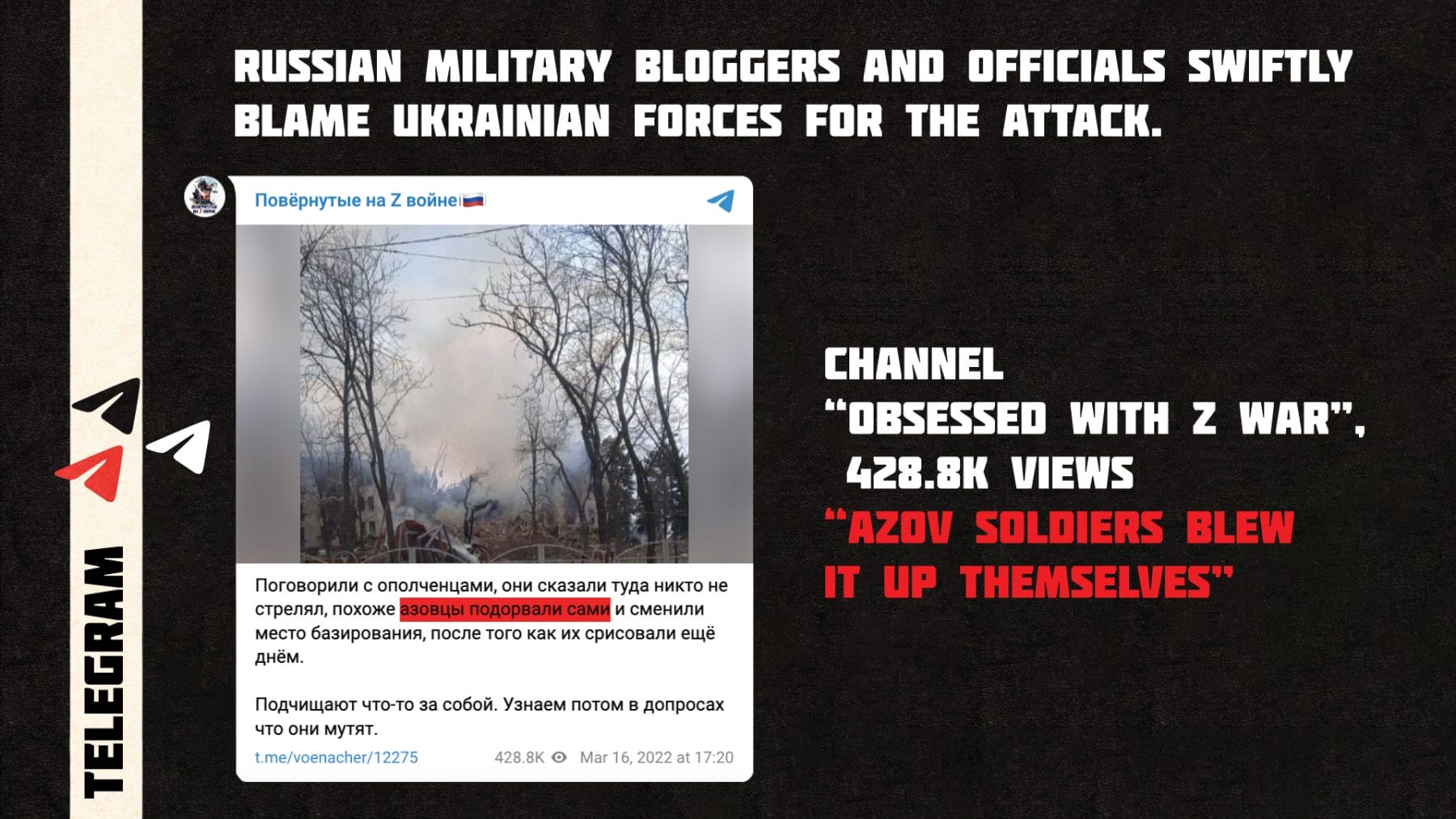
Media outlets and officials deny that Russia is to blame, and instead blame Ukraine.

“Whenever you're looking at war crimes, crimes against humanity, there's always the excuse that this is a one-off, there's a bad apple, one person did something. When you see it as a pattern, when you see the actors repeating, then you can go, okay, this is part of a consistent behavior, part of a plan, and it becomes like a character trait for a criminal in a court case.“

Peter Pomerantsev

The Reckoning Project Co-Founder

The Syrian civil war morphed out of the pro-democracy Arab Spring protests of 2011, when demonstrations against President Bashar al-Assad's authoritarian government were met with violent repression. 

The country fractured into a complex conflict involving government forces, armed opposition groups, and jihadist factions including Al Qaeda and Islamic State.

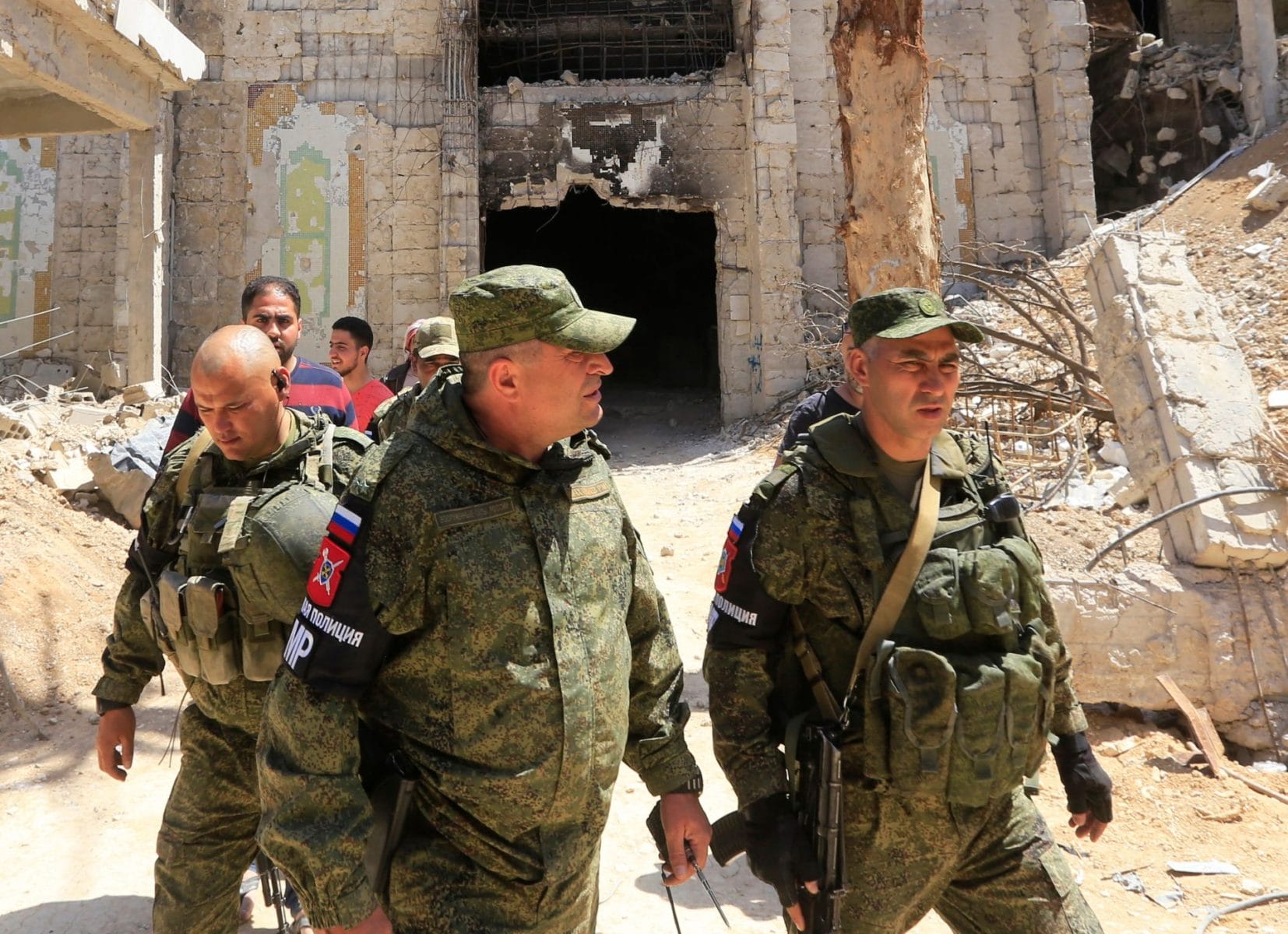
Russia entered the Syrian civil war at the request of President Assad in late 2015. 

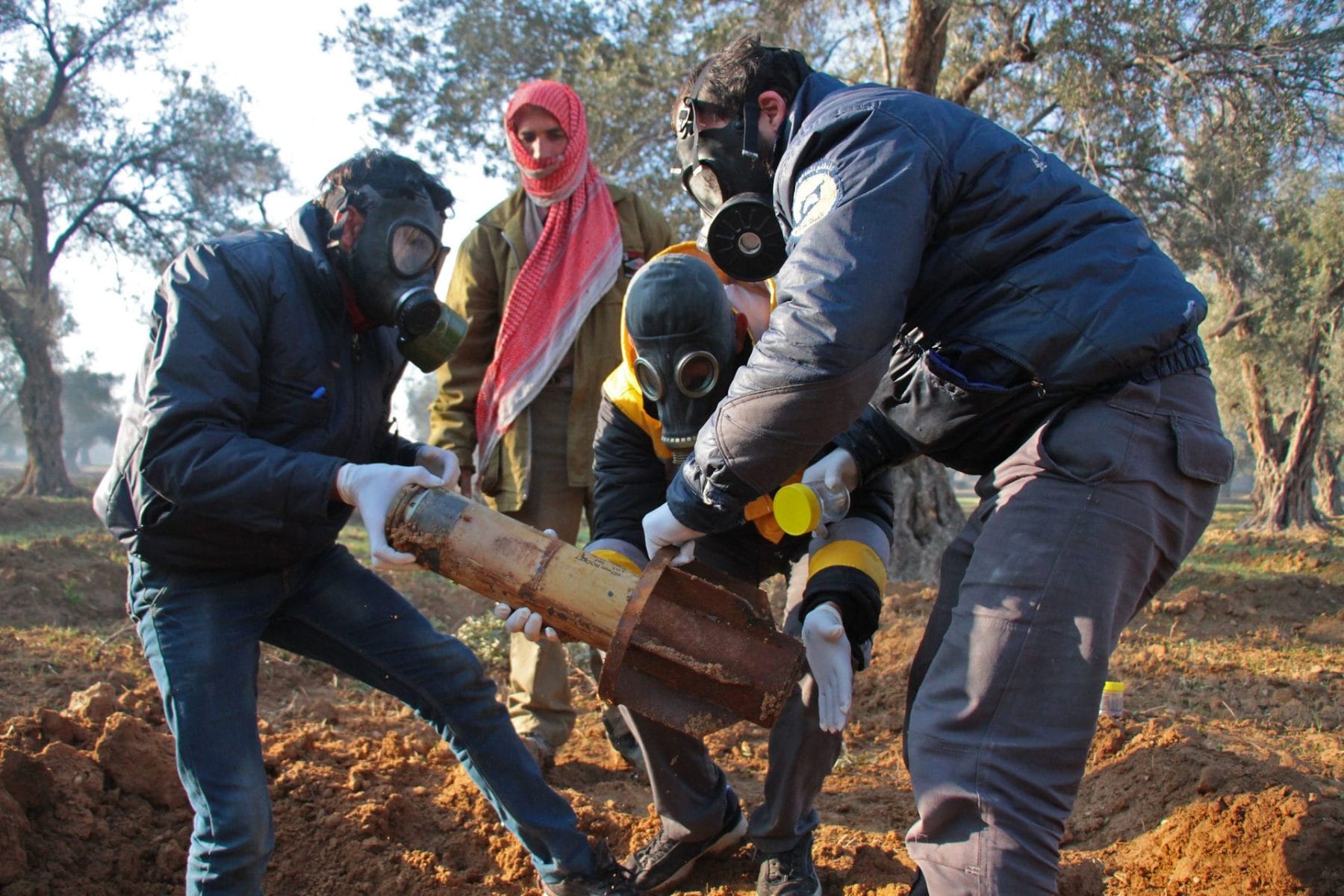
Syrian forces had already used chemical weapons against civilians by the time Russia entered the war. By 2016, their use was ‘widespread and systematic,’ according to Human Rights Watch.

By 2018, as Syrian government forces continue to carry out chemical attacks against civilians, a pattern emerges in Russia’s behavior.
THE PATTERN:

Russian officials say Syrian rebels are planning to fake a chemical weapons attack and blame it on the Syrian army.
Several weeks later an attack takes place. 

Dozens of civilians are killed. 

Syrian rebels and Western governments blame Syrian government forces.
Russia denies the accusations

And then blames others.
Investigation by the OPCW later confirmed that Syrian government forces carried out the attack. 

But it took five years.  

By then the same pattern was being repeated in Ukraine.

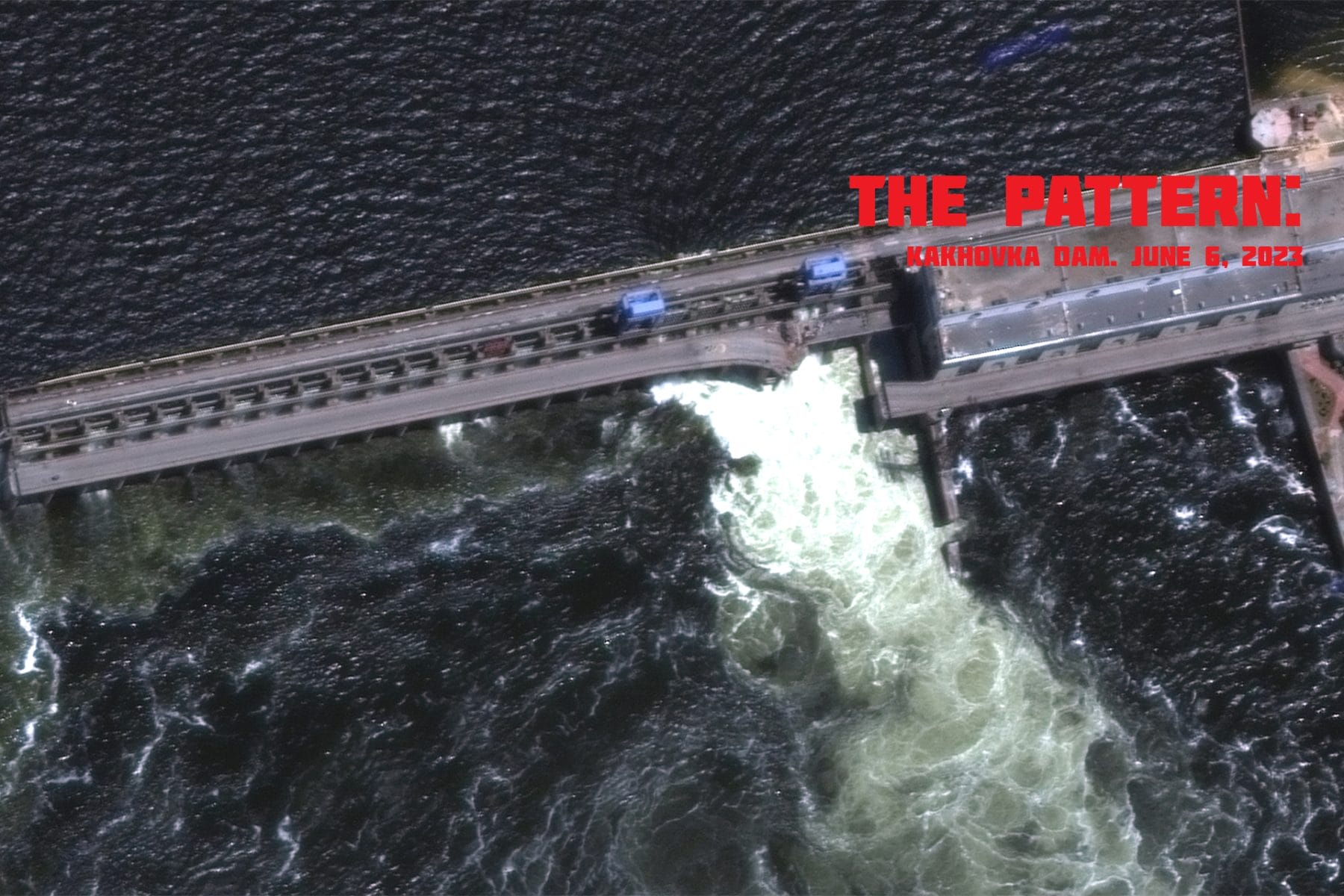
For months, Russia warned that Ukraine planned to destroy the dam and flood communities downstream.

On June 6 2023, the dam was destroyed. 

More than 30 people were killed.

A joint assessment by the UN and the Government of Ukraine finds that the flooding damaged more than 37,000 residential properties, 37 educational institutions and 11 health facilities. 

Total losses were more than $13 billion.

Russia denies involvement. It blames Ukraine.

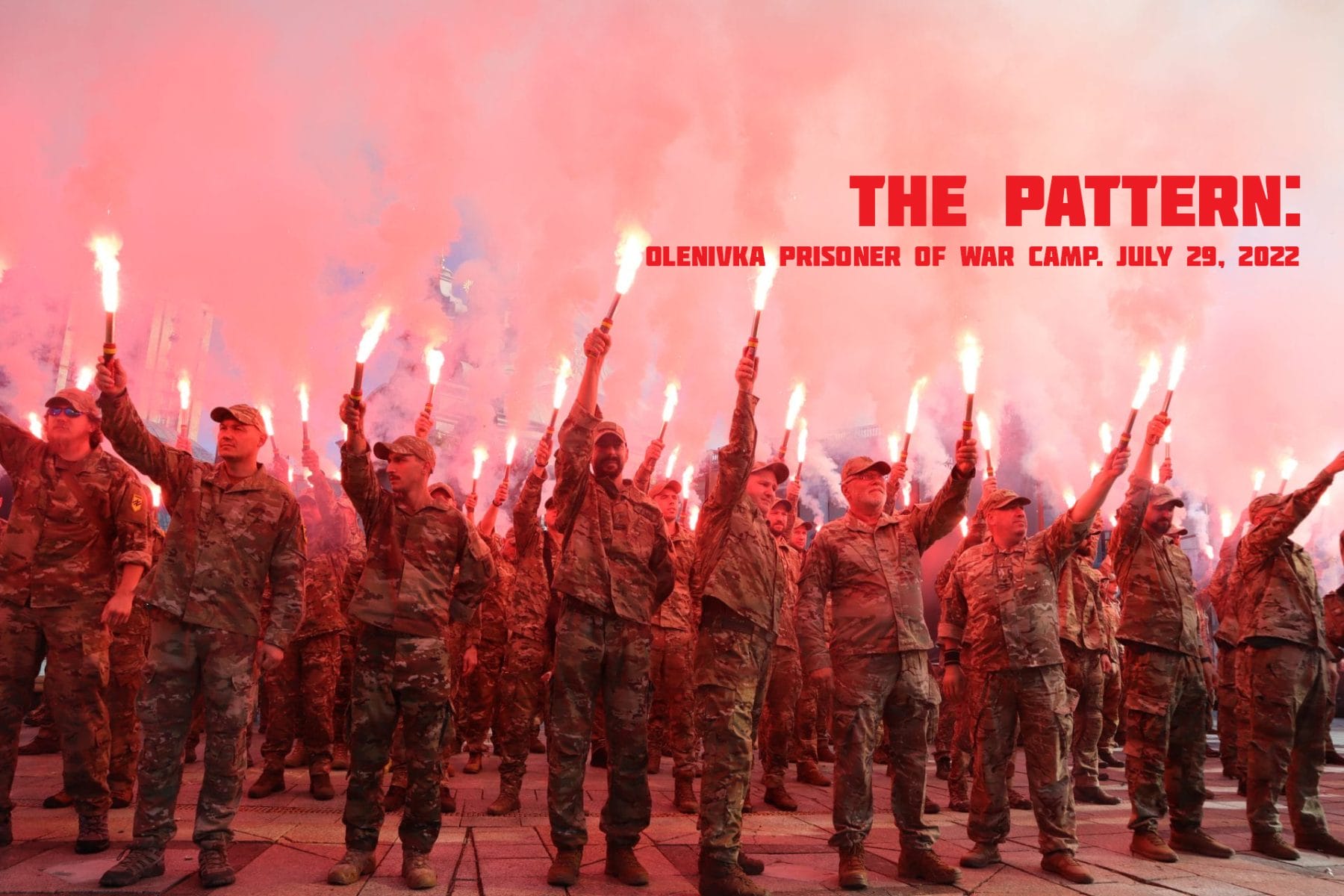
In May 2022, Russian blogs and Telegram channels start discussing captured Ukrainian soldiers, held at Olenivka prison. They say the Ukrainian POWs are “confessing” to “war crimes committed by the Ukrainian Army,” and Ukrainian authorities are planning to silence them.

On July 29, an explosion kills at least 53 Ukrainian POW and injures hundreds.

Russia denies involvement. It says Ukraine killed its own soldiers to keep them quiet.


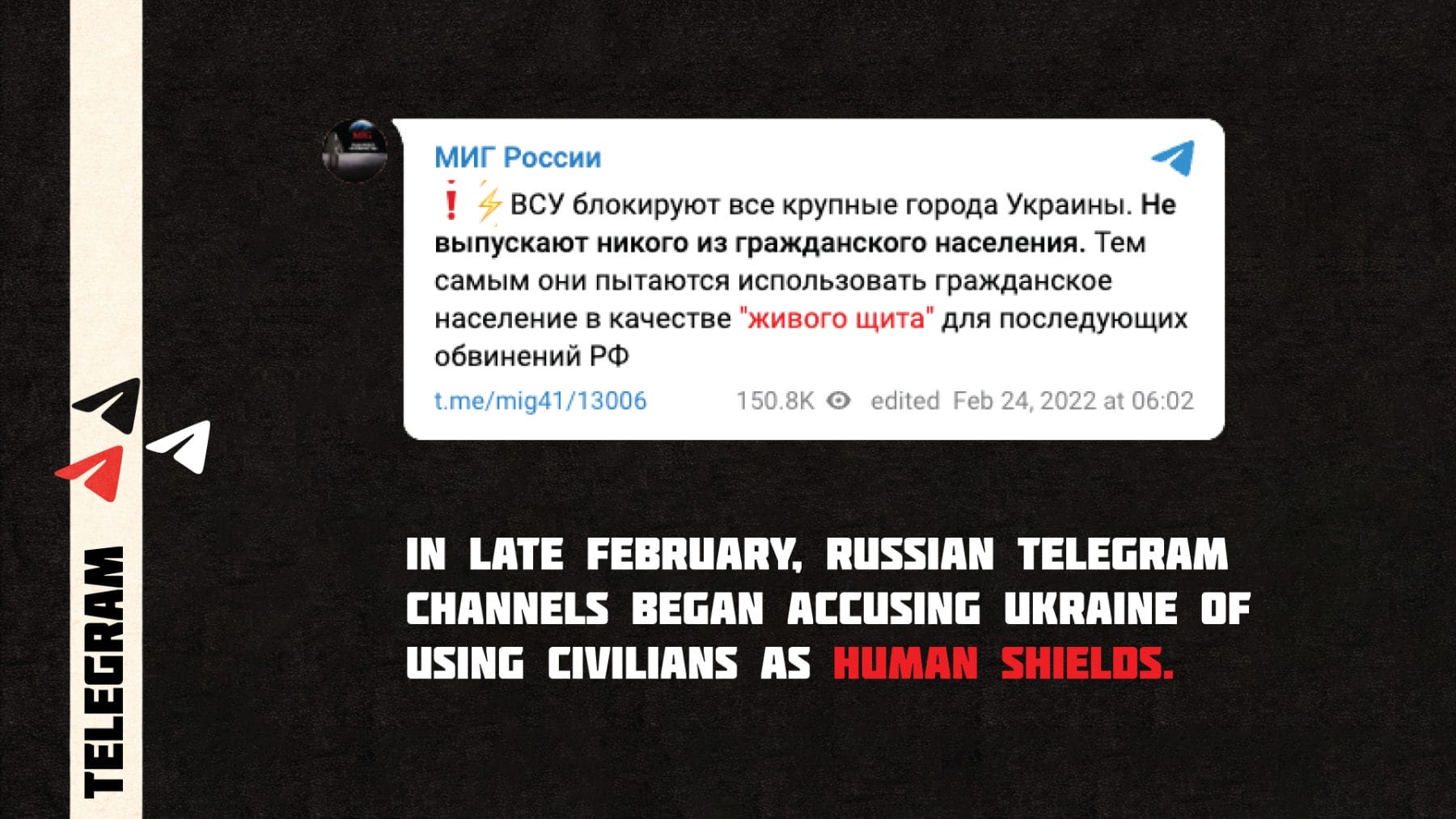
A week before the attack, Russian channels warn Ukraine will use civilians as ‘human shields’ in Kramatorsk. 
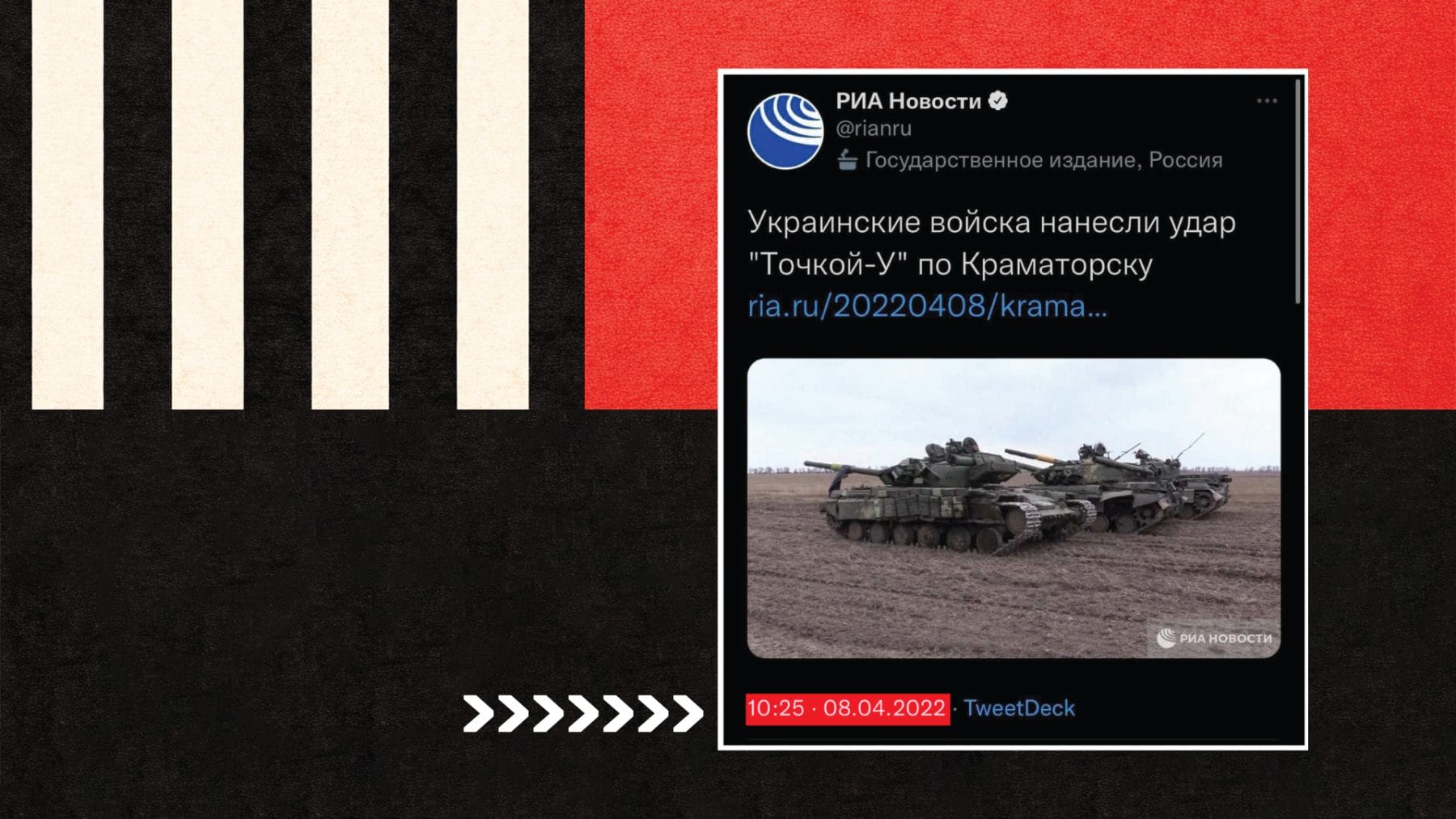
On April 8, at 10.28 A.M., a ballistic Tochka-U missile hits Kramatorsk railway station. It’s equipped with a cluster-munition warhead which disperses 50 small bombs across the station. 

At least 58 civilians are killed.

Russia denies involvement. It says Ukraine bombed its own citizens.

There’s something curious about the Kramatorsk attack though.

According to The Ukrainian Centre for Strategic Communications, Russian state-owned news agency RIA Novosti posts about the attack at 10:25 A.M.

That’s three minutes BEFORE the attack takes place.


The tweet is now deleted, but screenshots were taken before it was removed.

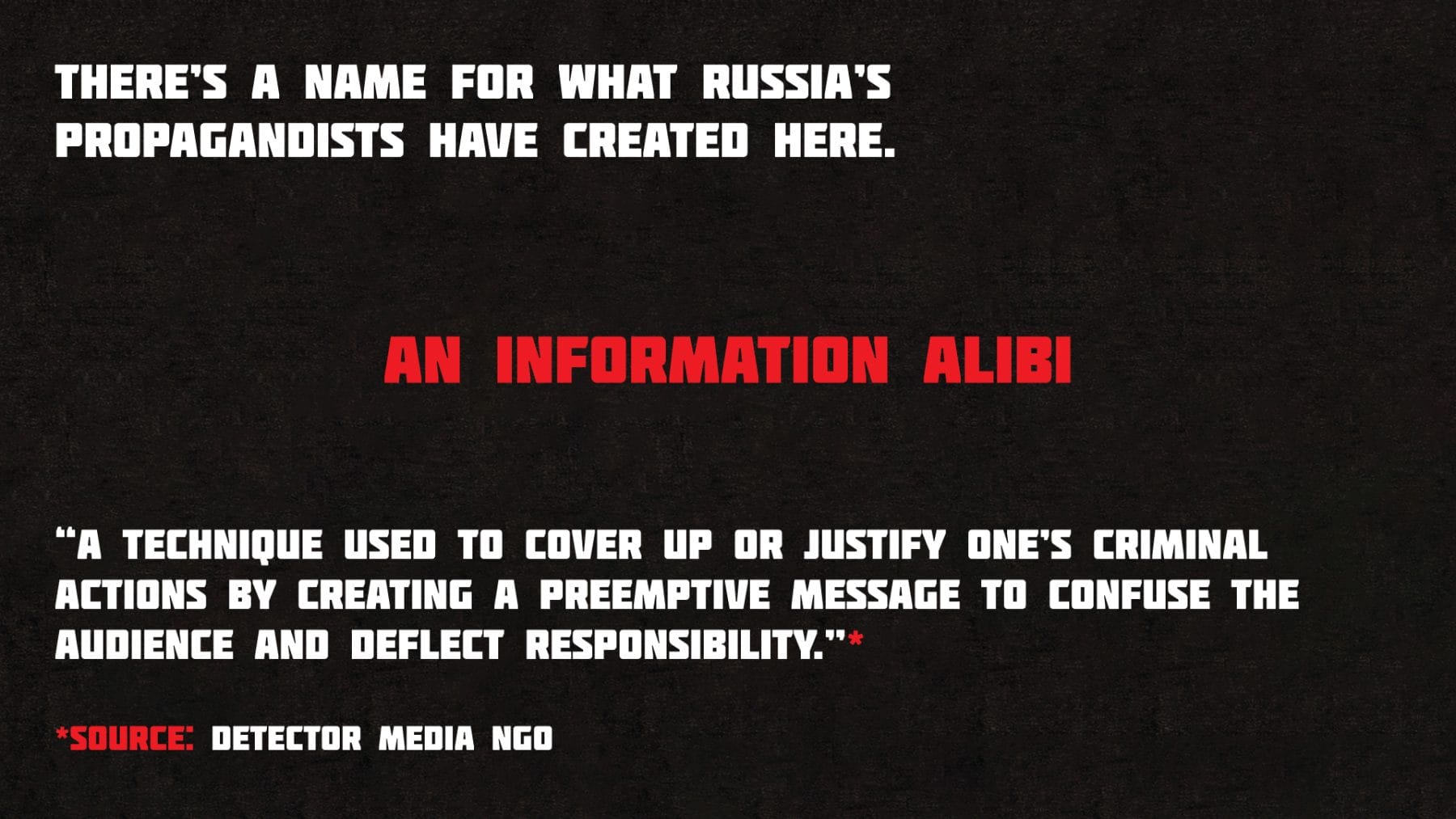
"One of the possible mistakes the Russian info alibi machine could have made was to publish information about a strike on the Kramatorsk railway station before it actually took place.

It's a sort of sloppy mistake that you always want the criminal to make. Without all the other evidence, I don't think we'd be seeing the important patterns that we're looking into, but it's always good for a lawyer if the criminal ends up leaving a shoe at the crime scene.”

Peter Pomerantsev 

The Reckoning Project Co-Founder

Photo Credits: 1.Mohammed Khair/Anadolu Agency/Getty Images. 2.Stringer/AFP via Getty Images. 3. White helmets/Handout/Anadolu Agency/Getty Images. 4. Louai Beshara/AFP via Getty Images. 5. Hamza Al-AjwehAFP via Getty Images. 6. Satellite image (c) 2023 Maxar Technologies. 7. Andriy Zhyhaylo/Obozrevatel/Global Images Ukraine via Getty Images. 8. Fadel Senna/AFP via Getty Images. 9. Grzedzinski for The Washington Post via Getty Images.

Russia, Disinformation, and the Syrian Civil War

Russia repeatedly attacked the credibility of the OPCW (Organisation for the Prohibition of Chemical Weapons) which determined that the Syrian regime was carrying out chemical attacks. 

Michael Weiss, of The Insider, is writing a history of the GRU (Russian military intelligence) and reports that the unit hacked the OPCW as part of its information warfare operations:

Read more

Why did they want to exfiltrate data from the OPCW? So that they could see this is what the West is preparing to say, and this is how we have to muddy the waters. So here are the counterfactual narratives that we should be putting out. One of them was ‘there was no attack, it was all just manufactured, it was a stage play by crisis actors who feigned asphyxiation and symptoms of being exposed to chlorine.’ Or ‘it was a chemical attack but it was done by the other side.’

The Syria Civil Defence, better known as the White Helmets, was another major target of Russian disinformation. This volunteer rescue organisation documented the attacks on the ground, and their footage and physical evidence proved critical to international investigations. Networks of bots and trolls linked to Russia attacked the White Helmets repeatedly. Russia’s ambassador to the UN submitted one such blogger's report as formal evidence to the Security Council.

The post The Alibi Machine: The Pattern appeared first on Coda Story.
  •  

The Alibi Machine: The Suspects

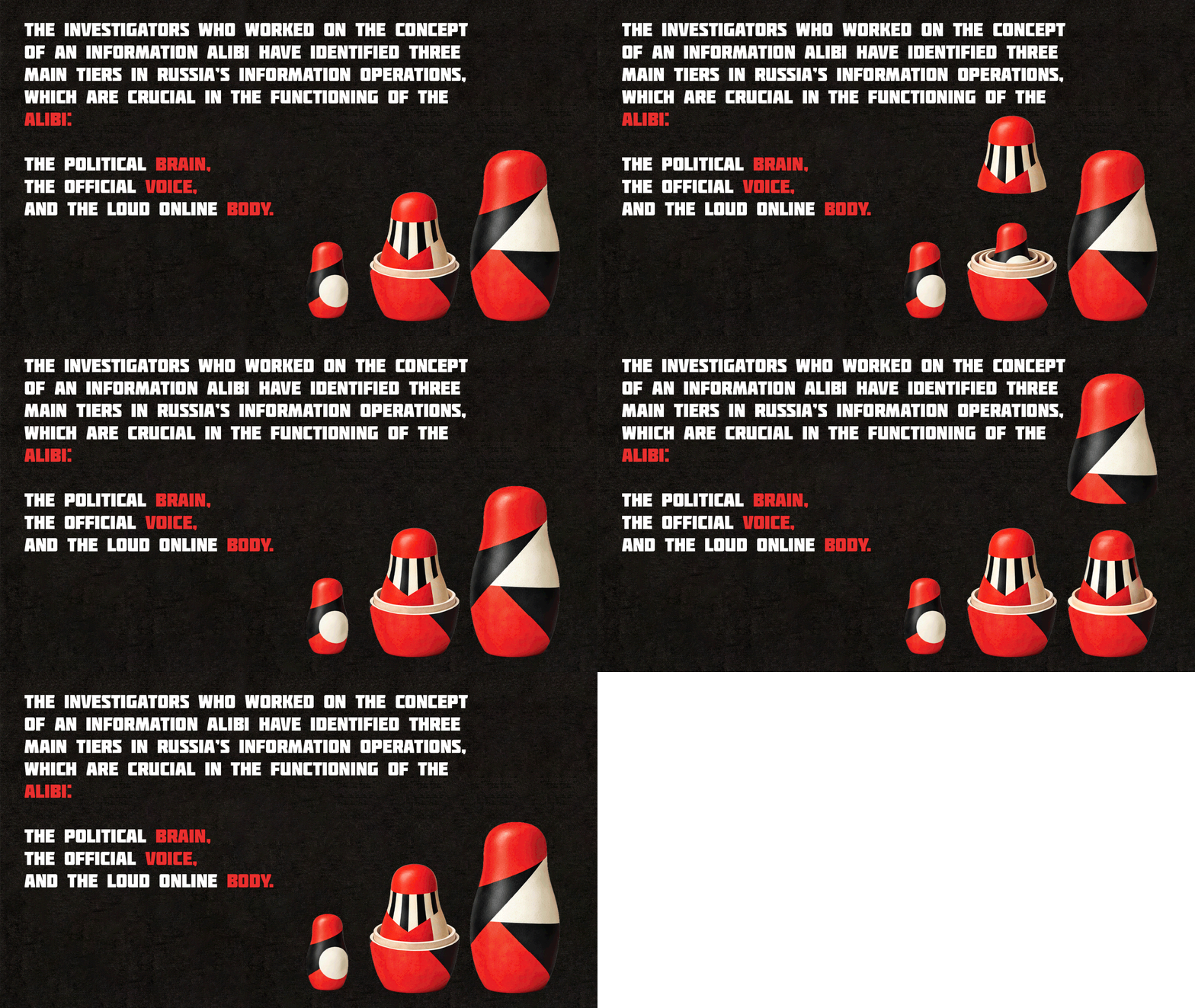
To identify suspects, investigators need to map out the landscape of Russia’s information operations.

At the heart of the alibi machine are real people — government officials, media executives, reporters and bloggers.

“Understanding the system depends in part on knowing who participates in it. So firstly, we have to identify a hierarchical network involved in a particular information operation. This may include senior political leaders, media organizations, and social media influencers… We have to prove that there were some orders or instructions that were given by more senior groups to less senior groups.”

Nadiia Vaskivska,

Legal Advisor at Global Rights Compliance

They distribute the talking points — called “temniki” — directly to editors-in-chief of Russia’s biggest state media outlets: TASS, Channel One, Rossiya, RIA Novosti.

We asked Alexey Kovalev — a Russian journalist in exile who once worked inside one of those outlets — to describe how it functions.

“The presidential administration intervenes with specific instructions. It has a kill switch that can immediately blacklist any coverage in Kremlin-controlled media of any unwanted, undesirable topics, like protests, for example. The presidential administration is like the central nervous system of the beast.” 

Alexey Kovalev

The Kremlin ‘brain’ doesn't only issue orders. It also enforces silence. Russia's official censorship body, Roskomnadzor, can red-flag content and suspend licences. The effect, Kovalev says, is a system that rarely needs to give explicit instructions because everyone already knows the rules.

"You should instinctively know what things to cover, what things not to cover, and from which angle. Do what you think is expected of you." 

Alexey Kovalev

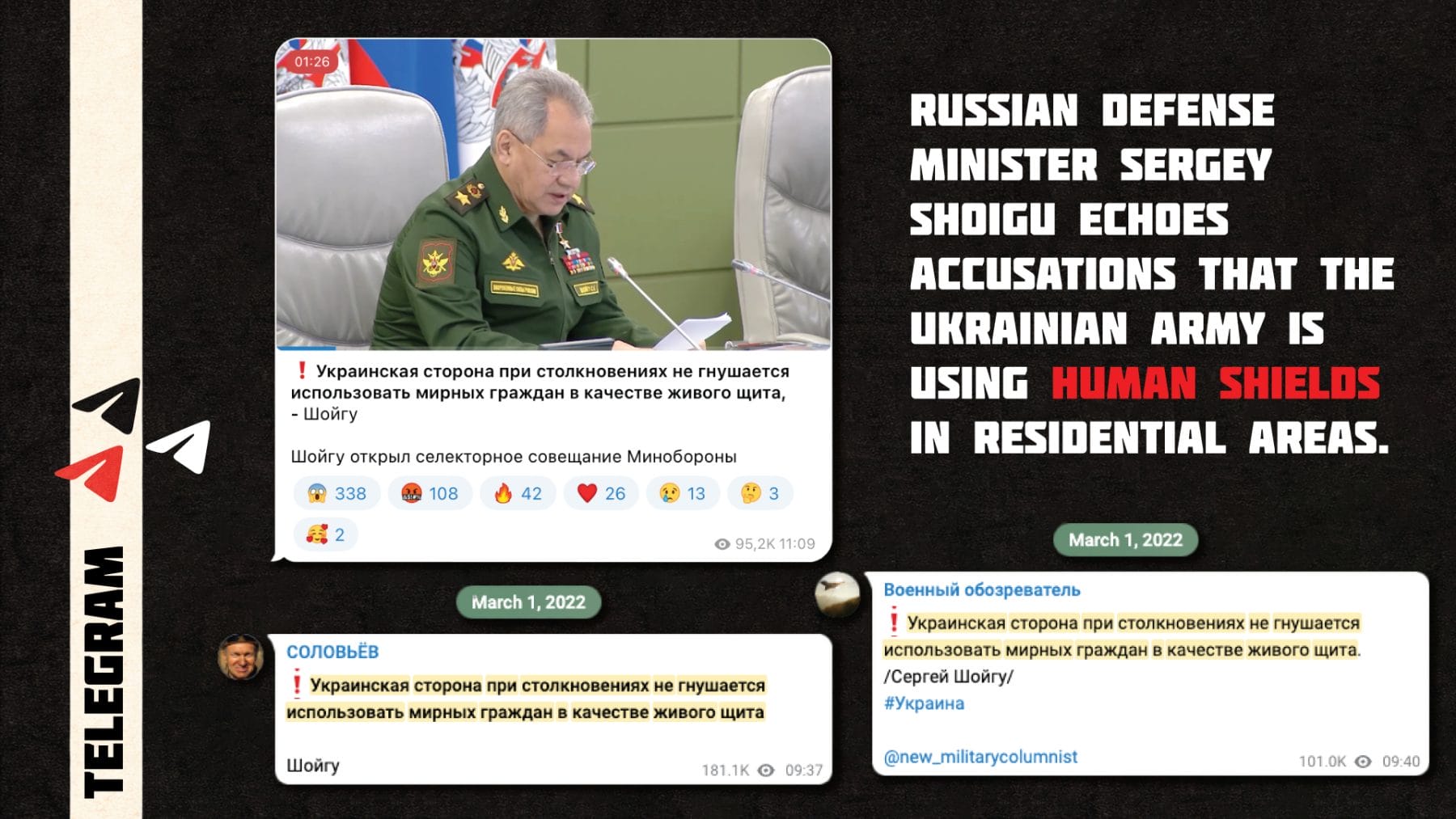
These are the people whose job it is to take Kremlin narratives and project them onto the world stage. As well as Sergei Shoigu, Minister of Defense, and Foreign Minister Sergey Lavrov, several names crop up regularly in the information alibis we’ve looked at:

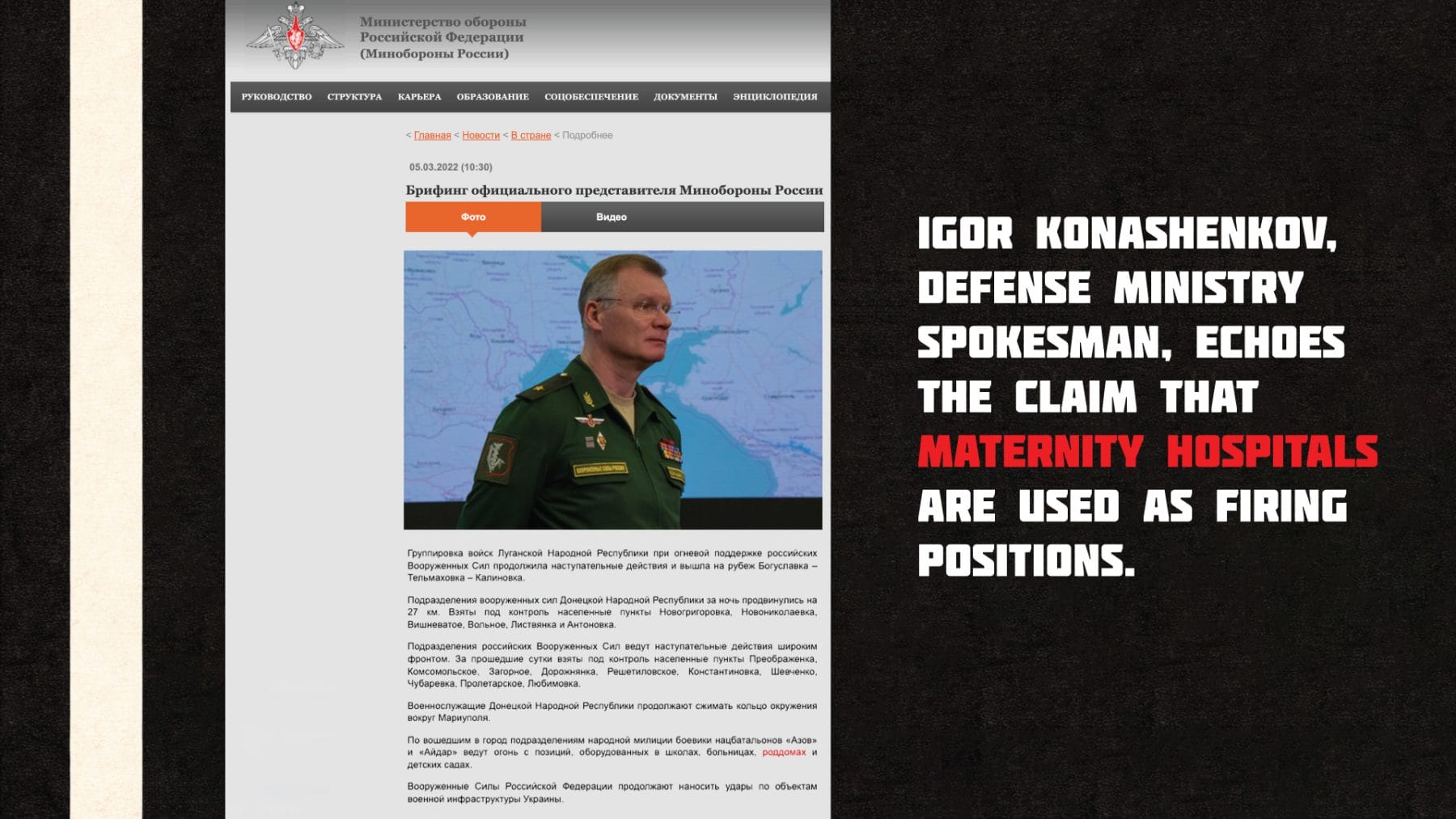
Igor Konashenkov, spokesman for the Russian Ministry of Defense — the military's public voice, whose briefings provide official cover for Russian military actions.

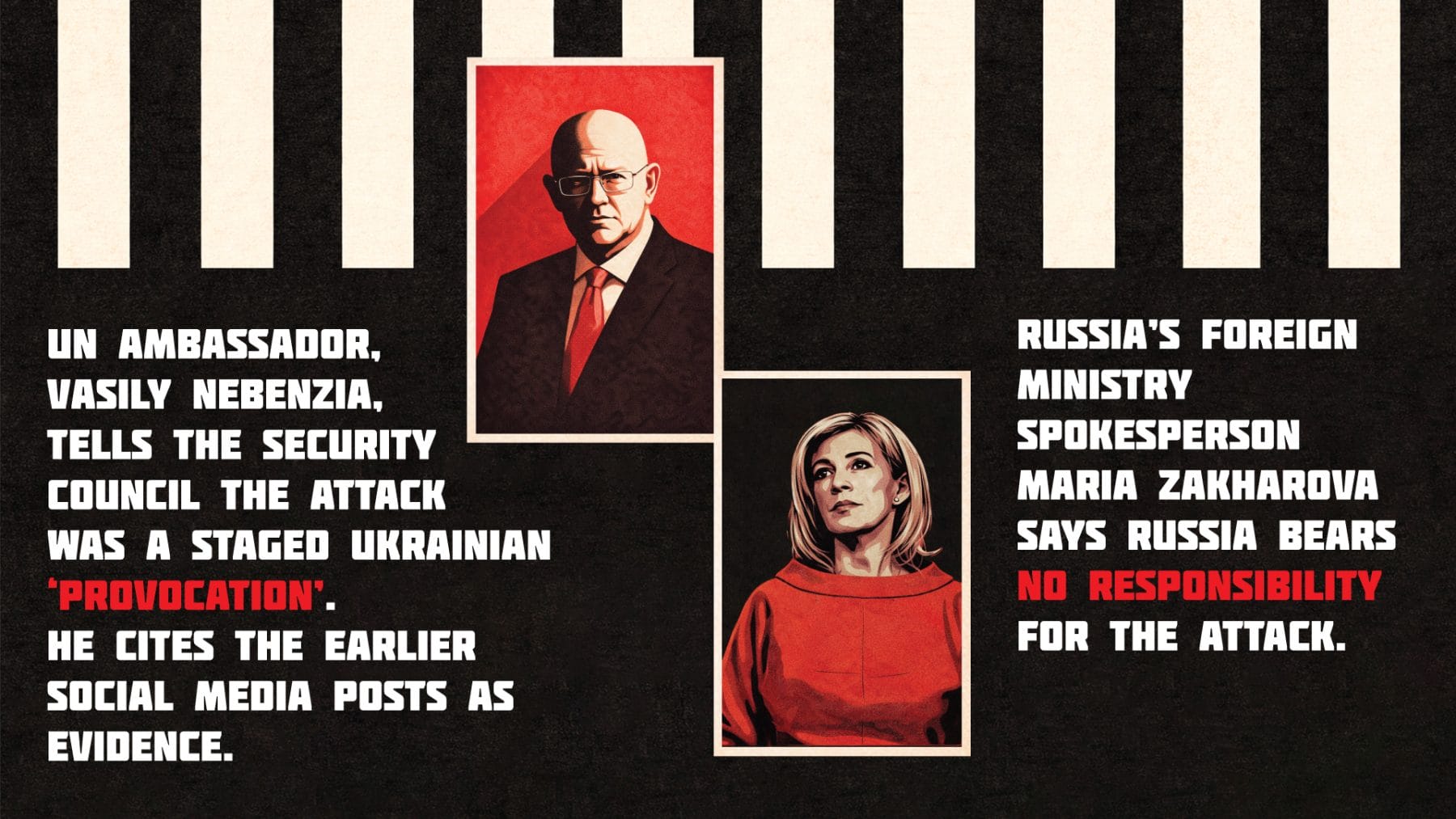
Maria Zakharova, Russian Foreign Ministry spokesperson, who amplifies narratives across international media from behind her podium.

Vasily Nebenzia, Russia's Ambassador to the United Nations, who takes the alibi to the Security Council, where it can be delivered with diplomatic immunity and broadcast live to the world.

“The Russian mission to the UN plays a very central role in this ecosystem. It picks up and amplifies disinformation that has been seeded in more esoteric parts of the internet and gives it a global platform.”

Peter Pomerantsev

The words of these officials have the full weight of the state behind them. And that helps achieve one of the key goals of the information alibi.

“The Russian use of info alibis has to be seen in their general kind of strategy of ultimately avoiding responsibility and giving their allies enough “implausible” deniability about what the Russians are up to… It gives allies at the UN, for example, a way to go ‘well, we just don't know what happened, maybe this was an accident, maybe the Ukrainians bombed themselves.’”

Peter Pomerantsev

The Reckoning Project Co-Founder

This includes organizations that look independent, but which are actually funded by and have direct links to the Russian state.

ANO Dialog and the Social Design Agency — both now sanctioned by the U.S., UK and EU — are the engine room of this layer.

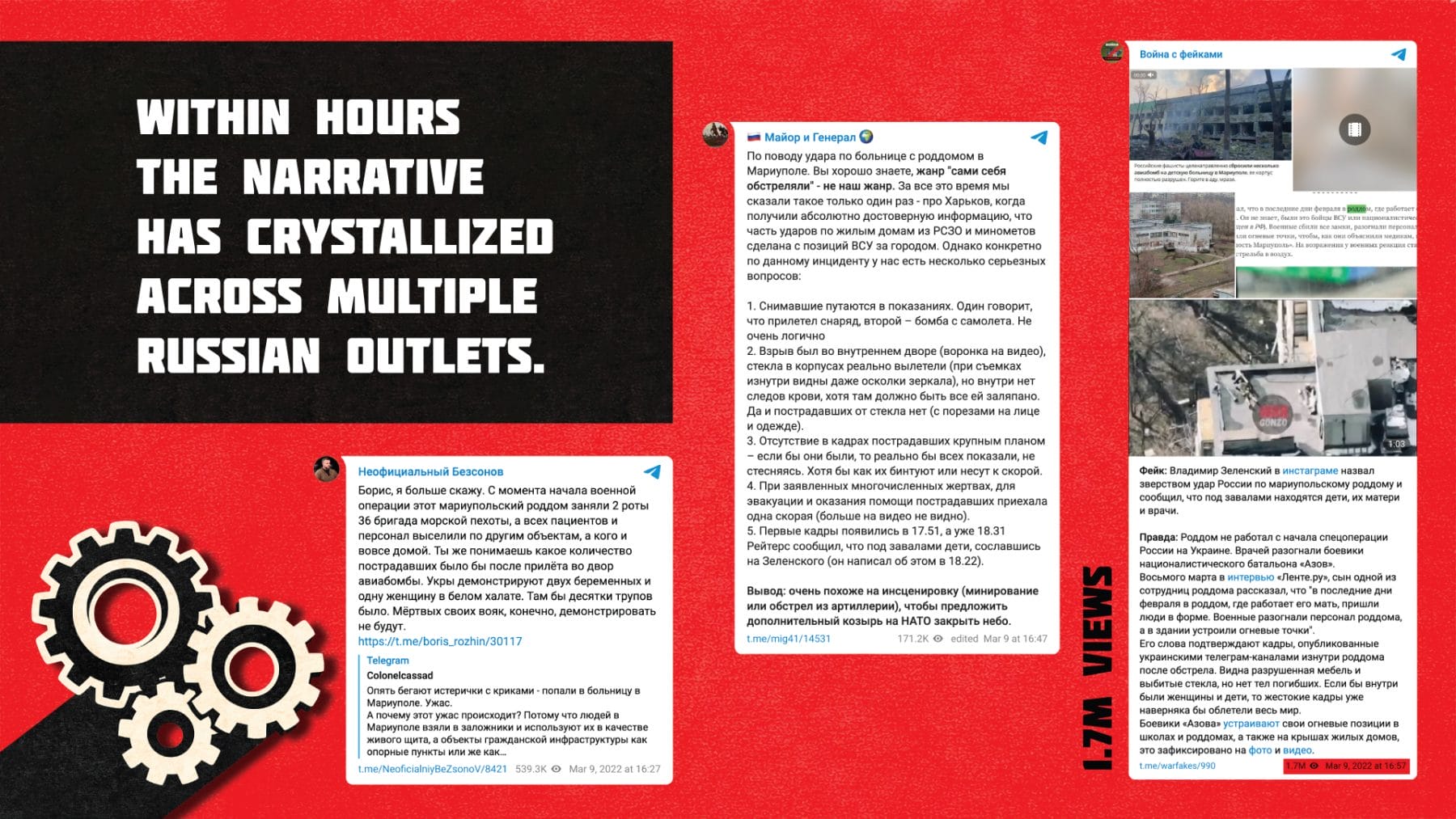
ANO Dialog — reportedly directly linked to Sergey Kiriyenko and the Presidential administration — distributes billions of rubles in grants to social media creators. Its network of social media channels started spreading fakes about Ukraine from the start of the invasion. One of the examples — a pseudo fact-checking Telegram channel War on Fakes, with over 400k subscribers.

“It's a way to ensure that every content creator is hooked on the government money… The ‘don't bite the hand that feeds you’ mentality.”

Alexey Kovalev

The Social Design Agency (SDA) operates differently — it focuses on creating and spreading Russian disinformation abroad.

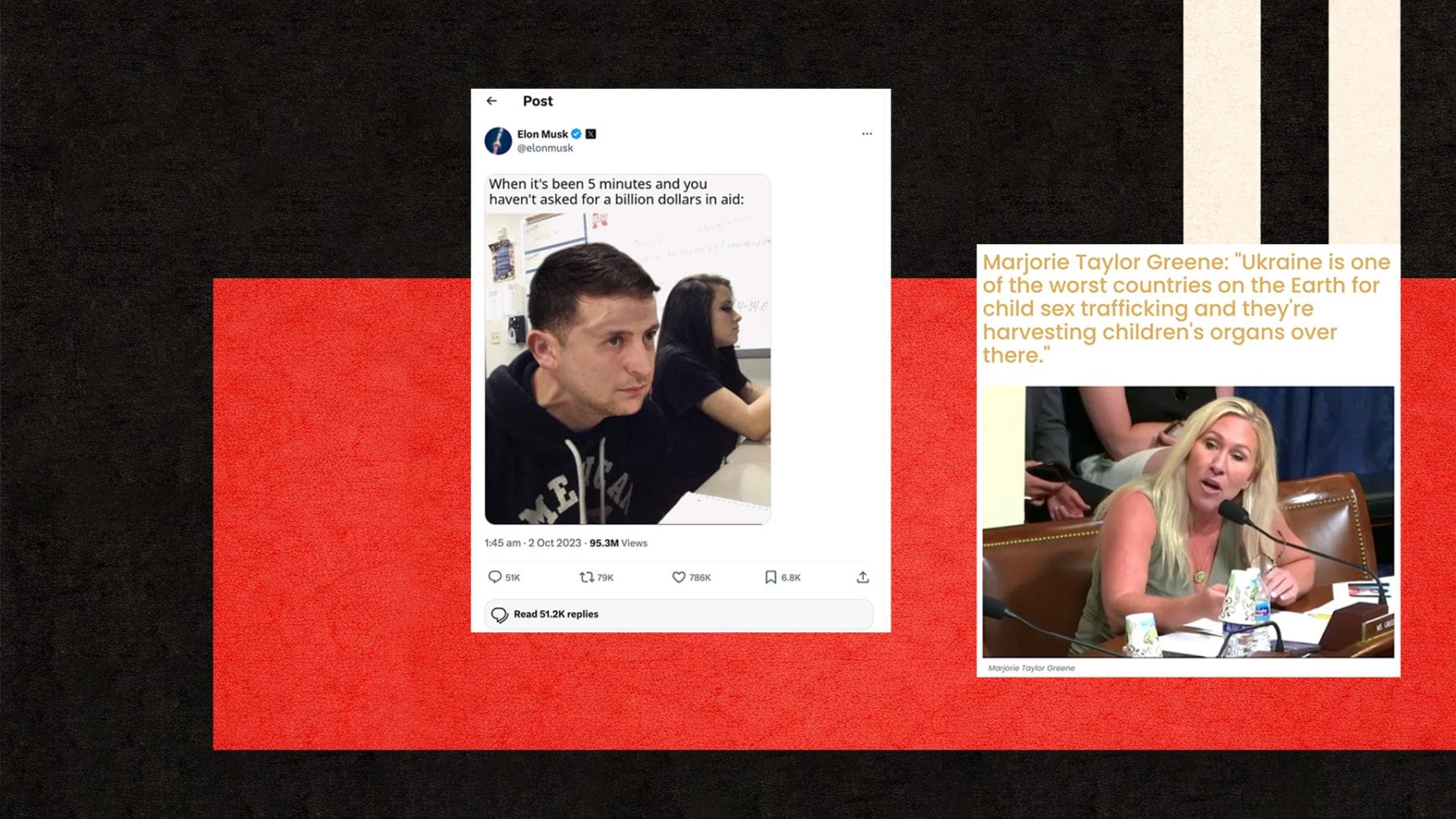
“The Social Design Agency is industrialized disinformation, and it can be terrifyingly effective because explicitly pro-Kremlin narratives created by the SDA were shared by people like Elon Musk and Marjorie Taylor Greene. The stuff that they're creating is really bleeding into mainstream Western discourse.”

Alexey Kovalev

An investigation by RFERL found that this meme denigrating President Zelensky, and shared by Elon Musk, was created by the SDA. 


Prominent MAGA voice and noted conspiracy theorist Marjorie Taylor Greene also repeated SDA narratives, including about child abductions and organ harvesting in Ukraine.

Beyond the funded networks lies the wild west of the information ecosystem: Telegram channels run by so-called “voyenkory” — “war correspondents” — and “Z-bloggers” — activists and war supporters with an estimated audience of approximately 10 million.

They share each other's content, amplify each other's narratives, and give the impression of a spontaneous, grassroots consensus.
“Their value to the state is that they create the appearance of organic grassroot support, and can be disowned if something goes wrong.” - Alexey Kovalev


Their “disposable” nature is also what makes them so difficult to pin down and prosecute.

Let’s take the Mariupol hospital attack as an example. 

It appears that bloggers and Telegram channels were the first to point to maternity wards being used as firing positions.

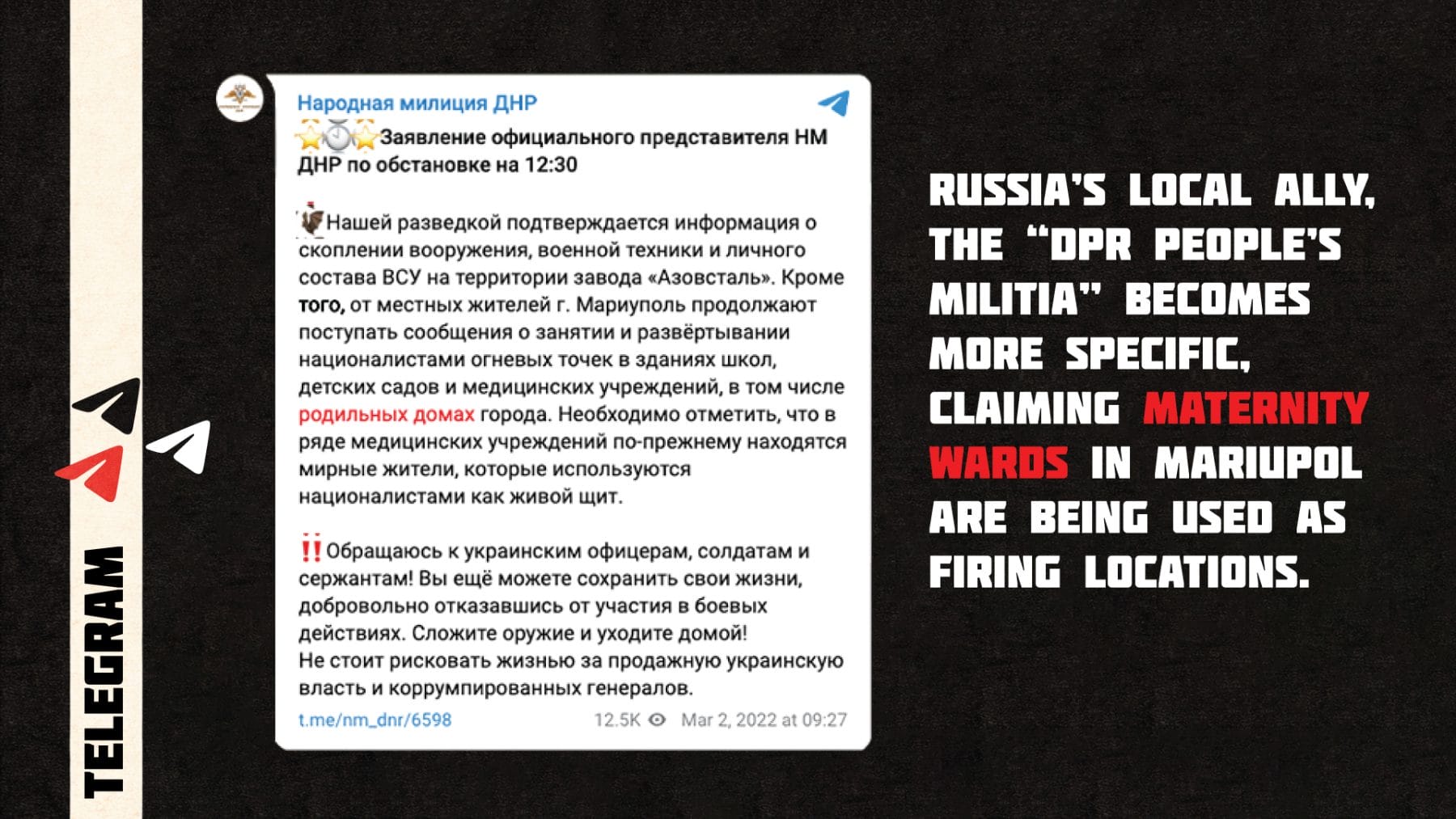
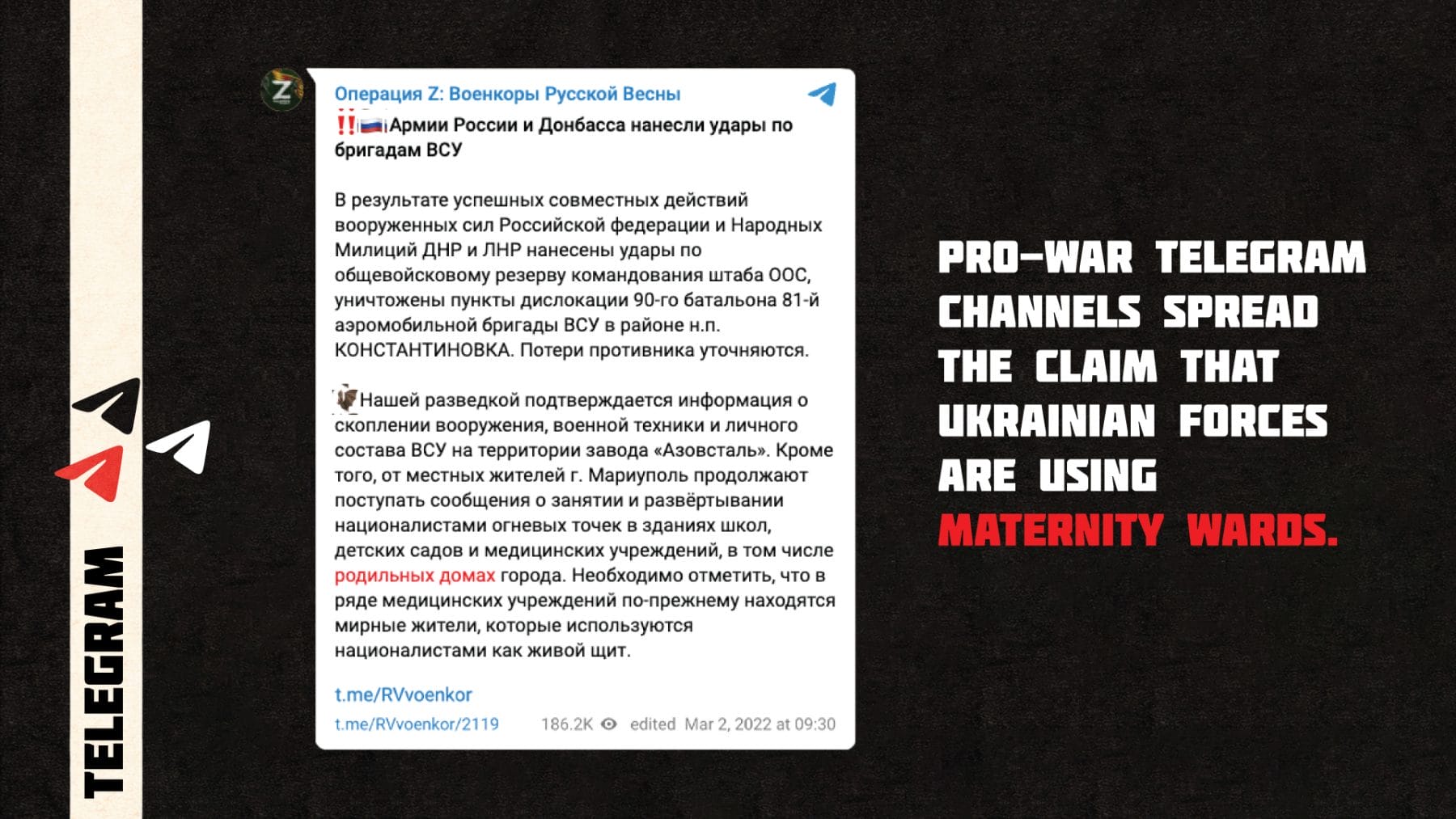
A week before the attack, DPR People's Militia channels were claiming that maternity wards were being used as firing positions. Pro-war Telegram channels amplified it within hours. 

It was after that, that official spokespeople reinforced the message:

  • Igor Konashenkov, Defense Ministry spokesman, accused the Ukrainian army of turning hospitals into firing positions. 
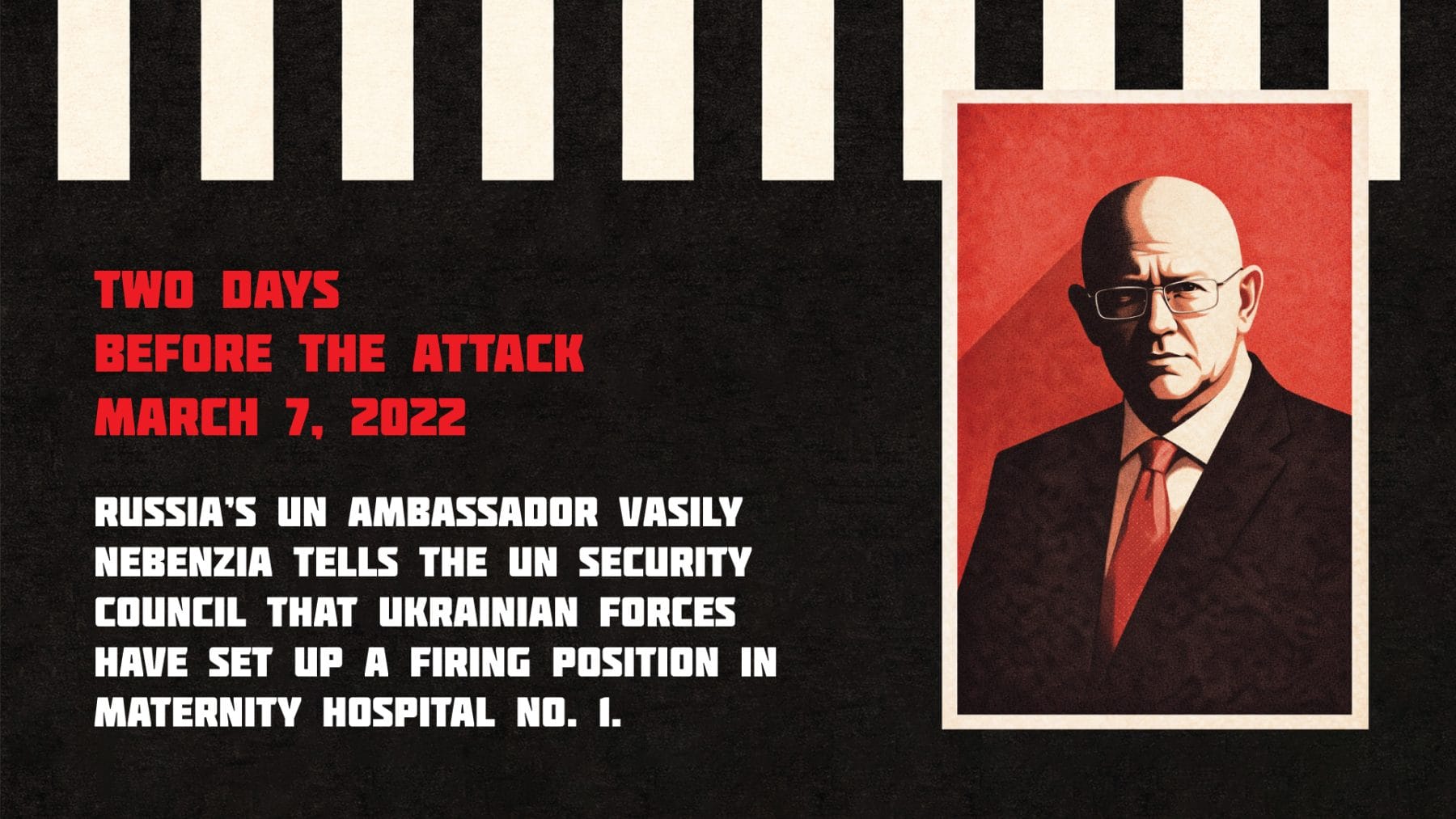
  • Vasily Nebenzia, UN Ambassador told the Security Council that Ukrainian forces had placed a firing position in a Mariupol maternity ward before the attack, and reminded them of his warning two days after the attack.
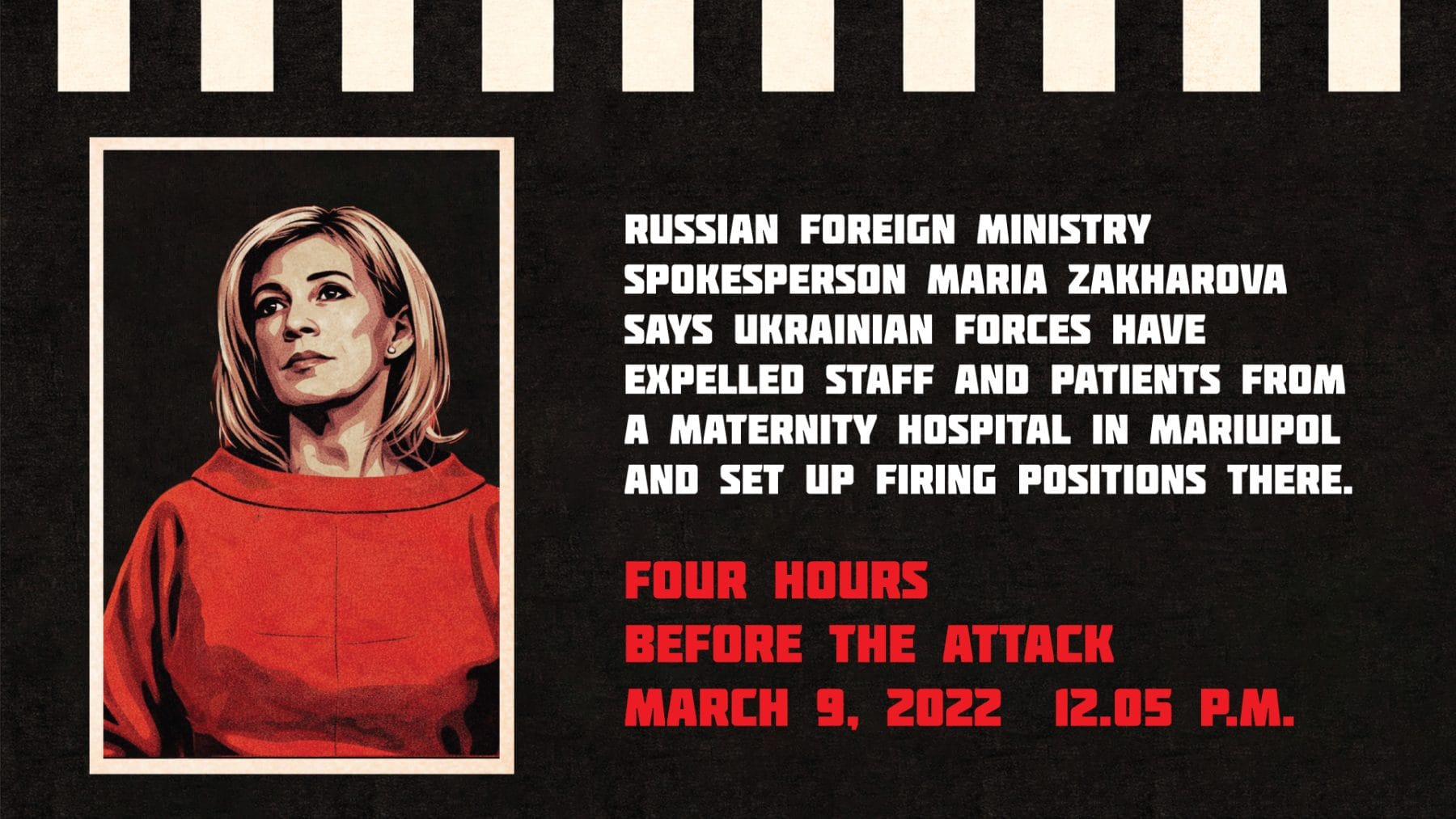
  • Maria Zakharova, Foreign Ministry spokesperson — remember the briefing she gave just four hours before the bombs fell on the maternity ward?

And then, almost before the dust had settled, the bloggers and Telegram channels echoed the narrative the spokespeople had told the world.

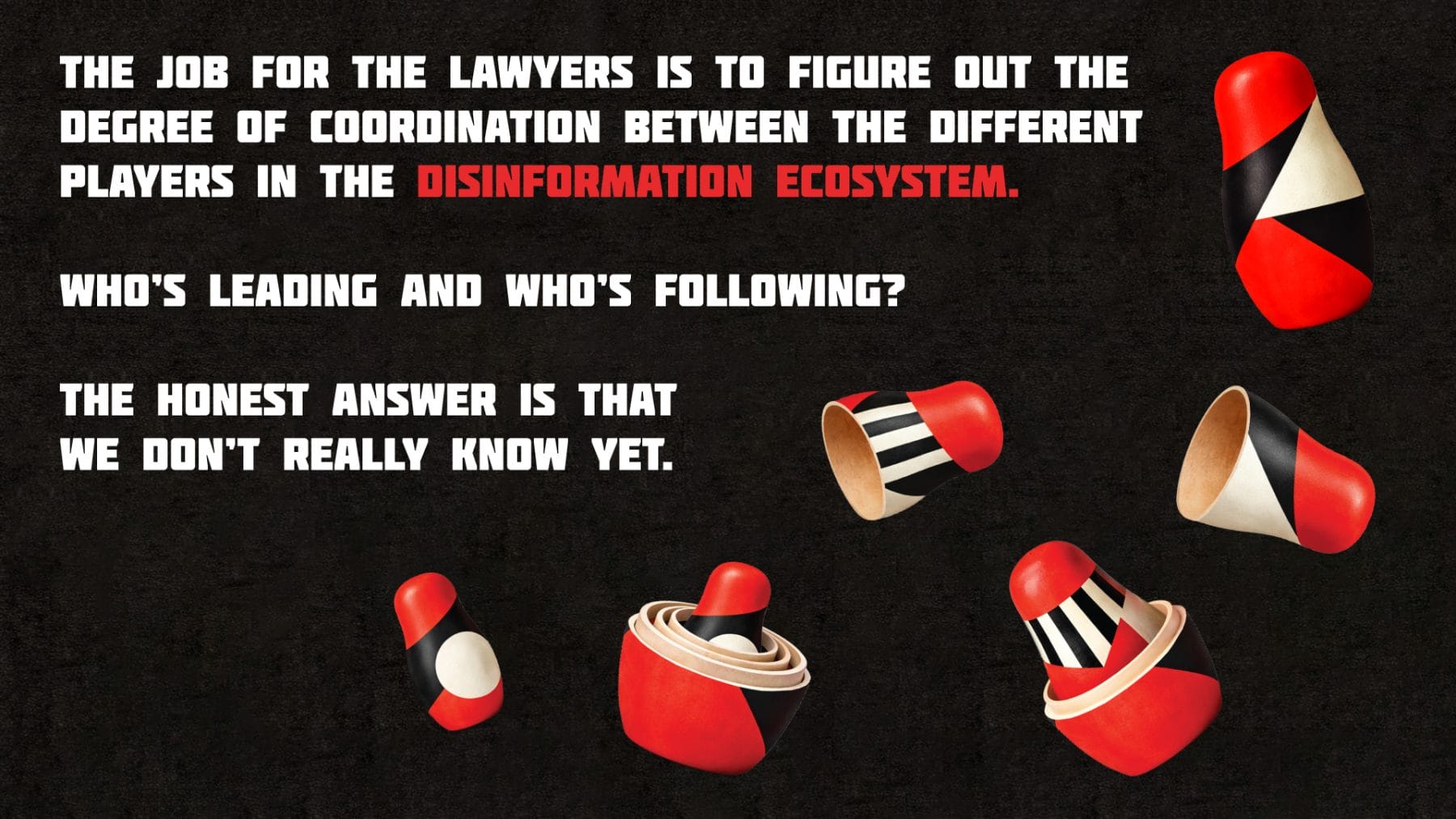
So, as far as who’s leading who, Vasily Gatov, former Russian media strategist and disinformation researcher, thinks it’s a two-way street. Some indications come from the Kremlin, other initiatives are launched from the bottom.

“My opinion is that most of these information operations are created in small groups, mostly people with very limited knowledge of psychology and especially media effects. Some are military, maybe military intelligence. Some are journalists, war journalists. And most of them are people who make their living from telling the Kremlin they're doing a great job.”

Vasily Gatov

Alexey Kovalev agrees that, in his experience as a journalist, there are rarely detailed instructions flowing from the top. Each individual is expected to use their own judgment, as long as it’s favorable to the Kremlin.

“It's a way of controlling by omission that you should not say under any circumstances, and that is anything that is not on the Russian defense ministry's website. Steer clear from any Ukrainian perspective. It doesn't matter. Ukrainians don't have agency. Flood the zone with shit, with a million conflicting narratives. It doesn't really matter that they don't make any sense or it falls apart at the slightest scrutiny. Seeds of doubt have been sowed.”

Alexey Kovalev

“We can tell when an info alibi is peaking. We can look at the online patterns and see how it's spiked. We can see so many telltale signs that this is not organic activity, but part of a planned operation. The technology is a double-edged sword and I think this war is going to be a game changer globally for holding propagandists accountable.”

Peter Pomerantsev

The Reckoning Project Co-Founder

Russia's Disinformation Agencies and their links to the Kremlin

1. The “Doppelganger” case

In 2024, an FBI agent’s affidavit submitted to the Eastern District of Pennsylvania reported that Sergei Kirienko and Sofia Zakharova, both employed with the Russian presidential administration, played key leadership roles in a disinformation campaign named “Doppelganger”.

Read more

In this campaign, entities including the SDA and ANO Dialog created and spread deep fakes about the war, between at least 2022 and 2024.

2. The Dmitri Simes case

Another indictment, filed in 2024 by US prosecutors in the case against Channel One host Dimitri Simes, also reports direct involvement of Russian executive bodies in disinformation operations.

3. Investigations like this one established the impressive width of ANO Dialog’s network of over 100,000 social media pages, as well as regional governance centres and direct links to the Ministry of Defense.

The post The Alibi Machine: The Suspects appeared first on Coda Story.
  •  

The Alibi Machine: The Case for the Prosecution

Scott Martin, International Lawyer at Global Rights Compliance

Scott Martin: There's nothing wrong in general with propaganda, disinformation, information operations — they're a common form of any military operation. But when something helps to contribute to the perpetration of a crime, if it helps to conceal crimes or if it obstructs investigations, it shouldn't be seen as background support of propaganda but actually an operational aspect of a kinetic military action. And legally relevant as a consequence.

Free speech is a protected right. Don’t you risk infringing on that right?

SM: This report was done by a group of human rights lawyers with a firm commitment to an expansive understanding of freedom of expression or freedom of speech. However, the right to speak, the right to freely express yourself, ends when speech becomes a tool of a crime. Propaganda is lawful. Information operations are lawful. Participation in a crime is not.

So what exactly is the crime? Which law would you use to bring a case?

SM: It's called Article 25(3)(d) [of the Rome Statute] and it relates to the criminalization of contributions to a crime by a group acting with a common purpose.

Can you break down what exactly a prosecutor would need to show?

SM: - Show that an international crime was perpetrated.

- Show that the perpetrators of the crime were part of a group that acted with a common purpose.

- Then demonstrate that the person disseminating the false narrative made a significant contribution to the commission of that crime.

And what counts as a ‘significant contribution’ to the crime?

SM: If the contribution led to impunity for the crime, because the narrative disseminated in advance was strong enough to conceal the perpetration of a crime or otherwise obstruct accountability investigations, then you should be able to argue that that could be a significant contribution.

How do you prove a group is working with ‘common purpose?’ In the information ecosystem, rumours circulate all the time, they get picked up and passed on, details may change as the story mutates. It doesn’t have to  mean there’s coordination between the people involved.

SM: I wouldn't think you'd need to show that here's this group sitting together saying ‘here's how we're going to attack and Vlado this is your responsibility, and Sergei this is your responsibility.’ And international criminal law is a lot like this because we don't have access to many of the conversations that went into a plan. What you do is you draw inferences. And then from there you hopefully will be able to see: Is it accidental? Do we have a group acting together pursuant to a common purpose?

Is that why you need to show a pattern of behavior?

SM: This pattern is important principally for legal reasons. It helps to show that this attack wasn't isolated. It wasn't a mistake. It wasn't opportunistic. It's taking place repetitively in Ukraine. It [the pattern] shows integration between the information operation and the military operation. The speech wasn't just incidental to the military action. It was functionally connected. And as a consequence, maybe providing a material contribution to the crime that takes place and the obfuscation afterwards.

Wouldn’t you need to show direct links between the security services and the people conducting the information operations?

SM: We need to show a full integration and plan of the information operation within the kinetic military action because that's what connects it to the crime. And if we can show that a high-ranking political or diplomatic official in Russia was participating from the beginning, during and after the attack, it leads you to believe that this was being done. But we still must work to ensure an unassailable direct link between the disinformation and the crime that took place. The way it normally comes, in international crimes work, is through an insider who was present at a particular moment and she or he can testify that this information operation was integrated into the military operation as an information alibi.

What gives you confidence a prosecution of Russian propagandists could ever be brought using this law? It’s never been done before.

SM: Its legal coherence is jumping off the page. There was no stretching of definitions. There was no creating new ideas or practices. This was, ‘here's what the law says and here's how it fits and here is supporting jurisprudence.’

There have been plenty of conversations about whether any Russian interference campaigns that they launch online, or these types of disinformation operations can be elevated to a crime. And while a lot of it remains and ought to remain protected speech, when you're looking at it through a human rights lens, in this case, I think we found a very clear example where it should be investigated as a contribution to a crime and perhaps even prosecuted as such.

The post The Alibi Machine: The Case for the Prosecution appeared first on Coda Story.

  •  

The Alibi Machine: The Crime

March 2022  Ukraine’s port city of Mariupol is under siege. 

400,000 civilians are trapped as the Russian Army and its local allies, the so-called Donetsk People’s Republic People’s Militia, blockade the city.

Over the following weeks senior officials, state-backed TV channels and news agencies, war reporters and bloggers echo a version of the same story. 

The details don’t always match. 

Some reports say the maternity ward was used by Ukrainian soldiers, and was therefore a legitimate target. 

Others say the attack was “staged” — that Ukrainian forces carried it out and made it look as though Russia had done it. 

But the conclusion is always the same: Russia is not to blame for this attack.

“Sometimes things are just chaotic because war is chaotic. At other times, spreading many, many, many different versions of the same event is a very classic Russian tactic to blur the reality of what happened… This is the way you undermine the very idea of truth and belief and just create a sort of a haze around what really happened.”

Peter Pomerantsev 

The Reckoning Project Co-Founder

Independent investigations have determined that the hospital was clearly identifiable and operational.  

There was no evidence of Ukrainian military positions. 

The OSCE calls the attack a "clear violation of international humanitarian law" and a "war crime."

“The narratives were planted well in advance. And I can essentially break them down into:

1 - “We didn’t do it.”

2 - “We warned you that Ukraine was planning to do it.”

3 - “Even if we did it, the maternity ward was a legitimate target.”

They create so many alternative versions of the truth that if you are having at least some doubt you can pick and choose the one that suits you the most and go with it.”

Anastasiia Vorobiova

Legal Advisor at Global Rights Compliance

The mystery of the “Mariupol Madonna” who became the face of Russian propaganda

You might remember this woman, who in the first days after the maternity ward attack appeared on front pages of the media worldwide.

Read more

Her name is Mariana Vyshemirskaya. She’s a Ukrainian blogger, who was about to deliver her baby in that maternity ward. 

In the first days after the attack, images of her, taken by Evgeniy Maloletka and Mstyslav Chernov, heavily pregnant, her terrified face covered in blood, made her a symbol of Russian brutality. 

Meanwhile, an intense propagandist campaign against Mariana was happening in Russian media. 

“She’s an actress” they said. “The blood is fake. She’s not really pregnant.”

Soon after, an interview with the blogger appeared in ChVK media, in which she repeated the Russian version of events: the hospital had been used by Ukrainian military, and Russia had nothing to do with the attack. 
Vyshemirskaya has since become a well-known blogger inside Russia, collaborated with Russian media and continued to support the government's agenda.

The post The Alibi Machine: The Crime appeared first on Coda Story.

  •  
❌