Donald Trump promised Americans they would get tired of winning.
If this is what winning looks like, America can’t afford much more of it.
We are losing ground economically. We are losing credibility abroad. We are losing tourists, workers, stability, trust, constitutional guardrails, and whatever remained of the illusion that the government answers to “we the people.”
The tourism economy is taking a hit, with international visitors increasingly reluctant to come to the United States. Even migration—the lifeblood of America’s economic growth, innovation, labor force and national renewal—is now moving in the wrong direction. Fewer people are coming in, more Americans are leaving, and by some estimates the country has already crossed into negative net migration.
That is not the mark of a nation “winning.” It is the mark of a nation people are increasingly choosing to escape.
That is what happens when a nation treats visitors, immigrants and dissenters as threats first and human beings second: people stop coming, businesses suffer, and fear becomes official policy.
The economy, despite the administration’s relentless victory laps, is flashing warning signs: downgraded growth, strained consumers, rising costs, depleted savings, and policy chaos that leaves families, small businesses and entire industries guessing what fresh disruption tomorrow will bring.
We are being worn down by the losses.
Meanwhile, the man who promised to end wars has presided over their continuation and expansion. The man who promised to bring prices down has helped drive uncertainty up. The man who promised to drain the swamp has turned government into a spoils system for loyalists, cronies, contractors, oligarchs and power brokers. The man who promised law and order has treated the law as something to be weaponized against enemies and waived for friends.
This is not winning.
This is the slow-motion defeat of a constitutional republic by spectacle, grievance, greed and brute force.
The losses are piling up.
Americans were told they would get prosperity. What they got was an economy in which corporate profits and stock market gains mask the fact that ordinary households are stretched thin, savings are shrinking, debt is mounting, and the cost of basic necessities keeps eating away at wages.
They were told tariffs would punish foreign governments and bring jobs home. What they got were higher costs passed down to consumers, retaliation, supply disruptions, and a trade policy built less on strategy than on political theater. Even the courts have begun treating the tariff agenda as what it is: economic policy by executive improvisation, with judges striking down or narrowing tariff maneuvers while the administration keeps looking for new legal workarounds.
They were told immigration crackdowns would make America stronger. What they got was a nation frightening away the workers, students, tourists, entrepreneurs and families who have long helped power its economy.
They were told America would be respected again. What they got was a country increasingly viewed as unstable, hostile, unpredictable and unsafe—not merely by adversaries, but by allies, visitors, investors and would-be partners.
They were told the wars would end. What they got was more war talk, more military escalation, more blank checks for the war machine, and more excuses for expanding executive power in the name of national security.
Listen carefully when any ruler says something like that.
That is not constitutionalism. That is the language of kings, dictators and strongmen who believe their intentions place them above the law.
The Constitution was written precisely to prevent that kind of thinking from taking root in America.
The problem with Trump’s brand of winning is that it requires Americans to lose.
For the police state to win, the Fourth Amendment must lose.
For the surveillance state to win, privacy must lose.
For the war machine to win, peace must lose.
For the executive branch to win, the separation of powers must lose.
For the oligarchs to win, working families must lose.
For the propaganda machine to win, truth must lose.
For a strongman to win, the Constitution must lose.
Trump’s “winning” is simply the latest branding campaign for an old con: convince the people they are winning while stripping them of the power to govern themselves.
Call it what you will—national security, border security, economic nationalism, law and order, anti-corruption, emergency authority, America First—but when the end result is more government power and less individual freedom, we should know by now who is really winning.
The winners are the same as always: the defense contractors, data brokers, private prison operators, surveillance companies, lobbyists, political insiders, Wall Street speculators, government contractors, partisan enforcers, donors with access, loyalists seeking payouts, and bureaucratic power centers that thrive on fear, crisis and control.
The losers are “we the people.”
This is the hard truth Americans must face: a government that promises to make you “win” by taking power away from someone else will eventually take power away from you, too.
Rights are not partisan. Due process is not partisan. Free speech is not partisan. Privacy is not partisan. Limits on executive power are not partisan. The Constitution is not supposed to be a campaign prop, a legal technicality or a speed bump on the road to political victory.
The Constitution is the contract that binds the government down.
Without it, all we have are rulers and subjects.
That is why the real measure of any administration is not how loudly it boasts, how many enemies it punishes, how many executive orders it signs, how many troops it deploys, how many agencies it purges, or how many headlines it dominates.
The real measure is whether the people are freer, safer in their rights, more secure in their property, more protected from government abuse, and more capable of holding power accountable.
By that measure, we are not winning.
We are losing in all the ways that matter.
A president can call it winning. A party can call it winning. The media can package it as winning. The crowds can chant along.
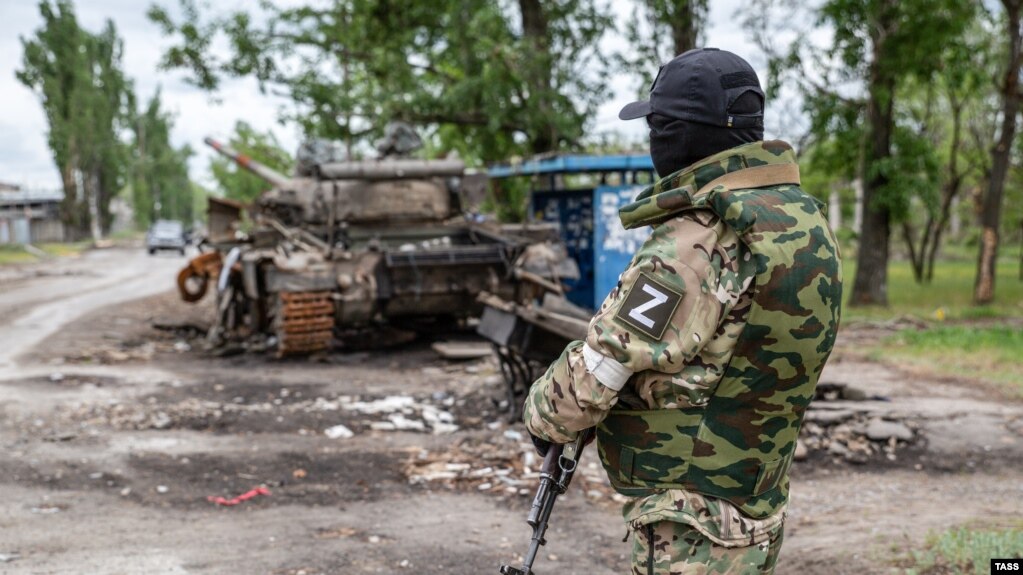
Russian occupation forces have deliberately manufactured a food shortage in occupied Rubizhne, cutting civilian food deliveries to the Luhansk Oblast city even as military supply convoys continue to flow, the head of the Luhansk Regional Military Administration reported on 8 June.
Shelves in the city's stores are emptying rapidly, Kharchenko said. Russian propaganda blames disrupted transport links, citing an alleged drone threat. Yet the occupiers have had no difficulty maintaining their own logistics routes to resupply military units stationed across the region, he noted.
"They need to make the next victim for Russian television out of local residents. They chose Rubizhne."—Luhansk governor OleksiiKharchenko
A city turned into a propaganda prop
The official accused Russia of weaponizing hunger for television cameras. He said the occupiers intend to film bare shelves and hungry residents, then broadcast the footage to Russian audiences as evidence of suffering they themselves engineered.
Before Russia's full-scale invasion, Rubizhne was home to more than 55,000 people. Russian forces seized the city in May 2022 after weeks of devastating urban combat during which they fired up to 1,500 shells per day, the BBC's Quentin Sommerville reported from the front lines. The city's current population remains unknown, but residents who stayed have endured four years of occupation without reliable utilities, communications, or public services.
In nearby Sievierodonetsk, conditions have deteriorated so far that residents now mow the grass in their own neighborhoods and clean communal areas themselves, Kharchenko added—an admission that Russia's occupation authorities provide no basic municipal services even in the cities they claim to have "liberated."
A pattern of deliberate starvation across occupied Ukraine
The manufactured food shortage in occupied Rubizhne fits a documented pattern of Russia using hunger as a weapon against Ukrainian civilians trapped behind the front lines.
In Oleshky, a frontline city in occupied Kherson Oblast, roughly 2,000 civilians have been cut off from food, medicine, and clean water for months. "If the situation doesn't improve, people will just die there from hunger. Because there's no way out, no food supplies coming in," an Oleshky resident who escaped occupation told the Kyiv Independent. Russian forces mined the access roads, destroyed the Kakhovka dam's water infrastructure, and deployed FPV drones that residents describe as conducting "human safari" attacks—hunting anyone who steps outside. People there hunt pigeons and wild ducks with fishing line, plant vegetables in shell craters, and bury their dead in wheelbarrows because no coffins or transport exist.
Ukraine's Foreign Ministry in May appealed to the United Nations and the International Committee of the Red Cross over what it called a "severe humanitarian crisis" in Russian-occupied Kherson Oblast. Russia rejected calls for a humanitarian corridor.
In Nova Kakhovka, upstream from Oleshky, most coastal areas have been abandoned. The few residents who remain live in distant high-rise microdistricts with no functioning hospital and minimal Russian administrative presence, governed remotely from Henichesk, roughly 130 kilometers away.
The Rubizhne food shortage also coincides with Russia's broader restriction of civilian movement through occupied territories. On 6 June, occupation authorities shut down bus and private car traffic on main arteries, capping two weeks of land-corridor breakdowns that have further isolated occupied communities.
Starvation as premeditated policy
International human rights investigators have gathered evidence that Russia planned to use hunger as a weapon before the 2022 invasion. A report by Global Rights Compliance found that a Russian defense contractor purchased grain-transport trucks and bulk cargo ships in December 2021—two months before the invasion began. The evidence was submitted to the International Criminal Court for what could become the first prosecution of a head of state for the war crime of starvation as a method of warfare.
Global Rights Compliance has drawn a direct parallel to the Holodomor—the Soviet-engineered famine that killed millions of Ukrainians in 1932–1933. Russia's current starvation tactics are being perpetrated, the organization noted, by "the same attacking state."
Under the Geneva Conventions, using starvation of civilians as a method of warfare is a war crime. The Rome Statute of the ICC codified the offense in 1998. Yet in occupied Rubizhne, occupied Oleshky, and across the territories Russia claims to have annexed, the pattern continues: military convoys pass, civilian supply lines close, and shelves empty.
In the flatlands of Italy’s Po Valley, the decommissioned Caorso nuclear power plant can be seen for miles, the reactor looming into the sky. When Alessandro Maffini, now an assistant professor at the Polytechnic University of Milan, was growing up in the 1990s, the plant's distant silhouette captured his imagination. “The physical presence of that thing was so significant to me as a child. It was a very visible, tangible, concrete presence,” Maffini remembers. “It was like a white Duomo, there on the horizon, always in the background.” For many others, though, it was a specter of disaster, a ghost nuclear plant — shuttered, alongside all of Italy’s nuclear power stations, in the wake of the Chernobyl accident.
“If that plant explodes, we’re all dead,” Maffini’s mother used to intone, looking out at the defunct Caorso station, once the largest in Italy. As Maffini rode his bike six miles across the countryside to get a closer look at the plant from a nearby overpass, his mother’s doom-laden words rang in his ears. Her warning scared him. It also made him want to learn more. When he left home to go to university, Maffini decided to work in nuclear physics. “Radioactivity is a strange thing,” he says. “You can’t see it, you can't hear it, you can't smell it. It leaves a lot of room for imagination, for speculation, for fear.”
Four decades on from Chernobyl, and Italy has some of the highest energy bills in Europe. The country is scrambling to disentangle itself from its dependence on Russian gas in the wake of Russia’s invasion of Ukraine, and build out its energy sovereignty. War in Iran, and a growing European consensus that turning away from nuclear power was, in the words of European Commission president Ursula von der Leyen, a “strategic mistake,” has given more impetus to the Italian government’s argument that the country needs to move past its qualms.
Last year, the Italian cabinet approved a new draft law reintroducing the prospect of returning to nuclear power. “The government has approved another important measure to ensure clean, safe, low-cost energy that can guarantee energy security and strategic independence,” the Prime Minister Giorgia Meloni announced.
Italy is already surrounded on all sides by nuclear power plants: Slovenia’s Krsko plant is 90 miles away from the border, and there are four French nuclear power plants within 110 miles. Italy is the world’s second-largest importer of electricity, with nuclear power, largely imported from France, making up 5% of its energy basket. Italy also plays host to more U.S. nuclear warheads than any other European country. An estimated 35 thermonuclear gravity bombs are stored at two NATO airbases in northern Italy, according to the Nuclear Threat Initiative.
Now, as data centers spring up in Italy’s industrial north, the country’s energy needs are expected to increase exponentially and the government is turning, albeit cautiously, to a long-held Italian taboo. Since the spring of 1986, when the most serious accident in nuclear history unfolded in Unit 4 of the Chernobyl Nuclear Power Plant in northern Ukraine, the Italian population has lived in fear of nuclear energy. It voted to shutter its once-burgeoning nuclear industry in 1987, and in 2011, after the Fukushima nuclear accident, when 94% of voters rejected government plans to revive the industry.
It is a fear that has transformed Italy’s energy fortunes, making it reliant on imports and vulnerable to volatility and price shocks.
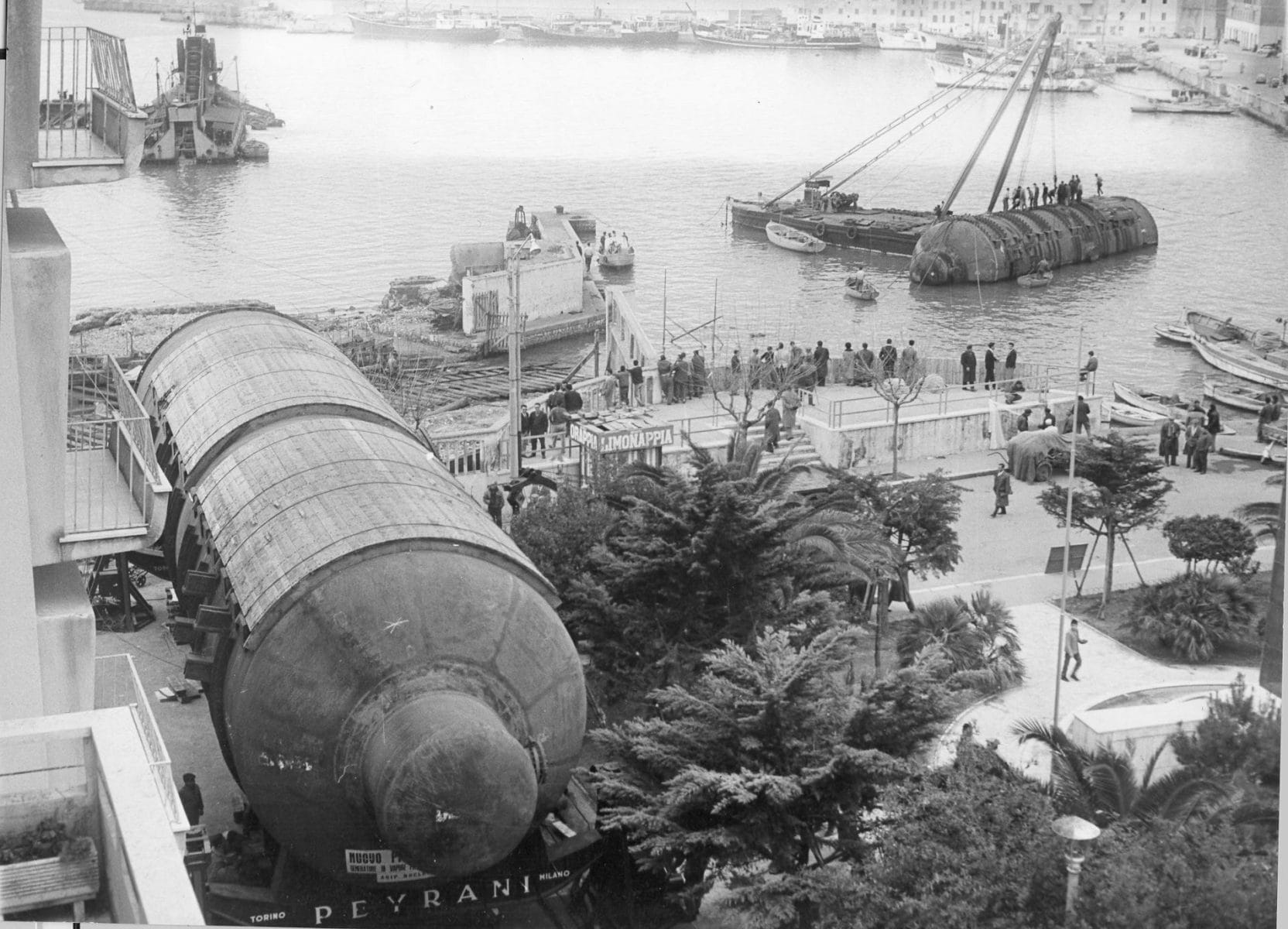
The Latina nuclear power plant during its construction in the late '50s and early '60s. Photos courtesy of SOGIN.
“The international crises of recent years have clearly demonstrated the risk of excessive dependence on imported fossil fuels or vulnerable supply chains,” said Fiorella Corrado, communications chief at Italy’s environment and energy ministry. “The government approaches this issue with great respect for the country's history and the democratic choices expressed by citizens. The 1987 and 2011 referendums profoundly impacted the national energy strategy at very different historical moments. Precisely for this reason, the point is not to ignore those choices, but to acknowledge that today's technological, climatic, industrial, and geopolitical context has radically changed.”
For Meloni’s government, the argument is not so much whether Italy needs to revive its nuclear industry, it’s whether the country is ready to shake its demons, to shake the cultural memory of what happened at Chernobyl forty years ago, a thousand miles away from Rome.
In the early hours of April 28, 1986, in the control room of the Latina nuclear power plant south of Rome, a young technician called Ruggero Dell’Aquila was working the night shift. “Everything was perfectly quiet,” he recalled. As morning broke, teletype messages from Northern Europe began to rattle in. A clerk came down from the control room with reports from the Forsmark Nuclear Power Plant in Sweden. Their monitoring stations were registering radiation spikes far above background levels, and no one knew why.
Inside the control room of the Latina power plant, 1963. Photo courtesy of Pionieri Del Nucleare.jpg
That evening, nuclear physicist Sergio Malossi, a director at the Latina plant responsible for monitoring radioactive risk, drove home. His mind was turning over what the clerks had been reporting. “He came in extremely agitated,” remembers his daughter, Roberta Malossi, who was 16 at the time. “We knew he was worried about something going wrong at the facility, but we didn’t understand.” Malossi says that her father’s first paranoid thought was that there had been a malfunction in his own plant, that radiation was leaching into the air, and that it was somehow his fault.
At 9 p.m. Moscow time — aperitivo hour in Latina — the Soviet Union announced there had been an accident at the Chernobyl nuclear plant. In the ensuing days, Italian news was full of dire warnings.
On April 30, 1986, Soviet television aired this image of the Chernobyl plant, claiming there was “no destruction, no major fires, and no mass casualties.” AFP via Getty Images.
“Television was showing these clouds that would soon reach Italy. Everyone was terrified. The only information we got was from state TV, and the news was shocking,” said Monica Tommasi, President of Friends of the Earth Italy, who was a child at the time. Radiation, the news said, would rain down on the population. “The fear from the sky,” ran one La Repubblica headline. “The cloud above us, the doubt within us,” ran another.
On the night of April 30, 1986, Italy’s nuclear monitoring stations began recording increases in radioactivity. The cloud moved over the Valley of the Po, and while the government called for calm, the country began to descend into panic. In the minds of the Italian people, the worst had happened, explained Luca Romano, a writer and activist campaigning for the return of nuclear power in Italy. “Nuclear annihilation, death by radiation, the radioactive cloud and the nuclear holocaust, had arrived,” he said. Nuclear armageddon was a fear that had gripped the West for decades. This was not a nuclear war, but in the Italian collective consciousness, that didn’t make a difference.
The reality was, says Barbara Curli, Professor of Contemporary History at the University of Turin, that “Italy was only marginally affected by the cloud.”
The cloud in northern Italy meant radioactivity levels peaked briefly, but ten days later they had fallen dramatically back down. Because this spike was short-lived, the total radiation exposure remained low. A United Nations committee report recorded that northern Italy received an additional radiation dose of about 380 microsieverts in the year following Chernobyl — less than a fifth of the normal background radiation humans absorb in a year; equivalent to taking about six transatlantic flights. It was much smaller than the doses received by neighboring countries like Bulgaria, Austria and Greece, and in the south of Italy the dose was lower still.
Nuclear Physicist Sergio Malossi, Long-time Director of the Department of Medical Physics at the Latina Nuclear plant. Photo courtesy of Pionieri del Nucleare di Latina.
Down by the Latina power plant, though, the community was shaken by events in Chernobyl, and rumors and misinformation began to spread about the fallout. The friends and family of the technician, Ruggero Dell’Aquila, started asking him if a Chernobyl-style disaster could happen at Latina, too. “Everyone was afraid, asking — ‘can it explode, can it explode?’” he recalled.
The reality was, a Chernobyl-style explosion was not possible at Latina, because its reactor lacked the unstable characteristics of the Soviet design. But this was not such an easy concept to explain.
“The problem was that a slew of journalists took over, telling lies,” Malossi said, recalling paranoid rumours about radioactivity causing mutations in nature. People started telling stories, Malossi said, about “frogs with three heads, animals and fish with four tails. Strange things. When in fact absolutely nothing like that was happening.”
The government advised people to avoid fresh vegetables and dairy products, particularly for children. Farmers destroyed crops and poured away milk. Sergio Malossi ignored the warnings, having measured radiation levels in the air himself. “My father and others from the plant brought the vegetables home and we ate them,” his daughter recalled.
It was these warnings — delivered amid a lack of clear information — that shifted public attitudes toward nuclear energy, said Renzo Colombo, 65, who was just beginning a career in nuclear engineering when the explosion happened. Now a member of Nucleare e Ragione, a nonprofit that promotes a rational approach to nuclear energy in Italy, he recalls how quickly fear took hold. “A real phobia was born, a panic about radioactivity,” he said. “And this panic marked the next 25 years.”
The months after the accident were a shadowy, uncertain period for Italians working in the nuclear industry. “I have to be honest, I felt a little guilty,” said Colombo. “As a nuclear engineer, I thought ‘what have we done?’ My colleagues and I always thought we were designing something useful for humanity. And at that moment we felt betrayed by our own profession.”
Workers at Latina nuclear plant during its construction in 1961. Photo courtesy Pionieri del Nucleare di Latina.
Outside Italy’s nuclear plants, crowds began to gather. A coalition of environmental groups and political parties started pushing for people to vote against nuclear power in an upcoming referendum.
This movement was not new. “Many years before Chernobyl, an environmentalist culture was born — and it didn’t just concern nuclear power, but risky industry in general,” explained Curli, the Turin historian. The anti-nuclear environmental movement, which spread across Europe in the 1970s, was particularly potent in Italy — a country rocked by violent political turmoil, organized crime, and corruption scandals. Public fears, explained Curli, were sharpened by the Seveso disaster, an accident at an industrial plant in the north of Italy in 1976 that exposed tens of thousands of people to a toxic cloud of chemicals. Nuclear power, she said, “was not perceived by public opinion as a credible policy because there's this underlying distrust in institutions.”
Workers in protective suits clean up the land and homes contaminated by the industrial accident at Seveso chemical manufacturing plant in 1976. Alberto Roveri/Archivio Alberto Roveri/Mondadori Portfolio via Getty Images.
In 1977, almost a decade before Chernobyl, a 10,000-strong crowd of protesters showed up at Montalto di Castro, to protest against a large new nuclear plant that was planned. A Time magazine correspondent described the activists as “an improbable mix of elegant members of the Italian nobility, radical students in American Indian garb, middle-class citizens and Christian Democratic and Communist politicians.”
Demonstrators taking part in an anti-nuclear demonstration. Turin, 1980s. Alberto RoveriMondadori via Getty Images.Anti-nuclear protest, Milan, 1980s. Universal Archive / Universal Images Group via Getty Images.Anti-nuclear protest, Rome, 1980s. Universal Archive / Universal Images Group via Getty Images.
In the wake of Chernobyl, Renzo Colombo was working at that very same plant, helping to build the thermohydraulic cycle. By then, the station was nearly complete. “It was a beautiful plant,” Colombo said. “I loved working there.”
In November 1987, 18 months after the Chernobyl accident, the Italian government held a referendum on nuclear energy. Nearly 80% of Italians voted in favor of measures that would end the country’s use of atomic energy.
One morning, following the referendum, the Montalto di Castro plant’s director called the workers to a meeting. Colombo remembers him saying: “‘Ragazzi, gather round, I need to talk to you. I’ve just been to the ministry, and Italy has decided that we are closing all nuclear activity and will focus on coal and gas instead.’” The room went silent. “I was young,” said Colombo. “But there were people there who were older and had devoted years of their life to the nuclear field. There was just this urge to cry.”
The effect of the referendum was all-encompassing: construction was halted, and over the next three years Italy’s nuclear plants were shut down for good; its nuclear engineers scattered — many going to work abroad, or, like Colombo, re-training to work in other industries.
It was hailed as a victory for Italian environmentalism, says Curli. But the result was that there was a push to “gasify” Italy. That is, she says, “to choose the gas route — less expensive, and less demanding than nuclear power. But this made Italy almost completely dependent on Russian gas, Libyan gas, Algerian gas.” The Montalto di Castro site was converted into a fossil-fuel powered plant, running on gas and fuel oil.
Decades on from that post-Chernobyl referendum — and a second referendum in the wake of the Fukushima nuclear accident in 2011 — Italy remains in the process of dismantling its nuclear power stations, even as it now contemplates a return to nuclear power.
In the vast, cavernous belly of the Latina nuclear power plant, three workers in hazmat suits hammer away at pieces of the shielding cylinders that once protected the rest of the plant from radiation emitted from the reactor. From the viewing gallery, they look tiny in the enormous space, and the vastness of their task feels Sisyphean.
Watching them work is Enrico Bastianini, director of operations at the Latina plant. As I walk with Bastianini through the plant, we come to the old control room. When it first opened in 1963, the Latina plant was the largest nuclear power station in Europe — a feat of Italian and British engineering (the reactor was of UK design) and a symbol of Italy’s post-war industrial growth.
“We were emerging from the destruction of the war, and this was progress. And it was what allowed us to escape the economic hardships of war, and have low-cost energy,” Bastianini says.
Now, over 60 years on from when the plant opened, more than half of its existence has been spent being taken apart. Critics of nuclear power often focus on precisely this point: the long and complex process of dismantling nuclear plants, and the problem of managing radioactive waste, some of which takes millennia to decay.
There are two phases to the process of taking apart the plant. “The first phase allows us to dismantle everything that’s nuclear except the reactor. That’s because the reactor contains a huge amount of graphite,” Bastianini explains. “When we have a national repository, it can be removed. But for now, it’s safest if it stays in the first phase.”
Bastianini leads me into a deposit room where radioactive material is being stored in steel containers, inside an earthquake-resistant facility. These containers are only for temporary storage.
There were attempts in the early 2000s to establish a national nuclear waste repository at a salt mine in Basilicata in southern Italy, but huge protests forced the government to abandon its plans. Today, SOGIN, the state-owned Italian company in charge of decommissioning nuclear sites, is still actively searching for a suitable location for a permanent repository and faces considerable opposition.
Rumours and anxiety swirl around the Latina plant itself — just as they did in the 1980s, when Malossi heard stories of radioactive fish with four tails. Last April, an article by the Italian magazine L’Espresso published claims that the Latina plant could leach radioactive material into the soil. The plant vigorously denies these claims — a spokesperson for SOGIN said the company periodically checks the quality of vegetables, milk and fodder as well as air, soil and groundwater for radiation and that “as always, the results of the analyses confirm radiologically negligible environmental impacts.”
The old control room of the Latina nuclear plant. Photos courtesy of SOGIN
In the gloaming of a summer evening in Umbria, Monica Tommasi drives me through the twilight-darkened hills surrounding the medieval city of Orvieto. This land is rich in archeological and ecological heritage — filled with ancient tunnels, Etruscan caves, untapped archeological sites, wild places where wolves and boar roam. Tommasi is the President of Amici Della Terra — "Friends of the Earth" in Italian — an organization that was once the Italian chapter of the international Friends of the Earth network before breaking away in 2014. "We left, because we argued a lot," she said of the split, describing how the network "wanted to put turbines and panels everywhere, and we couldn't be in favour of that approach."
The International Friends of the Earth association was born from the anti-nuclear movement in America, where the group successfully lobbied to shut down two reactors, and has since 1969 made anti-nuclear campaigning a core part of its identity.
But Tommasi remembers precisely when she first began to reconsider nuclear power. “I started thinking about it in 2011, when I began to see that the government was investing heavily in solar and wind power, which would invade and industrialize the natural landscape,” she recalled. Many of these green transition projects have been fraught with problems in Italy — wind farm companies accused of corruption and profiteering, of erecting wind farms in areas where there’s little wind, and laying waste to nature.
For the first time, Tommasi began to think about ways to decarbonize “that don’t destroy the environment where people live and the landscape around them.”. She became intrigued by the nuclear option. “We needed to start reasoning and changing our minds,” she said.
Tommasi now advocates for a national conversation about nuclear power. “This choice must be accompanied by a public debate,” she told me, “but it isn’t happening because everyone is still afraid.”
“The future of Italy's energy sector must lie in nuclear,” she said, adding that if Italy was to continue pursuing solar and wind energy alone, “it means destroying all the natural areas that are still left.”
I asked the government to respond to allegations about how criminality, speculation and land-grabs in the renewable energy sector might be affecting Italians’ opinions on nuclear power.
“We do not believe it is appropriate to frame the energy debate by ideologically pitting nuclear power against renewables, nor should we use any administrative or criminal issues in certain sectors to discredit a technology as a whole,” said Fiorella Corrado, communications chief at Italy’s environment and energy ministry. “Nuclear power is not an alternative to renewables, but their best ally,” she said.
Wind turbines and solar panels near Cagliari, Sardinia, 2024. The island relies largely on coal but must phase it out by 2028 as Italy transitions to cleaner energy. Giovanni Grezzi / AFP via Getty Images.
On a warm autumn day in Rome, several thousand people gathered for an annual “climate pride” march. They brandished homemade cardboard wind turbines that spun in the breeze. Vincenzo Migliucci, 83, was among them. He worked for more than three decades for ENEL, Italy’s energy corporation, and he’s been anti-nuclear for much of his life. After the Chernobyl accident, he protested outside the nuclear plant under construction in Montalto di Castro almost every day, picketing the workers as they went through the gates.
“The wrath of God happened,” he said, referring to Chernobyl. “And when a true estimate is made, we’ll one day see how many disasters Chernobyl caused.”
Migliucci is against nuclear power plants of all types — arguing for solar panels instead — and is particularly concerned about what happens to the plants after they become obsolete and must, like the Latina plant, be slowly dismantled over decades. “The decommissioning costs a fortune; the nuclear waste repositories cost a fortune,” he said.
Subscribe to our coda currents newsletter
Insights from the Coda newsroom on the global forces that shape local crises.
He began telling me some of the stories that surround Italy’s shuttered nuclear plants. “Near the Garigliano power plant,” he told me, “a child was born with only one eye.” His own eyes widened as he pressed a finger into the middle of my forehead. “Sheep and cattle,” he said, “were born with six legs, or entirely red in colour. It’s not a myth, it’s real.”
Younger generations of Italians don’t have the same collective impressions around nuclear power, nor around Chernobyl or its aftermath, explained Luca Romano, a young pro-nuclear influencer with a quarter of a million followers on Instagram. Romano makes videos with his partner, Luiza Munteanu, about the advantages of nuclear power. The main problem he runs up against, he says, is that “we have a very low scientific literacy, the level of debate is abysmal.” And culturally, he adds, “Italy has always been a country that looks backwards rather than forwards.”
In May, the director general of the International Atomic Energy Agency visited Italy’s Lombardy region, and signed a Memorandum of Understanding with the governor to cooperate on applying nuclear science for development across the region. The choice of Lombardy was significant. It is home to Milan, and is at the heart of Italy’s digital infrastructure. Speckled with no fewer than 60 data centers, with more cropping up, Lombardy has opened itself up to Silicon Valley. Microsoft is investing billions in the area to boost its AI and cloud computing infrastructure. Amazon Web Services has committed to spending over $1 billion to expand its data center operations around Milan.
How northern Italy’s growing AI infrastructure will be powered, though, is still a problem to be solved — one that cuts to the heart of Italy’s energy dependence. Since Giorgia Meloni became prime minister in October 2022 — which coincided with the launch of ChatGPT a month later — the Italian government has been broaching the topic of nuclear power as essential to Italy's energy future. “World population and economic growth will significantly increase energy demand,” Meloni said at a sustainability summit in Abu Dhabi. “Not least due to the growing requirements arising from the development of generative artificial intelligence.”
Artificial intelligence is a “highly relevant topic,” said Corrado, the communications chief at Italy’s environment and energy ministry. “As more things run on electricity, the economy goes digital, and data centers and AI expand, demand for steady, low-emissions power will rise. Nuclear energy can help as a reliable, controllable source that works alongside renewables.”
In August, it emerged that the government had set aside €7.5 million purely for pro-nuclear communication and information campaigns directed at regions where new plants may be built. One focus of the Meloni administration is on the prospect of building small modular reactors, sometimes called “mini nukes.” They are compact fission plants, a fraction of the size of the traditional, cathedral-like nuclear power stations. They have a smaller core, and proponents argue their safety features mean there’s minimal chance of an epic, Chernobyl-scale nuclear disaster, something the government is keen to get across to voters.
Currently, only China and Russia have these small reactors up and running, but mini nuclear plants have attracted significant attention in Silicon Valley. OpenAI’s Sam Altman was chairman of Oklo, a nuclear startup focused on SMRs, while U.S. nuclear startup Kairos has signed an agreement with Google to develop these reactors to power its data centers. This month, the European Commission unveiled a strategy for rolling out small modular reactors and bringing them “online” by the 2030s.
Soon, Italy may take the first steps towards the reconstruction of a nuclear industry that has been abandoned for decades. “I believe it won't be easy to relaunch nuclear energy,” said Barbara Curli, the Turin historian. “Knowing a little about the history of nuclear power in Italy and its political dimension, I'd be quite skeptical about the possibility of relaunching nuclear power here in Italy — but let’s see.”
A little under 1,500 miles away, in the Chernobyl exclusion zone, among wild boar, birds, and deer, radiation levels in some areas have dipped below around 0.3 microsieverts per hour, lower than background radiation levels in many European cities. Not least the eternal city of Rome.
Why Did We Write This Story?
As the U.S.-Israel war against Iran enters its second month, strikes on nuclear facilities have raised the stakes of an already catastrophic conflict. The WHO is now openly preparing for a nuclear incident it hopes will never come. Whether or not this escalates further, the fear already has a life of its own.
That is something we follow closely at Coda: how fear settles into collective memory and shapes policy long after the original crisis has passed, or even when the disaster people dreaded never fully arrived.
Isobel Cockerell takes us to Italy, one of the only industrialized nations to have dismantled its entire nuclear energy program after Chernobyl, despite being barely touched by the fallout.
This story is about nuclear power, but it is also about how fear can shape the world more than the event that caused it.

 Login
Login