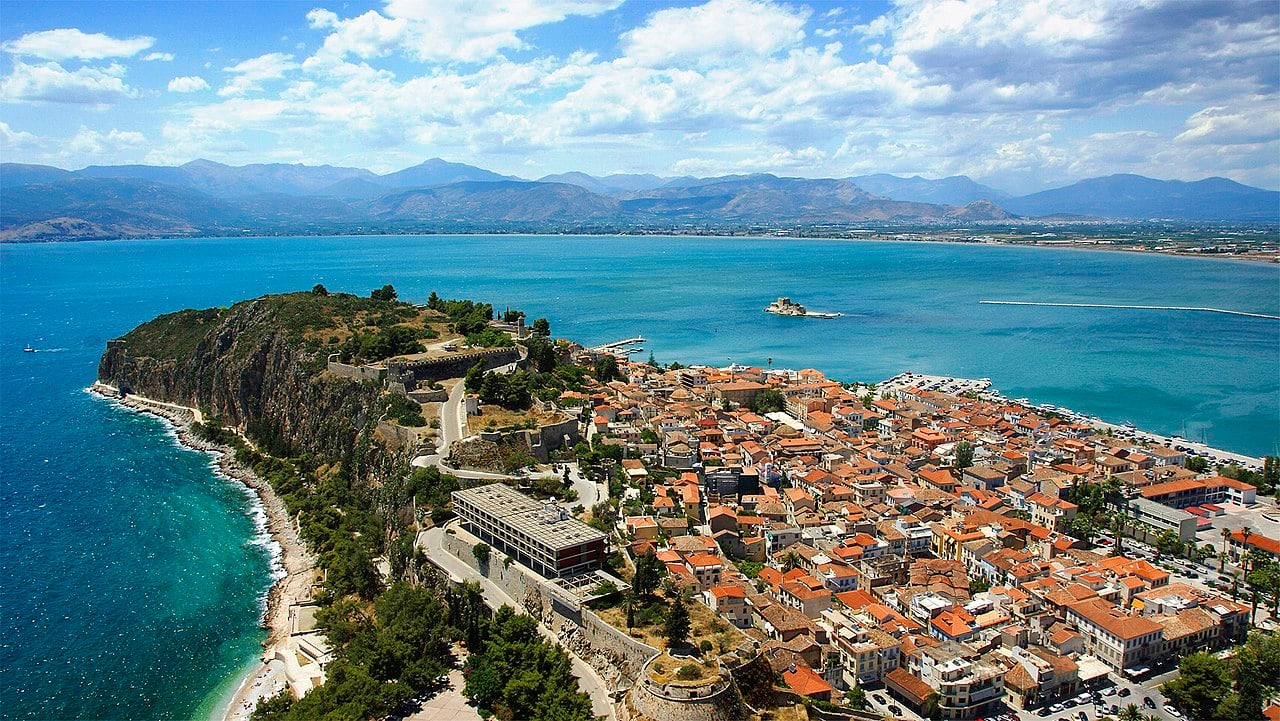
Nafplio at Peloponnese Region, Greece. Credit: Mtale/Wikimedia Commons/ CC BY 2.0
Located at just about a 1-hour drive from Athens, the Peloponnese region offers a plethora of historical sites, culture, and beauty to tourists looking for a spectacular trip in Greece; there are many reasons why this region of Greece is one that you do not want to miss! Let’s take a look at 10 reasons you will have an unforgettable trip in the Peloponnese this summer.
1. Nafplio
Bourtzi Castle, Nafplio. Credit: Wikimedia commons cc by 4.0
The first capital city of modern Greece was Nafplio, and until this day, you will see ruins of the fortress walls up high overlooking the town from the mountain side. This charming and romantic town has small streets that wrap around neoclassical buildings and squares and is the perfect place to visit any time of the year.
2. Epidavros
Ancient Theatre of Epidavros. Credit: Wikimedia Commons, Olecorre
From ancient ruins and an impressive ancient theater to a quaint town with tavernas serving up local treats, Epidavros is a must-see on any trip through the Peloponnese. During summer months, there are weekend shows at the ancient theater that draw in crowds of thousands of spectators. It is simply an amazing experience!
3. Beaches
– Aerial view of Zogeria Beach on Spetses with Peloponnese in the background, Greece. Crédit: By dronepicr CC BY 2.0
Check out the unspoiled beaches that this region has to offer! There is such diversity in terrains surrounding the sea in this region. The seas are clean and the beaches might have either pebbles or soft sand, and you can jump off of cliffs. There is something for everyone in the Peloponnese!
4. Ilia
Ilia Theater. Crédit: Kritheus – Own work, CC BY-SA 4.0
This is where the mountain meets sea and provides tourists with the amazing experience of staying in a quaint, beautiful village with sandy beaches and clear blue waters outlined by forests of pine trees reaching down to the sea. There are also some significant archaeological sites you should check out while in Ilia, such as the Temple of Epicurios Apollo.
You will find Arcadia in the center of the Peloponnese Region. This area is famous for its huge mountains, such as Mainalo and Parnonas, as well as its natural landscapes. It was first settled by the Arcadians who are considered to be one of the oldest people in the Peloponnese and are purported to have been responsible for the establishment of numerous significant cities throughout the region.
6 &7. Olives and Kalamata
The Old City of Kalamata. Crédit: G Da, CC BY-SA 3.0
You can find 65 percent of Greece’s 132 million olive trees in the Peloponnese with the black Kalamata olives being the most well-known variety. So why not stop by Kalamata, enjoy some olives, try great local Greek dishes with fresh olive oil, and enjoy the villages and beaches in this beautiful part of the Peloponnese? You can purchase souvenirs, such as olive oil or sculptures made from olive tree wood that are locally hand-crafted.
8. Wine Tours and Vineyards
A vineyard in Peloponnese. Credit: Robert Wallace, Flickr
A perfect way to get to know the beautiful Peloponnese region of Greece is to enjoy an amazing wine tour during your visit. Greece is one of the oldest wine-producing regions in the world, having begun cultivating vineyards and producing wine over 6,500 years ago.
9. Achaia
Rio, as seen from the Antirrio ferry. Patras, Acaea, Greece.Crédit: LBM1948 – Own work, CC BY-SA 4.0
Home to the port city of Patras, the biggest city in the Peloponnese, Achaia is the place to go for beautiful mountain and seaside landscapes, including some of the most desirable beach destinations in the region along the Corinthian Gulf. Achaia is considered Greece’s “seaside gate” to Western Europe and is one of the most historic sites in the Peloponnese. On the way to Patras from Athens, you will also pass the iconic Rio-Antirrio Bridge.
10. Something for Everyone
Dafnon valley, Leonidio. Crédit: Natalia Mostova – Own work, CC BY-SA 4.0
The Peloponnese Region is known for its variety of activities as well quite diverse landscape. From hiking to wine tours, there really is something for everyone in this region of Greece! Enjoy the breathtaking waters of the gulfs of Corinth, Patras, Saronic, Messinia, Argolida, and Laconia and the Peloponnese’s diverse climate, ranging from the less humid east to the colder climate with snow and rich vegetation in the central and more mountainous parts of the region and the rain and hot weather of the west.
The Temple of Apollo at Delphi was one of the most common travel destinations in Ancient Greece, as people were travelling from all over the country to consult the oracle. Credit: Greek Reporter
The Ancient Greeks were active travelers, despite the dangers of land travel and the fear of highwaymen. Sea travel required ample supplies and means.
A fascinating archaeological find exhibited in the Agora Museum in Athens is rectangular clay tablets with inscribed names and occupations that purportedly served as travel documents in antiquity.
Most travelers were aristocrats and well-to-do citizens who traveled to witness and experience the wonders of the ancient world, and other famous places and sights.
Others traveled for pilgrimage; healing in sanctuaries such as the Sanctuary of Asclepius in Olympia, the Sanctuary of Apollo on Delos Island, or to attend religious festivals and monumental athletic events like the Olympic Games at Olympia or the Panathenaic Games in Athens.
Merchants also traveled to other parts of Greece, or across the Mediterranean and beyond to promote and sell their goods to destinations such as Egypt, Asia Minor, the Middle East, and the Black Sea.
The Ancient Greeks were curious about the world and had a great desire to learn. For that reason, they held travel in high regard. The most famous epic journeys, such as Homer’s Iliad and Odyssey or Jason’s expedition to retrieve the Golden Fleece, had protagonists who had to travel far and undergo trials to achieve their goals.
In their long journeys. They experienced great adventures, encountered grave dangers, and saw things and, above all, places they would never see if confined in their birthplace all their lives. These epics celebrated heroic adventures through travel.
Then people from all over Greece and beyond would travel far to consult the oracle at Delphi and plan their future.
Also, it was through travel that ancient Greeks discovered places worth exploring and exploiting, such as uninhabited fertile lands or seaside areas with great potential, where they established trading colonies.
Overall, the accounts of travelers provided valuable information about the contemporary world. In modern day, these accounts help us understand the world during that period.
Practical issues of traveling in antiquity
Travel in ancient times required means that not all people could afford. Travelling by land meant using carriages and horses for people with means and walking for the rest. Pack animals, like mules and donkeys, were necessary. Greece had a widespread road network connecting even remote settlements, but there was always the danger of being robbed by highwaymen.
Traveling by sea was considered a safer and more comfortable means. Most major cities were located near a shore. Yet, there were no passenger ships back then, so those willing to travel by boat had to be next to the cargo, and at a price, too.
To take long journeys, overall, required a lot of money. Baggage porters and other attendants were necessary, along with armed bodyguards. The presence of security was important because the traveler could face highway robbers who could also abduct them. Similarly, when traveling by sea, there was the danger of being attacked by pirate ships.
Since there were no maps, natural landmarks such as mountains and rivers were used. In sea travel, similar landmarks across the shoreline served as guides to the destination.
Friends or social peers usually provided hospitality at the destinations for free. However, there were specific businesses that provided basic food and accommodation, especially in the larger cities, and for significant events such as the Olympic Games or religious festivals.
In the Archaic period, there was the additional legal danger of unknowingly being in another city-state territory without permission while trying to arrive at one’s destination. However, by the Classical period, relations between states were more regulated, and interstate travel was facilitated. In addition, systems of communication had improved by then. Nevertheless, the travel hazards remained.
Greek goods were found all over the then-known world
There is ample evidence that ancient Greeks traveled. Archaeological finds show contacts with other peoples and civilizations. Greek coins and goods such as amphorae have been found all over the Mediterranean. Artifacts emulating artistic styles and evidence of the adoption of rituals originating in Ancient Greece also indicate long and close contact with different peoples and cultures.
In addition, Greeks who traveled frequently brought back new ideas, Eastern tastes in clothing, jewelry, and foods, as well as architectural trends.
The ancient Greeks discovered new lands and established trading colonies across the Mediterranean, Asia Minor, and the Black Sea from the 8th through the 6th centuries. Many of these have evolved into the great cities that still stand today.
The most famous of the colonies were those in Magna Graecia, in today’s southern Italy and Sicily (Calabria, Apulia, Basilicata, Campania, Syracuse, Tarentum, Sybaris, and Croton), where the Greek element is still alive today, especially in the language.
Other important ancient Greek colonies were Massalia (modern-day Marseilles in France), Cyrene in Libya, and Byzantium on the Bosporus Strait, which later became Constantinople.
Greek philosophers on travelling
Several ancient Greek philosophers valued travelling as a means to gain knowledge and experience. Encountering different cultures and experiencing new environments broadens one’s perspective. Great figures like Thales and Pythagoras traveled to Egypt and other regions to study and acquire knowledge.
Aristotle believed that empirical observation and practical experience are good sources of knowledge. Provided, though, that one had the foundations in reason and virtue through formal education. Otherwise, one could not learn simply by travelling. The philosopher is known as saying, not in the exact words, that travel is education for the young and experience for the old.
For those who are older, Aristotle believed that they accumulate experience and wisdom by travelling. They reflect on their lives, gain new insights into the world, and may appreciate life more profoundly.
“Those who wish to know about the world must learn about it in its particular details,” said Heraclitus, the Greek philosopher from Ephesus. The quote implies that a man should travel to learn about the world with his own eyes. Heraclitus believed that the world is constantly changing: “The only thing that is constant is change,” is one of his famous quotes.
With his phrase “τα πάντα ρεί” (everything flows), Heraclitus said that the world is in perpetual motion; therefore, man should be constantly moving as well.
Plato is known for having traveled extensively, visiting Italy, Sicily, Egypt, and Libya. The reason he traveled so much was his disappointment with Athenian society. He was exposed to new cultures and ideas during his travels, which influenced his philosophical development and his Theory of Forms.
Other philosophers who traveled extensively were Thales of Miletus, who visited Egypt to study science and mathematics. Pythagoras traveled to Egypt, Israel, Babylonia, and possibly India. Democritus traveled in Asia, Egypt, and possibly India and Ethiopia.
Socrates, on the other hand, was against travelling and he never left Athens, his hometown. The father of philosophy, for many, believed that man should only make internal journeys. He emphasized self-knowledge and ethical development, which he believed were best pursued through internal reflection and dialogue.
 Login
Login






.jpg)
