PORT HUGHES, Australia — Situated midway along the Great Southern Reef that spans Australia’s southern coastline, the waters off Port Hughes typically teem with life. The coastal hamlet northwest of Adelaide plays host to a multitude of coral, bivalve and fish species. But in late March, the largest and longest harmful algal bloom (HAB) in Australian history arrived to Port Hughes, depleting its waters’ rich biodiversity. The bloom had first appeared elsewhere off the state of South Australia’s coast a year earlier, causing eye and skin irritation and respiratory symptoms among beachgoers. Then, along with waves of acrid-smelling sea foam, scores of dead marine animals began washing ashore. In Port Hughes, the HAB’s impacts were most visible below the surface. The town’s wooden jetty had previously been one of the most consistent locations in South Australia to observe temperate species, said Stefan Andrews, co-founder of the Great Southern Reef Foundation, a conservation advocacy group. But by mid-April, when Mongabay joined Andrews on a dive, the site was drab compared with vibrant photographs taken in February and March. Under the jetty, sponges and corals that had previously adorned its pylons in a brilliantly hued mosaic appeared colorless. Apart from a short-headed seahorse (Hippocampus breviceps) — a “sign of hope,” Andrews called it — little life was visible in the murky waters. The reef, he said, had become quieter, lacking the sounds of snapping shrimp and other creatures that once played in the underwater soundtrack. “There’s a sense of loss when you…This article was originally published on Mongabay
Wildlife department says drought conditions and water released from dam led to ‘major fish kill’ at San Carlos Lake
Arizona officials have indefinitely closed a popular lake to visitors after its entire population of fish died recently.
The recreation and wildlife department that maintains San Carlos Lake said in a Facebook statement on Friday that drought conditions as well as water released from a dam there “resulted in a major fish kill affecting approximately 100% of the fish population”.
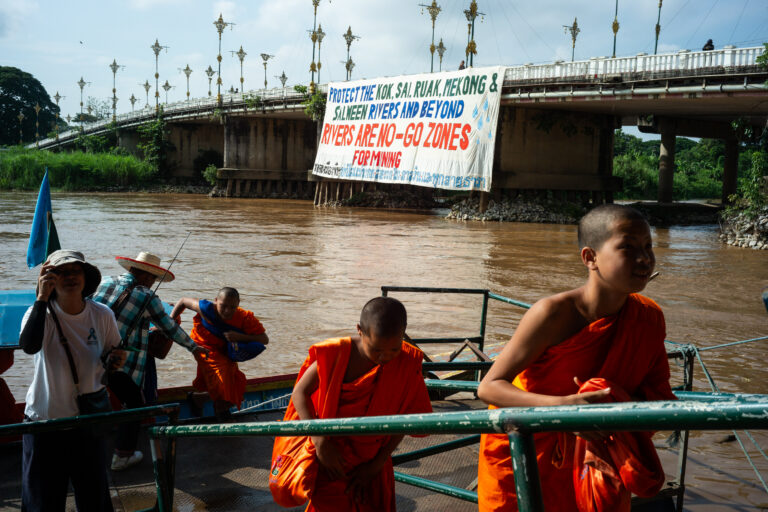
BANGKOK — More than 600 residents of Chiang Mai and Chiang Rai provinces embarked May 31 on a roughly 68-kilometer, six-day ‘peace walk’ to demand the Thai government take action on the river pollution crisis that has seen Thai rivers polluted with heavy metals. The ensemble of affected residents, civil society groups, monks and students marched from Tha Ton subdistrict in Chiang Mai to the city of Chiang Rai in northern Thailand, reaching their destination on June 5, World Environment Day. For more than a year, Thailand’s Pollution Control Department has reported dangerous levels of arsenic, mercury, cadmium and other heavy metals in rivers across northern Thailand, with mining operations across eastern Myanmar suspected to be responsible for the pollution. “We are walking because our rivers are slowly dying,” Pianporn Deetes, executive director of the Rivers and Rights Foundation, which helped to organize the peace walk, told Mongabay by phone. “Toxic contamination from unregulated mining upstream is already affecting water, fish, food, livelihoods, and public health. We do not want to wait until more people become sick. This is an emergency.” Pianporn said the walk (42 miles) was about taking collective action to share information, document impacts and build public pressure in a bid to force the government to address the issue, which Pianporn said has, so far, been lacking. “Monitoring has improved, but action has not matched the scale of the crisis,” she said. “We need urgent diplomatic engagement with neighboring countries, stronger health monitoring, transparency, and action to…This article was originally published on Mongabay

 Login
Login