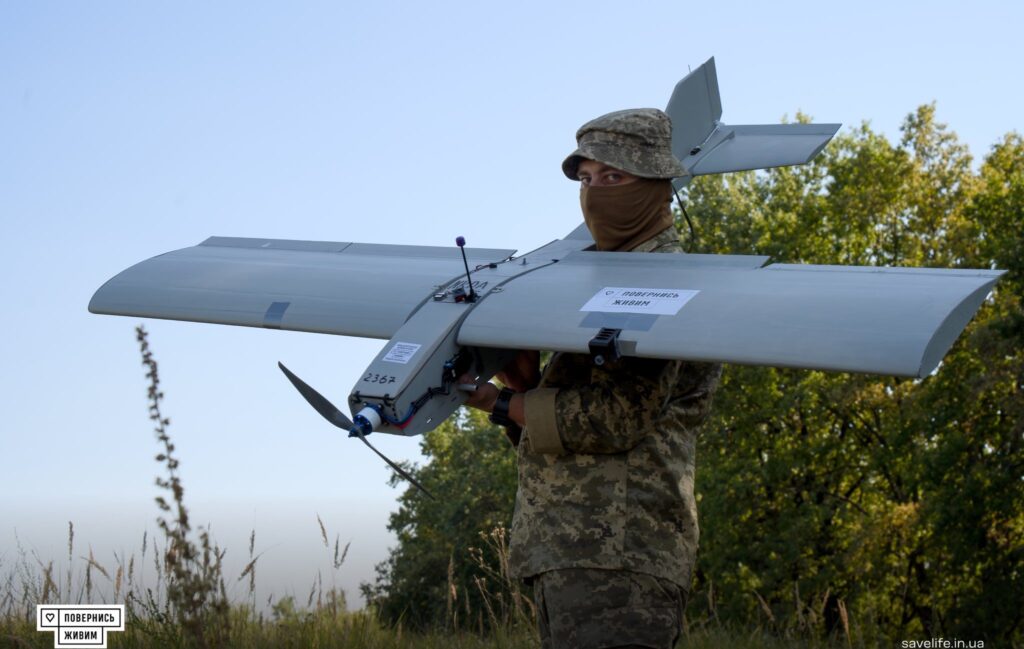
Ukrainian attack drone tech is racing to become harder to intercept. Recently, Russian military bloggers have highlighted another development: the use of directional antennas mounted on a dynamic gimbal—something Ukrainian sources confirmed.
Unlike omnidirectional antennas, these beam the connection in a tight cone between a drone and a signal repeater, while the gimbal keeps the antenna pointed in the right direction to avoid losing contact. This reinforces the connection between drone and operator and makes it harder for enemies to detect its presence.
“Omni antennas are like a bad swimmer. Thrashing around making waves in all directions. He might move in the right direction, but not very efficiently and everyone knows about it,” said James, an American engineer who heads an Azov Corps laboratory. He requested to omit his last name for the sake of operational security.
“A directional antenna is like a whale. Better swimmer than you or I, but still makes a lot of waves, and takes a lot of power to push through the water. A Yagi-Uda antenna (a type of directional antenna first developed a century ago) is like a shark—sleek & focused. They can really sneak up on you.”
“The latest beamforming phased arrays are like swordfish, or a barracuda,” he concluded. “Just a silver flash.”
From bombers to mid-range attack drones
According to an Unmanned Systems Forces service member, speaking on condition of anonymity, Ukrainians are using this tech on their Vampire heavy bomber drones and their Baton small attack drones.
“It is quite a simple task in terms of engineering,” they said. “And of course it makes the link stronger.”
They added that it's often simpler to just use Starlink. However, Russia has once again started to deploy large jammers that can disable Starlink in a 20-kilometer area, making it useful for troops to have other tools in their arsenal.
Explore further
Russians deploy massive $1.5M Starlink jammers, Ukrainians are blowing them up
Russian military bloggers write that it is also being used for the Darts mid-range kamikaze drones, which, along with the AI-enhanced Hornet drones, have been wreaking havoc on Russian logistics networks.
“Given these technical capabilities, in addition to a stable and high-quality signal (as losses are minimal due to directionality), the adversary eliminates the detection of their UAV by sensors, and video signal interception devices,” Russian Telegram channel Ruporofbattle wrote.
“In other words, if this UAV flies near you, even with a standard analog transmitter, on a relatively standard frequency, your existing detection equipment will not alert you to its presence.”
Technology marches on
James said that this technology was, for a while, not fully viable to be used on drones due to its size and form factor. However, successful miniaturization has seen it being used on smaller and smaller hardware.
Ukrainian company Chupakabra provides multiple examples. Its website shows off Yagi-Uda antennas, rotary platforms for automatic antenna angle adjustments, and a quadcopter mounting its proprietary FlyMonkey signal repeater.
"Just don't show this to our ground control station producers, they haven't yet copied (Ukrainian) technology from 2023, have pity on them," Ruporofbattle opines, snidely.
James said that he’s glad this technology is finally getting its time in the sun. “I am glad they're finally doing this. I've been screaming about it for years in this war.”
Ukrainian forces have many tools in their arsenal to make sure the warheads meet their appointed foreheads—or trucks, trains, ferries, forward bases, and air defenses. Of all these tools, Starlink is one of the most problematic for the Russians because it’s reliable and jam-resistant.
Still, it’s not jam-proof. The Russians have again begun deploying giant jammers, such as the Volna Kupol Garant, which can disrupt a satellite signal and protect an area of 20 square kilometers, Defense Ministry adviser Serhiy “Flash” Beskrestnov posted on 16 June.
There are two problems though. The first is that they cost $1.5 million per system, require massive amounts of power, and are giant, having to be dragged around on six trailers.
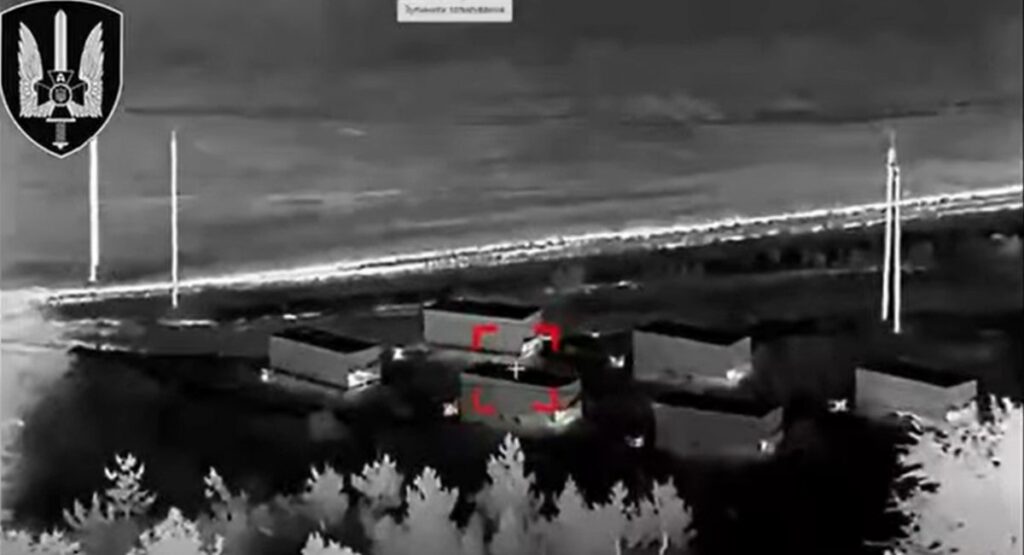
Which leads into the second: they’re being hunted and destroyed, as one was by the Security Service of Ukraine and the 422nd Separate Unmanned Systems Battalion Luftwaffe on 14 June.
In the 422nd’s video of the strike, a Ukrainian strike drone maintains a perfect, uninterrupted video feed as it flies into the cluster of six trailers, while an observation drone nearby records the explosion.
The 422nd Unmanned Systems Regiment “LUFTWAFFE” of the 17th Army Corps and the Special Operations Centre “A” of the Security Service of Ukraine destroyed a Russian electronic warfare (EW) station in the southern direction.
“The first case of suppression of Starlink by the enemy was recorded in 2024 in the Kharkiv direction,” Flash wrote. It was “quickly detected by the Ukrainian military and destroyed. Until 2026, there were no mass attempts to repeat its use.”
Even if it’s effective at disabling Starlink in an area, the Volna Kupol Garant and its ilk appear not to actually offer any kind of guarantee against Ukrainian attacks. Even when intact, they appear very expensive and cumbersome for the amount of coverage they provide. Also, while Starlink has been a massive lifeline for Ukraine, it’s just one of the tools at Kyiv’s disposal.
“New systems are already entering service whose capabilities the enemy is entirely unaware of,” the Azov Corps told Euromaidan Press on 13 June. “They have a substantially greater range and are equipped with next-generation communications systems.”
Why Starlink is hard to jam
Starlink makes it less likely that a UAV will lose signal to the operator and improves the odds of an uninterrupted live video feed to the pilot, who can be anywhere in the world and react in real time.
Starlink connections also run at much higher frequency ranges than most drones controlled from the ground. To jam a connection, an EW system should match the target frequency. The higher the frequency, the more complex the jamming solution has to be.
Explore further
Ukrainian drones adopt focused antennas to slip by Russian detection
Most drones are controlled at single-digit gigahertz ranges. Starlink can operate between 11 and 20 GHz, Ukrainian engineers previously told Euromaidan Press—Flash put the range at 14-14.5 GHz.
Finally, Starlink points straight up at space, making these waves harder for ground-based EW and radar systems to interfere and detect them, respectively.
How the jammer works and why it falls short
The Volna Kupol Garant works through a series of satellite antennas that point at passing satellites overhead, according to Flash.
“The system emits powerful interference from Earth to the satellite, so that the satellite does not hear signals from conventional terminals,” he wrote.
Since Starlink’s range is divided into eight channels spaced at specific bandwidths apart, the Russians “took eight satellite ‘dishes,’ directed them at the satellite, and each ‘dish’ transmits interference on that channel. That’s it. The satellite is ‘deaf.’”
If the system can only jam one overhead Starlink satellite at a time, that could mean its utility is limited, as SpaceX has 10,000 satellites in orbit. Drones in flight can “jump” between them, as the Russians showed when they used to mount Starlink terminals on Shahed attack drones before Ukraine and SpaceX booted them off the service in February.
And even if it does work, Ukrainian forces have shown that it presents a very juicy target that costs a lot of money to the Russian military.
"The gentlemen from Russian Dome (the company that makes this system) managed to sell these products to the army for $1.5 million apiece," Flash wrote. "This is simply a fairytale."
NATO fighters from the Baltic Air Policing mission shot down a foreign unmanned aerial vehicle over Latvia's Latgale region this morning, after the drone entered Latvian airspace as a result of Russian electronic warfare action, the Latvian Ministry of Defense says. It is the most direct documented NATO engagement of a drone over Latvian territory tied to Russia's war against Ukraine to date.
The shoot-down comes against a backdrop of repeated drone incursions over NATO territory along the eastern flank in 2026. In May, a Russian drone crashed into a residential building in Galați, Romania.
What did Latvia say?
"NATO Baltic Air Policing mission shot down a foreign unmanned aerial vehicle (drone) that had entered Latvia as a result of Russian electromagnetic warfare," the Latvian Ministry of Defense statement said.
The ministry stressed that the Latvian Armed Forces and NATO allies continuously monitor Latvian airspace to enable an immediate response to potential threats, and that the Latvian Armed Forces have reinforced air defense capabilities along the eastern border by deploying additional units.
"As long as Russia's aggression in Ukraine continues, the recurrence of incidents where a foreign unmanned aerial vehicle enters or approaches Latvian airspace remains possible," the ministry added.
Baltic context: Estonia's months of frustration
Latvia's incident comes after months of similar incidents in Baltic airspace. In May 2026, Estonia's Foreign Minister Margus Tsahkna and Defense Minister Hanno Pevkur publicly told Ukraine to control its drones better after months of airspace breaches across the Baltic states and Finland.
In March 2026, Tsahkna said, several drones breached Estonian airspace. One hit a chimney at the Auvere Power Plant, two kilometers from the Russian border, and another crashed in Tartu County, with debris washed up along Estonia's northern coast.
A drone also struck a fuel storage depot near the Latvian border. Russia has claimed the Baltic states are allowing Ukraine to use their airspace for attacks.
Ukraine has accused Russia of deliberately directing drones into Baltic airspace through electronic warfare. Today's Latvian statement that "Russian electronic warfare action" caused the intrusion aligns with Ukraine's reading of the pattern rather than Russia's.
Turkey’s new electronic warfare jet appears to be moving closer to operational status, with by far the clearest imagery yet of the aircraft emerging in an anniversary video for the Turkish Air Force. The platform is loosely similar to Western standoff electronic attack platforms such as the U.S. Air Force’s EA-37B Compass Call and once again underscores the widening spectrum of defense aerospace products, crewed and uncrewed, as well as weapons and sensors, that Turkey is now producing.
A very brief clip of the HAVA SOJ (Airborne Standoff Jammer) appears in a video published today on the official X account of the Turkish Ministry of Defense. The video was prepared to mark the 115th anniversary of the foundation of the Turkish Air Force and features various other types, either operated by the service or under development. The footage is embedded below, with the HAVA SOJ appearing at around the 1:39 mark.
115 yıldır Türk milletinin gökyüzündeki sarsılmaz gücü, Gök Vatan’ın yılmaz bekçisiyiz!
Şanlı tarihi, üstün fedakârlığı ve kahraman personeliyle milletimizin gururu olan Hava Kuvvetleri Komutanlığımızın kuruluşunun 115’inci yıl dönümünü kutluyor; görev başındaki tüm… pic.twitter.com/ktxuhgy2jk
— T.C. Millî Savunma Bakanlığı (@tcsavunma) June 1, 2026
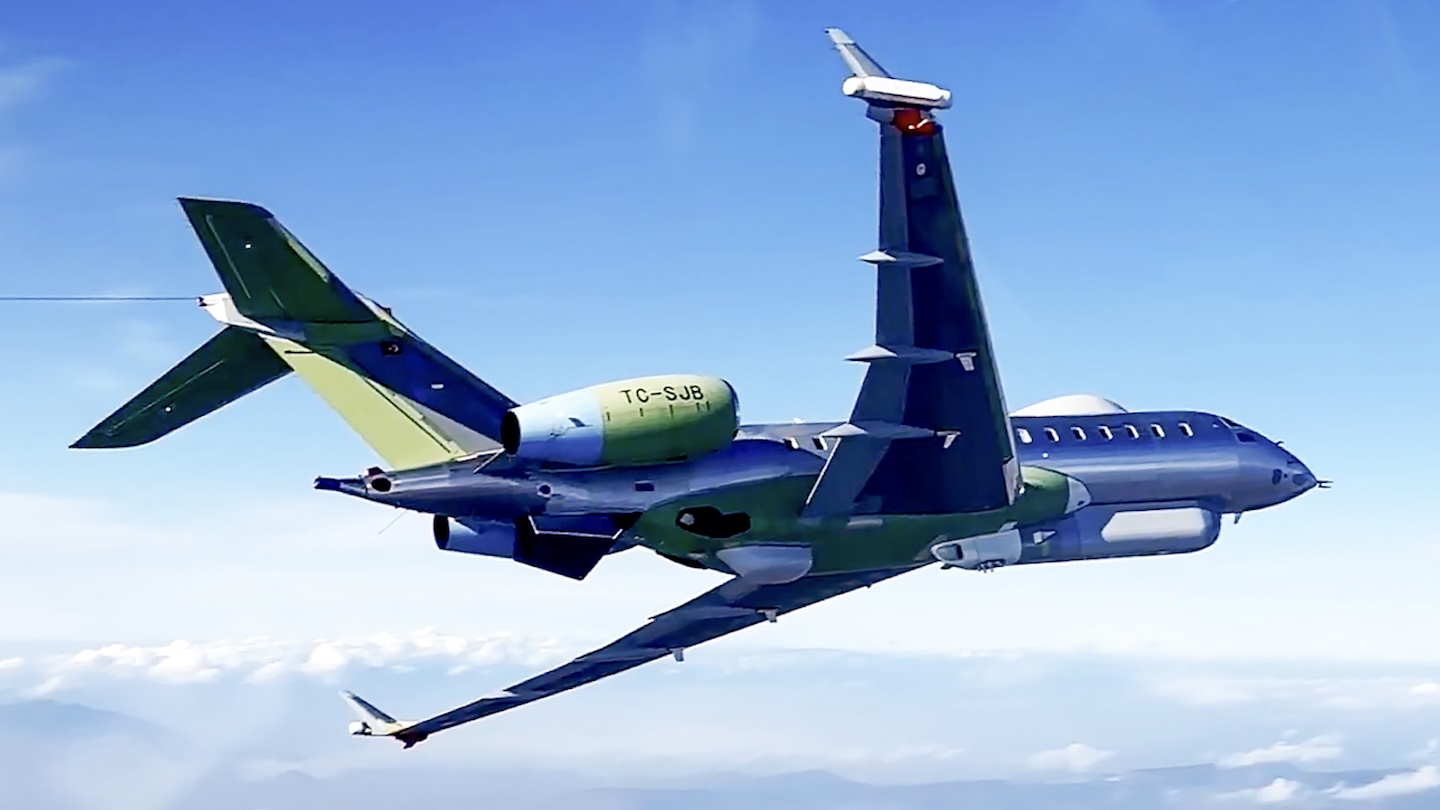
The new image shows the HAVA SOJ with its external fairings and antennas, but still unpainted. The aircraft is trailing a cable from the top of its vertical stabilizer, which is likely a trailing cone that is often used for early flight tests of new aircraft configurations. An air-data probe, a temporary fixture associated with test work, is fitted to the nose.
A first, very poor quality image of the HAVA SOJ on March 1 of this year, when the aircraft was making a test flight out of the Turkish Aerospace Industries (TAI) facility in Ankara.
Simultaneously conducted land and air platform based radar and jammer projects
Air SOJ MIT Intelligence Aircraft IHA-SOJ (ASOJ-234U) Kara-SOJ 1 (Koral-1) Kara-SOJ 2 (Koral-2) AEW-C (ALP-200A) IHA AEW-C (Baykar-S band early warning radar) https://t.co/pfcATqqKWqpic.twitter.com/rv1sqF5Lt6
Previously, two examples of the aircraft had been noted flying on February 20, with their test sorties appearing on publicly available flight-tracking websites.
Türk Hava Kuvvetlerine ait iki adet yerli HAVA SOJ uçağı Ankara'da uçuş gerçekleştirdi. pic.twitter.com/kYJIlfrhGL
Around the late 2000s, Turkey and Aselsan began scheming a homegrown replacement for the Turkish Air Force’s existing standoff jamming capability, based on the Transall C-160 turboprop transport, as seen in the photo embedded below.
With the program taking longer than anticipated, thought was given to fielding an interim aerial standoff jammer, under a program known as Golge (shadow). This would have provided an urgent operational capability with two Global Express-based systems and would have integrated equipment from local and international companies. Negotiations made no progress and the Golge program was terminated in 2017.
The first Canadian-made Bombardier Global 6000 airframes for the HAVA SOJ program were delivered to TAI facilities back in 2019. Ultimately, four conversions are planned. Interestingly, some early graphics associated with the program had depicted the system installed on a Gulfstream platform.
The Global 6000 airframes are receiving mission payloads from Aselsan, which are integrated by TAI. Several official images of the aircraft had appeared before the integration system had taken place, but, since then, the aircraft has been notably camera-shy.
One of the Global 6000 airframes before receiving its mission equipment. SSB
The Turkish Defense Industry Agency (SSB), a government body that manages defense industry in Turkey, and which runs this program, describes the role of the HAVA SOJ as follows:
“Standoff Jamming (SOJ) platforms are high-value assets that suppress adversary air defense radars, disrupt command and control cycles, and interfere with communications by conducting deception and noise jamming from long ranges without entering hostile airspace. By doing so, they create corridors through which friendly air forces can penetrate enemy airspace. The effective employment of these platforms has become an undeniable reality of modern warfare, acting as a force multiplier and generating powerful asymmetric effects.”
As well as jamming systems, the HAVA SOJ will also have a surveillance capability, with electronic support measures (ESM) equipment, and there are also accounts of an onboard radar.
Most of this equipment is housed within large sensor fairings around the fuselage.
An early Aselsan graphic shows the extensive array of receiver sensors, jammers, and communications equipment around the aircraft. Aselsan
As to the specifics of the equipment, few details have been released, but it is known to be based on Aselsan’s Koral/Kara SOJ land-based electronic support/attack suite that is mounted on two heavy-duty vehicles. All of the systems for the jets are being developed in-country.
We know that the primary stated mission for the HAVA SOJ is electronic attack, in the form of both deception and jamming. For this purpose, the aircraft is likely fitted with powerful active electronically scanned array (AESA) antennas, like those used in the land-based Koral/Kara SOJ. These could be used to send out highly focused beams of electromagnetic energy to jam the radars and other radio frequency sensors and emitters in the air, on land, and at sea. This is a capability we have talked about before in relation to the U.S. Air Force’s EA-37B electronic warfare jet. Additionally, these same AESA antennas could be used to trigger cyber attacks, a capability you can read more about here.
A U.S. Air Force EA-37B Compass Call. U.S. Air Force
Another parallel is found in Australia’s MC-55A Peregrine airborne intelligence, surveillance, reconnaissance, and electronic warfare (AISREW) jet, based on the Gulfstream G550 business jet airframe. As we have discussed in the past, the Peregrine is likely a multi-role platform, providing both intelligence collection and electronic attack functions.
Australia’s first MC-55A Peregrine at RAAF Base Edinburgh, South Australia, earlier this year. @airman941
In practice, the HAVA SOJ would use its ESM equipment to detect and track enemy radio-frequency emissions. After detecting and geolocating the hostile emitter, its frequency value would be determined. Then, the electronic attack element would be activated, sending out its own emissions to electronically attack that emitter, whether it be via jamming or spoofing. Using its AESAs, with its fast-scanning capability, the jet would be able to make pinpoint attacks, not just barrage jamming, and also execute these attacks against multiple emitters of different types and at various ranges simultaneously.
This kind of capability has a clear application against air defense systems and command and control nodes, as the SSB points to. However, it is also able to degrade, deny, and disrupt some kinds of adversary communications, causing havoc in the enemy’s data-sharing architecture and command-and-control system, and reducing adversary commanders’ ability to make effective decisions and share them. And, in peacetime, the aircraft would be able to conduct surveillance intelligence work, helping to build up an electronic order of battle (EOB) on opposing forces, which would be of high value to NATO.
Interestingly, the wingtip pods on the HAVA SOJ look a lot like those found on the EA-18G Growler, as part of its AN/ALQ-218 Tactical Jamming System Receiver system, which includes radar warning receiver (RWR), electronic support measures (ESM), and electronic intelligence (ELINT) functionality.
An EA-18G, with the AN/ALQ-218 Tactical Jamming System Receiver pods on the wingtips. U.S. Navy
While designed to work from outside hostile airspace, there have been increasing questions about the ability of specialized aircraft like these to survive against more capable air defenses, with the threat of long-range anti-air missile systems only set to grow.
With regard to the long ‘canoe’ fairing under the fuselage, these are similar to that which appears on the U.S. Army’s ME-11B HADES and the Royal Air Force’s now-retired Sentinel R1s, both also based on the Bombardier Global Express. In these applications, the ‘canoe’ houses a synthetic aperture radar/ground moving target indicator (SAR/GMTI) radar. SAR imagery consists of highly detailed ground maps, while GMTI functionality can spot and track moving vehicles on the ground, regardless of cloud cover, smoke, dust, or other obscurants. If a similar radar was installed in the HAVA SOJ, it would confer a powerful intelligence-gathering capability, but we cannot say for sure. It is also possible that AESA arrays on the jet that are primarily used to support the electronic attack mission can also perform some SAR/GMTI and other radar functions. It’s also worth noting this aircraft actually has two ventral fairings, which could feature separate arrays.
A Royal Air Force Sentinel R1 before its retirement. Crown Copyright
Finally, the aircraft features two large dorsal SATCOM enclosures on its spine. This would allow for the data this aircraft collects to be distributed anywhere in near-real time. In addition, the aircraft will clearly feature an impressive communications suite for supporting line-of-sight communications and data sharing as well, which will be critical for working as a force multiplier for the Turkish Air Force.
When Aselsan was awarded the contract for its part of the HAVA SOJ program in 2018, it was planned that the first would be delivered to the Turkish Air Force in 2023. That deadline has clearly been missed, hardly uncommon for a program of this technological complexity.
A head-on view of a Global 6000 before receiving its HAVA SOJ mission equipment. SSB
Bearing in mind Turkey’s success in finding customers for its defence products, the HAVA SOJ could also attract substantial foreign interest, with Pakistan having been identified as a possible opportunity in the past.
Aselsan has also entered a joint venture with Taqnia in Saudi Arabia, with the aim of promoting a version of the HAVA SOJ known as Kasih.
For export customers, the mission suite installed in the HAVA SOJ, like other Turkish military equipment, would not be subject to the restrictions imposed by the U.S. International Traffic in Arms Regulations (ITAR) guidelines, which can limit the transfer of defense and military technologies and services — especially the more sensitive ones — to certain countries. Even among NATO operators in Europe, the HAVA SOJ will likely provide an unmatched set of capabilities. With air defenses becoming more capable, even among lower-end foes, the need for high-end electronic attack capabilities is only growing.
While many questions remain about the exact capabilities of the HAVA SOJ, the aircraft’s increasingly frequent appearances suggest the long-delayed program is entering a more mature phase. As Turkey continues to invest heavily in indigenous technologies, the HAVA SOJ is set to become one of the more significant force multipliers in the Turkish Air Force’s inventory, providing a valuable standoff capability, including against modern integrated air defense networks.

 Login
Login