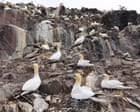
Annual killing of infant gannets has been carried out on a remote Scottish island for at least 400 years
Animal welfare campaigners have called for talks on phasing out the “inhumane” hunt for infant gannets known as guga, which are killed by hunters on a remote Scottish island once a year.
OneKind and the League Against Cruel Sports said it should be slowly phased out in dialogue with the Hebridean islanders who see the hunt, which has been carried out for at least 400 years, as a cultural pursuit and as sustainable food harvesting.
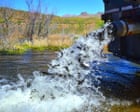
Wildlife department says drought conditions and water released from dam led to ‘major fish kill’ at San Carlos Lake
Arizona officials have indefinitely closed a popular lake to visitors after its entire population of fish died recently.
The recreation and wildlife department that maintains San Carlos Lake said in a Facebook statement on Friday that drought conditions as well as water released from a dam there “resulted in a major fish kill affecting approximately 100% of the fish population”.
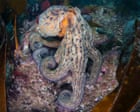
Record numbers linked to warming waters is mixed news for fishers, with shellfish catches down but octopus catches booming
Record numbers of octopuses found off the south-west coast of England last year have now spread as far as Scotland and Wales and are transforming the fishing industry and the marine ecosystem, according to a study.
The surge in sightings of one of the world’s most intelligent invertebrates was first recorded in 2025 off the south coast of Devon and Cornwall.
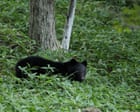
Police and hunters in Utsunomiya, 100km north of the capital, resume their search for animal that is not usually seen so close to Tokyo
A city in Japan has closed all its 94 primary and secondary schools after a bear was spotted in the municipality for the first time.
Officials in Utsunomiya, a city of half a million people about 100km (62 miles) north of Tokyo, took action after a medium-sized black bear – estimated to be about one-metre-long – was seen near a park in the city on Saturday. The bear was spotted again on CCTV running just in front of two startled young men in the city centre, in the early hours of Sunday.
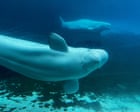
Beluga whales, which Marineland threatened to euthanize in 2025, will be moved to aquariums in Spain or across US
Canada and an embattled marine park have reached a tentative deal on the future of 30 beluga whales, ending a saga that has captivated the public and angered animal rights groups.
The federal fisheries ministry announced this week that all of Marineland’s belugas would be shipped to either Spain or one of four locations in the US, ending whale captivity in Canada.
As offshore wind farms expand rapidly in the global renewable energy transition, scientists are studying how these large marine infrastructure projects affect ecosystems beneath the waves. Research from Wageningen University & Research in the Netherlands suggests that offshore wind may bring both risks and benefits for sharks and rays, known collectively as Elasmobranchii, which are highly sensitive to electromagnetic fields (EMFs). A six-year project called “Elasmopower” examined how EMFs from subsea power cables in offshore wind farms affect bottom-dwelling sharks and rays. These species depend on natural electric and magnetic fields for key behaviors such as navigation, prey detection, habitat use and long-distance movement, particularly in low-visibility environments. The studies conducted as part of the Elasmopower project have been published in four papers, with three additional papers currently undergoing peer review. Sharks and rays have specialized electroreceptors called ampullae of Lorenzini. The jelly-filled sensory canals around the head and snout can detect even extremely weak EMFs from prey and predators, water movement, and the Earth’s geomagnetic field, Erwin Winter, a scientist at Wageningen, told Mongabay. This system is central to hunting and orientation, making Elasmobranchii especially relevant for studying EMF exposure from offshore energy infrastructure, Winter added. Erwin Winter, a researcher with the Elasmopower project, presented findings on offshore wind, electromagnetic fields and bottom-dwelling sharks and rays at the Sharks International 2026 conference in Colombo, Sri Lanka, in May. Image by Malaka Rodrigo for Mongabay. During a presentation on a summary of the Elasmopower research at the Sharks International 2026…This article was originally published on Mongabay

 Login
Login