Antes da entrada em bolsa, a OpenAI quer transformar o ChatGPT num assistente único capaz de programar, criar imagens e executar tarefas, numa viragem estratégica para produtos pagos e clientes empresariais. A OpenAI prepara a maior remodelação do ChatGPT desde que o seu lançamento deu início ao boom da inteligência artificial, numa altura em que o grupo, avaliado em cerca de 738 mil milhões de euros, procura novos motores de crescimento antes da entrada em bolsa prevista para este ano. A empresa pretende transformar o chatbot numa “superapp” que combine ferramentas de programação e agentes de inteligência artificial, acrescentando produtos
O passe ferroviário verde passa agora a estar disponível na aplicação gov.pt, deixando assim de ser necessário um cartão físico, anunciou hoje o Governo.
“O passe ferroviário verde passa a estar disponível na app gov.pt, a aplicação oficial do Estado português de acesso a documentos digitais”, lê-se num comunicado conjunto dos ministérios das Infraestruturas e da Reforma do Estado.
Conforme detalhou o executivo, após o carregamento no ‘site’ da CP – Comboios de Portugal, os titulares passam a ter acessível no seu telemóvel este passe, dispensando o cartão físico, à semelhança do que acontece, por exemplo, com o cartão de cidadão ou com a carta de condução.
“O investimento que estamos a fazer em comboios e na ferrovia traduz-se igualmente num reforço da aposta na digitalização. O Governo está empenhado em continuar a trabalhar para uma mobilidade mais sustentável, inteligente e digital”, afirmou, citado na mesma nota, o ministro das Infraestruturas e Habitação, Miguel Pinto Luz.
Por sua vez, o ministro da Reforma do Estado, Gonçalo Matias, sublinhou que esta nova funcionalidade reflete o compromisso do Governo “com um Estado mais simples, digital e próximo dos cidadãos”.
De acordo com dados avançados pelo executivo, desde 2024 foram vendidos mais de um milhão destes passes.
O passe ferroviário verde, que custa 20 euros, permite ao seu titular viajar em toda a rede de comboios regionais, intercidades e nos troços urbanos que não estão incluídos nos títulos intermodais.
Egyptian archaeologists have uncovered part of an ancient cemetery from the Greco-Roman period at Tell Kom Aziza in Egypt’s Nile Delta, offering fresh insight into one of the region’s most historically layered sites. The site sits in Beheira Governorate and spans multiple historical periods stretching back thousands of years.
The Egyptian archaeological mission, working under the Supreme Council of Antiquities, found a wide range of burial types during excavations. Some bodies were placed directly in simple earth pits.
Others were buried in mud brick-framed pits, painted plaster coffins, or barrel-shaped pottery coffins. The barrel-shaped pottery coffin was among the most common burial types during the Ptolemaic era.
Tourism and Antiquities Minister Sherif Fathy said that the site holds value far beyond its burial remains. He described it as a window into settlement patterns, daily life, and how people interacted with their environment over millennia.
Burial diversity points to centuries of ritual evolution
Secretary-General of the Supreme Council of Antiquities Hisham El-Leithy said that early analysis of human remains pointed to a notable variety in burial practices. Some graves were individual, while others were collective.
Burial orientations ran along both north-south and east-west axes. Hand positions ranged from resting at the sides to the crossed-arms “Osirian” pose on the chest.
El-Leithy added that studying the archaeological layers confirmed the Greco-Roman cemetery was built over earlier settlement levels. Artifacts trace human activity at Tell Kom Aziza from the Old Kingdom through the New Kingdom, the Late Period, and into the Greek and Roman eras.
Mohamed Abdel Badie, head of the Egyptian Antiquities Sector, said that excavations produced a broad range of everyday artifacts. These included pottery and stone vessels, bread molds, multi-purpose stone tools, ovens, and storage jars.
Large quantities of fish, bird, and animal bones were also recovered, offering clues about the diet and daily habits of the site’s ancient residents.
Wild boar burials found at Egypt’s Greco-Roman cemetery
Among the more unusual finds, mission chief and Beheira Antiquities Director Khaled Abdel Ghani Farhat reported the discovery of complete wild boar burials within one of the archaeological layers.
He said that this is rare at ancient Egyptian funerary sites, given the pig’s symbolic association with the god Set. The find may suggest the boar played an economic or livelihood role at the site during a specific period of use.
Farhat said that the findings confirm Tell Kom Aziza is more than a burial ground. It is a detailed archaeological record of human life across successive historical eras. Further excavation seasons are expected to uncover more of what the site still holds.
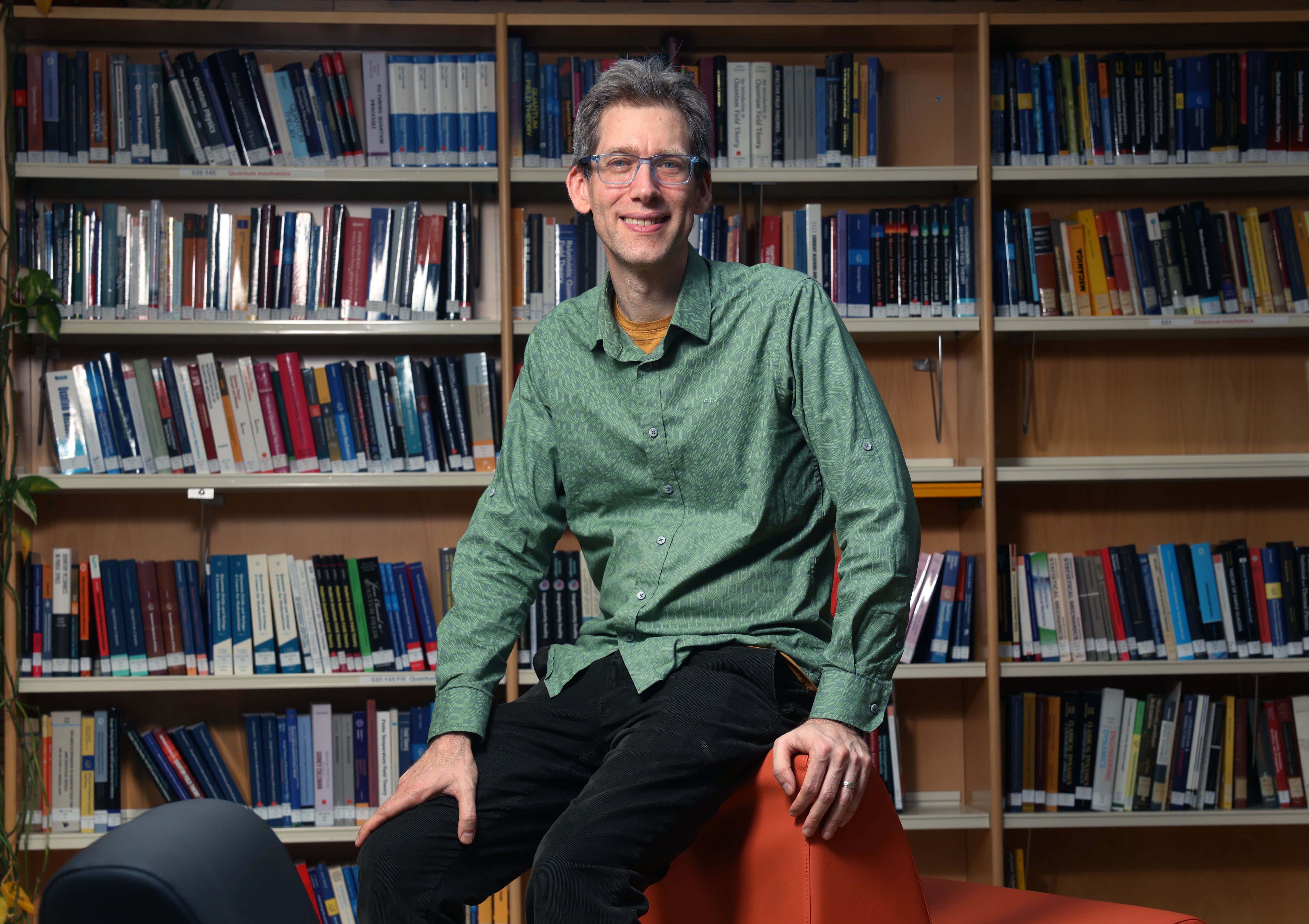
Aram Harrow has spent 25 of his 46 years working in quantum computing. He is a researcher at the Massachusetts Institute of Technology (MIT) and is best known for co-developing the HHL algorithm in 2008, considered one of the first demonstrations of an exponential advantage of quantum computers over classical ones. This June marks the end of the year he has spent at Spain’s Institute of Mathematical Sciences (ICMAT) in Madrid, where he speaks with EL PAÍS.
O TSE (Tribunal Superior Eleitoral) divulgou nesta quarta (3) a divisão dos valores do fundo eleitoral de financiamento de campanha. Ao todo, cerca de R$ 4,9 bilhões serão distribuídos entre 30 partidos.
A divisão considera a representatividade dos partidos no Congresso e o desempenho nas últimas eleições. Como PL e PT elegeram as maiores bancadas na Câmara e Senado, recebem mais recursos.
Veja quanto cada partido vai receber
o PL: R$ 881.657.477,34
o PT: R$ 615.367.980,20
o União Brasil: R$ 526.242.858,11
o PSD: R$ 421.008.404,89
o PP: R$ 417.067.738,40
o MDB: R$ 400.002.399,99
o Republicanos – R$ 348.587.815,77
o Podemos: R$ 245.969.763,68
o PDT: R$ 169.285.643,92
o PSB: R$ 152.252.956,07
o PSDB: R$ 147.895.172,40
o PSOL: R$ 131.506.284,42
o Solidariedade: R$ 88.526.669,83
o Avante: R$ 72.516.777,19
o PRD: R$ 71.819.227,37
o Cidadania: R$ 60.714.157,11
o PCdoB: R$ 60.531.914,25
o PV: R$ 45.183.873,26
o Novo: R$ 37.044.203,26
o Rede: R$ 35.803.821,03
o Agir: R$ 3.307.679,85
o DC: R$ 3.307.679,85
o Democrata: R$ 3.307.679,85
o Missão: R$ 3.307.679,85
o Mobiliza: R$ 3.307.679,85
o PCB: R$ 3.307.679,85
o PCO: R$ 3.307.679,85
o PRTB: R$ 3.307.679,85
o PSTU: R$ 3.307.679,85
o UP: R$ 3.307.679,85
Recursos podem ser usados em despesas de campanha
Os valores podem ser utilizados para despesas relacionadas à campanha. Gastos incluem produção de material gráfico, impulsionamento de conteúdo na internet, contratação de pessoal, aluguel de espaços para eventos, transporte e serviços de comunicação. (UOL/FOLHAPRESS)
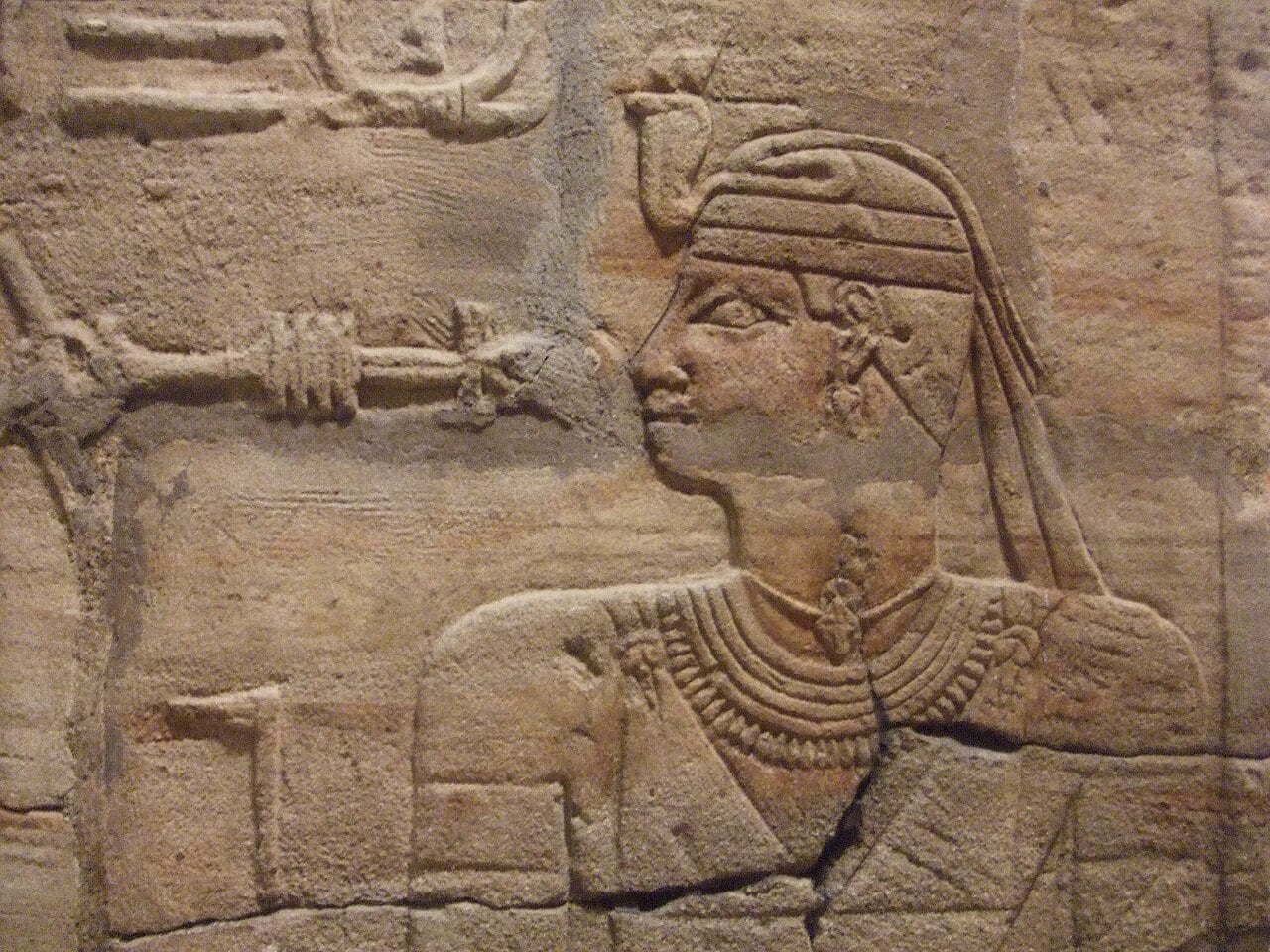
A relief depicting the Ethiopian king of Egypt Taharqa from Kawa, Nubia. Credit: Wikimedia Commons, CC-BY-2.0, Aidan McRae Thomson
For some time, Ancient Egypt was ruled by a dynasty of Ethiopian kings. According to legend, one of them was so powerful that he conquered Anatolia, across the Mediterranean from Egypt. Could such a conquest have really occurred, and if not, then what led to this legend of an Ethiopian king of Egypt who was said to have conquered Anatolia?
Strabo’s legend of the Ethiopian king of Egypt who conquered Anatolia
The source for this legend comes from one particular document. This is Strabo’s Geography, written in the first century BC. Strabo mentions a particularly notable Ethiopian king twice. In the first instance, he mentions him alongside other notable conquerors of the ancient world, writing:
“Nor yet for the most part are the expeditions of their chiefs, for instance, Madys the Scythian, Tearko the Ethiopian, Cobus of Trerus, Sesostris and Psammeticus the Egyptians.”
Without going into details, the context of this reference makes it clear that Tearko the Ethiopian was supposed to have set out on a major expedition or conquest. He is grouped together with other famous conquerors of antiquity, such as Sesostris.
The next mention of Tearko provides additional information. Here, Strabo calls him “Tearco.” Referring to the claims of an earlier historian called Megasthenes, he wrote:
“Sesostris, the Aegyptian, he adds, and Tearco the Aethiopian advanced as far as Europe; and Nabocodrosor, who enjoyed greater repute among the Chaldaeans than Heracles, led an army even as far as the Pillars. Thus far, he says, also Tearco went; and Sesostris also led his army from Iberia to Thrace and the Pontus.”
According to this legend, Tearco the Ethiopian conquered as far as the Pillars, meaning the Pillars of Hercules. However, how is this associated with Anatolia, and why have we called this Ethiopian ruler a king of Egypt?
Who was Tearco the Ethiopian?
To understand the answer to these questions, we first need to understand who Tearco actually was. It is necessary to take a look at the context in which Strabo places him. In the first reference to him, Strabo grouped him together with figures such as Madys the Scythian, known to modern historians as Madyes, his contemporary king Cobus, and Psammeticus of Egypt. These were figures of the seventh century BC.
In the second reference to Tearco, Strabo groups him together with Nabocodrosor of the Chaldaeans, known to historians as Nebuchadnezzar of Babylon, and Sesostris of Egypt, probably the historical Shebitku. These were also figures of that same era. Furthermore, immediately after the quoted passage, Strabo mentions Idanthyrsus, a Scythian king of the sixth century BC.
Therefore, based on the context in which Tearco is mentioned, it is obvious that we should be looking for an Ethiopian king who ruled at some point within that same era. For this reason, the mainstream conclusion among scholars is that Strabo’s Tearco is the historical Taharqa.
Taharqa was a member of the Ethiopian dynasty that ruled Egypt for much of the eighth and seventh centuries BC. Chronologically, he fits in perfectly with the other figures mentioned by Strabo, and his name is a linguistic match as well. We know, historically, that Taharqa became the ruler of Egypt, despite Strabo making no mention of this fact.
A bust of Taharqa from the Nubian Museum, Aswan. Credit: Wikimedia Commons, CC-BY-2.0, Bruce Allardice
Understanding the legend
Now that it’s clear who Strabo was referencing, let us see if we can actually understand Strabo’s claim. It is easy to be confused by the reference to Tearco conquering as far as the Pillars. It might seem like Tearco was said to have conquered as far as Spain. After all, the Strait of Gibraltar is the standard location of the Pillars of Hercules.
For a king of Egypt, this might appear to make sense in the context of an exaggerated tale. It would mean that Tearco warred across the coast of North Africa until finally reaching the Strait of Gibraltar. However, this is illogical in the context of Strabo’s passage. As the quoted passage shows, Strabo states that both Nebuchadnezzar and Tearco reached the Pillars.
Given the reference to Nebuchadnezzar, Strabo may be referring to pillars that, according to Isocrates, were situated near the entrance of the Black Sea, at Troy, rather than the actual Pillars of Hercules at Gibraltar. While Nebuchadnezzar never historically got as far as Troy, he did conquer parts of Anatolia.
Furthermore, Strabo associates the event with Sesostris’ campaigns as far as Thrace and the Pontus (the Black Sea). This reinforces the point that Strabo was referring to pillars by the entrance to the Black Sea rather than the Pillars at the Strait of Gibraltar. Incidentally, the reference to Iberia in association with Sesostris must point to the Caucasian Iberia, as it is often called by modern historians, on the eastern end of the Black Sea region.
Conclusively, Tearco the Ethiopian, the historical Taharqa king of Egypt, was said to have conquered all across the Levant and right through Anatolia.
Is the legend of the Ethiopian king who conquered Anatolia actually true?
If an Ethiopian king of Egypt really did conquer Anatolia, we would definitely know about it. There would have been clear references to such an event in archaeological records. Nevertheless, that does not mean that this legend has no identifiable historical basis.
It is clear that the legend is not simply based on exaggerated accounts of Taharqa’s historical conquests. The reason is that Taharqa was, in reality, not a notable conqueror. Plenty of kings of Egypt engaged in far more impressive conquests than he ever did, yet no legends ever centered around them. Therefore, the true explanation must be something unique in his case.
The Bible provides the answer. In its account of Sennacherib of Assyria waging war against Jerusalem, the Bible mentions Taharqa. Using the spelling “Tirhakah,” it describes how this Ethiopian king went out to fight against Sennacherib. Historically, Taharqa was unable to secure a victory.
Nevertheless, we know that the Egyptians remembered it as a victory. Herodotus, in the fifth century BC, recorded an Egyptian legend about a king of Egypt named Sethos who successfully defeated the Assyrians. Scholars generally understand Sethos to be Shebitku. It appears that Shebitku was the senior king at the time of Sennacherib’s attack, with Taharqa as the junior king. Shebitku was the king of Egypt, while his relative Taharqa was the king of Ethiopia and the one who actually led the army against the Assyrians.
Hence, what appears to have occurred is that the Egyptians remembered the attack as a victory, regardless of the historical outcome. It was then exaggerated into tales of Tearco actually conquering the Assyrians. Since their territory extended far into Anatolia, this naturally led to the legend of Tearco, an Ethiopian king of Egypt, conquering as far away as Anatolia.
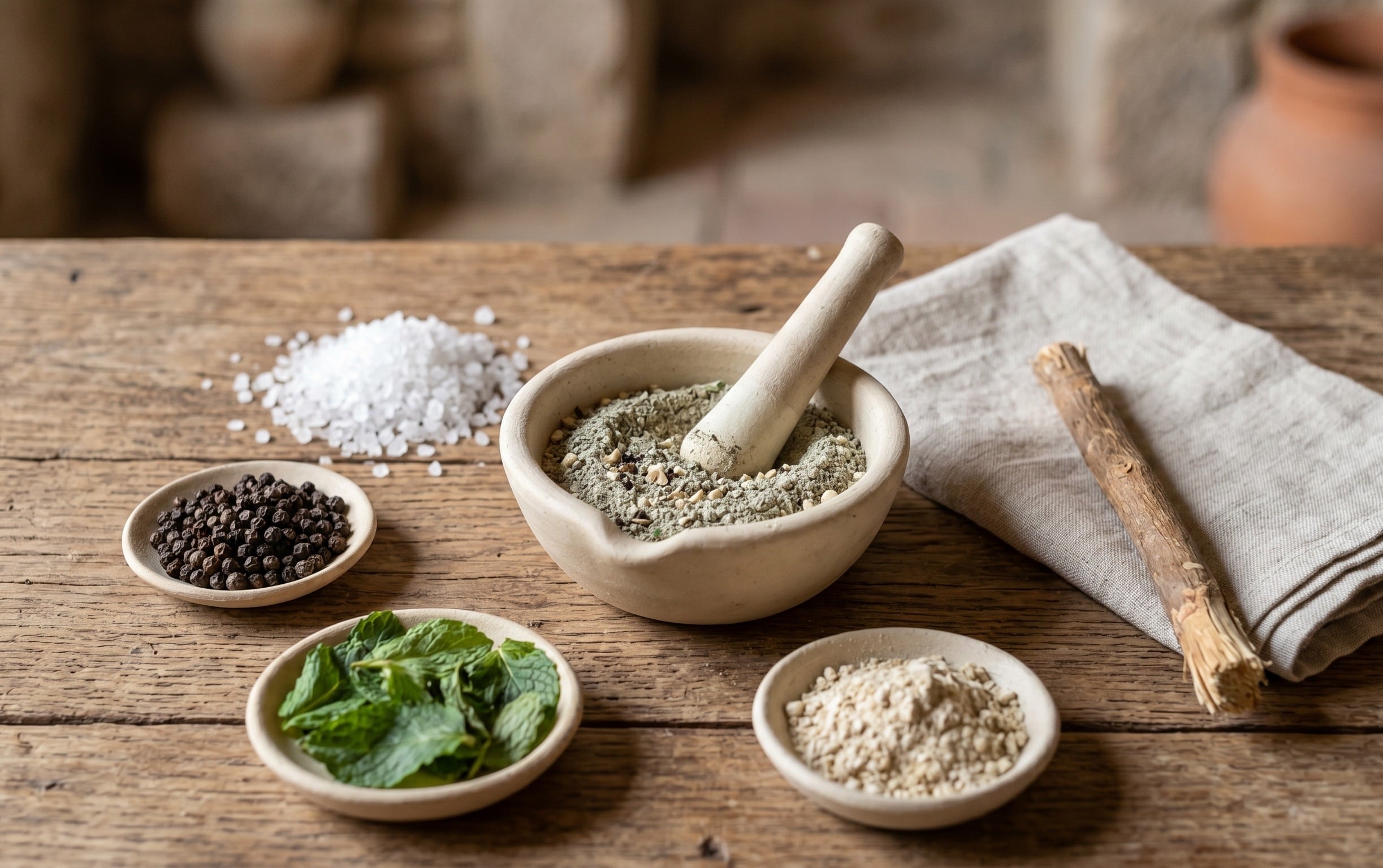
The natural, abrasive components used by Ancient Greeks to maintain oral hygiene, such as crushed oyster shells, charcoal, and mint. Credit: Greek Reporter archive
Most of us assume that looking after our teeth is a modern habit shaped by supermarket shelves, mint-flavored ads, and childhood dentist scares, but a surviving Ancient Greek toothpaste recipe suggests otherwise.
Sitting quietly in the Austrian National Library in Vienna is one of the most remarkable documents in the history of medicine: a small, faded papyrus from the fourth century AD containing what is widely considered the world’s oldest surviving, precise toothpaste formula.
The existence of this Ancient Greek toothpaste recipe points to something larger at work. By the time it was copied onto papyrus, Greek had long since become the language of science, medicine, and intellectual life across the Mediterranean. This linguistic dominance was a legacy of the conquests of Alexander the Great and, above all, of Alexandria, the city his successors transformed into the ancient world’s foremost hub of knowledge. Even in Roman Egypt, centuries after the Ptolemies had given way to the Caesars, Greek remained the language a physician used when he wanted to be taken seriously.
When was the toothpaste recipe written in Ancient Greek discovered?
The papyrus first came to the attention of modern researchers in 2003, when curators at the Austrian National Library in Vienna identified it while preparing for an international dental congress. It had likely been sitting in the collection for years, its significance unnoticed and largely forgotten. Once translated, however, scholars quickly realized what they were looking at—a toothpaste formula that predates the first commercially marketed toothpaste, Colgate, launched in 1873, by well over fifteen hundred years.
The formula itself is strikingly systematic. The scribe prescribes “a powder for white and perfect teeth” composed of four ingredients: one drachma of rock salt, two drachmas of mint, one drachma of dried iris flower, and twenty grains of pepper. The drachma in this context was a standard unit of Greek medical weight, roughly equivalent to one-eighth of an ounce (about 3–4 grams), part of the same measurement system used throughout the major pharmacological texts of the ancient world. Taken together, the recipe reads less like folklore and more like a physician’s deliberate prescription, carefully calibrated for a patient.
But one might wonder if it actually worked. In 2003, Austrian dentist Dr. Heinz Neuman decided to test it for himself by recreating the formula. His conclusion was cautious but intriguing: the mixture was mildly abrasive and caused slight gum bleeding, yet it also produced a noticeable sensation of cleanliness and freshness. Modern dental science helps explain why. Dried iris flower, or orris root, is now known to contain antibacterial compounds that target the pathogens responsible for gum disease. What might once have looked like ancient guesswork increasingly appears to be empirical knowledge derived through observation and practice. In this sense, modern pharmaceutical science is only now arriving at conclusions the Greeks and Egyptians had already explored more than a thousand years earlier.
Dioscorides is considered the father of pharmacology. Painting of unknown artist depicting Heuresis (the personification of discovery) presenting Dioscorides with a mandrake root. Credit: Unknown artist. Wikipedia Public Domain
None of this should entirely surprise us when we consider the world from which this recipe emerged. Ancient Greece had produced Pedanius Dioscorides, whose monumental work on medicinal plants shaped medical practice for more than a millennium. It had also produced physicians, botanists, and scholars who approached the human body with a level of rigor and curiosity that few ancient traditions matched. The anonymous scribe who recorded this formula was working squarely within that intellectual lineage, effectively encoding practical medical knowledge in Greek because it was the language in which serious medicine was conducted at the time.
The paste itself would have been applied without anything resembling a modern toothbrush. A folded linen cloth or a frayed chew stick—a fibrous twig worn soft at the tip through repeated use—would have served the purpose well enough. The tools were simple, but the intention was essentially the same as ours.
There is a quiet continuity in that detail. The next time you reach for mint toothpaste in the morning, you are participating in a ritual that a Greek-speaking scribe in Roman Egypt thought important enough to preserve on papyrus seventeen centuries ago. The ingredients have been refined, the packaging has changed beyond recognition, and no one is applying the mixture with linen anymore. Still, the impulse behind it—the very human desire for clean, white teeth—remains as old as the ancient world itself, and in many ways, the Ancient Greek world had already put the first working version of the answer into writing.
By 2030, water consumption linked to the use of artificial intelligence will be equivalent to that of 1.3 billion people in sub-Saharan Africa, while it will require nearly three times the annual energy consumption of Pakistan, Bangladesh and Nigeria — countries with a combined population of 650 million. In terms of carbon emissions, these could reach 400 million tonnes of CO₂ equivalent, comparable to the United Kingdom’s total emissions. The operation of AI will require 14,500 square kilometres of land, including infrastructure and supply chains — twice the size of the Jakarta metropolitan area, a megacity with more than 32 million inhabitants, or 10 times that of Mexico City (21 million).
In 2021, Miriam González, a 35-year-old from Murcia, Spain, went to the doctor because she was bleeding from her breast. She was told to relax: everything was normal. But in 2024, she was diagnosed with breast cancer. And, shortly afterward, she discovered it was metastatic, at stage four.

 Login
Login