
Normal view

Ancient Greek Scientist Erasistratus Was the King’s Lie Detector

6 June 2026 at 15:01
Erasistratus
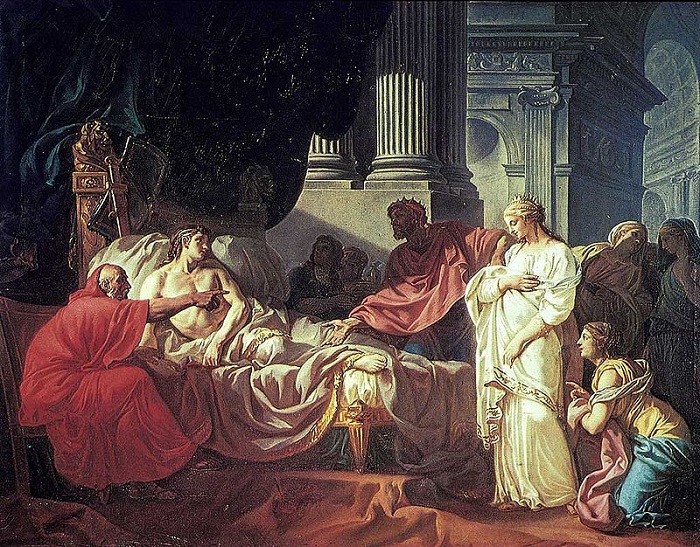
Erasistratus discovers the cause of the illness of Antiochus. Painting by Jacques-Louis David. Public Domain

Ancient Greek scientist Erasistratus (300-250 B.C.) is credited with being among the first human lie detectors. He devised a specific technique to read a person’s physical response so as to spot when an individual was lying.

While in Alexandria, Egypt, he is said to have proven Prince Antiochus was desperately in love with his father’s new wife, Stratonice. He noted how his pulse increased significantly whenever the queen’s name was mentioned, despite his insistence that he did not have the hots for his stepmother.

Love-struck, he fell ill with passion and chose to pine away in silence. The physicians were unable to discover the cause and nature of his disease.

Erasistratus himself was at a loss at first, until, finding nothing amiss about his body, he began to suspect that it must be the man’s mind that was diseased and that he might perhaps be in love.

Erasistratus confirmed his conjecture when he observed that the skin of Antiochus grew hotter, his color deeper, and his pulse quicker whenever Stratonice came near him, while none of these symptoms occurred on any other occasion.

The Greek physician eventually told the father, King Seleucus, that his son’s disease was incurable, for he was in love with the monarch’s wife and that he chose to die rather than to disclose his secret.

According to the anecdote, Seleucus not only gave up Stratonice, but also resigned to his son several provinces of his empire.

Erasistratus founded school of anatomy in Alexandria

Erasistratus, along with fellow physician Herophilus, founded a school of anatomy in Alexandria where they carried out anatomical research.

He is credited for his description of the valves of the heart. He also concluded that the heart was not the center of sensations. Instead, he said, it functioned as a pump. He was among the first to distinguish between veins and arteries, believing that arteries were full of air and carried the “animal spirit” (pneuma).

Together with Herophilus, he is credited by historians as the potential founder of neuroscience due to his acknowledgment of nerves and their roles in motor control through the brain and skeletal muscles.

Furthermore, Erasistratus is seen as one of the first physicians/scientists to conduct recorded dissections and potential vivisections alongside Herophilus.

The two physicians were said by several Roman authors, notably, Augustine, Celsus, and Tertullian, to have performed controversial vivisections on criminals to study the anatomy and possible physiology of human organs while they were in Alexandria.

Related: Ancient Library of Alexandria One of Greatest Treasures of Mankind
Crete Remembers the Razing of the Village of Kandanos by the Nazis

4 June 2026 at 18:09
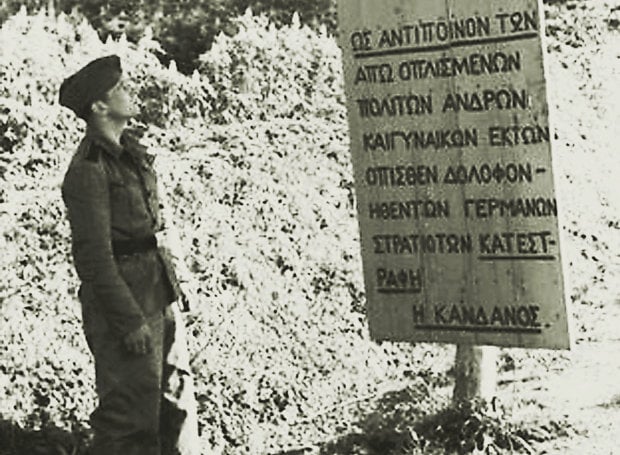
A German soldier in front of one of the signs in Greek erected after the razing of Kandanos, Crete by the Nazis.
A German soldier in front of one of the signs erected after the razing. The text reads: “Kandanos was destroyed in retaliation for the bestial ambush murder of a paratrooper platoon and a half-platoon of military engineers by armed men and women.” Credit: Bundesarchiv, CC BY-SA 3.0 de/Wikipedia

The village of Kandanos on Crete was burned to the ground, and Nazi troops massacred all 180 residents on June 3, 1941 during the years of the German occupation.

It was one of the worst atrocities committed by the occupiers and has haunted Crete and Greece for decades.

Battle of Crete

The Battle of Crete began on May 20, 1941, with Germany employing 750 glider-borne troops, 10,000 paratroopers, 5,000 airlifted mountain soldiers, and 7,000 seaborne troops. It was the first occasion when German parachutists were used en masse and the first mainly airborne invasion in military history.

It was also the first time German soldiers had encountered mass resistance from a civilian population, and they suffered unexpectedly large numbers of casualties.

The outnumbered Greek soldiers, along with the Allied forces based on Crete, fought bravely but were vastly outnumbered. Cretan civilians joined the battle with whatever weapons were at hand—mostly kitchen knives, but rakes, clubs, and even walking sticks were used in desperate hand-to-hand combat for their homeland.

German parachutists were often knifed or clubbed to death as they landed on fields of Crete. In one recorded incident, an elderly Cretan man clubbed a paratrooper to death with his walking cane before the German could even disentangle himself from his parachute.

In another incident, a local priest and his son broke into a village museum, took two rifles from the Balkan War era, and sniped at German paratroops as they landed. The Cretans also began to use small arms from captured German soldiers as the battle continued.

However, this courage came at a terrible cost, as the Germans retaliated as soon as they managed to gain control of Crete.

The temporary German commander of the island, Kurt Student, ordered a series of brutal reprisals against the local population immediately after the surrender of Crete on May 31, 1941.

Kandanos Crete Nazi
The Nazi occupying forces massacred civilians on Crete. Credit: Bundesarchiv, CC BY-SA 3.0 de/Wikipedia

Every last resident of Kandanos, amounting to a total of 180 men, women, and children, were brutally massacred, and their ancient village was burned to the ground.

Nazis order for the destruction of Kandanos

Below is the order of the German commander:

“It is certain that the civilian population including women and boys have taken part in the fighting, committed sabotage, mutilated and killed wounded soldiers. It is therefore high time to combat all cases of this kind, to undertake reprisals and punitive expeditions which must be carried through with exemplary terror. The harshest measures must indeed be taken and I order the following: shooting for all cases of proven cruelty, and I wish this to be done by the same units who have suffered such atrocities. The following reprisals will be taken:
1. Shooting
2. Fines
3. Total destruction of villages by burning
4. Extermination of the male population of the territory in question
My authority will be necessary for measures under 3 and 4. All these measures must, however, be taken rapidly and omitting all formalities. In view of the circumstances the troops have a right to this and there is no need for military tribunals to judge beasts and assassins.”

After the surrender of Germany, General Kurt Student was captured by the British. In May 1947, he came before a military tribunal to answer to charges of mistreatment and murder of prisoners of war by his forces on Crete.

Greece’s demand to have Student extradited was declined. Student was found guilty of three out of eight charges and sentenced to five years in prison. However, he was given a medical discharge and was released in 1948. Student was never tried for crimes against civilians.

Today, Kandanos has been rebuilt and is the seat of the eponymous municipality. Reproductions of the somber Wehrmacht signposts commemorating the village’s destruction are displayed on a local war memorial.

Related: Greek Scientists Identify Nazi Victims Executed 83 Years Ago in Crete

❌