Normal view

How Ancient Greeks Used Chicken Feathers to Defeat the Romans

9 June 2026 at 17:36
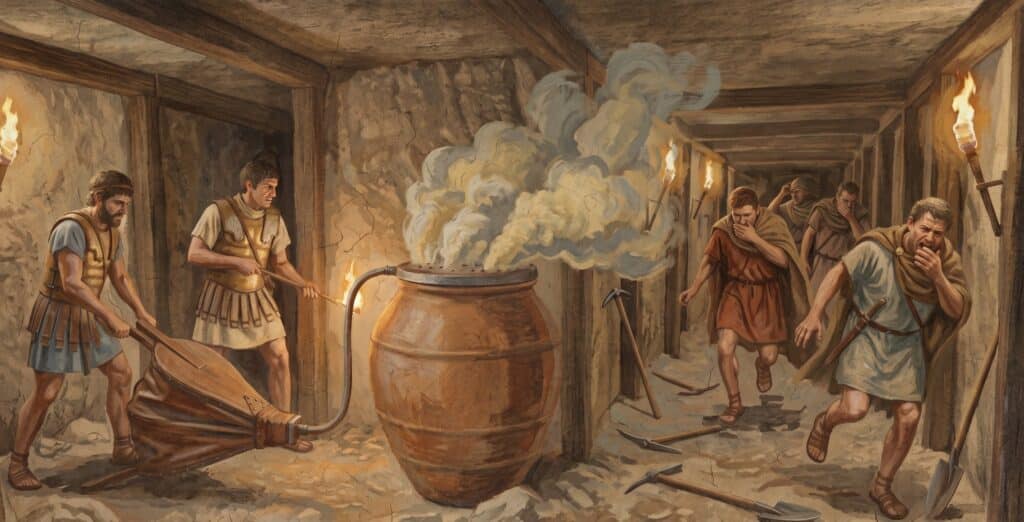
Siege of Ambracia image depicting a barrel in which burning feathers are used as a type of early chemical warfare tactic
The burning feathers tactic used by the Ancient Greeks is considered one of the first chemical weapons in human history. Credit: Greek Reporter archive

In 189 BC, Ancient Greeks defending the city of Ambracia used an early form of chemical warfare against Roman forces during a siege, deploying a clay jar filled with burning chicken feathers.

At first, the story sounds almost absurd, but it becomes far more striking once the details are unpacked and we understand what was happening beneath the city walls—and, more importantly, why this moment even matters in the history of ancient warfare.

Ancient Greeks turn to chemical warfare and burning feathers as siege intensifies

The Romans arrived in Ambracia with overwhelming force. Consul Marcus Fulvius Nobilior deployed battering rams under a two-hundred-foot covered gallery, a massive mobile shed designed to protect his engineers from arrows and boiling pitch as they hammered away at the walls. The Ambraciot defenders held firm. The walls didn’t collapse.

Frustrated and running out of options above ground, the attackers eventually turned underground. Their plan was straightforward enough: tunnel beneath the city, collapse the foundations, and force the stubborn Greeks to surrender. For a while, the effort proceeded in silence. Then the Greeks noticed the piles of excavated earth building up outside the camp and understood exactly what was going on. Locating the tunnel was another matter. The Greeks solved it with one of the most clever pieces of field engineering in ancient history.

They placed thin bronze vessels against the ground at various points inside the city and then pressed their ears to them to listen. The vibrations traveling through the earth from the pickaxes told them exactly where the tunnel was heading. It functioned as an early acoustic detection system, and it worked brilliantly. They then dug a counter-tunnel and broke through into the mine. What followed was the kind of close-quarters underground fighting where normal weapons become useless. Spears are too long, shields too wide, and you can’t even see the man you’re fighting, so they built something new.

The Greeks took a large clay jar, a pithos, sized to precisely fit the tunnel, capped it with an iron lid drilled with holes, inserted an iron tube connected to a blacksmith’s bellows, and filled the jar with glowing charcoal covered in a dense layer of fine feathers, creating what can be described as an early chemical warfare device. When it was pushed into the tunnel and activated with the bellows, it produced a thick cloud of acrid, choking smoke that billowed forward into the darkness.

The Roman miners couldn’t breathe, couldn’t see, and had nowhere to go. They abandoned their tools and fled to the surface to escape the choking fumes. The Greeks had driven off a superior Roman force solely with clay, iron, fire, and feathers. Military historian Adrienne Mayor has pointed to this episode as evidence of just how sophisticated ancient weapons technology really was.

This deliberate act of chemical engineering would be remembered in later accounts of ancient warfare. The pithos was matched to the tunnel width specifically to prevent blowback. The feathers were chosen for the particular quality of smoke they produced when burned at high temperatures. Someone thought this through. The parallels to later warfare are hard to ignore. The same basic horror—an invisible, suffocating enemy in a dark enclosed space—would define trench warfare on the Western Front more than two thousand years later.

The psychology hasn’t changed even if the chemistry has. Ambracia ultimately surrendered. Cut off and outnumbered, the city eventually negotiated terms rather than fight on indefinitely, but the defenders had already shown what was possible. Historians now regard what happened in those tunnels as one of the earliest documented uses of asphyxiating chemical weaponry in a tactical military context—a genuine milestone in the history of warfare.

@timelinehistoryoffical

During the Roman siege of Ambracia in 189 BC, the defenders deployed what is one of the earliest recorded uses of a chemical weapon in history — and they used it underground. Rome was besieging the Greek city, held by the Aetolian League. When the walls held and the siege artillery failed, the Romans turned to mining — digging a tunnel beneath the walls, concealed behind a two-hundred-foot covered walkway, worked in relays day and night. For days the defenders didn’t notice. Then the pile of excavated earth grew too large to hide. Unable to see the tunnel, the defenders pressed bronze vessels against the ground to detect the vibration of digging, located the Roman mine, and dug a counter-tunnel straight toward it. The two tunnels met. Soldiers fought face to face in darkness too cramped to swing a sword. When direct combat failed, the defenders built a device described in detail by the historian Polybius: a clay jar fitted to the tunnel’s width, packed with feathers over burning coals, sealed with a perforated iron lid, and connected to a blacksmith’s bellows. They pumped the choking smoke directly into the Roman tunnel. The Romans were driven out of their own mine. According to Polybius, it was among the first uses of toxic smoke in the history of war. 📖 Further reading — Polybius, The Histories: https://amzn.to/4uWM9wN #AncientHistory #RomanEmpire #Ambracia #Shorts #HistoryShorts #ChemicalWarfare #TimelineHistory #history #shorts #ancientrome #education

♬ original sound – Timeline History

Mithridates’ Kingdom: What Alexander’s Empire Could Have Been?

8 June 2026 at 17:31
Marble bust of the king of Pontus Mithridates VI as Heracles, a mythical association that Alexander the Great often touted.
Portrait of the king of Pontus Mithridates VI as Heracles, a mythical association that Alexander the Great often touted. Marble, Roman imperial period (1st century), Credit: Musée du Louvre, Paris, Public Domain.

Alexander the Great’s (356-323 BC) death meant his vision for a Greco-Persian Empire was extinguished with him—or was it?

A hodgepodge of East and West, Mithridates’ Pontic Empire emerges as a compelling possibility of what Alexander’s empire could’ve been, a faint apparition of that fleeting dream.

Alexander 2.0

Mithridates (135–63 BC) was the inheritor of two cultures and, naturally, an incarnation of two worlds. He delighted in his Macedonian heritage as much as his Persian forbearers.

Claiming Macedonian ancestry on one side and Persian dynastic lineage on the other, Mithridates used his mixed descent to reveal the commonalities between his diverse subjects.

Taking on Alexander’s mantle of global empire, Mithridates envisioned an alternative to Roman supremacy, a new world order.

To achieve this ambitious aim, the Pontian King united his Greek, Anatolian, and Persian subjects under an anti-Roman cross-cultural coalition.

The result of this cooperation was three wars mounted against Rome, wars that escalated to the point of genocide.

How could he amass such a diverse following against such a formidable foe?

Mithridates took a page from Alexander’s book and embodied East and West, both in appearance and idea. 

Pontus: Alexander’s vision of empire?

Map of the Kingdom of Pontus, Wikimedia
Map of the Kingdom of Pontus. Credit: Photograph by Javierfv1212,  Public Domain, via Wikimedia Commons.

Mithridates hailed from the Kingdom of Pontus, a cultural melting pot that Alexander the Great would have approved of.

The north of Pontus’s snow-clad Alps was a largely Hellenic-dominated coastline. There, Greek colonists had erected the city of Sinope, Mithridates’ capital.

The historian Strabo, himself a Pontian, claimed that it was “the most noteworthy of the cities in the region.”

South of the Alps was known as Katpatuka (land of horses) by the Iranians and, later, Cappadocia by the Greeks. There, villages predominated apart from a few settlements, such as Amaseia, Strabo’s hometown, and Cabeira.

While Hellenic culture dominated the coast, the Cappadocian hinterland preserved its old Anatolian non-Greek heritage. Rostovtzeff (1932), a pioneer in Pontic history, described the Hellenic influence around the Black Sea as “a thin Greek shell around a hard native kernel.”

The third influence on the region was Iranian. The enduring relics of Persian rule would have been visible to many a Hellenistic Pontian. Strabo says that the Pontic people took sacred vows at the state temple, Zela, which were dedicated to Persian deities: Anaitis, Omanus, and Anadatus.

Moreover, Zeus Stratios, most likely a syncretic reincarnation of Ahura Mazda, received lavish offerings from Persian Kings, which Pontian rulers, including Mithridates Eupator, continued. The continuation of Persian religious customs well after an eclipse of Achaemenid authority attests to the impression Persian presence had made on Pontic royalty and their subjects.

In the subsequent Hellenistic period, the increasing pace of Hellenization of the kingdom meant that the Mithridates Dynasty had to evolve.  There needed to be a balance between the new incoming wave of this ancient form of globalization with their Perso-Anatolian traditions that still held sway in their domain. 

Divine descent

A coin of Mithridates Eupator depicted as Dionysus
Mithridates Eupator depicted as Dionysus, Credit PHGCOM, Public Domain, via Wikimedia Commons.

Mithridates Eupator’s dual lineages afforded him illustrious ancestors and a unique hybrid set of dynastic customs. He was a Helleno-Persian Prince who practiced mixed religious rites.

Mithradates divine connections are well in accordance with Alexander the Great’s own claims. Like the Pontic King, Alexander claimed Heracles and Dionysus, among other numinous figures, as ancestors.

Consequently, the Pontic King embodied redemptive qualities resonating in the Greek and Perso-Anatolian worlds. For the Greeks, he established a mythical connection with Dionysus, the god of liberation and new beginnings, and took the theonym Mithridates Eupator Dionysus.

Likewise, Mithridates claimed heritage from Herakles, who emancipated the titan Prometheus, humanity’s creator. On the other hand, Mithridates’ star-signaling birth was said to fulfill Persian prophecies of a coming savior from the East, as did his name, “Mithras-sent.” 

Global principles

An vase painting of a Persian Magus-king conducting a fire ritual. Mithradates' fire ceremony followed the traditional customs of his Persian ancestors. Detail from red-figure vase 3297, side A, by the Underworld Painter, 4th century BC.
Persian Magus-king conducting a fire ritual. Mithradates’ fire ceremony followed the traditional customs of his Persian ancestors. Detail from red-figure vase 3297, side A, by the Underworld Painter, 4th century BC. Credit: Staatliche Antikensamm lungen und Glyptothek, Munich, Public Domain

In addition to religious mediation, Mithridates weaponized the growing resentment of his subjects. Just like Alexander’s vision for his diverse empire, the Pontian King tried to respect Greek and Iranian values.

Both Greeks and Perso-Anatolians were chafing under Roman occupation. In mainland Greece and Anatolia, the common hatred towards Roman rule provoked a transcultural antagonism against Roman hegemony.

Debt accrued by Roman taxation hindered asa or Truth, a prominent Persian tenet. For the Greeks, Roman occupation was seen as compromising their eleutheria, or freedom, which was fundamental to Greek identity.

Mithridates acknowledged these grievances in his speeches, along with coins and other allusions. By showing sensitivity to both cultures, the Pontian King illustrated how compatible Iranian and Greek cultures could be.

This may be surprising, considering the tumultuous history that plagued the relations between Greeks and Iranians. Egregious crimes were committed in Athens by the Persians and by Greeks in Persepolis at Alexander’s instigation as punishment.

Yet Mithridates successfully harmonized the two cultures, as Alexander the Great’s policies aimed to accomplish.

Was Mithridates’ Pontian kingdom what Alexander’s empire could have been?

Sensitive to Greek and Perso-Anatolian culture, Mithridates entangled much of the Eastern Mediterranean in opposition to Rome. Mithridates carried on Alexander’s vision for an international empire even though he was unsuccessful in his wars against Rome. By doing so, the Pontian king proved Alexander the Great’s Helleno-Persian hypothesis was possible.

Alexander’s vision for joining East and West wasn’t an idyllic dream but was ultimately an achievable reality. 

New Pompeii Discovery Reveals Equine Skeleton in Ancient Bread-Making Workshop

5 June 2026 at 20:30
The skeleton of an equine at ancient bread making complex in Pompeii
The skeleton of an equine at an ancient bread-making complex in Pompeii. Credit: Pompeii Archaeological Park

Archaeologists in Pompeii have uncovered an equine skeleton inside a bread-making workshop at one of the city’s most celebrated ancient complexes, opening a new chapter in the understanding of how humans and animals lived and worked together nearly 2,000 years ago.

The remains were discovered at the Insula of the Chaste Lovers, a large residential and commercial site renowned for its striking “chaste kiss” fresco, painted inside the dining room of the owner’s home.

The complex includes a working bakery, storage rooms, processing spaces, and the owner’s private residence. Researchers had previously found other equids at the site’s stables, where animals were used to power grain mills and transport the grain needed for bread production.

Pompeii’s chaste lovers complex was also a busy bakery

This latest skeleton was not found in the stables. Researchers found it in a separate room, suggesting the animal had fled there during the catastrophic eruption of Mount Vesuvius in 79 AD.

The excavation brought together archaeologists and specialists from the Applied Research Laboratory, including experts in animal remains, plant life, and human bones. This interdisciplinary approach has become one of the most important aspects of modern archaeological research at the site.

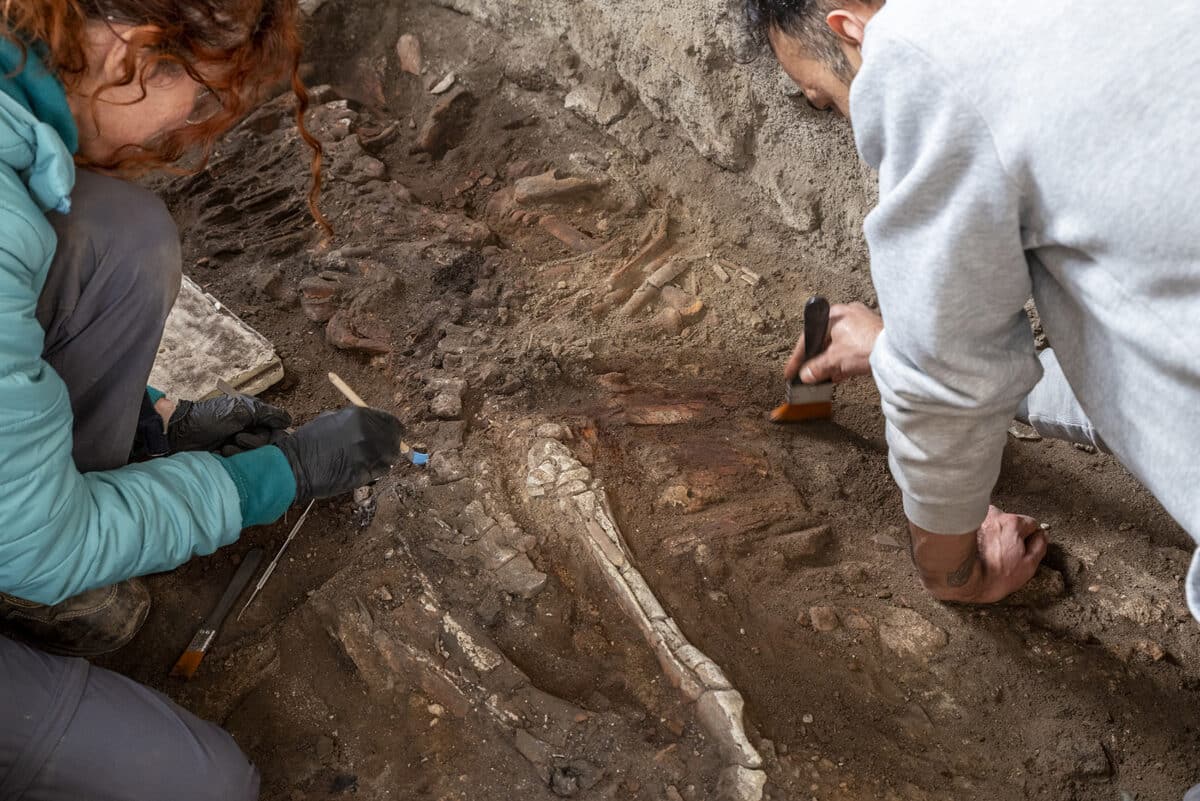
Archaeologists excavating the skeleton of an equine
Archaeologists are excavating the skeleton of an equine. Credit: Pompeii Archaeological Park

Laboratory analysis is still ongoing. Researchers expect it to reveal more about the animal’s specific role in the production complex and the conditions it faced during the eruption.

The study could also contribute to a wider understanding of how animals responded to the disaster in real time, adding detail to the reconstruction of those final, chaotic hours.

Pompeii equine skeleton suggests a desperate Vesuvius escape

Gabriel Zuchtriegel, director of the Pompeii Archaeological Park, said that Pompeii offers far more than beautiful frescoes and ancient objects.

He said it gives researchers the opportunity to understand lives that were ended by the eruption, and that this extends to animals as well as people. The horse or donkey, he noted, was found inside a house with remarkable frescoes that also served as a working mill and bakery.

Its location in a room away from the stables points to an attempt to escape the eruption. Zuchtriegel called the excavation a strong example of the daily multidisciplinary collaboration at the site and said ongoing lab results will continue to offer significant scientific value.

Pompeii continues to yield new layers of ancient life. The site preserves not just objects and artwork but the full texture of daily existence, including the bonds between people, animals, and the spaces they shared.

The equine skeleton discovered in Pompeii’s ancient bread workshop is the latest reminder that the city still holds stories waiting to be told.

❌