Ukrainian counterattacks are spoiling the Russian assault toward the city of Lyman
In protecting Lyman, the Ukrainians also protect the nearby twin cities of Kramatorsk and Sloviansk
The problem for Ukraine is that there's another route to Kramatorsk and Sloviansk
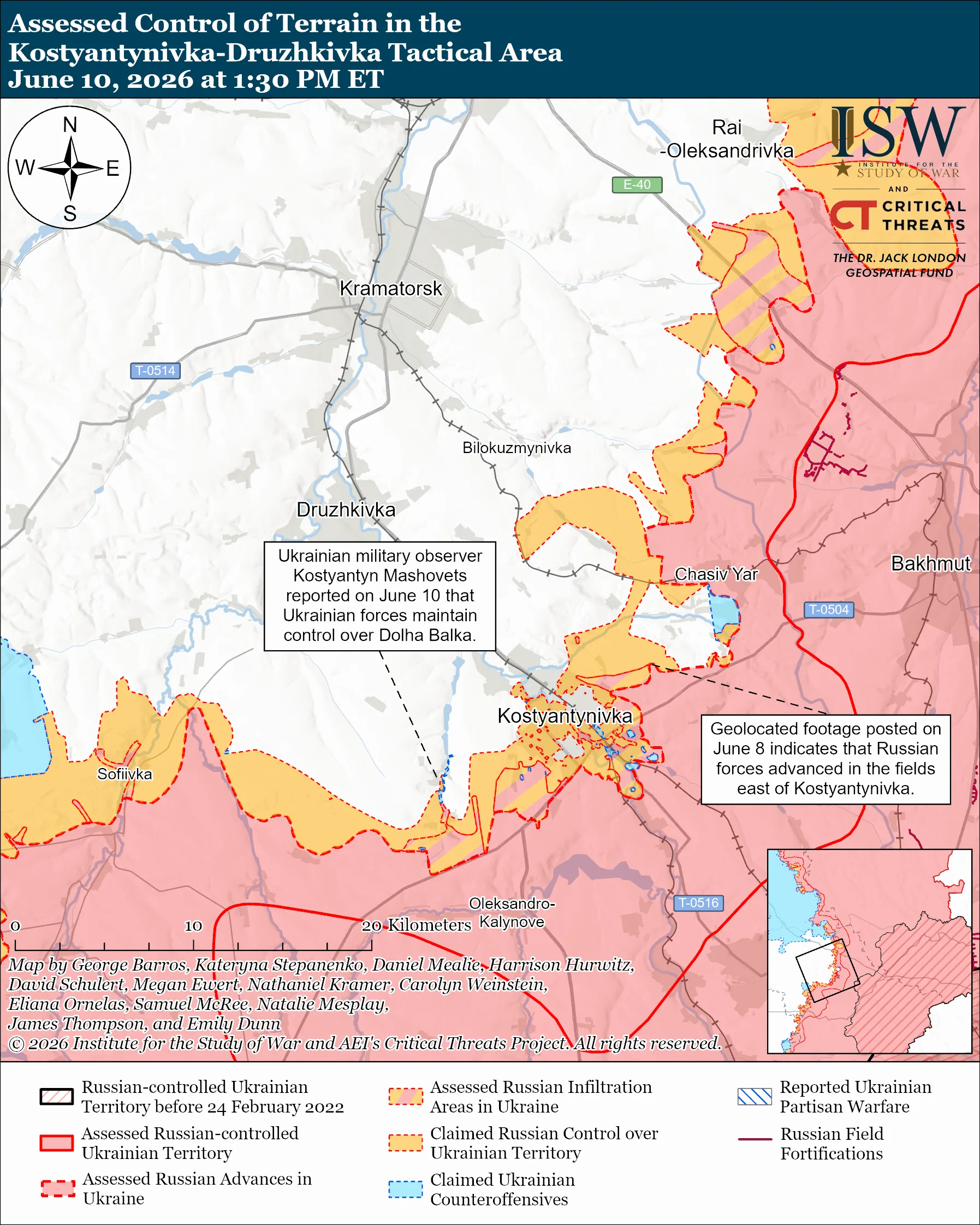
The city of Lyman, in eastern Ukraine's Donetsk Oblast, stands between Russian forces and their main objectives as Russia's wider war on Ukraine grinds into its 52nd month: the twin cities of Sloviansk and Kramatorsk.
To attack Sloviansk and adjacent Kramatorsk from the north, the Russians must first march through or around Lyman and then travel another 13 km along the T0514 road. But the Ukrainian 3rd Army Corps is doing its best to spoil the Russian attack—by counterattacking behind the lead Russian elements.
It's been a successful strategy for the Ukrainians. Since late May, mappers and analysts have noted evidence of Ukrainian troops marching through the villages of Nove and nearby Katerynivka, 16 km northeast of Lyman. The villages buttressed the northern edge of a Russian-held salient just north of Lyman.
If the Russians had succeeded in extending the salient farther to the west, they may have succeeded in partially surrounding Lyman, potentially putting pressure on Ukrainian supply lines into the city. The Ukrainian counterattacks along the northern edge of the salient around Nove and Katerynivka did to the Russians north of Lyman what the Russians were trying to do to the Ukrainians in Lyman: threaten their supply lines.
All evidence suggests that Ukraine has advanced further than any map currently depicts north of Lyman. Russians say Ukraine has captured towns and other areas that were once firmly held are now contested. I try to keep my map to only verified facts so I am far more conservative. pic.twitter.com/Wx22pncLLk
Now the Russians are reeling and Ukrainian troops are pushing back against the westernmost edge of the salient. Analyst Andrew Perpetua claimed he logged Russian social media posts, which he explained have since been deleted, that purportedly indicated meaningful Ukrainian advances at multiple points around the tip of the salient.
"All evidence suggests that Ukraine has advanced further than any map currently depicts north of Lyman," Perpetua wrote. "Russians say Ukraine has captured towns and other areas that were once firmly held are now contested."
The Ukrainian attacks on the salient north of Lyman are good news for the overall Ukrainian defense not just of Lyman, but also of Sloviansk and Kramatorsk. Preventing an encirclement of Lyman could forestall a Russian advance past the city—and delay or block a northern assault on Sloviansk and then Kramatorsk.
The situation around Lyman as per deepstatemap does not show the latest Ukrainian advances. Map: Euromaidan Press
Southern approach
That doesn't mean the Russians won't march on Kramatorsk and Sloviansk from another direction. Having occupied the ruins of Pokrovsk and neighboring Myrnohrad early this year, the Russians are now staging for a southern assault toward Kramatorsk and then Sloviansk.
But the most direct route, along the H-20 highway, is blocked by the Ukrainian garrison in Kostiantynivka, 15 km south of Kramatorsk. Here, the Russians are enjoying much greater success than they are around Lyman. Successfully pushing the disputed gray zone north until it fully encompassed Kostiantynivka, the Russians can now infiltrate the city from several directions.
"There are a number of positive trends on the battlefield for Ukraine compared to 2025 (and advances in some directions), but the situation in Kostiantynivka is still deteriorating," noted Rob Lee, an analyst with the Foreign Policy Research Institute in Philadelphia.
According to mapper Clément Molin, the most optimistic scenario for Russia is that its forces occupy Lyman and Kostiantynivka this summer, possibly allowing the Russians to lay siege to Kramatorsk and Sloviansk by the end of the year.
Ukraine’s FATUM crews destroyed Russian equipment on the Lyman axis, one of the front’s most intense sectors. Losses included a Grad MLRS, artillery tractor, ground robotic platform and self-propelled gun, while Troika operators hit several vehicles. #Ukrainepic.twitter.com/e91jLg2J9P
But Lyman holds thanks in part to those counterattacks and Kostiantynivka is "holding longer than thought," Molin noted. So the optimistic scenario for Russia may be slipping away.
That means the pessimistic scenario for Russia is increasingly likely. In that scenario, Molin explained, the Russians capture Lyman too late to lay siege to Kramatorsk and Sloviansk this year. "That's what is currently happening," Molin concluded.
For Ukraine, even delaying a Russian siege of Kramatorsk and Sloviansk represents a major win. Time means opportunity, and Ukrainian drone forces have been seizing the opportunity to intensify their attacks on Russian supply lines all across occupied Ukraine.
The counterlogistics campaign could reshape the entire battlefield in the coming months. For Russia, Kramatorsk and Sloviansk are realistic objectives right now, even if it takes another six months for Russian forces to reach the twin cities. That could change as Ukraine continues fraying Russian supply lines.
Explore further
Ukraine is droning Russian ships. The goal: to create supply bottlenecks on land.
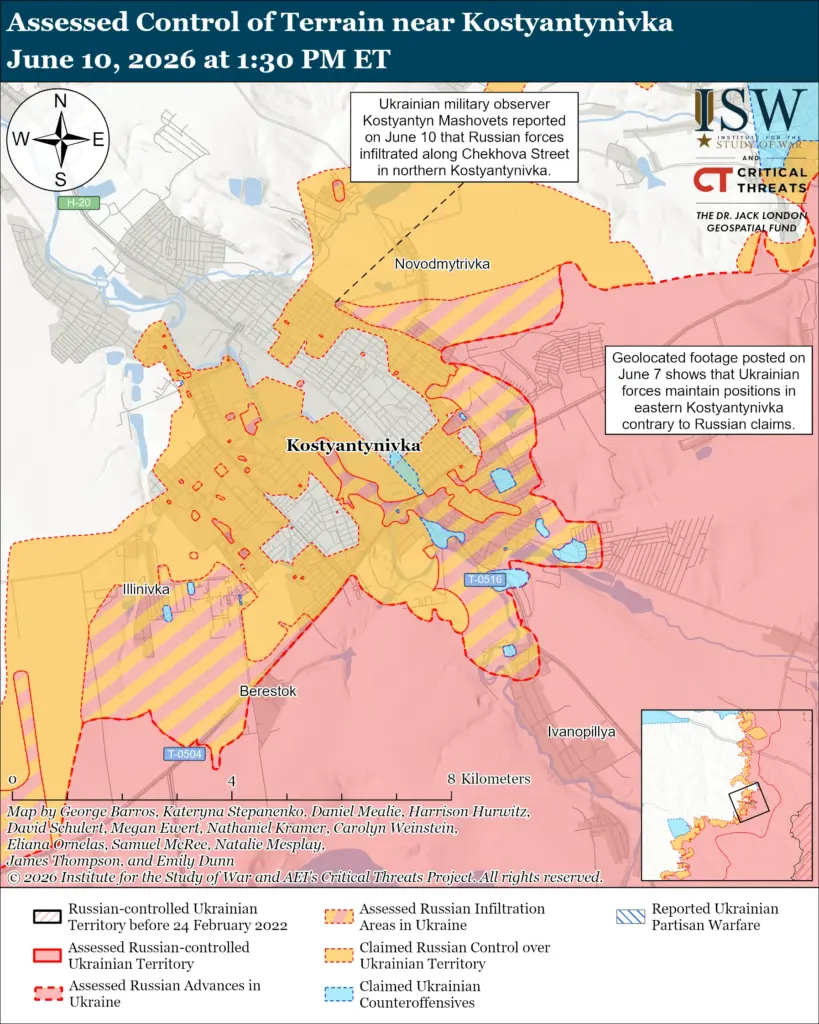
Russian forces have made fresh tactical advances into Kostiantynivka, the Institute for the Study of War (ISW) assessed on 10 June. The city sits at the southern tip of Ukraine's Donetsk Oblast Fortress Belt — Moscow's main effort for the spring-summer 2026 offensive. Russia missed its own May deadline to take the city, and the wider fortified chain stays out of operational reach.
For more than four years now, Russia has been struggling to seize the rest of Donetsk Oblast in eastern Ukraine, making only gradual costly advances. Ukraine's Fortress Belt anchors the region's defense. Unable to capture the Ukrainian-controlled part, the Kremlin demanded the whole region in peace talks, which predictably isn't a condition Ukraine can accept. Slow infiltration drains Russian reserves while Ukrainian drone interdiction continues to erode Moscow's assault tempo across the theater.
Two Russian tactical groups push into eastern Kostiantynivka
Two named Russian formations have pushed into eastern Kostiantynivka from the south, Ukrainian military observer Kostiantyn Mashovets reported on 10 June. He identified them as the "Bakhmut" tactical group and the "Dzerzhinsk" (Toretsk) tactical group. The "Bakhmut" group is built around Russia's 3rd Army Corps (AC) under the Southern Grouping of Forces. The "Dzerzhinsk" group operates in the area of responsibility of the 8th Combined Arms Army (CAA) of the Southern Military District. It likely includes elements of five CAAs, the 3rd AC, and Russian naval fleets, Mashovets noted.
Elements of the "Bakhmut" group pushed from Stupochky through Novodmytrivka into northeastern Kostiantynivka. They also advanced along the T-0504 Pokrovsk-Bakhmut road as far as the city's railway station. The "Dzerzhinsk" group moved from Illinivka, south of the city, into areas stretching from northwestern to southwestern Kostiantynivka near the railway station. Mashovets assessed that it has likely achieved a tactical breakthrough in the western, central part of the city. Forward assault elements of the two groups now stand roughly two kilometers apart. Russian forces have so far failed to seize the railway station. Ukrainian troops cleared the village of Dovha Blaka southwest of the city of Russian infiltrators.
Map: ISW
Eight months of grinding, one missed deadline
ISW noted that Russian forces opened the campaign for Kostiantynivka in August 2025 after seizing the majority of Chasiv Yar and Toretsk, with Toretsk alone running to roughly 26,000 Russian casualties. The first Russian troops infiltrated Kostiantynivka itself in October 2025. Russia has since worked into at least 12.69% of the city. Ukrainian officials reported earlier this spring that the Russian command had set a May 2026 deadline for the seizure. That deadline has come and gone.
Explore further
Russia’s monthly land grab in Ukraine has collapsed from hundreds of km² to 14, OSINT data show
Russia has poured forces into the effort regardless. Ukrainian Commander-in-Chief Oleksandr Syrskyi said on 2 May that Russian activity in this direction noticeably increased in April. Russian units in the area had reportedly been replenished by 80% as of 6 June, ISW noted. The Russian command reportedly redeployed elements of the 70th Motorized Rifle Division to the Kostiantynivka-Chasiv Yar area last December. The redeployment likely came in preparation for the spring push.
Tactical gains likely, the Fortress Belt still out of reach
ISW assessed that Russian forces will likely keep infiltrating throughout Kostiantynivka. They will likely consolidate positions in parts of the city while suffering high casualties. Russia's 3rd AC northeast of the city appears to be struggling to dislodge Ukrainian forces from Chasiv Yar. That inhibits any move to envelop Kostiantynivka from the north. A Russian milblogger claimed on 9 June that Ukrainian forces recently counterattacked near Chasiv Yar. The milblogger added that Ukraine still holds Podilske and Mykolaivka west of the town.
Explore further
ISW: Russia’s grand territorial ambitions are divorced from battlefield reality
The northern flank of the Fortress Belt is also bogged down. Russia opened its spring-summer 2026 offensive with mechanized assaults around Lyman. Those assaults signaled intent to advance on Sloviansk from the northeast. They produced no significant gains, ISW noted. The Russian command likely shifted weight south to Kostiantynivka. Russia's Western Grouping of Forces covers the front from Kupiansk through Lyman. It likely lacks the combat power to push on Sloviansk while balancing operations toward Kupiansk and Borova.
Ukrainian counterattacks in the Borova direction have likely forced Russian units to choose between defending their positions and pushing north or northwest of Lyman, ISW says.
 Login
Login