VJOSA-NARTA, Albania — In late April, heavy machinery began moving into the Pishë Poro-Narta protected landscape on Albania’s Adriatic coast without permits or public notice. Bulldozers and excavators felled coastal pine trees, flattened sand dunes, and cut new roads through previously untouched habitat. Then, barbed wire fences went up along the shoreline. The incursion was the realization of a luxury resort development backed by Jared Kushner, U.S. President Donald Trump’s son-in-law. The development plans of Kushner’s Affinity Partners, a private equity fund, stretch from the uninhabited Sazan Island into the Vjosa-Narta Protected Landscape, the delta region of Albania’s Vjosa River that includes Pishë Poro-Narta. Roughly twice the size of Paris, the Vjosa-Narta area shelters flamingos, Dalmatian pelicans (Pelecanus crispus), loggerhead sea turtles (Caretta caretta) and more than 70 endangered species, among them the Mediterranean monk seal (Monachus monachus). Neither Affinity Partners nor the office of the prime minister of Albania responded to Mongabay’s requests for comment. Aerial drone video of demonstrators gathering at Dalan Beach on June 6 for a rally near the site of the original resort-construction site. Footage by Stefan Lovgren for Mongabay. When protesters arrived at the site, security guards confronted them. Video of a demonstrator being dragged across the dunes on May 30 near the village of Zvërnec went viral. Soon demonstrations erupted in Tirana, the Albanian capital, in what has since been dubbed the Flamingo Revolution. The protests have grown larger every day, with tens of thousands demanding accountability for corruption, an end to…This article was originally published on Mongabay
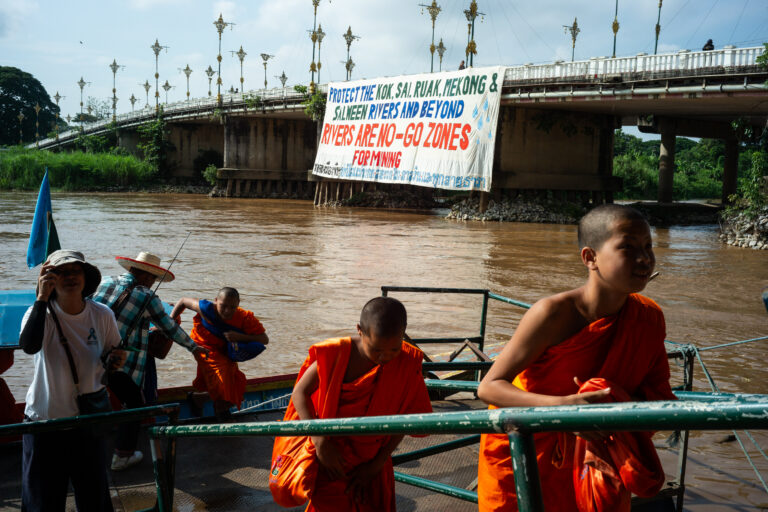
BANGKOK — More than 600 residents of Chiang Mai and Chiang Rai provinces embarked May 31 on a roughly 68-kilometer, six-day ‘peace walk’ to demand the Thai government take action on the river pollution crisis that has seen Thai rivers polluted with heavy metals. The ensemble of affected residents, civil society groups, monks and students marched from Tha Ton subdistrict in Chiang Mai to the city of Chiang Rai in northern Thailand, reaching their destination on June 5, World Environment Day. For more than a year, Thailand’s Pollution Control Department has reported dangerous levels of arsenic, mercury, cadmium and other heavy metals in rivers across northern Thailand, with mining operations across eastern Myanmar suspected to be responsible for the pollution. “We are walking because our rivers are slowly dying,” Pianporn Deetes, executive director of the Rivers and Rights Foundation, which helped to organize the peace walk, told Mongabay by phone. “Toxic contamination from unregulated mining upstream is already affecting water, fish, food, livelihoods, and public health. We do not want to wait until more people become sick. This is an emergency.” Pianporn said the walk (42 miles) was about taking collective action to share information, document impacts and build public pressure in a bid to force the government to address the issue, which Pianporn said has, so far, been lacking. “Monitoring has improved, but action has not matched the scale of the crisis,” she said. “We need urgent diplomatic engagement with neighboring countries, stronger health monitoring, transparency, and action to…This article was originally published on Mongabay
CONCEPCIÓN DE SOLUTECA, Honduras — In the 1970s, the Honduran government granted a piece of land in the mountains of Concepción de Soluteca to Roberto González’s parents. They duly grabbed a chainsaw and a machete to clear the forest. On the 12 hectares (30 acres) they received as part of a land reform, they planted corn, beans and bananas, the basic staple foods. It was a hard life up in the mountains, allowing the farmers and their families to just survive. There wasn’t much public infrastructure, and most children had to help with farmwork early on. This included González, who only attended elementary school for three years. When González inherited the land 20 years later, coffee cultivation was just taking off. Middlemen promised the farmers good money for the export crop, and the banks provided loans for cultivation. At first, this worked well, González, now 39, remembers. Coffee helped the farmers to generate income and improve living conditions. But it didn’t last long. They grew coffee much the same way they did other crops, without adequate soil or shade management. When harvests dwindled, they expanded their area, cutting the last standing forests and damaging water sources. Around 2012, they faced an outbreak of coffee rust, a fungal disease. It was a complete disaster: many farmers were thrown into poverty and forced to migrate. “We destroyed the foundations of our livelihoods, but it was out of ignorance; we just didn’t know better,” González tells Mongabay. Under the EUDR, coffee farmers step…This article was originally published on Mongabay

 Login
Login